
A fully charged car battery should typically read between 12.6 and 12.8 volts when measured after it has rested for several hours, with no load applied. This voltage range signifies that the battery’s chemical reactions are at their peak, providing optimal power for starting your vehicle and running its electrical systems. Understanding this reading is key to diagnosing battery health and preventing unexpected car troubles.
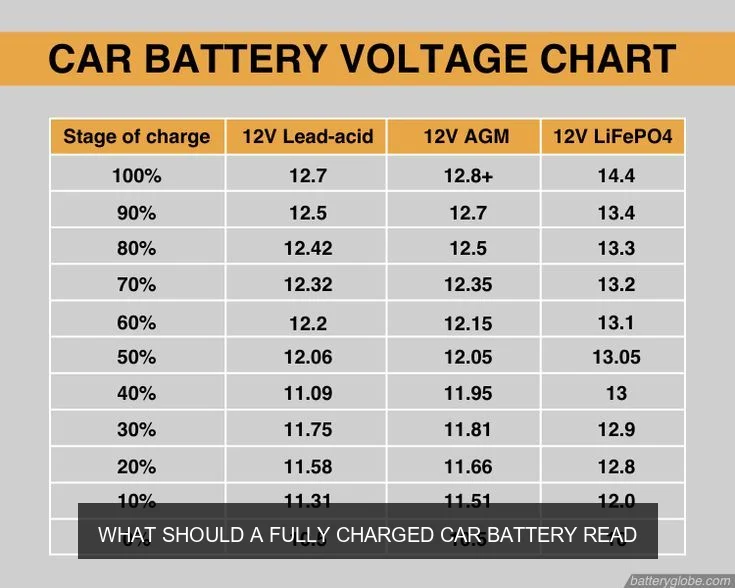
Image source: Pinimg
📋 Table of Contents
- 🔹 Introduction
- 🔹 What a Fully Charged Car Battery Reads: The Ideal Numbers
- 🔹 Understanding Voltage in Car Batteries
- 🔹 Why Knowing Your Battery’s Charge Matters
- 🔹 How to Accurately Check Your Car Battery’s Charge
- 🔹 Interpreting Your Battery’s Voltage Readings
- 🔹 Factors That Influence Battery Readings
- 🔹 Common Misconceptions About Car Battery Charging
- 🔹 Practical Tips for Maintaining a Healthy Car Battery
- 🔹 People Also Ask (FAQ)
- 🔹 Conclusion: Keeping Your Car Powered Up
Introduction
Ever wondered if your car battery is truly ready for the road? We often take our car batteries for granted until they fail us at the worst possible moment. Knowing “what should a fully charged car battery read” is incredibly important. It’s like knowing your own blood pressure; it gives you a clear picture of its health.
In this guide, we’re going to dive deep into understanding what those numbers on a voltmeter mean. We’ll cover the ideal voltage for a fully charged battery, why checking it regularly is a smart move, and how you can do it yourself with a simple tool. By the end, you’ll feel confident in assessing your battery’s state and keeping your car running smoothly.
What a Fully Charged Car Battery Reads: The Ideal Numbers
For most standard 12-volt lead-acid car batteries, a fully charged state corresponds to a reading of 12.6 to 12.8 volts. This measurement is crucial. It tells you that the battery’s internal chemistry is balanced and it has its maximum stored energy available.
This reading is specifically known as open-circuit voltage. That means you’re measuring the voltage when the battery isn’t connected to anything drawing power. It’s just sitting there, fully rested. Think of it like a full fuel tank before you start driving.
Understanding Voltage in Car Batteries
When we talk about a 12-volt car battery, “12-volt” is actually its nominal voltage. In reality, a truly full 12-volt battery will read a bit higher. Each cell within the battery produces about 2.1 volts, and since most car batteries have six cells connected in series, the total fully charged voltage is around 12.6 to 12.8 volts (6 cells x 2.1 volts/cell = 12.6 volts).
Voltage is essentially the electrical “pressure” or “force” that pushes current through a circuit. A higher voltage, up to a certain point, means more potential energy is stored and ready to be used by your car’s electrical components, especially for that initial powerful crank to start the engine.
Why Knowing Your Battery’s Charge Matters
Understanding what a fully charged car battery should read isn’t just trivia; it’s a practical skill with several significant benefits for your vehicle and your peace of mind.
- Reliable Starting: Your car’s starter motor needs a strong surge of power to turn the engine over. A fully charged battery delivers this power efficiently, ensuring quick and consistent starts.
- Preventing Breakdowns: A battery that consistently reads below the optimal range is a warning sign. It might indicate that it’s losing its ability to hold a charge, or that there’s an issue with your car’s charging system. Catching this early can prevent you from being stranded.
- Extending Battery Life: Deeply discharging a car battery repeatedly can significantly shorten its lifespan. By monitoring its charge, you can make sure it stays within a healthy range, preserving its capacity for longer.
- Diagnosing Electrical Issues: If your battery isn’t holding a charge, it could be the battery itself, or it could point to a problem with your alternator (which charges the battery while driving) or a parasitic drain (something in your car is using power even when it’s off). Knowing the proper voltage helps narrow down the possibilities.
How to Accurately Check Your Car Battery’s Charge
Checking your car battery’s voltage is a simple process you can do at home with a basic tool. It gives you direct insight into “what should a fully charged car battery read” right from your driveway.
Using a Voltmeter or Multimeter
You’ll need a digital voltmeter or a multimeter set to measure DC (Direct Current) voltage. Here’s how to do it safely:
- Safety First: Make sure your car is turned off, the ignition is off, and you’re wearing appropriate safety glasses and gloves. Batteries can produce gases and contain corrosive acid.
- Locate Terminals: Find the positive (+) and negative (-) terminals on your battery. They are usually marked. The positive terminal often has a red cover or cable, and the negative a black one.
- Connect the Voltmeter:
- Touch the red lead (positive) of your voltmeter to the positive terminal of the battery.
- Touch the black lead (negative) of your voltmeter to the negative terminal of the battery.
Make sure you have a good, solid connection.
- Read the Display: The voltage will show on the voltmeter’s screen.
When to Take the Reading
For the most accurate reading of “what should a fully charged car battery read,” it’s vital to measure its open-circuit voltage. This means the battery needs to be fully rested. Ideally, the car should have been sitting unused for at least 4-6 hours, or even overnight. If you’ve just turned off your car after a drive, the battery will show a higher surface charge, which isn’t a true reflection of its state of charge.
Waiting ensures any lingering “surface charge” from the alternator has dissipated, giving you a more accurate and reliable number.
Interpreting Your Battery’s Voltage Readings
Once you’ve taken a reading, understanding what the numbers mean is key. Here’s a quick guide to common voltage readings and what they indicate for a standard 12-volt lead-acid battery:
| Voltage Reading (After Resting) | Estimated State of Charge | What It Means |
|---|---|---|
| 12.6V – 12.8V | 100% (Fully Charged) | Your battery is in excellent health and ready to go. This is “what should a fully charged car battery read.” |
| 12.4V | 75% Charged | A good charge, but not quite full. Consider a short drive or a top-up charge. |
| 12.2V | 50% Charged | This is a significant discharge. The battery needs charging soon to prevent damage and ensure reliable starts. |
| 12.0V or Less | 25% or Less Charged | A very low charge. The battery is likely struggling to start the car and requires immediate charging. Repeated deep discharges at this level can shorten battery life. |
If your battery consistently reads below 12.4 volts after being fully charged and rested, it might be a sign that the battery is old, weak, or there’s an issue with your car’s charging system.
Factors That Influence Battery Readings
While 12.6-12.8 volts represents the ideal for “what should a fully charged car battery read,” a few factors can cause slight variations in your readings. It’s helpful to be aware of these so you can interpret your voltmeter results accurately.
- Temperature: Cold weather actually makes a battery’s voltage read slightly lower, even if it’s fully charged. The chemical reactions slow down, which temporarily reduces the available voltage. Conversely, very hot weather can sometimes show a slightly higher reading but also stresses the battery.
- Battery Age: As batteries age, their ability to hold a full charge can diminish. An older battery might read 12.6V when “fully charged” but might not have the same cranking power or duration as a newer one.
- Battery Type: Most cars use lead-acid batteries (either flooded, AGM, or Gel). While the 12.6-12.8V range is generally true for all, some specialized deep-cycle batteries might have slightly different characteristics. However, for everyday car starting batteries, this range is standard.
- Recent Use or Charging: As mentioned, measuring immediately after driving or charging will give you a “surface charge” reading that is temporarily higher. Always let the battery rest for several hours for an accurate open-circuit voltage.
Common Misconceptions About Car Battery Charging
There are a few common ideas about car batteries that aren’t quite accurate. Clearing these up can help you better understand “what should a fully charged car battery read” and how your car’s electrical system really works.
“My car’s alternator always charges the battery to 100%.”
While your alternator does charge the battery while you drive, it’s primarily designed to maintain the battery’s charge and power your car’s electrical systems. It usually charges at around 13.8 to 14.4 volts. If your battery is significantly discharged, short drives might not fully replenish it to a true 100% (12.6V-12.8V rested voltage). For a truly deep charge, especially after a significant drain, a dedicated battery charger is often more effective.
“If my car won’t start, the battery is completely dead.”
Not necessarily. A battery that won’t start your car might simply be deeply discharged, perhaps down to 11 or 10 volts. While it lacks the power to crank the engine, it might still be recoverable with a proper charge. “Completely dead” usually implies internal damage or an inability to hold any charge, even after attempting to charge it.
Practical Tips for Maintaining a Healthy Car Battery
Keeping your battery healthy is a proactive way to avoid inconvenient breakdowns and ensure you always see “what should a fully charged car battery read” when you check it. Here are some simple tips:
- Regular Voltage Checks: Make it a habit to check your battery’s resting voltage every few months, especially before winter or after long periods of inactivity. This helps you catch problems early.
- Keep Terminals Clean: Corrosion (a white or blue powdery substance) on your battery terminals can interfere with electrical flow. Clean them regularly with a wire brush and a baking soda-water mixture.
- Avoid Short Trips: Frequent short drives (less than 20 minutes) don’t give your alternator enough time to fully recharge the battery after starting the car. If your commute is short, consider taking a longer drive occasionally or using a trickle charger.
- Use a Trickle Charger for Storage: If you store your car for extended periods, a “trickle charger” or “battery maintainer” can keep the battery at an optimal charge level without overcharging it. This is excellent for preserving battery life.
- Ensure Secure Connections: Make sure the battery cables are tightly fastened to the terminals. Loose connections can lead to poor performance and charging issues.
People Also Ask (FAQ)
Can a car battery be overcharged?
Yes, a car battery can be overcharged. Overcharging occurs when a battery receives too much voltage or current for too long. This can cause the electrolyte to boil, leading to excessive water loss, plate damage, and a shortened battery lifespan. Modern smart chargers and alternators have regulators to prevent this, but older or faulty systems can still overcharge a battery.
How long does it take for a car battery to fully charge?
The time it takes to fully charge a car battery depends on several factors: the battery’s initial state of charge, its capacity, and the output of the charger. A deeply discharged battery with a 10-amp charger might take 4-6 hours or more to reach a full charge, while a battery only slightly down might take an hour or two. A trickle charger, which delivers a very low current, could take overnight or even days for a deeply discharged battery.
What is the lowest voltage a car battery should read?
Generally, a healthy car battery should not consistently read below 12.0 volts when fully rested. At 12.0 volts, the battery is only about 25% charged. Below this level, you risk permanently damaging the battery (sulfation) and experiencing starting issues. While it might still start at slightly lower voltages, it’s a clear sign of trouble and indicates the battery needs immediate attention.
Does temperature affect battery voltage readings?
Yes, temperature significantly affects battery voltage readings. In colder temperatures, the chemical reactions inside the battery slow down, causing the voltage to appear slightly lower even if the battery is fully charged. Conversely, hotter temperatures can lead to slightly higher voltage readings but can also accelerate battery degradation over time. It’s always best to take readings at a moderate ambient temperature if possible, or be aware of the temperature’s influence.
Conclusion: Keeping Your Car Powered Up
Understanding “what should a fully charged car battery read” is more than just knowing a number; it’s a vital piece of information for proactive car maintenance. A reading of 12.6 to 12.8 volts on a rested battery is your green light, signaling optimal health and readiness.
By regularly checking your battery’s voltage, you empower yourself to identify potential issues before they become major problems. It’s a simple step that can save you from unexpected breakdowns, extend the life of your battery, and ensure your car starts reliably every single time. So, grab that voltmeter and start monitoring your car’s power source – your future self will thank you for it!