
A trickle charger is a device that provides a small, continuous electrical current to a car battery, essentially matching the battery’s natural self-discharge rate. Its main job is to keep a battery topped up and healthy over extended periods, like when a vehicle is stored, ensuring it remains ready for use without risking overcharging or damage. Think of it as a slow, steady sip of power, rather than a big gulp.
Ever wondered how to keep your car battery healthy during long storage? This comprehensive guide explains what a trickle charger is, how it works to prevent battery drain, and why it’s a vital tool for maintaining your vehicle’s readiness and extending battery life, all without the risk of overcharging.
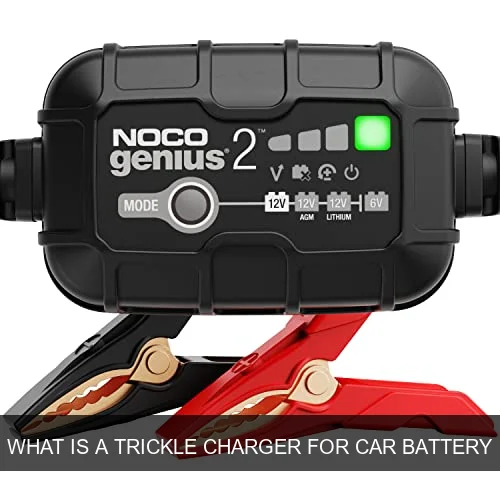
Image source: Media-amazon
📋 Table of Contents
- 🔹 Understanding the Car Battery Challenge
- 🔹 What Exactly is a Trickle Charger for Car Battery?
- 🔹 How Does a Trickle Charger Work?
- 🔹 Key Benefits of Using a Trickle Charger
- 🔹 When Should You Use a Trickle Charger?
- 🔹 Trickle Chargers vs. Battery Maintainers: What’s the Difference?
- 🔹 Important Considerations When Using a Trickle Charger
- 🔹 Common Mistakes to Avoid
- 🔹 Practical Tips for Safe and Effective Use
- 🔹 People Also Ask (FAQ)
- 🔹 Conclusion
Understanding the Car Battery Challenge
You hop into your car, turn the key, and… nothing. That dreaded click or silence is a familiar, frustrating sound for many car owners. Often, the culprit is a dead battery, especially if your car has been sitting idle for a while. Car batteries, even when not in use, slowly lose their charge through a process called self-discharge. Add to that the small electrical drains from your car’s computer, clock, and alarm system, and you’ve got a recipe for a flat battery.
This is where understanding what a trickle charger is and how it helps becomes incredibly useful. It’s a simple tool that can save you a lot of hassle and expense by keeping your battery ready to go, no matter how long your vehicle sits.
What Exactly is a Trickle Charger for Car Battery?
At its core, a trickle charger is an electrical device designed to deliver a very low, consistent current to your car battery. Its primary goal isn’t to rapidly charge a completely dead battery, but rather to maintain an already charged or partially charged battery. Think of it as an IV drip for your car battery, providing just enough energy to counteract the natural discharge and keep it at an optimal level.
Unlike a standard, high-amperage car battery charger that’s built to quickly restore a depleted battery, a trickle charger works slowly and gently. This slow approach is key to its benefit: it helps prevent the kind of stress that fast charging can sometimes put on a battery, which can shorten its lifespan over time.
The “Trickle” in Trickle Charger
The term “trickle” really describes the method of charging. Instead of a strong, fast flow of electricity, it’s a minimal, continuous flow. This low amperage output, typically less than 1.5 amps, is precisely what makes it suitable for long-term connection to a battery without the risk of overcharging or damaging the battery”s internal chemistry. It’s all about preservation, not rapid revival.
How Does a Trickle Charger Work?
The operation of a trickle charger is quite straightforward, though modern versions have become much smarter. Here’s a look at the basic principles:
- Low Current Delivery: A trickle charger takes standard AC household electricity and converts it into a low-voltage DC current, typically 12 volts for car batteries. It then sends this current to the battery at a very low amperage.
- Counteracting Self-Discharge: All lead-acid batteries naturally lose charge over time, even when disconnected. This self-discharge rate can be influenced by temperature, battery age, and type. A trickle charger’s steady, low current replaces the energy lost through self-discharge and minor parasitic drains from the vehicle’s electronics.
- Maintaining Peak Voltage: By continuously supplying a small charge, the trickle charger keeps the battery’s voltage within its optimal range. This prevents the battery from falling into a deeply discharged state, which can cause sulfation – a buildup of lead sulfate crystals that permanently reduce a battery’s capacity.
The Evolution: Smart Chargers and Battery Maintainers
While traditional trickle chargers simply provide a continuous, fixed low current, many modern devices are actually “smart” chargers or “battery maintainers.” These advanced units offer additional features:
- Automatic Monitoring: They constantly monitor the battery’s voltage and adjust their output.
- Multi-Stage Charging: They might go through different charging stages – bulk charge, absorption charge, and float charge – to optimize the charging process.
- Float Mode: Once the battery is fully charged, smart chargers switch to a “float” mode. In this mode, they provide only a tiny maintenance current, just enough to compensate for self-discharge, effectively turning them into battery maintainers. This is the safest way to keep a battery connected for months or even years.
- Overcharge Protection: Crucially, these smart chargers have built-in circuits to prevent overcharging, which can boil away electrolyte and damage the battery.
Understanding this distinction is important because while older, basic trickle chargers could theoretically overcharge a battery if left connected indefinitely, modern battery maintainers are designed for indefinite connection without harm.
Key Benefits of Using a Trickle Charger
Using a trickle charger offers several significant advantages, especially for vehicles that aren’t driven every day.
- Extends Battery Lifespan: Deep discharges are a battery’s worst enemy. By preventing the battery from ever dropping to a critically low state, a trickle charger helps preserve the battery’s chemical integrity and significantly prolong its useful life.
- Ensures Vehicle Readiness: Nothing’s worse than needing your car and finding the battery dead. A trickle charger guarantees your battery is always at full charge, ready to start your engine whenever you need it.
- Prevents Sulfation: When a battery sits discharged, lead sulfate crystals can form on the plates, hardening and reducing the battery’s ability to hold a charge. This process, called sulfation, is a major cause of battery failure. A trickle charger prevents this by keeping the battery adequately charged.
- Cost Savings: While there’s an initial cost for the charger, it’s far less than frequently replacing dead car batteries. Extending your battery’s life means fewer purchases over time.
- Ideal for Seasonal Vehicles: If you own a classic car, motorcycle, RV, boat, or any other vehicle stored for long periods, a trickle charger is an indispensable tool to keep its battery in prime condition during the off-season.
When Should You Use a Trickle Charger?
A trickle charger isn’t for every situation, but it shines in specific scenarios where battery health and readiness are crucial.
- Long-Term Storage: This is the most common use. If you’re storing a car, boat, motorcycle, or RV for weeks or months – for example, a convertible for the winter, or a boat during the off-season – a trickle charger will keep its battery from dying.
- Infrequently Used Vehicles: Do you have a secondary car that only gets driven once a month or less? A trickle charger can ensure it starts reliably every time.
- Classic Cars or Show Cars: These vehicles often sit for extended periods. A trickle charger maintains their specialized batteries, which can sometimes be expensive to replace.
- Vehicles with Persistent Parasitic Drains: Some older vehicles or those with aftermarket electronics might have small, constant draws on the battery even when off. A trickle charger can effectively counteract these minor drains.
- Cold Climates: Cold weather significantly reduces a battery’s cranking power and can accelerate self-discharge. Keeping a battery on a trickle charger in winter ensures it’s fully charged and ready to face the cold.
Trickle Chargers vs. Battery Maintainers: What’s the Difference?
While often used interchangeably, there’s a subtle yet important distinction between a traditional trickle charger and a modern battery maintainer (which is often a “smart” trickle charger).
| Feature | Traditional Trickle Charger | Modern Battery Maintainer (Smart Charger) |
|---|---|---|
| Charging Output | Constant, low current (e.g., 1-2 amps) | Variable current; adjusts based on battery’s needs |
| Charging Stages | Single stage (continuous low charge) | Multi-stage (bulk, absorption, float) |
| Overcharge Protection | Limited or none; can overcharge if left too long | Built-in sensors prevent overcharging; automatically switches to float mode |
| Long-Term Connection | Not recommended for indefinite connection without supervision | Designed for safe, indefinite connection |
| Battery Condition | Best for maintaining an already charged battery | Can often safely charge a partially discharged battery and maintain it |
Essentially, a battery maintainer is an evolution of the trickle charger, incorporating smart technology to make long-term battery care safer and more effective. When people refer to “trickle chargers” today, they’re often thinking of these smarter, more advanced maintainers.
Important Considerations When Using a Trickle Charger
To get the most out of your trickle charger and ensure battery safety, keep a few things in mind:
- Battery Type Compatibility: Not all batteries are the same. Most car batteries are lead-acid, but some vehicles might use AGM (Absorbent Glass Mat) or Gel batteries. Ensure your charger is compatible with your battery type, as charging profiles can differ.
- Voltage Matching: Car batteries are almost universally 12-volt. Ensure your trickle charger is designed for 12V systems. Using a 6V charger on a 12V battery won’t work, and a 24V charger could cause serious damage.
- Amperage Output: For trickle charging, you want a low amperage. Chargers typically range from 0.75 amps to 1.5 amps for true trickle charging. Higher amperage chargers are for faster charging and aren’t meant for long-term maintenance.
- Safety Features: Look for features like spark-proof clamps, reverse polarity protection (to prevent damage if you connect the clamps incorrectly), and automatic shut-off or float mode. These are standard on most modern battery maintainers.
Common Mistakes to Avoid
While trickle chargers are relatively simple, a few common errors can lead to problems:
- Connecting Incorrectly: Always connect the positive (+) charger clamp to the positive battery terminal and the negative (-) clamp to a grounded metal part of the vehicle, away from the battery, or to the negative battery terminal if instructed by the charger’s manual. Incorrect connections can damage the battery or the vehicle’s electrical system.
- Using a Standard Charger for Long-Term Maintenance: A regular high-output battery charger is designed for quick charging, not prolonged connection. Leaving one on a battery indefinitely will almost certainly overcharge and damage it.
- Ignoring Battery Maintenance: A trickle charger helps, but it doesn’t replace basic battery checks. Periodically inspect your battery for corrosion on terminals, loose connections, or swelling of the casing, which indicates serious issues.
- Assuming All Trickle Chargers are “Smart”: As discussed, older or very basic trickle chargers may not have float mode or overcharge protection. If you’re unsure, don’t leave it connected for weeks without checking. Modern battery maintainers are generally safe for continuous connection.
Practical Tips for Safe and Effective Use
To ensure your trickle charger works efficiently and safely, follow these tips:
- Read the Manual: Every charger is a bit different. Always read the manufacturer’s instructions for specific connection methods and safety warnings.
- Safety First: Work in a well-ventilated area. Wear eye protection. Batteries can produce hydrogen gas, which is flammable. Avoid sparks or open flames near the battery.
- Clean Terminals: Ensure your battery terminals are clean and free of corrosion. A good connection is crucial for effective charging.
- Secure Connection: Make sure the charger clamps are firmly attached to the terminals or grounding point.
- Placement: Place the charger on a stable surface, not hanging from the battery cables.
- Check Water Levels (if applicable): For traditional flooded lead-acid batteries, periodically check the electrolyte levels and top up with distilled water if needed, *before* charging. Sealed batteries (like AGM or Gel) don’t require this.
- Monitor (for basic chargers): If you have an older, non-smart trickle charger, check the battery voltage periodically to ensure it’s not overcharging. Modern maintainers typically handle this automatically.
People Also Ask (FAQ)
Is a trickle charger bad for your car battery?
No, a modern trickle charger or battery maintainer is generally not bad for your car battery; in fact, it’s beneficial. It’s designed to deliver a low, steady current that prevents self-discharge and maintains optimal charge without overcharging, thereby extending the battery’s lifespan. Older, non-smart trickle chargers could overcharge if left indefinitely, but modern maintainers have smart circuitry to prevent this.
How long can you leave a trickle charger on a battery?
If you are using a modern battery maintainer (which is often what people mean by a “trickle charger” today), you can safely leave it connected to your car battery for months or even indefinitely. These smart devices automatically switch to a “float” mode once the battery is full, only providing enough current to counteract natural discharge. For older, basic trickle chargers without automatic shut-off or float mode, it’s best not to leave them on for more than 24-48 hours without checking.
Do trickle chargers fully charge a dead battery?
A trickle charger is not typically designed to fully charge a completely dead battery quickly. Its low current output means it would take a very long time, potentially days, to bring a deeply discharged battery back to full power. For a dead battery, a higher amperage battery charger or jump starter is usually needed first to get it to a usable charge, then a trickle charger can maintain it.
What are the signs of a failing car battery?
Common signs of a failing car battery include: slow engine crank (the engine turns over sluggishly), dim headlights or interior lights, the check engine light or battery warning light coming on, a clicking sound when you try to start the car, and visible issues like a swollen battery case or a sulfuric smell. Batteries also tend to fail more quickly in extreme hot or cold weather.
Can a trickle charger bring a completely dead battery back to life?
While a trickle charger might eventually put some charge into a completely dead battery, it’s not its intended purpose or strength. It’s designed for maintenance, not resuscitation. A deeply discharged battery may have permanent damage (sulfation), and a trickle charger might not be able to overcome this. It’s better to use a dedicated battery charger with a higher output to revive a dead battery, and then use the trickle charger for maintenance.
Conclusion
Understanding what a trickle charger is for a car battery is a valuable piece of knowledge for any vehicle owner. It’s a simple, yet highly effective device for preserving your car’s battery health, especially if your vehicle sits idle for extended periods. By providing a gentle, continuous charge, a trickle charger – particularly the modern “smart” battery maintainer versions – prevents the common issues of self-discharge and sulfation, thereby extending battery life and ensuring your vehicle is always ready to go.
Whether you’re storing a classic car for the winter or simply have a secondary vehicle that doesn’t get much use, a trickle charger is an investment in reliability and peace of mind. It’s a small effort that can save you significant hassle and cost down the road, making dead batteries a thing of the past.