
Understanding what amp battery charger for car is best for your vehicle is crucial for battery health and safety. This guide explains the meaning of “amps” in chargers, why matching amperage to your car battery is important, and how different amp chargers work, empowering you to make the right choice without damaging your battery.
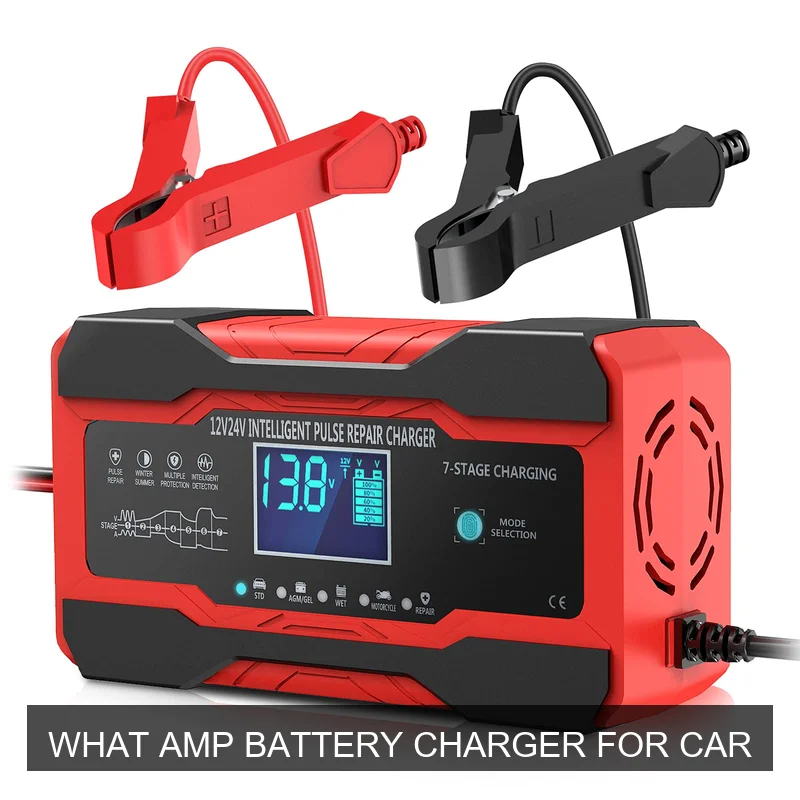
Image source: Media-amazon
📋 Table of Contents
- 🔹 What Amp Battery Charger for Car?
- 🔹 Introduction to Car Battery Chargers
- 🔹 Understanding “Amp” in Car Battery Chargers
- 🔹 Why Charger Amperage Matters for Your Car Battery
- 🔹 Matching Amperage to Battery Size
- 🔹 How Different Amperage Chargers Work and Their Uses
- 🔹 Practical Scenarios: Choosing the Right Amperage
- 🔹 Common Misconceptions About Car Battery Charger Amperage
- 🔹 Tips for Safe and Effective Car Battery Charging
- 🔹 Frequently Asked Questions (FAQ)
- 🔹 Conclusion: Making an Informed Choice
What Amp Battery Charger for Car?
The ideal amp battery charger for a car typically falls between 4 and 15 amps for standard charging, and 1 to 3 amps for battery maintenance or “trickle” charging. The specific amperage you need depends on your car battery’s size (Ah rating) and how quickly you want to charge it, balancing efficiency with battery health. Selecting the correct amperage prevents damage and ensures a full, safe charge.
Introduction to Car Battery Chargers
Ever found yourself with a dead car battery, wondering how to bring it back to life? A car battery charger is your trusty tool. But if you’ve ever looked at chargers, you’ve probably noticed they come with different “amp” ratings. This number isn’t just a random specification; it’s absolutely central to how effectively and safely your battery gets charged.
Understanding what amp battery charger for car is right for your situation can feel a bit confusing at first. What do these numbers mean? Why does it matter if a charger is 2 amps or 20 amps? Don’t worry, we’re going to break it all down simply. By the end of this article, you’ll feel confident in choosing and using the right charger for your vehicle, keeping your battery healthy and ready to go.
Understanding “Amp” in Car Battery Chargers
First things first, let’s talk about what an “amp” actually is. “Amp” is short for “ampere,” and it’s a unit of electrical current. Think of electricity like water flowing through a hose. The voltage (volts) is like the water pressure, pushing the water. The amperage (amps) is like the volume or rate of water flow.
When it comes to a car battery charger, the amp rating tells you how much electrical current the charger can deliver to your battery at one time. A higher amp rating means a faster flow of electricity, which generally translates to a quicker charge time. A lower amp rating means a slower, gentler flow.
It’s important to differentiate between a charger’s continuous amperage and things like “peak amps” or “cranking amps” often found on jump starters. For a battery charger, we’re usually talking about the continuous charging current it provides. This steady flow is what recharges your battery over time.
Why Charger Amperage Matters for Your Car Battery
Choosing the correct amperage for what amp battery charger for car you use isn’t just about speed; it’s vital for your battery’s health, safety, and lifespan. Here’s why it’s so important:
- Battery Health: Just like you wouldn’t chug a gallon of water in one gulp, your battery prefers to be charged at a rate it can handle. Too much current (too many amps) can overheat the battery, potentially causing internal damage. This damage can shorten its overall lifespan or reduce its ability to hold a charge effectively in the future.
- Safety: Overheating batteries aren’t just bad for the battery; they can be a fire hazard. Excessive current can cause gases to build up inside the battery, which can be dangerous. Chargers are designed with safety features, but matching the amp rating to the battery is a primary safety measure.
- Efficiency and Time: Using a charger with too few amps on a large, deeply discharged battery will take an incredibly long time to charge, possibly never getting it to full capacity. Conversely, using a charger with too many amps on a small battery is inefficient and risky.
- Battery Type: Different battery types (like conventional lead-acid, AGM, or Gel) have specific charging requirements. Modern smart chargers often adjust amperage automatically, but understanding the general principles is still useful.
Matching Amperage to Battery Size
So, how do you know what amp battery charger for car is the right fit? A good rule of thumb is to aim for a charger with an amp rating that is about 10-20% of your battery’s Amp-hour (Ah) rating. The Amp-hour rating is usually found on a sticker on your battery and tells you how much energy the battery can deliver over time.
Let’s say your car battery has a rating of 60 Ah. A 10% charge rate would mean a 6-amp charger. A 20% rate would be a 12-amp charger. This range generally provides a safe and effective charge without undue stress on the battery.
Here’s a simple table to illustrate typical battery capacities and recommended charger amperages:
| Battery Capacity (Ah) | Recommended Charger Amperage (General Car Use) | Use Case |
|---|---|---|
| 10-20 Ah (Motorcycle, Small Lawn Mower) | 1-2 Amps | Maintenance, gentle charging |
| 40-60 Ah (Compact Car, Small SUV) | 4-8 Amps | Standard charging, maintenance |
| 70-100 Ah (Mid-size/Large Car, Truck, SUV) | 8-15 Amps | Faster charging, deeply discharged batteries |
Remember, these are general guidelines. Always check your battery manufacturer’s recommendations if available, and consult your charger’s manual.
How Different Amperage Chargers Work and Their Uses
Car battery chargers come in a variety of amp ratings, each suited for different situations. Let’s look at the common types:
Low Amperage Chargers (1-4 Amps)
- Description: These are often called “trickle chargers” or “battery maintainers.” They deliver a very low, steady current.
- How they work: They don’t quickly recharge a dead battery. Instead, they slowly bring a battery up to full charge and then switch to a maintenance mode, keeping the battery topped off without overcharging. Modern ones are often “smart” chargers that constantly monitor the battery’s state.
- Use cases:
- Maintaining batteries in vehicles stored for long periods (e.g., classic cars, motorcycles, RVs during winter).
- Keeping infrequently used batteries (like those in lawnmowers or ATVs) ready to go.
- A very slow, gentle charge for small batteries where speed isn’t a factor.
Mid-Range Amperage Chargers (5-15 Amps)
- Description: These are the most common type of car battery charger for general use. They provide a moderate charging current.
- How they work: They can effectively recharge a partially or fully discharged car battery in a reasonable amount of time (several hours to a full day, depending on the battery’s state and size). Many also incorporate smart charging features, adjusting current and voltage as the battery charges.
- Use cases:
- Recharging a car battery that’s been drained from leaving lights on or from short trips.
- Regular battery maintenance for daily drivers, especially in cold weather.
- A good all-around choice for most passenger vehicles.
High Amperage Chargers (20+ Amps)
- Description: These are powerful chargers designed for fast charging. Some models even include “engine start” or “boost” functions, delivering hundreds of amps for a short burst to help start a vehicle with a very low battery.
- How they work: They can deliver a significant current, drastically reducing charge times. However, this faster rate generates more heat and can be more stressful on the battery, especially if not used correctly. The “engine start” feature is basically a mini jump starter built into the charger.
- Use cases:
- Quickly recharging a deeply discharged battery in an emergency (with caution).
- Providing a temporary boost to start a vehicle when the battery is too weak to crank the engine.
- Professional garage use where speed is often essential.
- Important Note: High-amp charging should be used sparingly for typical lead-acid batteries and always with careful monitoring. Excessive fast charging can reduce battery life over time.
Practical Scenarios: Choosing the Right Amperage
Let’s consider some real-life situations to help you decide what amp battery charger for car is best:
- Your car is stored in the garage for the winter: A 1-2 amp battery maintainer is perfect. It will keep the battery topped off without overcharging, ensuring it’s ready to go when spring arrives.
- You accidentally left your headlights on overnight, and your battery is dead: A 5-15 amp mid-range charger is a great choice. It will steadily recharge your battery over several hours, bringing it back to full capacity safely.
- You need to start your car RIGHT NOW, and the battery is completely flat: A 20+ amp charger with an “engine start” feature could be used for an immediate boost to get the car running. However, remember this isn’t a long-term charging solution; you’d still want to fully charge the battery afterward with a lower amp setting or a separate mid-range charger.
- You have a small ATV or motorcycle battery: A 1-2 amp charger is usually ideal. Its smaller capacity can’t handle the high current of a car charger without risking damage.
Common Misconceptions About Car Battery Charger Amperage
When it comes to understanding what amp battery charger for car is suitable, there are a few myths to clear up:
- “Bigger amps are always better for faster charging.”
Not necessarily. While higher amps do charge faster, continually using a high-amp charger can stress your battery, leading to premature failure. It’s like sprinting everywhere instead of walking or jogging; it’s faster, but unsustainable.
- “Any car battery charger will do for any car battery.”
This is a common and potentially damaging misconception. Using a charger with an inappropriate amperage for your battery’s size or type can lead to undercharging, overcharging, or even permanent battery damage.
- “Once it’s plugged in, I don’t need to worry about it.”
While modern “smart” chargers do a great job of monitoring and adjusting, it’s always wise to keep an eye on the charging process, especially if you’re using an older, simpler charger or a high-amp setting. Ensure proper ventilation and check for any signs of overheating.
Tips for Safe and Effective Car Battery Charging
To get the most out of your car battery charger and ensure safety, follow these practical tips:
- Always Read Your Battery Label: Look for the Amp-hour (Ah) rating or other charging recommendations directly on your car battery. This is your primary guide for matching amperage.
- Read the Charger Instructions: Every charger is a bit different. Your charger’s manual will provide specific guidance on its capabilities, safety features, and recommended use.
- Charge in a Well-Ventilated Area: Car batteries can produce hydrogen gas during charging, which is highly flammable. Good ventilation disperses these gases and helps prevent dangerous buildups. Never charge in an enclosed space without airflow.
- Connect Cables Correctly: Always connect the positive (+) charger clamp to the positive (+) battery terminal first, then the negative (-) charger clamp to a clean, unpainted metal surface on the engine block or frame (away from the battery and fuel lines) or directly to the negative (-) battery terminal if specified by the charger manufacturer and vehicle manual. This helps prevent sparks near the battery, especially with older, non-smart chargers.
- Monitor the Charging Process: Even with smart chargers, it’s a good idea to periodically check the battery and charger. Look for any signs of overheating, swelling, or unusual smells.
- Avoid Overcharging: While smart chargers are designed to prevent this, older or simpler chargers might not. Overcharging can significantly reduce battery life. If your charger doesn’t have an automatic shut-off or maintenance mode, disconnect it once the battery is fully charged.
- Consider a Smart Charger: If you don’t already have one, a modern “smart” charger or battery maintainer is a fantastic investment. These units automatically adjust the charging current and voltage based on the battery’s state, preventing overcharging and optimizing battery health.
Frequently Asked Questions (FAQ)
Is it okay to charge a car battery overnight?
Yes, but only if you are using a modern “smart” charger or battery maintainer. These devices are designed to safely charge your battery to full capacity and then switch to a maintenance mode, preventing overcharging. Using an older, non-smart charger overnight could overcharge and damage the battery.
Can I use a 2-amp charger on a dead car battery?
You can, but it will take a very, very long time. A 2-amp charger is typically a trickle charger or maintainer, designed for slow, gentle charging or maintaining an already charged battery. For a dead car battery, a mid-range charger (5-15 amps) would be much more effective and quicker.
What’s the difference between a car battery charger and a battery maintainer?
A car battery charger is designed to actively recharge a discharged battery, typically offering higher amp settings (5-20+ amps) to bring the battery back to full power. A battery maintainer (often 1-3 amps) is designed to keep an already charged battery at its peak capacity over long periods, preventing self-discharge without overcharging. Many modern “smart” chargers combine both functions.
Conclusion: Making an Informed Choice for Your Car Battery
Understanding what amp battery charger for car you need is more than just technical knowledge; it’s about protecting your investment and ensuring reliable starts. By paying attention to the amperage and matching it to your battery’s size and needs, you’re taking a big step toward proper car maintenance.
Remember, the goal isn’t always the fastest charge, but the safest and most effective one. Whether you need a gentle trickle charge for long-term storage or a steady flow to revive a drained battery, knowing your amps empowers you to make an informed choice. Keep these guidelines in mind, and your car battery will thank you with a longer, healthier life.