
Schumacher SC1281 6A Battery Charger Review

Drivers who let a battery sit too long know the sinking feeling of a dead click when the key turns. The Schumacher SC1281 aims to solve that problem while also handling the slower job of keeping a battery topped off between drives. It combines a 100-amp engine starter with a more modest 2A to 6A charging system, plus testing and reconditioning features that most basic chargers skip.
This review looks at how those pieces fit together in real ownership, where the SC1281 earns its reputation, and where buyers need to manage expectations based on verified specs and customer feedback.
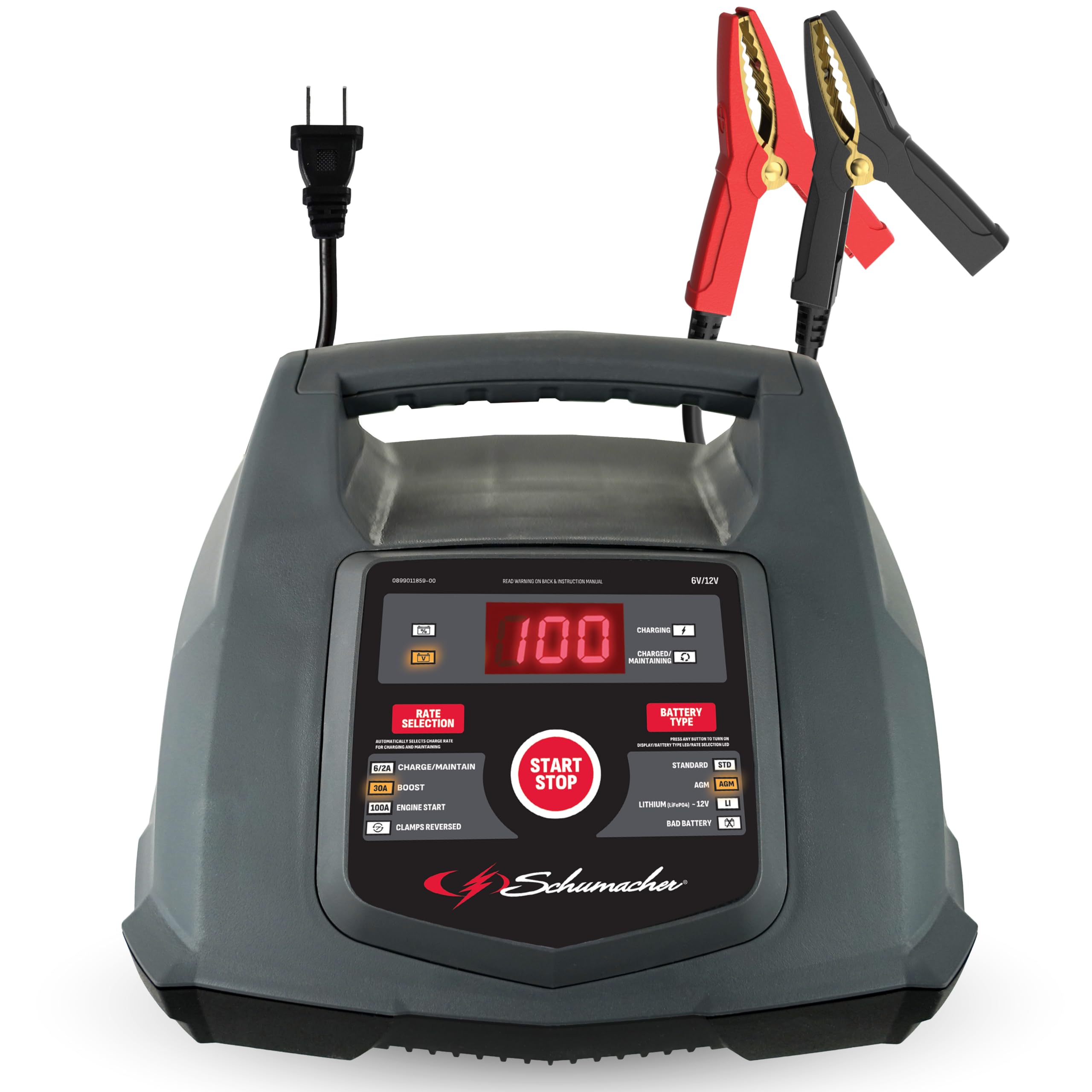
The SC1281 works best as a two-purpose tool: a slow, safe battery maintainer for daily use and a backup engine starter for occasional emergencies, not a fast charger for quick top-offs. It supports 6V and 12V batteries across several chemistries, including lithium, which gives it flexibility across different vehicles and equipment.
Bottom Line
The SC1281 suits owners who want one device to maintain a battery over weeks of storage and still have starting help on hand for the rare dead-battery morning. Buyers who need rapid high-amp charging should look elsewhere. For everyone else, this charger covers a wide range of practical needs at a reasonable size and weight.
Check current price and availability for the Schumacher SC1281 on Amazon.
Schumacher Electric 6A Car Battery Charger & Maintainer, 6V/12V – SC1281 6/12V Automatic Charger 30/100A Starter 5-in-1 with Engine Start Overview
Quick Verdict
The SC1281 delivers real value as a multi-function charger, but its strength lies in maintenance and emergency starting, not speed. Owners with larger batteries or a need for daily fast charging should treat the 100A starter as backup power, not a primary charging tool. For garages that need one device to start, charge, maintain, test, and recondition batteries, it fills that role well.
Verified Specifications at a Glance
| Spec | Detail |
|---|---|
| Engine Start | 100A |
| Boost Charge | 12A to 30A |
| Maintenance Charge | 2A to 6A |
| Voltage Support | 6V and 12V |
| Battery Types | Standard, AGM, gel, deep-cycle, 12V lithium (LiFePO4) |
| Input Voltage | 120V |
| Weight | 12.7 lbs |
| Dimensions | 10.25″D x 10″W x 7″H |
| Warranty | 1 year |
These specs place the SC1281 in the mid-range of home battery chargers, built for garage use rather than professional shop work.
100A Engine Start and 30A Boost Charging
The 100A engine start function gives a dead battery enough of a jolt to help an engine turn over, without acting as a full jump-start replacement for every situation. It works alongside the vehicle’s own battery and alternator, supplying extra current for a short burst rather than running the car on its own.
What the Starting and Boost Modes Are Designed to Do
The boost charge mode, rated from 12A to 30A, is meant for faster recovery of a low battery before switching to slower maintenance charging. This is different from the engine-start function, which is built for short emergency use rather than sustained charging.
Some customer feedback points out that the unit starts in boost mode by default when powered on, which means users need to select the correct setting before connecting cables. Reading the manual before first use matters here, since starting in the wrong mode on a sensitive battery could cause issues.
Automatic 6V/12V Charging and Smart Maintenance
The SC1281 automatically detects whether a connected battery is 6V or 12V, adjusting its charging behavior without manual switching. This automatic detection reduces the risk of user error, which matters for anyone charging different vehicles or equipment on the same charger.
Supported Battery Types and Voltage Detection
The charger works with standard flooded, AGM, gel, deep-cycle, and 12V lithium (LiFePO4) batteries. This range covers most cars, trucks, motorcycles, ATVs, and boats, though owners should confirm their battery’s chemistry setting matches what the charger offers before starting a charge cycle.
Multi-Stage Charging, Automatic Shutoff, and Reverse-Polarity Protection
Multi-stage charging adjusts current and voltage as the battery fills, which helps prevent overcharging during long maintenance periods. Automatic shutoff and reverse-polarity protection add safety layers for less experienced users, cutting power if the clamps are connected backward or if the battery reaches full charge.
Battery Testing and Desulfation Reconditioning
The built-in tester checks battery and alternator condition before or after charging, giving owners a basic health readout without a separate multimeter. Desulfation mode works to break down the crystal buildup that forms on plates in an older or neglected battery, which can restore some lost capacity in batteries that have not failed completely.
When the Built-In Battery and Alternator Tester Is Useful
This tester is most useful for diagnosing why a battery keeps dying, such as distinguishing a weak battery from a failing alternator. It will not replace a professional load test on a battery near the end of its service life, but it gives a quick first read before deciding whether to charge, recondition, or replace.
Pros and Cons
Pros
- Supports both 6V and 12V batteries across multiple chemistries, including lithium
- 100A engine start offers backup help for dead-battery situations
- Automatic shutoff and reverse-polarity protection add safety for everyday users
- Built-in tester and desulfation mode add diagnostic and reconditioning value
- Compact enough for garage storage at under 13 pounds
Cons
- Maintenance charging output (2A to 6A) is slow compared to dedicated fast chargers
- Defaults to boost mode on startup, requiring careful mode selection
- Only ships with a US plug, which limits use in regions with 240V power
- Some customer reports mention warranty service issues
Customer Reviews and Buyer Fit
What Verified Customer Feedback Suggests
Feedback on the SC1281 splits between satisfied long-term users and a smaller group reporting problems. Several reviewers describe years of reliable use as a garage maintainer and occasional starter aid, while others mention the charger failing to charge a battery properly or needing to be returned.
A recurring theme involves the boost-mode default at startup, which some buyers found alarming until they understood how to switch modes. International buyers noted the lack of a proper plug for 240V systems, since the charger is built for 120V input only.
Who Should Buy It?
Owners with a 6V or 12V vehicle, boat, or powersport battery who want a maintainer that also offers backup starting help are a good fit. This includes seasonal vehicle owners, those storing a car for months at a time, and anyone who wants a tester and desulfation feature in one unit.
Who Should Avoid It?
Drivers needing fast, high-amp daily charging should choose a dedicated fast charger instead, since the SC1281’s 2A to 6A rate is built for maintenance, not speed. Buyers outside the US with 240V household power should also look for a charger rated for their region’s voltage and plug type.
Conclusion
The Schumacher SC1281 fills a specific role well: a 6V/12V maintainer with backup engine-start capability, a battery tester, and a desulfation mode in one compact unit. Its 100A starter and 30A boost charge are meant for occasional emergency use, while the 2A to 6A range handles the slower, steadier task of keeping a battery healthy over time.
Buyers who understand this split get solid value from the SC1281, particularly if they store a vehicle seasonally or want one tool that covers charging, maintenance, and diagnostics. Those who need rapid charging speed or live in a region with 240V household current should look at other models built for those specific needs.