
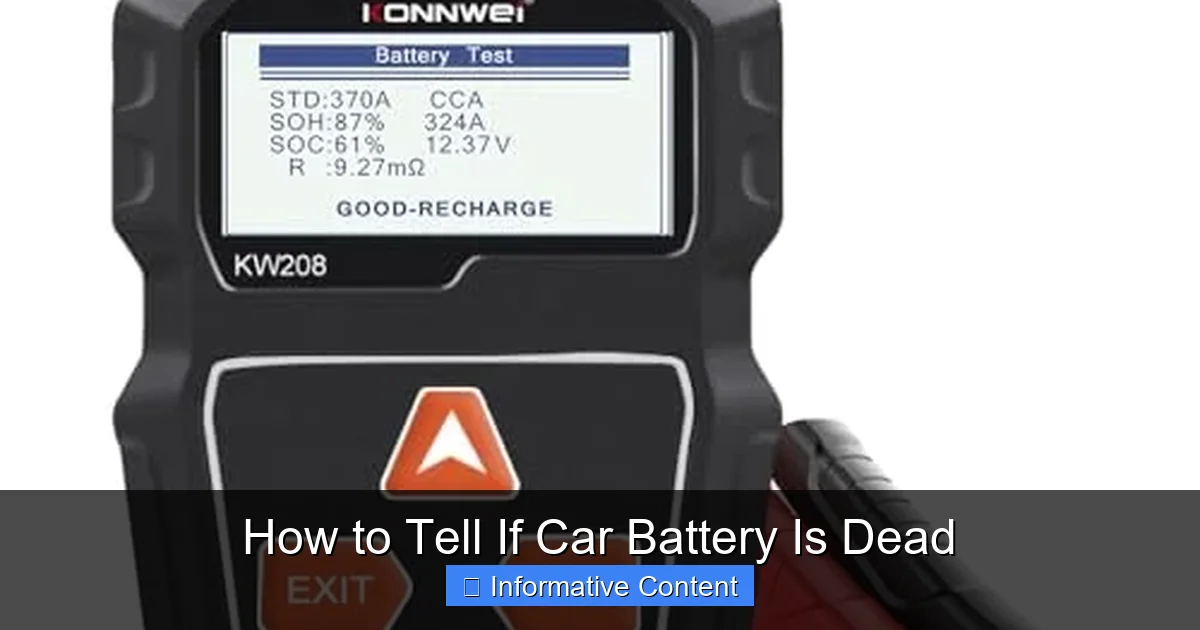
There’s nothing worse than a car that won’t start when you’re in a hurry. Knowing how to tell if your car battery is dead can save you significant time and stress. Look for common signs like no power at all, dim lights, a slow engine crank, or a rapid clicking sound, and use simple visual checks or a multimeter to confirm a dead battery, helping you diagnose the issue quickly and determine your next steps.
How to Tell If Car Battery Is Dead
Imagine this: You’re running late for work, you jump into your car, turn the key, and… nothing. Or perhaps you hear a weak, struggling groan before silence. It’s a universally frustrating experience that almost every car owner faces at some point. The culprit? Often, it’s a dead car battery. But how do you know for sure if your car battery is dead, or if it’s another issue entirely?
Diagnosing a dead car battery isn’t always as simple as a complete power outage. Sometimes, the signs can be subtle, leading to confusion and unnecessary stress. Understanding the common symptoms, knowing what to look for, and learning a few simple diagnostic steps can save you time, money, and a lot of headaches. This guide will walk you through everything you need to know to confidently tell if car battery is dead and what your next steps should be.
Let’s dive in and unravel the mystery of the lifeless car, empowering you with the knowledge to identify a dead battery quickly and accurately. We’ll cover everything from the obvious red flags to the more subtle whispers of a dying battery, visual inspections, and even using a few simple tools for a definitive diagnosis. By the end of this article, you’ll be an expert at identifying when your car battery is dead.
Key Takeaways
- No Power/Dim Lights: The most straightforward sign of a dead car battery is a complete lack of power, or extremely dim headlights and dashboard lights when you try to start your car.
- Clicking Sound: A rapid clicking noise when turning the key or pushing the start button often indicates an insufficient power supply, a classic symptom of a dead or severely discharged battery.
- Slow Engine Crank: If your engine struggles to turn over slowly and sluggishly, it’s a strong indicator that the battery isn’t providing enough power, suggesting it’s dying or already dead.
- Visual Cues: Inspect your battery for physical signs like corrosion around the terminals, a bulging or swollen case, or any leaking fluid, all of which point to a failing battery.
- Multimeter Test: For a definitive diagnosis, use a multimeter to check the battery’s voltage. A reading below 12.4 volts for a 12V battery suggests a discharged or dead battery.
- Common Causes: Batteries typically die due to age, extreme temperatures, leaving lights or accessories on, or a “parasitic drain” in the vehicle’s electrical system.
- Safety First: Always wear safety glasses and gloves when inspecting or working near a car battery, and be mindful of proper jump-starting procedures.
Quick Answers to Common Questions
Question 1?
Yes, a completely dead battery can often be jump-started, provided it isn’t internally damaged or short-circuited. Jump-starting temporarily provides enough power to start the engine, allowing the alternator to recharge the battery. However, if the battery immediately dies again, it indicates it can no longer hold a charge.
Question 2?
The time it takes to fully charge a car battery depends on its state of discharge and the charger’s amperage. A completely dead battery can take anywhere from 4 to 24 hours to fully charge using a standard trickle charger (2-4 amps). A higher amperage charger (10-20 amps) might do it in 2-6 hours, but faster charging can sometimes stress the battery.
Question 3?
The average lifespan of a car battery is typically between 3 to 5 years. This can vary significantly based on factors like climate (extreme heat shortens life), driving habits (frequent short trips), and maintenance (e.g., keeping terminals clean).
Question 4?
Yes, cold weather can significantly impact a car battery, often making it seem dead even if it’s just weak. Cold temperatures reduce the battery’s ability to produce current, and simultaneously thicken engine oil, requiring more power from the battery to start the engine. A battery that performs adequately in mild weather might fail in freezing conditions.
Question 5?
Yes, it is generally safe to replace a car battery yourself, provided you follow proper safety precautions. These include wearing safety glasses and gloves, ensuring the car is off, disconnecting the negative terminal first and reconnecting it last, and avoiding contact with battery acid. If unsure, professional installation is always recommended.
📑 Table of Contents
- The Obvious Signs: When Your Car Is Completely Silent
- The Less Obvious Whispers: Signs of a Weak or Dying Battery
- Visual Inspection: What Your Eyes Can Tell You
- Using Tools: The Definitive Way to Test Your Battery’s Health
- Common Reasons Why Car Batteries Die
- What to Do Next: From Diagnosis to Solution
- Conclusion
The Obvious Signs: When Your Car Is Completely Silent
Sometimes, the signs are glaringly obvious. Your car acts like it has completely given up the ghost, leaving you stranded. These are the symptoms that most clearly indicate you have a dead car battery.
No Power at All
This is the most definitive and frustrating sign that your car battery is dead. When you turn the key or press the start button, absolutely nothing happens. No dashboard lights, no radio, no sound of the engine even attempting to crank. It’s as if the car is completely disconnected from any power source. This usually means your battery is fully discharged or has an internal fault preventing any power delivery. If you experience this, it’s very likely your car battery is dead.
No Dashboard Lights or Radio
You get into your car, and it’s like a ghost town. The dashboard remains dark, the radio won’t turn on, and the interior lights are completely off. This signifies that there’s no electrical power reaching these essential components. A healthy battery should at least power these low-draw items, even if it doesn’t have enough juice to start the engine. A total lack of these usually confirms that your car battery is dead.
The Dreaded “Click, Click, Click”
When you turn the key and hear a rapid “click, click, click” sound, but the engine doesn’t turn over, it’s a classic symptom of a dead or severely discharged battery. This sound comes from the starter solenoid trying to engage, but not receiving enough voltage from the battery to fully connect and spin the engine. There’s just enough power to activate the solenoid repeatedly, but not enough for the main starter motor. This is a very strong indicator of a dying or dead car battery.
The Less Obvious Whispers: Signs of a Weak or Dying Battery
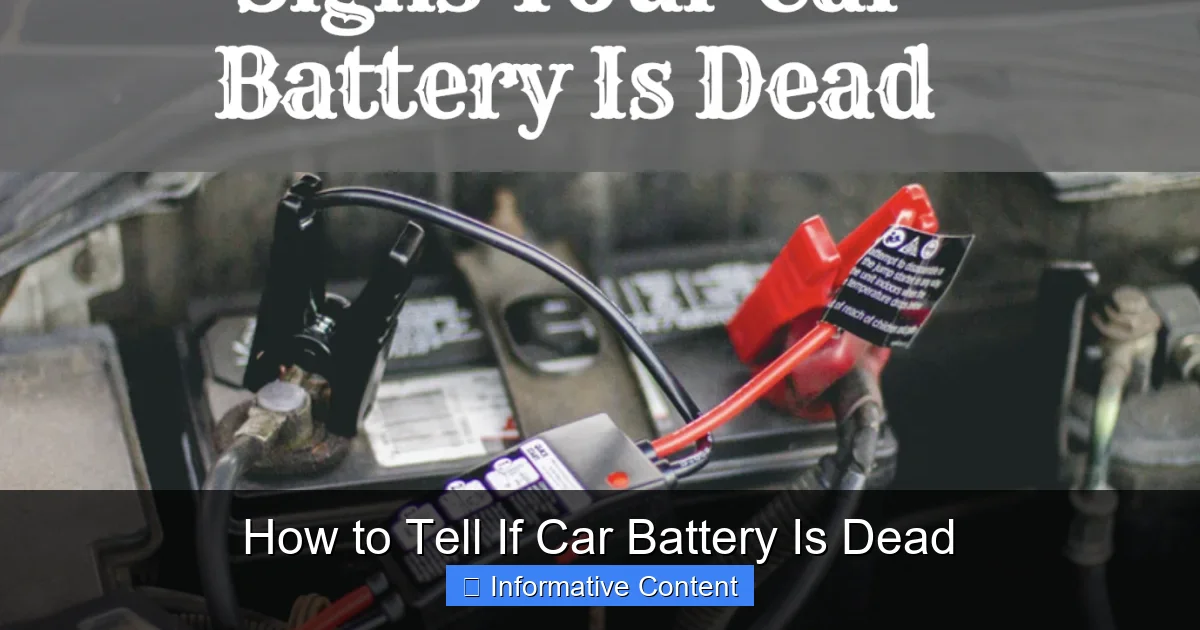
Visual guide about How to Tell If Car Battery Is Dead
Image source: usercontent2.hubstatic.com
A battery doesn’t always die suddenly. Often, it gives you hints that it’s on its way out. Recognizing these less obvious signs can help you replace your battery *before* you’re stranded. These symptoms indicate a battery that is struggling and likely nearing the end of its life, signaling that your car battery is dead or will be soon.
Slow Engine Crank
Instead of a quick, confident “vroom,” your engine struggles to turn over. It sounds sluggish, weak, and takes longer than usual to start. This is often described as a “tired” sound. This happens because the battery isn’t providing the full burst of power needed for a robust start. While it might eventually start, this prolonged cranking puts extra strain on the starter and is a clear sign that your battery is losing its ability to hold a charge effectively. You’re witnessing the slow death of your battery.
Dim Headlights and Interior Lights
Before you even try to start the car, turn on your headlights. If they appear noticeably dimmer than usual, or if your interior lights seem weak, it’s a sign of low battery voltage. The battery simply doesn’t have enough power to run even these basic electrical components at full strength. This issue will become even more apparent when you try to start the car, as the remaining power will be diverted to the starter, often causing the dim lights to flicker or go out entirely. This is a definite indicator that your car battery is dead or on its way out.
Warning Lights on Your Dashboard
Modern cars have sophisticated systems that monitor battery health. If your “Battery” or “Check Engine” light illuminates on your dashboard, especially while driving, it could indicate a problem with your charging system, which includes the battery. While a battery light might also point to an alternator issue, if it’s coupled with slow starting or dim lights, it strongly suggests a battery problem. Pay attention to these warnings; they are often the car’s way of telling you that your car battery is dead or critically low.
Issues with Electrical Components
Beyond lights, other electrical components might act strangely. Power windows might roll up or down slower than usual, the radio might cut out intermittently, or the car’s clock might reset every time you start the engine. These inconsistent electrical behaviors stem from an unstable power supply, which is a hallmark of a failing battery. When the battery can’t maintain a steady voltage, everything powered by electricity can suffer.
Visual Inspection: What Your Eyes Can Tell You
Sometimes, you don’t even need to turn the key to know there’s a problem. A quick look under the hood can reveal physical signs that indicate your car battery is dead or severely compromised.
Corrosion Around Terminals
Pop your hood and take a look at the battery terminals (where the cables connect). If you see a fuzzy, white, blue, or green powdery substance around the terminals, that’s corrosion. This buildup can impede the flow of electricity from the battery to the car’s electrical system, acting as a resistor. While light corrosion might just need cleaning, heavy corrosion can indicate an acid leak or a severe lack of maintenance, contributing to the battery’s inability to deliver full power, making it difficult to tell if car battery is dead without a proper clean.
Bulging or Swelling Battery Case
A healthy car battery has a neat, rectangular shape. If you notice that the sides of your battery case are bulging, swelling, or misshapen, it’s a serious red flag. This can be caused by internal damage, overcharging, or exposure to extreme temperatures, especially freezing. A bulging battery is not only failing but can also be dangerous. If you see this, your car battery is dead or on the verge of catastrophic failure and needs immediate replacement.
Leaking Battery Fluid
Any signs of liquid on or around the battery, especially near the top, are cause for concern. Car batteries contain corrosive sulfuric acid, which is highly dangerous. Leaking fluid indicates that the battery casing is compromised. This not only signals a dying battery but also poses a safety hazard. If you spot a leak, exercise extreme caution and consider professional help for diagnosis and replacement.
Old Age and Date Codes
Batteries don’t last forever. Most car batteries have a lifespan of 3-5 years, though this can vary depending on climate and usage. Look for a manufacturing date code stamped on the battery case or a sticker. If your battery is older than 3-4 years and you’re experiencing starting issues, age is likely a significant factor, and your car battery is dead or about to be. Proactive replacement can prevent unexpected breakdowns.
Using Tools: The Definitive Way to Test Your Battery’s Health
While visual and audible cues are helpful, using specific tools provides a precise diagnosis, confirming whether your car battery is dead.
Testing with a Multimeter (Voltage Check)
A multimeter is a handy tool for accurately checking your battery’s voltage.
- Turn off your car: Make sure the engine is off and all accessories (lights, radio, etc.) are off.
- Connect the multimeter: Set your multimeter to DC voltage (VDC) and a range of 20V. Connect the red (positive) probe to the positive (+) battery terminal and the black (negative) probe to the negative (-) battery terminal.
- Read the voltage:
- 12.6 volts or higher: Your battery is fully charged and in good health.
- 12.4 to 12.6 volts: Good charge, but not 100%.
- 12.0 to 12.4 volts: Discharged. Your battery needs to be recharged. While it might start your car, it’s not optimal.
- Below 12.0 volts: Severely discharged or potentially dead. If it won’t hold a charge above this after attempting to charge it, then your car battery is dead.
This simple test can give you a clear answer on your battery’s charge level.
Using a Dedicated Battery Load Tester
A battery load tester goes a step further than a multimeter. It simulates the load placed on the battery during starting. It measures the battery’s ability to maintain voltage under a specific current draw for a short period. If the voltage drops too low during the test, it indicates that the battery can’t hold a sufficient charge, even if the static voltage seems okay. This is the most accurate way to tell if car battery is dead or simply weak. Many auto parts stores offer this test for free.
Professional Diagnostic Services
If you’re unsure about using tools or interpreting the results, don’t hesitate to seek professional help. Mechanics and auto parts stores have specialized equipment that can perform comprehensive battery tests, including testing the alternator and starter to ensure the entire charging system is functioning correctly. They can definitively tell you if car battery is dead or if another component is failing.
Common Reasons Why Car Batteries Die
Understanding why batteries fail can help you prevent future issues and extend the life of your next battery.
Age and Wear
As mentioned, batteries have a limited lifespan. Over time, the internal components degrade, and their ability to hold a charge diminishes. This is the most common reason for a dead car battery.
Parasitic Drain
Sometimes, a component in your car continues to draw power even when the engine is off. This is called a parasitic drain. Common culprits include interior lights left on, a faulty trunk light, an aftermarket alarm system, or even a short in the wiring. Over time, this constant drain can completely kill your car battery.
Extreme Temperatures
Both extreme heat and extreme cold can shorten a battery’s life. Heat causes battery fluid to evaporate, leading to internal damage. Cold weather, on the other hand, reduces the battery’s cranking power and thickens engine oil, making it harder for the engine to turn over, thus increasing the demand on an already weakened battery.
Short Trips
If you frequently take short drives, your alternator might not have enough time to fully recharge the battery after starting the car. Over time, this can lead to a chronically undercharged battery, which eventually dies.
Leaving Lights On
This is a classic rookie mistake. Leaving headlights, interior lights, or the radio on for an extended period after the engine is off can quickly drain a battery, leaving you with a dead car battery.
What to Do Next: From Diagnosis to Solution
Once you’ve determined your car battery is dead, what are your options?
Jump Starting Your Car
If your battery is simply discharged, a jump start might get you going. Make sure you have jumper cables and another vehicle or a portable jump starter. Always follow the correct procedure to avoid damage or injury: connect positive to positive, negative to negative (with the last negative connection to an unpainted metal surface on the dead car, away from the battery).
Charging the Battery
If you have a battery charger, you can try charging the dead battery. Connect it properly and let it charge for several hours, or even overnight, depending on the charger type and battery’s state. After charging, use a multimeter to check if it holds a charge above 12.4 volts. If it quickly drops below this, then your car battery is dead and needs replacement.
Battery Replacement
If your battery is old, visibly damaged, or won’t hold a charge after being jump-started or recharged, it’s time for a replacement. You can often do this yourself with basic tools, or have it done professionally at an auto parts store or mechanic. Always ensure you purchase the correct battery type and size for your vehicle.
Conclusion
Knowing how to tell if car battery is dead is a valuable skill for any car owner. By paying attention to the common signs – from complete silence to sluggish starting and dim lights – and by performing simple visual checks or using a basic multimeter, you can confidently diagnose the problem. Understanding the causes of battery failure also empowers you to take preventative measures and extend the life of your next battery.
Don’t let a dead car battery catch you off guard. With the knowledge gained here, you’re now equipped to identify a failing battery, take appropriate action, and get back on the road with minimal fuss. Stay safe, stay informed, and happy driving!
🎥 Related Video: DEAD BAD CAR BATTERY SYMPTOMS – How To Tell If Your Battery is Dead
📺 YOUCANIC
Buy YOUCANIC Pro Scanner https://www.youcanic.com/scanner/ Get Factory Service Repair Manuals & Specs …
Frequently Asked Questions
What does a clicking sound mean when starting a car?
A rapid clicking sound when starting your car typically means your battery doesn’t have enough power to fully engage the starter motor. It’s usually a sign of a dead or severely discharged battery, as there’s just enough power to activate the starter solenoid but not enough to turn the engine over.
Can a bad alternator mimic a dead battery?
Yes, a failing alternator can absolutely mimic the symptoms of a dead battery. If the alternator isn’t charging the battery while the engine is running, the battery will eventually drain, leading to starting problems, dim lights, and electrical issues. A professional diagnostic test can differentiate between the two.
How often should I check my car battery?
It’s a good practice to check your car battery’s voltage and physical condition (for corrosion or leaks) at least twice a year, ideally before extreme weather seasons (summer and winter). If your battery is older than 3 years, more frequent checks are advisable.
What’s the ideal voltage for a healthy car battery?
A fully charged and healthy 12-volt car battery should read approximately 12.6 to 12.8 volts when the engine is off (static voltage). A reading below 12.4 volts suggests the battery is discharged and needs recharging, while anything below 12.0 volts indicates a severely drained or potentially dead battery.
Can leaving car lights on for a short time kill the battery?
Yes, even leaving car lights on for a relatively short time, like 30 minutes to an hour, can completely drain a weak or old battery, especially if it’s already low on charge. A healthy, fully charged battery might withstand it longer, but it’s always best to turn off all accessories when the engine is off.
Are there any warning signs before a battery completely dies?
Yes, there are often several warning signs. These include slow engine crank, dim headlights or interior lights, the car struggling to start in cold weather, frequent jump-starts needed, or dashboard warning lights appearing. Paying attention to these subtle cues can help you replace your battery before it leaves you stranded.