Learning how to remove a car battery is a fundamental skill for any car owner, crucial for maintenance, replacement, or storage. This comprehensive guide walks you through every step, from gathering essential tools and prioritizing safety to disconnecting terminals correctly and handling the battery post-removal. Follow our clear instructions to confidently tackle this task, ensuring both your safety and your vehicle’s integrity.
Ever found yourself needing to replace a dead car battery, perhaps clean up some terminal corrosion, or even prepare your vehicle for long-term storage? Knowing how to remove a car battery safely and correctly is a truly invaluable skill for any car owner. It’s one of those DIY tasks that might seem a little intimidating at first glance, given the electrical components and the sheer weight of a battery, but with the right guidance, it’s completely manageable.
This isn’t just about saving a few bucks at the mechanic; it’s about empowering yourself with the knowledge to maintain your vehicle. A properly executed battery removal can prevent costly electrical issues, extend the life of your new battery, and most importantly, keep you safe. So, whether your battery is old and tired, or you’re just looking to do some routine maintenance, stick with us. We’re going to walk you through every step, making sure you feel confident and prepared for the task ahead.
Key Takeaways
- Safety is Paramount: Always wear proper protective gear like gloves and eye protection. Car batteries contain corrosive acid and produce explosive gases.
- Negative Terminal First: When disconnecting, *always* remove the negative (black, -) terminal first. This prevents accidental short circuits and sparks, which can be dangerous.
- Positive Terminal Second: After the negative, disconnect the positive (red, +) terminal. This ensures the battery is fully isolated from the car’s electrical system.
- Secure Hold-Down Mechanism: Don’t forget to locate and loosen the battery’s hold-down clamp or strap before attempting to lift the battery. This prevents movement and potential damage.
- Proper Lifting Techniques: Car batteries are heavy. Use a battery carrier or lift with your legs, not your back, to prevent injury. Be mindful of battery acid.
- Cleanliness Matters: After removal, clean the battery tray and terminal clamps to prevent future corrosion and ensure a good connection for the new battery.
- Responsible Disposal: Car batteries are hazardous waste. Never throw them in regular trash. Recycle them at auto parts stores, service centers, or designated recycling facilities.
Quick Answers to Common Questions
Can I remove a car battery without tools?
No, you generally cannot remove a car battery without tools. You’ll need wrenches or a socket set to loosen the terminal clamps and typically the battery hold-down mechanism. Attempting to force them off without tools is unsafe and can damage the battery or your vehicle.
How long does it typically take to remove a car battery?
For someone with basic mechanical skills and the right tools, removing a car battery usually takes about 10-20 minutes, depending on the battery’s location and the level of corrosion. First-timers might take a bit longer as they familiarize themselves with the process.
What happens if I connect the positive terminal first when reinstalling?
If you connect the positive terminal first when reinstalling, and then accidentally touch your wrench to a metal part of the car while connecting the negative, you could create a dangerous short circuit and sparks. Always connect the positive terminal first when installing, but disconnect the negative terminal first when removing for safety.
Do I need to clean the battery tray and terminals every time I remove a car battery?
It’s highly recommended to clean the battery tray and terminal clamps every time you remove a car battery. This helps prevent corrosion buildup, ensures a good electrical connection for the new battery, and extends the life of your battery and cables.
What should I do if the battery acid spills during removal?
If battery acid spills, immediately neutralize it with a mixture of baking soda and water. Pour it over the spill, let it fizz, then rinse with clean water. Wear your safety glasses and gloves throughout this process, and ventilate the area.
📑 Table of Contents
Safety First! Essential Preparations and Tools
Before you even think about touching your car battery, let’s talk safety. This isn’t just a suggestion; it’s absolutely critical. Car batteries contain sulfuric acid, which is highly corrosive, and they produce hydrogen gas, which is explosive. Taking proper precautions will protect you and your vehicle.
Personal Protective Equipment (PPE)
- Safety Glasses or Goggles: This is non-negotiable. A splash of battery acid in your eyes can cause permanent damage. Protect those peepers!
- Heavy-Duty Gloves: Chemical-resistant gloves (like nitrile or rubber) are ideal. They’ll protect your hands from acid and provide a better grip.
- Old Clothes: Wear long sleeves and pants that you don’t mind getting dirty or potentially damaged by acid.
Gathering Your Tools
Having all your tools ready before you start will make the process smoother and safer. Here’s what you’ll typically need to remove a car battery:
- Wrench or Socket Set: You’ll usually need a 10mm or 13mm wrench/socket for the terminal bolts and potentially another size for the hold-down clamp. A ratcheting wrench set is a real convenience.
- Battery Terminal Cleaner Brush: This handy tool helps remove corrosion from terminals and posts.
- Wire Brush or Sandpaper: For cleaning the battery tray and clamps.
- Battery Terminal Puller (Optional but Recommended): If terminals are really stuck, this tool can save you a lot of frustration.
- Battery Carrier Strap or Handle (Optional but Recommended): Batteries are heavy and awkward. A carrier makes lifting much safer.
- Baking Soda and Water Mixture: Keep this nearby. It neutralizes battery acid if there’s a spill.
- Old Towels or Rags: For wiping up spills or covering terminals.
- Flashlight or Work Light: Especially useful if you’re working in a dimly lit garage or at night.
Vehicle Preparation
Before you touch anything under the hood:
- Turn Off the Engine: This might seem obvious, but double-check that your car is completely off and the keys are out of the ignition.
- Engage the Parking Brake: Ensure your vehicle won’t roll.
- Park on a Level Surface: Working on an incline can be dangerous.
- Remove Jewelry: Rings, watches, and bracelets can conduct electricity and cause severe burns if they short-circuit the battery.
Locating and Identifying Your Car Battery
Before you can remove a car battery, you need to find it and understand its layout. While most batteries are under the hood, some manufacturers get a little creative.
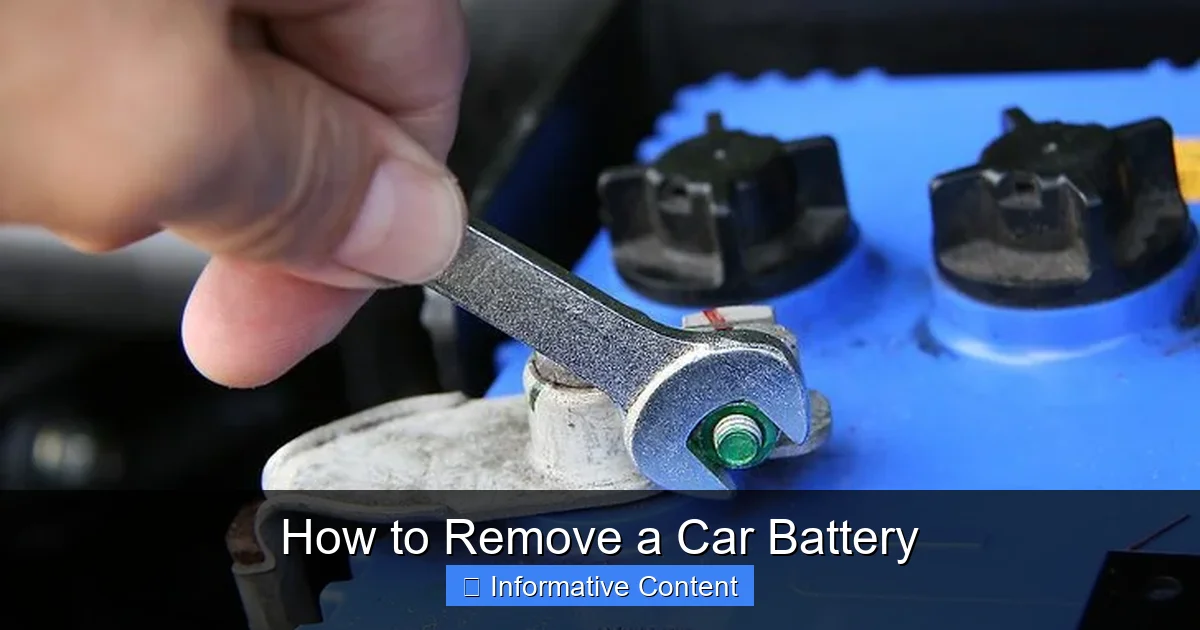
Visual guide about How to Remove a Car Battery
Image source: wikihow.com
Common Battery Locations
- Under the Hood (Most Common): Usually on one side of the engine bay, often near the firewall or fender.
- In the Trunk: Some luxury cars, European models, and even certain sedans place the battery here for better weight distribution.
- Under the Back Seat: Less common, but you might find it here in some vehicles.
- Under the Passenger Floorboard: Very rare, but possible in a few specific models.
If you can’t easily spot it, consult your car’s owner’s manual. It will clearly indicate the battery’s location.
Understanding Battery Terminals (Positive and Negative)
Once you’ve found the battery, you’ll see two terminals on top, each connected to a cable. It’s crucial to identify them correctly:
- Positive Terminal (+): This terminal is almost always marked with a “P” or a “+” sign. It’s typically covered by a red cap or has a red cable attached to it.
- Negative Terminal (-): This terminal is usually marked with an “N” or a “-” sign. It’s often covered by a black cap or has a black cable attached to it.
Remembering which is which is critical for safety during both removal and installation.
Battery Hold-Down Mechanism
Your battery isn’t just sitting loose in the engine bay; it’s secured by a hold-down mechanism. This prevents it from shifting or tipping over, especially during bumps or sudden stops. These come in various forms:
- Top Clamp: A metal strap that goes over the top of the battery, secured by bolts on either side.
- Bottom Clamp: A small wedge or bracket that fits into a lip at the bottom of the battery and is bolted down.
- Battery Tray/Box: The battery sits inside a plastic tray, which is then bolted to the vehicle frame.
- Strap: A fabric or plastic strap that wraps around the battery and is cinched tight.
You’ll need to locate and loosen or remove this mechanism before you can lift the battery out.
The Step-by-Step Process of Removing the Battery
With your safety gear on, tools ready, and battery located, it’s time for the main event. Take your time, follow these steps precisely, and remember the “negative first” rule.
Step 1: Disconnecting the Negative Terminal (Always First!)
This is arguably the most critical step for safety. Always, always, always disconnect the negative terminal first. Why? Because disconnecting the negative terminal breaks the electrical circuit with the car’s chassis. If you were to accidentally touch your wrench to a metal part of the car while disconnecting the positive terminal, you could create a dangerous short circuit and sparks. By removing the negative first, this risk is eliminated.
- Locate the negative terminal (black cable, “-” symbol).
- Use your wrench or socket to loosen the nut on the terminal clamp. You don’t need to remove the nut entirely, just loosen it enough for the clamp to move freely.
- Wiggle the clamp to free it from the battery post.
- Once loose, carefully lift the negative cable away from the battery post. Ensure it doesn’t accidentally swing back and touch the terminal. You can tuck it away or place an old rag over the battery post for extra caution.
Step 2: Disconnecting the Positive Terminal
Now that the negative terminal is disconnected, it’s safe to remove the positive terminal.
- Locate the positive terminal (red cable, “+” symbol).
- Using your wrench or socket, loosen the nut on the positive terminal clamp.
- Wiggle the clamp to free it from the battery post.
- Carefully lift the positive cable away from the battery post. Again, make sure it stays clear of the battery.
At this point, your battery is completely disconnected from your car’s electrical system.
Step 3: Releasing the Battery Hold-Down Clamp
Remember that hold-down mechanism we talked about? Now it’s time to free it.
- Identify the type of hold-down clamp securing your battery.
- Use the appropriate wrench or socket to loosen and remove any bolts or nuts holding the clamp in place.
- If it’s a strap, unclip or unbuckle it.
- Completely remove the hold-down mechanism so there’s nothing obstructing the battery’s lift path. Keep all bolts and parts organized; you’ll need them for reinstallation.
Step 4: Carefully Lifting and Removing the Battery
Car batteries are surprisingly heavy, ranging from 25 to 60 pounds or more. Lift with care to avoid injury.
- If your battery has a built-in handle or if you have a battery carrier strap, use it. This makes lifting much easier and safer.
- Bend at your knees, not your back, to lift the battery straight up and out of its tray.
- Be mindful of any remaining acid on the battery surface or in the tray. Try to keep the battery level to prevent spills.
- Once clear, set the battery down on a stable, non-conductive surface, away from anything flammable.
Congratulations! You’ve successfully completed the most challenging part of how to remove a car battery.
What to Do After Battery Removal
Removing the battery is only half the battle. Now you have an empty battery tray, disconnected cables, and a heavy power source to deal with.
Cleaning the Battery Tray and Terminals
This is a perfect opportunity to clean up any corrosion or debris that has accumulated. A clean environment ensures a better connection for your new battery and prevents future issues.
- Battery Tray: Use your wire brush and the baking soda/water mixture to scrub away any acid residue or rust from the battery tray. Rinse with clean water and dry thoroughly.
- Cable Clamps: Use your battery terminal brush or a wire brush to clean the inside surfaces of the positive and negative cable clamps. Ensure they are free of any white, powdery corrosion. A clean connection is vital for proper electrical flow.
Proper Battery Storage
If you’re removing the battery for storage (e.g., for a seasonal vehicle), ensure it’s stored correctly:
- Store it in a cool, dry place, away from direct sunlight and extreme temperatures.
- Place it on a non-conductive surface, like wood or rubber, not directly on concrete.
- Consider a trickle charger or battery maintainer to keep it charged. Batteries naturally discharge over time, and leaving them completely drained can cause permanent damage. Check the charge every month or so.
Responsible Battery Disposal
Never, ever throw an old car battery in the regular trash. They are considered hazardous waste due to the lead and sulfuric acid they contain. Luckily, recycling them is easy and often free:
- Auto Parts Stores: Most auto parts retailers (like AutoZone, Advance Auto Parts, O’Reilly Auto Parts) accept old batteries for recycling, often even paying you a small core charge or rebate.
- Service Centers/Garages: Many mechanic shops will also take old batteries.
- Recycling Centers: Check with your local waste management facility for designated hazardous waste collection points.
Common Challenges and Troubleshooting Tips
While removing a car battery is generally straightforward, you might encounter a few hiccups along the way. Here are some common issues and how to tackle them.
Corroded Terminals
White, powdery, or greenish buildup on terminals is common and can make clamps incredibly difficult to remove.
- Solution: Apply a generous amount of your baking soda and water paste to the corrosion. It will fizz as it neutralizes the acid. Let it sit for a few minutes, then scrub vigorously with a wire brush. Rinse with water and dry. Repeat if necessary. Once clean, the clamp should loosen more easily.
Stuck Hold-Down Clamps
Rust or overtightening can cause hold-down bolts to seize.
- Solution: Apply a penetrating oil (like WD-40) to the threads of the bolts and let it soak for 10-15 minutes. Use a breaker bar or a longer wrench for extra leverage. If a bolt head strips, you might need a bolt extractor kit.
Heavy Batteries and Awkward Spaces
Some batteries are just heavy, and some are tucked away in tight spots, making them hard to lift.
- Solution: Invest in a battery carrier strap. These are inexpensive and make lifting much safer and easier. If the space is very tight, make sure you have enough clearance to lift straight up. Don’t try to pry or force it out, as this can damage the battery or surrounding components. If you’re struggling, ask a friend for help or consider professional assistance.
Memory Keepers (Preventing ECU Reset)
On modern cars, disconnecting the battery can sometimes reset the car’s computer (ECU), leading to lost radio presets, engine idle learning, or even requiring a dealer to reprogram certain features.
- Solution: A “memory saver” or “memory keeper” device can be used. These devices plug into your car’s OBD-II port or a 12V accessory socket and provide a small amount of power from a separate battery (like a 9V or small 12V source) to maintain vehicle memory while the main battery is disconnected.
Conclusion
Learning how to remove a car battery is a truly empowering skill that every car owner should have in their toolkit. From the moment you gather your safety gear to the final step of responsible disposal, each part of the process is designed to be straightforward and safe when approached with care.
By following our detailed guide, you’ve gained the confidence to tackle this common automotive task. Remember the critical steps: prioritize safety with PPE, always disconnect the negative terminal first, remove the hold-down, and lift with care. And don’t forget the importance of cleaning and proper disposal. With this knowledge, you’re not just removing a car battery; you’re taking charge of your vehicle’s maintenance, one confident step at a time.
🎥 Related Video: How to Change a Car Battery | DIY Car Repairs | The Home Depot
📺 The Home Depot
Learn how to change your car battery in a few simple steps. Before you begin, you’ll want to assemble your tools and make sure …
Frequently Asked Questions
Is it safe to touch the car battery terminals with my bare hands?
No, it is not safe to touch car battery terminals with bare hands. While you might not always get a shock, batteries contain corrosive acid that can burn your skin. Always wear heavy-duty gloves when handling a car battery to protect yourself from chemical exposure.
What are the signs that I need to remove and replace my car battery?
Common signs that you need to remove and replace your car battery include slow engine cranking, dim headlights when the engine is off, a battery warning light on your dashboard, or visible corrosion around the battery terminals. If your car won’t start at all, it’s often a dead battery.
Can I just leave the battery disconnected for a long time?
You can leave a car battery disconnected for an extended period, especially for long-term storage of the vehicle. However, it’s advisable to store the battery in a cool, dry place and periodically charge it with a trickle charger to prevent it from fully discharging, which can damage the battery permanently.
Will removing the car battery reset my car’s computer or radio?
Yes, removing a car battery can often reset your car’s computer (ECU) and erase radio presets, navigation settings, and sometimes even require a security code for your stereo. Some modern vehicles might also need a “relearn” procedure for the engine idle or automatic window functions. Using a memory saver device can help prevent this.
What tools are absolutely essential for battery removal?
The absolutely essential tools for removing a car battery are a wrench or socket set (typically 10mm or 13mm) to loosen the terminal clamps and the battery hold-down mechanism. Safety glasses and heavy-duty gloves are also non-negotiable for personal protection against acid and sparks.
Where can I dispose of an old car battery responsibly?
You can dispose of an old car battery responsibly at most auto parts stores, which often have recycling programs and may even offer a core charge refund. Many service centers and local hazardous waste recycling facilities also accept old car batteries for proper and environmentally safe recycling.