
To reliably keep your car battery charged during periods of disuse, a battery maintainer or trickle charger is your best friend. These smart devices prevent overcharging while ensuring a consistent, low-level charge. For shorter breaks, consider brief, regular drives or simply disconnecting the negative terminal to halt parasitic drain.
Picture this: You’ve just returned from a relaxing vacation, or perhaps your car has been sitting in the garage for a few weeks while you worked from home. You eagerly hop in, turn the key, and… nothing. Just that dreaded, mournful click-click-click, or absolute silence. Your car battery, my friend, has decided to take a permanent holiday of its own, leaving you stranded and frustrated. We’ve all been there, and it’s a moment that can quickly turn a good day sour.
The truth is, car batteries aren’t designed to sit idle indefinitely. They slowly lose their charge over time, and modern vehicles, with their complex electronics, contribute to this drain even when switched off. But here’s the good news: a dead battery due to inactivity is almost always preventable. You don’t need to be a car mechanic to understand and implement simple, effective strategies for
Key Takeaways
- Use a Trickle Charger: Essential for maintaining charge during storage.
- Disconnect Battery: Prevents parasitic drains during long inactivity.
- Drive Weekly: Ensures the alternator recharges the battery effectively.
- Clean Terminals: Maintains strong connection; prevents corrosion buildup.
- Monitor Voltage: Use a multimeter to check battery health regularly.
- Address Parasitic Drains: Isolate and fix accessories drawing power.
Quick Answers to Common Questions
What’s the simplest way to keep car battery charged when not in use?
The absolute easiest way is to connect a smart battery tender or maintainer. These devices intelligently monitor your battery’s charge and provide just enough power to keep car battery charged when not in use without overcharging, ensuring it’s always ready to go.
Do I really need to start my car regularly if it’s just sitting?
Briefly starting your car can actually drain more power than it replenishes, especially during short runs. To truly keep car battery charged when not in use effectively, a dedicated battery maintainer is a much better solution than intermittent starts.
How long can a car battery sit unused before it starts to die?
It varies based on the battery’s health and any parasitic drains, but generally, a healthy battery can last a few weeks to a couple of months. For longer storage, using a maintainer is key to keep car battery charged when not in use and prevent unexpected power loss.
Can I just disconnect the battery to keep it from dying?
Yes, disconnecting the negative terminal can prevent parasitic drains from slowly killing your battery over time. However, be aware this might reset your car’s computer, radio presets, or security systems, making a battery maintainer a more convenient option for how to keep car battery charged when not in use.
What if I don’t have a battery maintainer? Are there other ways to keep it charged?
If a maintainer isn’t an option, driving your car for at least 20-30 minutes once a week can help the alternator recharge the battery sufficiently. Alternatively, you can disconnect the negative battery terminal to minimize drain, which is a good manual way to help keep car battery charged when not in use.
📑 Table of Contents
- Understanding Why Car Batteries Die When Not in Use
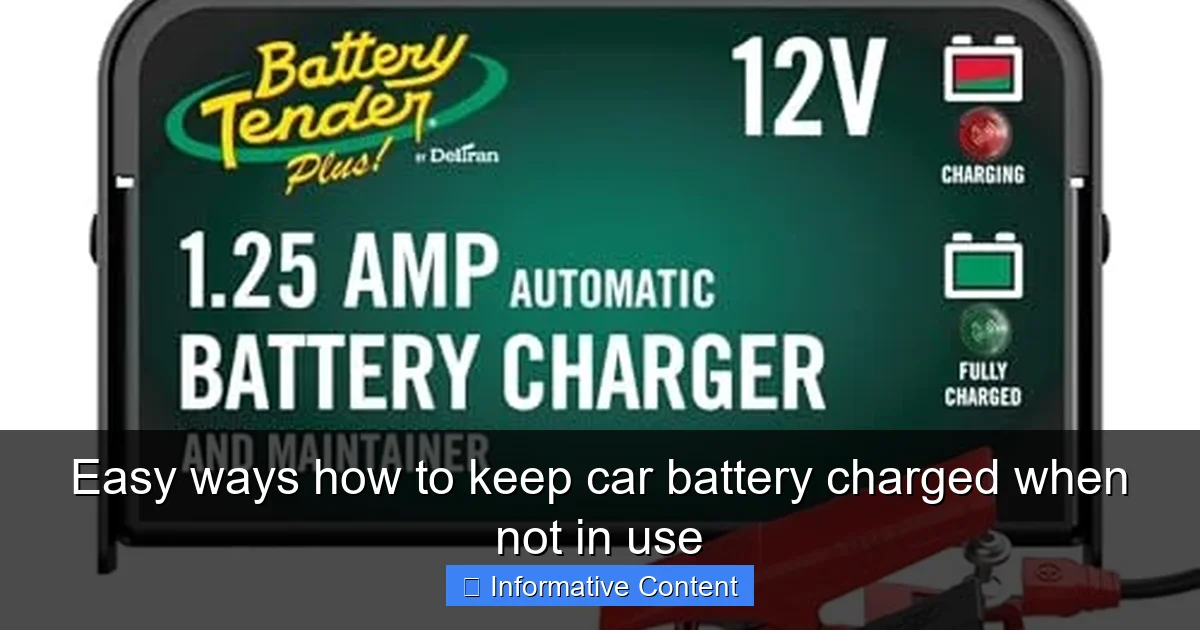
- The Lifesaver: Using a Battery Maintainer (Trickle Charger)
- The Manual Approach: Disconnecting Your Battery
- Regular Short Drives and Battery Jump Starts (When Necessary)
- Harnessing the Sun: Solar Battery Chargers
- Essential Car Battery Maintenance Tips (Beyond Charging)
- Comparison of Battery Charging Methods
- Conclusion
. It’s about proactive care, and I’m here to share some easy, practical ways to ensure your car starts reliably, every single time you need it, even after a long period of rest.
Let’s dive into the world of battery maintenance and discover exactly , saving you from inconvenient jump-starts and costly battery replacements. Trust me, a little knowledge and effort now can save you a lot of headaches later. It’s a common issue, and understanding the solutions is key to hassle-free car ownership. Visual guide about keep car battery charged when not in use Image source: batterymanguide.com Before we jump into the solutions, let’s briefly chat about *why* batteries go flat when a car isn’t being used. It’s like understanding the root cause of a problem before trying to fix it. Knowing this helps you appreciate why certain methods for are so effective. Visual guide about keep car battery charged when not in use Image source: m.media-amazon.com Your car, even when turned off, isn’t truly “off.” Think of it as a house with appliances plugged in but not actively running. There are always small draws on power. This phenomenon is called “parasitic drain.” Modern vehicles have numerous systems that constantly consume a small amount of power: the clock, radio presets, alarm system, remote keyless entry, engine control unit (ECU) memory, and various sensors. Even a tiny, unnoticed interior light left on or a faulty component can create a larger-than-normal parasitic drain. Over days or weeks, these small draws can add up significantly, especially if your car battery is already a bit old or not fully charged to begin with. This is a major reason why knowing is so important for many car owners. Beyond parasitic drain, car batteries naturally lose charge over time, even when completely disconnected from the vehicle. This is known as “self-discharge.” It’s an inherent chemical property of lead-acid batteries. The rate of self-discharge depends on the battery’s age, type, and temperature, but it’s a constant factor. You can think of it like a tire slowly losing air pressure even without a puncture. This natural process is yet another challenge when figuring out for extended periods. Temperature plays a crucial role in battery health. Extreme cold significantly reduces a battery’s capacity and its ability to deliver current, making it harder to start the engine. While a fully charged battery is more resistant to cold, an already partially discharged battery will suffer much more. On the flip side, extreme heat can accelerate the chemical reactions within the battery, leading to faster degradation and self-discharge. So, storing your car in a temperature-controlled environment, if possible, can contribute to keeping the battery healthier, but for most of us, understanding specific charging methods is key to effectively, regardless of the weather outside. When it comes to the most convenient and effective way for , a battery maintainer is hands down the hero of our story. It’s probably the first thing any car enthusiast or seasoned mechanic will recommend. A battery maintainer, often interchangeably called a “trickle charger” (though there’s a slight technical difference we’ll touch on), is a device designed to keep your car battery at its optimal charge level indefinitely. Unlike older, basic trickle chargers that continuously feed a low current regardless of the battery’s state (which could potentially overcharge and damage it), modern battery maintainers are smart devices. They monitor the battery’s voltage and only deliver charge when needed, cycling on and off to prevent overcharging. They also often include multi-stage charging, which means they can diagnose, recover, charge, and maintain the battery through different phases. This intelligent design makes them incredibly safe and effective for for weeks, months, or even years. When selecting a battery maintainer, consider these points: Using a battery maintainer is straightforward, but safety is paramount: That’s it! The maintainer will now do its job, keeping your battery topped up without any intervention. This is by far the easiest and most reliable method for for extended periods. Sometimes, a battery maintainer isn’t feasible, or you might prefer a completely passive solution. Disconnecting your car battery is another effective way for , especially for very long storage periods (months or more). Disconnecting your battery is a good option if: However, be aware that this method completely cuts power to all electronic systems, which can have some minor drawbacks. Safety first! Always wear gloves and eye protection when working with batteries. To reconnect, simply reverse the process: connect the positive terminal first, then the negative. This manual method is a robust answer to when electricity isn’t available. While effective, disconnecting the battery isn’t without its downsides: For these reasons, while disconnecting is a valid way to address , a battery maintainer is generally preferred for ease of use and preserving vehicle settings. For many, the simplest answer to is, well, to use it! Even short, regular drives can make a significant difference. Your car’s alternator is responsible for charging the battery while the engine is running. When you drive, especially for at least 20-30 minutes at highway speeds, the alternator can effectively replenish the charge lost from starting the car and from parasitic drains. Short hops around town, however, aren’t enough. Starting the engine uses a significant burst of power, and a very short drive might not allow the alternator enough time to fully recover that charge. In fact, consistently making only short trips can slowly drain your battery over time, as it’s always being discharged more than it’s being recharged. So, if your car sits for long periods, but you *can* take it out, aim for those longer drives. It’s a natural way for to decline. Practical Tip: If your car sits for more than a week, try to take it for a 30-minute drive once every 1-2 weeks. This not only charges the battery but also keeps other components like tires, brakes, and fluids in good working order. A jump start isn’t a method for ; rather, it’s the solution when you’ve failed to do so and find yourself with a dead battery. It’s an emergency measure. While useful, frequently jump-starting your car puts a strain on both batteries involved and doesn’t address the underlying issue of why your battery died in the first place. How to Jump Start Safely (Briefly): Remember, if you find yourself jump-starting frequently, it’s a clear sign you need to invest in a proper strategy for , or perhaps consider a new battery if it’s old. For those who park outdoors or have limited access to power outlets, solar battery chargers offer an ingenious solution for . Solar battery chargers (or solar maintainers) convert sunlight into electrical energy, which is then used to charge and maintain your car battery. They typically consist of a small solar panel, a charge controller (to prevent overcharging and manage power flow), and connecting cables (often with alligator clips or an OBD-II port/cigarette lighter adapter). These devices are generally low-wattage, meaning they are designed for maintenance, not for quickly charging a deeply discharged battery. They work best for slowly topping up the battery and counteracting parasitic drain and self-discharge while your car is parked in direct sunlight. Solar chargers are perfect for: They provide a hands-off, environmentally friendly answer to without the need for an AC outlet. While convenient, solar chargers have some limitations: Despite these, a good quality solar maintainer can be an excellent addition to your arsenal for , especially if your car enjoys a sunny parking spot. Knowing isn’t just about charging; it also involves general battery care that prolongs its life and ensures it can hold a charge effectively. Corrosion on battery terminals is a common enemy. It looks like a fluffy white or bluish-green buildup and acts as an insulator, preventing proper electrical flow. This can hinder both the car’s ability to start and the battery’s ability to charge properly. Regular cleaning is vital. You can clean terminals with a wire brush specifically designed for batteries or a mixture of baking soda and water (which neutralizes the acid). Just make sure to disconnect the battery (negative first!) before cleaning and rinse thoroughly afterward, drying completely before reconnecting. Clean terminals are a fundamental aspect of effective battery maintenance and contribute significantly to . Most modern car batteries are “maintenance-free” or sealed, meaning you can’t access the individual cells. However, if you have an older or certain heavy-duty lead-acid battery, it might have removable caps. In such cases, check the fluid levels periodically (every few months, or more often in hot climates). If the fluid level is below the lead plates, carefully add distilled water (never tap water!) until it covers the plates by about half an inch. This is crucial because low water levels can damage the battery plates and severely impact its capacity and lifespan. Even with perfect maintenance, batteries age and degrade. A healthy battery should hold a charge well. Have your battery tested periodically, especially as it approaches 3-5 years of age. Most auto parts stores offer free battery testing. They can perform a load test, which simulates starting the car and measures the battery’s ability to deliver current under stress. This can give you an early warning if your battery is nearing the end of its life, allowing you to replace it proactively rather than being stranded. Knowing the health of your battery is key to understanding the effectiveness of your methods for . Car batteries typically last between 3 to 5 years, depending on climate, usage patterns, and maintenance. Once a battery passes this age threshold, even with diligent charging and cleaning, its internal chemistry degrades, and it simply won’t hold a charge as effectively or deliver as much starting power. If your battery is old, and you’re consistently struggling with it, despite applying the best techniques for , it might be time for a replacement. There’s only so much even the best maintainer can do for a battery at the end of its life cycle. To help you choose the best strategy for , here’s a quick comparison: . if car is accessible Dealing with a dead car battery is undeniably frustrating, but as we’ve explored, it’s a completely avoidable situation with the right knowledge and tools. Whether your car sits for a few weeks or several months, there are easy and effective strategies for , ensuring your vehicle is ready to go whenever you are. From the intelligent care of a battery maintainer plugged into your garage wall to the sun-powered convenience of a solar charger, or even the simple act of a regular, decent drive, each method offers a practical solution. Understanding parasitic drain, self-discharge, and the impact of temperature helps you appreciate why these preventative measures are so crucial. Combine these charging techniques with good basic battery maintenance, like keeping terminals clean and knowing your battery’s age, and you’ll dramatically extend its life and reliability. Ultimately, the best approach for depends on your specific circumstances, parking environment, and how long your car typically sits idle. But no matter your situation, taking a proactive step will save you time, money, and the inevitable headache of a dead battery. So, go ahead, choose the method that best suits you, and give your car battery the consistent care it deserves!
📺 Tech·WHYS
Maintaining Charge: Keeping Your Car Battery Alive When Not in Use • Learn effective ways to keep your car battery charged … The lifespan of a car battery’s charge when not in use varies significantly, generally lasting from a few weeks to a couple of months. Modern vehicles often have more electronic components that contribute to “parasitic drain,” meaning the battery may discharge faster than older models. The best method is to use a “battery maintainer” (also known as a trickle charger or smart charger). These devices provide a low, continuous charge that prevents discharge without overcharging, keeping your car battery healthy and ready to go whenever you need it. Briefly starting your car periodically is generally not enough to fully recharge the car battery and can sometimes do more harm than good. To adequately replenish the charge, the engine needs to run for at least 20-30 minutes at driving speeds, which is often impractical for a parked car. Yes, for long-term maintenance, a smart battery maintainer is highly recommended over a standard battery charger. These intelligent devices monitor the battery’s charge level and automatically switch between charging and floating modes, preventing both overcharging and undercharging while preserving the car battery. For very long-term storage, consider disconnecting the car battery entirely to eliminate all parasitic drains, or remove it and store it indoors on a dedicated battery maintainer. This ensures the battery remains in optimal condition and extends its overall lifespan, ready for when you return. For shorter periods, ensure all interior and exterior lights are off, and disconnect any aftermarket accessories plugged into outlets. You can also drive the car for a good 30 minutes once every week or two to help maintain the car battery’s charge through the alternator.
Understanding Why Car Batteries Die When Not in Use
Parasitic Drain Explained
Self-Discharge
Environmental Factors: Temperature’s Role
The Lifesaver: Using a Battery Maintainer (Trickle Charger)
What is a Battery Maintainer?
Choosing the Right Maintainer
How to Connect and Use It Safely
The Manual Approach: Disconnecting Your Battery
When to Consider Disconnecting
Step-by-Step Guide to Disconnecting
Potential Drawbacks
Regular Short Drives and Battery Jump Starts (When Necessary)
The Importance of Regular Runs
Understanding Jump Starting (As a Last Resort)
Harnessing the Sun: Solar Battery Chargers
How Solar Chargers Work
Ideal Scenarios for Solar Charging
Limitations and Considerations
Essential Car Battery Maintenance Tips (Beyond Charging)
Keeping Terminals Clean
Checking Battery Water Levels (for Non-Sealed Batteries)
Regular Battery Testing
Understanding Battery Age
Comparison of Battery Charging Methods
Method Pros Cons Best Use Case Battery Maintainer (Smart Charger) Long-term storage in a garage or driveway with power. Most recommended for Disconnecting Battery Very long-term storage (many months to years) where electricity is unavailable. Regular Short Drives Car sits for 1-2 weeks at a time, and you can take it for a decent drive. Solar Battery Charger Outdoor parking with good sun exposure, where AC power is unavailable or inconvenient. Conclusion
🎥 Related Video: What are some effective ways to keep a car battery charged when not in use?
Frequently Asked Questions
How long can a car battery typically last without being driven before it starts to lose charge?
What’s the most effective way to keep my car battery charged when the car is not in use for extended periods?
Is starting my car occasionally enough to keep the car battery charged when it’s idle?
Do I need a special type of charger to safely keep my car battery charged long-term?
What extra steps should I take if I’m storing my car for several months or longer?
Are there any simple, non-equipment tips to help keep my car battery charged for shorter periods of inactivity?