
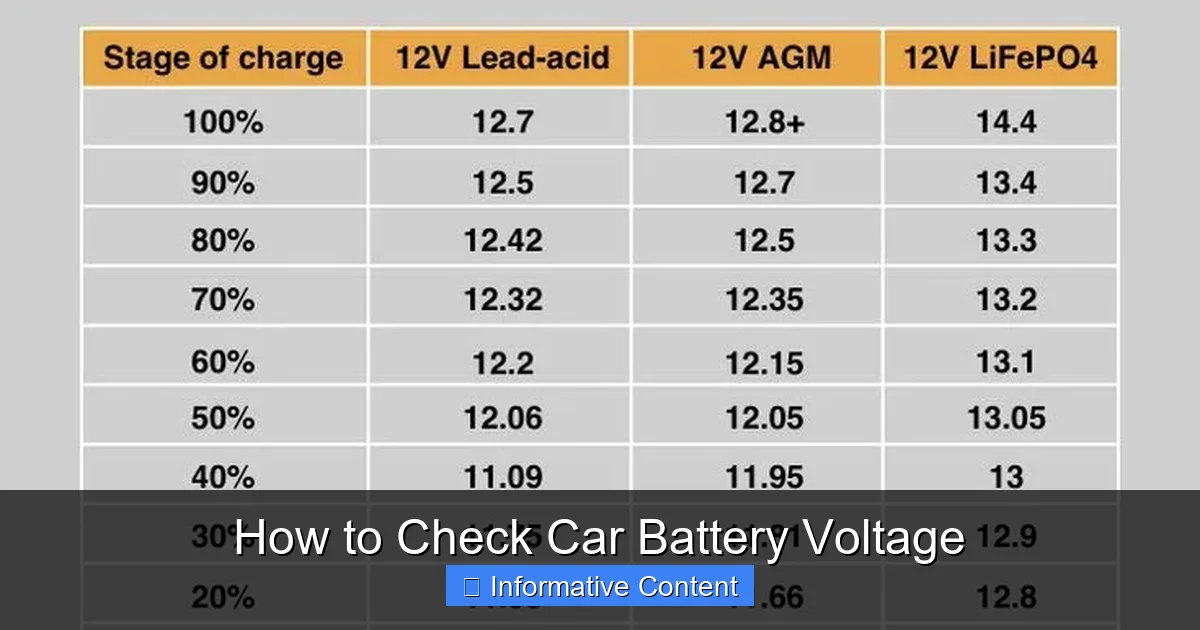
Learning how to check car battery voltage is a simple yet crucial skill for any car owner. Using a multimeter, you can quickly assess your battery’s health, helping you prevent unexpected breakdowns and prolong its lifespan. This guide provides all the necessary steps, tools, and insights to confidently perform a voltage check and understand what the readings mean.
How to Check Car Battery Voltage
Imagine this: You’re running late for an important appointment, you hop into your car, turn the key, and… nothing. Just a sad, clicking sound, or perhaps complete silence. This all-too-common scenario is often the result of a dead or dying car battery. It’s frustrating, inconvenient, and entirely preventable with a little proactive maintenance. One of the most effective ways to stay ahead of battery trouble is by regularly checking its voltage.
Learning how to check car battery voltage might sound intimidating if you’re not particularly mechanically inclined, but trust us, it’s one of the simplest DIY car maintenance tasks you can perform. With just a few basic tools and a clear understanding of the steps, you can quickly assess your battery’s health, diagnose potential issues, and potentially save yourself from an unexpected roadside breakdown. This comprehensive guide will walk you through everything you need to know, from gathering your tools to interpreting the readings and even offering tips for prolonging your battery’s life.
So, put those worries about dead batteries aside. By the end of this article, you’ll feel confident in your ability to perform a reliable car battery voltage check, giving you peace of mind and ensuring your vehicle starts reliably every time. Let’s dive in and empower you with the knowledge to keep your car’s electrical heart beating strong!
Key Takeaways
- Regular Checks Prevent Breakdowns: Knowing how to check car battery voltage allows you to identify a weak battery before it leaves you stranded, saving time and stress.
- Essential Tool: A Multimeter: A digital multimeter is the primary tool needed for accurate voltage measurement, and they are readily available and affordable.
- Safety First: Always wear safety glasses and gloves when working with car batteries to protect against acid splashes or electrical shocks.
- Two Main Tests: You can check battery voltage when the engine is off (resting voltage) and when it’s running (charging voltage) to get a full picture of its condition.
- Interpreting Readings is Key: A healthy car battery typically reads around 12.6V-12.8V when fully charged and off, and 13.7V-14.7V when the engine is running.
- Low Voltage Signals Trouble: Readings below 12.4V (engine off) or outside the charging range (engine running) often indicate a dying battery, alternator issue, or parasitic drain.
- Proactive Maintenance Helps: Keeping battery terminals clean, ensuring proper electrolyte levels (if applicable), and avoiding short trips can significantly extend battery life.
Quick Answers to Common Questions
How often should I check my car battery voltage?
It’s a good practice to check your car battery voltage at least twice a year, ideally before winter and summer, as extreme temperatures affect battery performance. If you notice any slow cranking or electrical issues, check it immediately.
Can I check my car battery voltage without a multimeter?
While basic “battery testers” exist, a digital multimeter provides the most accurate and reliable voltage readings. Other methods, like simple load testers, can give an indication but aren’t as precise for direct voltage measurement.
What is “surface charge” and how do I avoid it?
Surface charge is a temporary higher voltage reading that can appear on a battery immediately after it has been used or charged. To avoid it, let your car sit undisturbed for at least 3-4 hours (or overnight) before checking the resting voltage.
Is it safe to check car battery voltage with the engine running?
Yes, it is perfectly safe to check the charging voltage with the engine running, as long as you follow proper safety precautions like wearing gloves and safety glasses, and making sure the multimeter probes don’t touch any other metal parts.
What’s the difference between a battery charger and a battery maintainer?
A battery charger is designed to replenish a discharged battery relatively quickly. A battery maintainer (or trickle charger) is designed to keep an already charged battery at its optimal level over long periods without overcharging, ideal for vehicles stored for extended times.
📑 Table of Contents
Why Is Checking Car Battery Voltage So Important?
Your car battery is more than just a power source for starting your engine; it’s the heart of your vehicle’s entire electrical system. It provides the initial surge of power to crank the starter motor, and it also stabilizes the voltage for all the electronic components, from your radio to your navigation system. A weak or failing battery can lead to a host of problems beyond just a no-start situation.
Preventing Unexpected Breakdowns
The most obvious and perhaps most crucial reason to regularly check your battery’s voltage is to avoid being stranded. A battery doesn’t usually die without warning; it often shows signs of weakness over time. By performing a voltage check, you can catch these signs early, allowing you to replace the battery at your convenience rather than being forced to do so in an emergency, possibly in an unfamiliar or unsafe location. Understanding how to check car battery voltage proactively empowers you to manage your car’s health.
Diagnosing Other Electrical Issues
Sometimes, a low battery voltage isn’t just about a dying battery. It could be a symptom of a larger problem, such as a failing alternator (which charges the battery while the engine runs) or a parasitic drain (something in your car drawing power even when it’s off). A consistent low voltage reading can be the first clue that something else needs attention, guiding you or your mechanic towards the root cause. This makes a car battery voltage check an excellent diagnostic tool.
Extending Battery Lifespan
Just like any other component, your car battery has a finite lifespan, typically 3-5 years. However, factors like extreme temperatures, frequent short trips, and lack of maintenance can shorten this considerably. By regularly monitoring its voltage, you can ensure it’s operating within healthy parameters. This allows you to take corrective actions, such as recharging a partially discharged battery, which can help extend its overall life and get the most out of your investment.
What You’ll Need: The Essential Tools
Visual guide about How to Check Car Battery Voltage
Image source: aa1car.com
Before you learn how to check car battery voltage, you’ll need to gather a few simple tools. Don’t worry, these are generally inexpensive and easy to find at any auto parts store or even a general merchandise retailer.
Digital Multimeter
This is the star of the show. A digital multimeter is an electronic measuring instrument that combines several measurement functions in one unit. For our purposes, we’ll be using its voltmeter function. Look for a multimeter that can measure DC (direct current) voltage, typically up to 20V. Most multimeters will have this capability. You can find basic models for as little as $15-$30, which are perfectly adequate for checking car battery voltage.
Safety Gear
Safety should always be your top priority when working on any part of your vehicle, especially with batteries.
- Safety Glasses: Battery acid is corrosive and can cause severe eye damage. Always wear safety glasses to protect your eyes from accidental splashes or fumes.
- Gloves: Latex or nitrile gloves will protect your hands from battery acid and grease.
Wire Brush (Optional but Recommended)
If your battery terminals are dirty or corroded, it can interfere with accurate voltage readings. A wire brush, specifically a battery terminal cleaning brush, can quickly remove corrosion, ensuring a good connection for your multimeter probes. This is a small step that can make a big difference in the accuracy of your car battery voltage check.
Step-by-Step Guide: How to Check Car Battery Voltage Accurately
Now for the main event! Here’s a detailed, easy-to-follow guide on how to check car battery voltage. We’ll cover two important tests: resting voltage and charging voltage.
Part 1: Checking Resting Voltage (Engine Off)
This test tells you the current state of your battery’s charge when it’s not under load or being charged by the alternator.
Step 1: Ensure Your Car is Fully Off and Cooled Down
For an accurate resting voltage reading, your car should have been off for at least 3-4 hours, or ideally overnight. This allows the battery to stabilize and ensures no “surface charge” (a temporary higher voltage reading) interferes with the results. Make sure all accessories (lights, radio, interior lights) are off.
Step 2: Put on Your Safety Gear
Don your safety glasses and gloves. Better safe than sorry!
Step 3: Locate Your Car Battery
Most car batteries are located under the hood, but some vehicles place them in the trunk, under the back seat, or even in the wheel well. Consult your owner’s manual if you’re unsure.
Step 4: Inspect Battery Terminals
Before attaching the multimeter, visually inspect the battery terminals. If you see white, blue, or green powdery corrosion, clean it off with your wire brush. Corrosion can impede electrical flow and lead to inaccurate readings. Simply scrub the terminals until the metal is shiny again.
Step 5: Set Your Multimeter
Turn your digital multimeter’s dial to the DC voltage setting. This is usually marked with a “V” followed by a straight line and three dots (V—). Set the range to 20V (or the closest option if your multimeter has auto-ranging).
- Plug the red probe into the “VΩmA” or “V” jack.
- Plug the black probe into the “COM” (common) jack.
Step 6: Connect the Multimeter Probes
Carefully touch the red (positive) probe to the positive (+) battery terminal. This terminal is usually larger and marked with a plus sign. Then, touch the black (negative) probe to the negative (-) battery terminal. This terminal is smaller and marked with a minus sign. Ensure you have good metal-to-metal contact.
Step 7: Read the Voltage
The multimeter’s screen will display a voltage reading. Note this number down. This is your car’s resting battery voltage. For a fully charged, healthy battery that has been resting, you should typically see a reading between 12.6 and 12.8 volts. We’ll delve into what these numbers mean shortly.
Part 2: Checking Charging Voltage (Engine On)
This test helps you determine if your alternator is properly charging your battery and supporting the vehicle’s electrical system.
Step 1: Keep the Multimeter Connected
Leave the multimeter probes connected to the battery terminals as they were for the resting voltage test.
Step 2: Start Your Car Engine
With the multimeter still connected and reading, start your car’s engine. Let it run for a few minutes to stabilize.
Step 3: Observe the Voltage Reading
Once the engine is running, the voltage reading on your multimeter should increase. A healthy charging system should produce a reading between 13.7 and 14.7 volts. This indicates that your alternator is doing its job, sending power back to the battery to recharge it and power the car’s electronics.
Step 4: Turn on Accessories (Optional)
To further test the alternator’s capacity, you can turn on some high-draw accessories like headlights (high beams), the radio, and the air conditioning at full blast. The voltage might drop slightly, but it should still remain within the healthy range (above 13.0V generally). If it dips significantly or stays low, it could indicate a weak alternator.
Understanding the Readings: What Do the Numbers Mean?
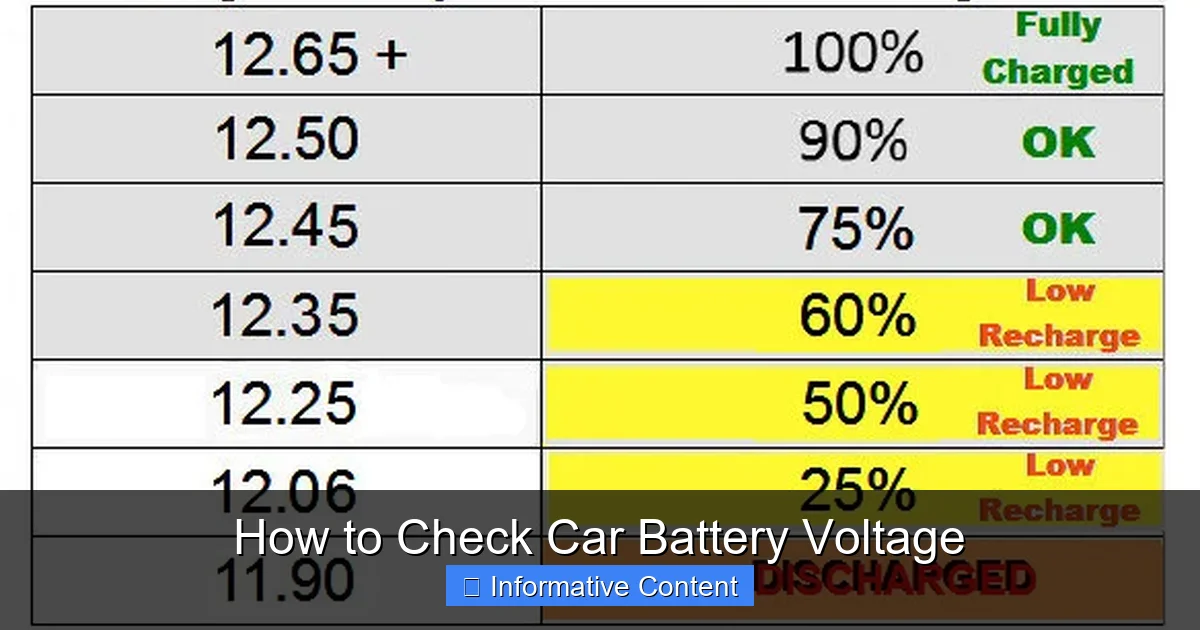
Knowing how to check car battery voltage is only half the battle; interpreting the numbers is crucial. Here’s a quick guide to what your voltage readings indicate:
Resting Voltage (Engine Off)
- 12.6V – 12.8V: Your battery is fully charged and in good health. Excellent!
- 12.4V – 12.6V: The battery is about 75% charged. It’s okay, but consider a trickle charge if you often do short trips.
- 12.2V – 12.4V: Approximately 50% charged. It’s getting low. You might experience slow cranking, especially in cold weather. A recharge is recommended.
- 12.0V – 12.2V: Only about 25% charged. Your battery is significantly discharged and might struggle to start the car. Definitely needs a full recharge.
- Below 12.0V: The battery is almost completely discharged. It may not have enough power to start the engine and could be permanently damaged if left in this state. A full charge and further investigation are needed.
- Below 10.0V: Likely a dead cell or severely damaged battery. Replacement is probably necessary.
Charging Voltage (Engine On)
- 13.7V – 14.7V: This is the ideal range. It indicates your alternator is properly charging the battery and powering the vehicle’s electrical system.
- Below 13.7V: The alternator might be undercharging the battery. This could lead to a consistently discharged battery. Check the alternator belt, wiring, or consider having the alternator tested.
- Above 14.7V (up to 15.0V in some cases, but consistently high): The alternator might be overcharging the battery. While less common, overcharging can damage the battery by “boiling” the electrolyte. This also indicates an issue with the alternator’s voltage regulator.
- No significant change from resting voltage (e.g., stays around 12.xV): This is a major red flag. It means your alternator is likely not working at all, and your car is running solely on battery power. You’ll eventually break down once the battery depletes.
Troubleshooting Low or High Readings
Now that you know how to check car battery voltage and interpret the readings, what should you do if your numbers aren’t ideal?
Dealing with Low Resting Voltage
If your resting voltage is consistently below 12.4V, here’s what to consider:
- Recharge the Battery: Your first step should be to fully charge the battery using a dedicated car battery charger. A smart charger is recommended as it prevents overcharging.
- Check for Parasitic Drains: After charging, if the voltage drops quickly again while the car is off, you might have something drawing power when it shouldn’t be (e.g., a faulty light switch, aftermarket alarm, or stereo component). Diagnosing a parasitic drain can be complex and may require professional help.
- Age of Battery: If your battery is older than 3-5 years, it might simply be reaching the end of its life. Even a full charge might only offer temporary relief. Consider a load test at an auto parts store; they often do this for free.
- Cold Weather: Batteries lose efficiency in cold weather, and voltage readings might appear lower. Keep this in mind, but a healthy battery should still perform adequately.
Addressing Charging System Issues
If your charging voltage is outside the 13.7V-14.7V range:
- Low Charging Voltage (Below 13.7V):
- Check Alternator Belt: Ensure the serpentine belt is tight and not slipping.
- Inspect Wiring: Look for loose or corroded connections between the alternator, battery, and vehicle’s electrical system.
- Test the Alternator: If the belt and wiring are fine, the alternator itself might be failing. Many auto parts stores can test alternators for free.
- High Charging Voltage (Above 14.7V):
- Alternator Regulator: This usually indicates a problem with the voltage regulator, which is often built into the alternator. An overcharging alternator can damage the battery and other electrical components. Professional diagnosis is recommended.
Prolonging Battery Life: Maintenance Tips
Learning how to check car battery voltage is a fantastic start, but a little preventative maintenance can go a long way in extending your battery’s life and avoiding future issues.
Keep Terminals Clean
Regularly inspect and clean your battery terminals. Corrosion can restrict current flow and reduce charging efficiency. Use a wire brush and a solution of baking soda and water to clean away any buildup, then rinse with clean water and dry thoroughly. Applying a thin layer of dielectric grease can help prevent future corrosion.
Avoid Short Trips
Your alternator needs time to fully recharge the battery after starting the engine. Frequent short trips (less than 20 minutes) don’t allow the battery to fully replenish its charge, leading to a state of constant undercharge. If you mostly drive short distances, consider taking a longer drive once a week or using a trickle charger periodically.
Limit Accessory Use When Engine is Off
Leaving headlights on, playing the radio, or using interior lights for extended periods when the engine isn’t running can quickly drain your battery. Always be mindful of your accessories.
Check Electrolyte Levels (for serviceable batteries)
Some older or heavy-duty batteries have removable caps, allowing you to check the electrolyte (acid and water) levels. If the levels are low, carefully add distilled water (never tap water) until the plates are covered. Be extremely cautious as battery acid is corrosive. Most modern car batteries are “maintenance-free” and sealed, so this step won’t apply.
Keep it Secure
Ensure your battery is securely mounted in its tray. Vibrations from driving can damage internal components and shorten its life.
Consider a Battery Maintainer
If you store your car for extended periods (weeks or months), a battery maintainer (or trickle charger) can keep the battery at an optimal charge level without overcharging, significantly extending its lifespan.
Conclusion
Mastering how to check car battery voltage is a simple yet powerful skill that every car owner should possess. It’s a proactive step that can save you from unexpected breakdowns, costly tow truck fees, and the general headache of a dead battery. By following the clear, step-by-step instructions outlined in this guide, you can confidently use a multimeter to assess your battery’s health, understand what the voltage readings mean, and diagnose potential issues with your charging system.
Remember, a healthy car battery is vital for a reliable vehicle. Regular checks, combined with proper maintenance, will not only extend the life of your battery but also provide you with peace of mind knowing that your car is ready to go whenever you are. So, grab your multimeter, put on your safety gear, and take control of your car’s electrical health today!
Frequently Asked Questions
What causes a car battery to die quickly?
Several factors can cause a car battery to die prematurely, including extreme temperatures (both hot and cold), frequent short trips that don’t allow full recharging, leaving accessories on, corrosion on terminals, and simply age. A faulty alternator or a parasitic electrical drain can also be culprits.
Can a dead battery be recharged, or does it need replacing?
Many dead batteries can be recharged, especially if the discharge was due to leaving lights on or infrequent use. However, if a battery is very old, has a dead cell (indicated by very low voltage, e.g., below 10V), or has been deeply discharged multiple times, it may not hold a charge effectively and will need to be replaced.
How long does a typical car battery last?
On average, a car battery lasts between 3 to 5 years. However, this lifespan can vary significantly based on driving habits, climate, battery type, and maintenance. Regular voltage checks can help you monitor its health and predict its end of life.
What are the signs of a weak car battery?
Common signs of a weak car battery include slow engine cranking, dim headlights when the engine is off, a dashboard battery warning light, electrical components (like the radio or power windows) acting erratically, and needing frequent jump starts. A resting voltage consistently below 12.4V is a strong indicator.
What if my multimeter shows a negative voltage reading?
A negative voltage reading on your multimeter simply means you’ve connected the probes in reverse. The red (positive) probe should be on the positive battery terminal, and the black (negative) probe on the negative terminal. Just switch the probe connections, and the reading should become positive.
Does extreme weather affect battery voltage readings?
Yes, extreme temperatures significantly impact battery performance and voltage. Cold weather reduces the battery’s chemical reaction efficiency, leading to lower voltage output and reduced cranking power. Hot weather, while not immediately impacting voltage as much as cold, accelerates battery degradation over time, shortening its lifespan.