
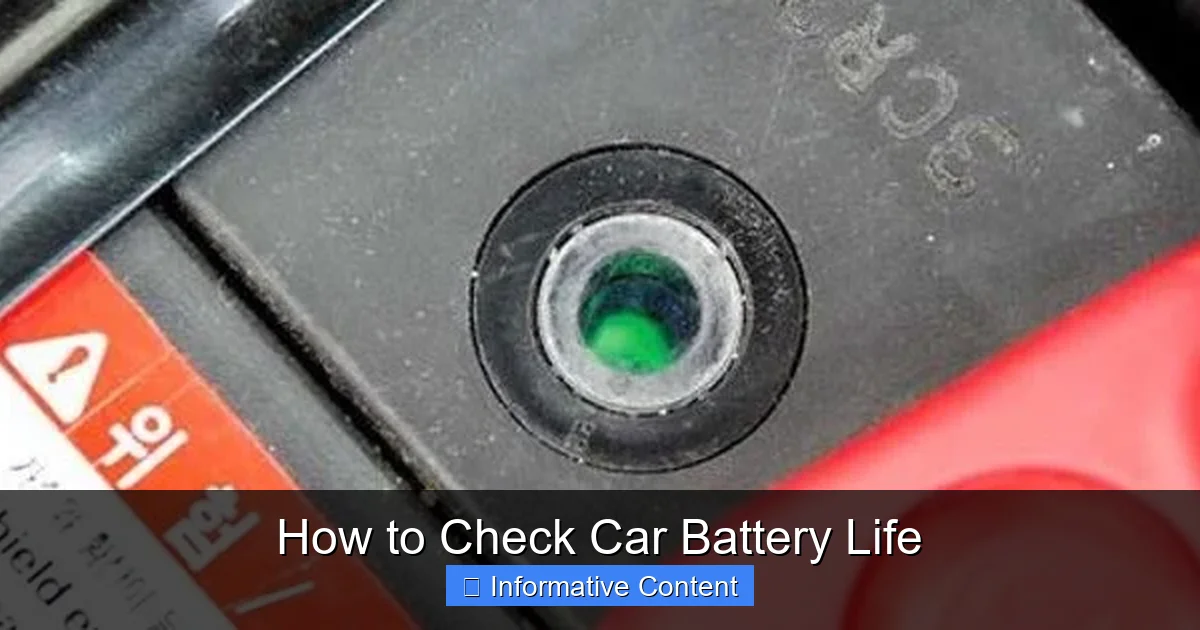
Knowing how to check car battery life is crucial for avoiding unexpected breakdowns and ensuring your vehicle starts reliably every time. This guide will walk you through easy visual inspections, voltage tests using a multimeter, and understanding when to seek professional load testing. By regularly monitoring your battery’s health, you can proactively address issues and extend its lifespan, saving you time and money in the long run.
There’s nothing quite like the sound of your car not starting on a cold morning. That dreaded click-click-click, or worse, absolute silence, can instantly ruin your day. More often than not, a dead car battery is the culprit. But what if you could predict that moment before it happens? What if you knew exactly how to check car battery life and identify potential issues before you’re stranded?
Understanding your car battery’s health is one of the easiest and most effective ways to ensure reliable transportation. It’s not just about avoiding inconvenience; a failing battery can also put a strain on your alternator and other electrical components. Luckily, checking your car battery life isn’t a job solely for mechanics. With a few simple tools and a little know-how, you can perform regular checks and gain peace of mind. Let’s dive into everything you need to know about keeping your battery in top shape!
Key Takeaways
- Regular Checks Prevent Breakdowns: Proactively learning how to check car battery life helps you identify a dying battery before it leaves you stranded, ensuring reliable vehicle starts.
- Start with a Visual Inspection: Look for obvious signs like corrosion on terminals, a swollen battery case, or any leaks, which indicate potential problems.
- Use a Multimeter for Voltage: A digital multimeter can easily measure your battery’s resting voltage. A healthy, fully charged battery should read between 12.6 and 12.8 volts.
- Understand Voltage Readings: A reading below 12.4 volts suggests a discharged battery, while anything consistently below 12.0 volts typically means a failing battery that needs replacement.
- Load Testing is Key for True Health: While a multimeter checks resting voltage, a load test simulates starting conditions, providing the most accurate assessment of a battery’s capacity and overall health. This is often best done by professionals.
- Check Water Levels (if applicable): For older, non-sealed batteries, ensuring electrolyte levels are adequate is a simple maintenance step to prolong life.
- Maintenance Extends Life: Keeping terminals clean, ensuring proper charging, and avoiding deep discharges can significantly extend your car battery’s lifespan.
Quick Answers to Common Questions
What is a good voltage reading for a car battery?
A healthy, fully charged car battery should read between 12.6 and 12.8 volts (V) when the engine has been off for several hours, ideally overnight.
How often should I check my car battery life?
It’s a good practice to visually inspect your battery every few months, and perform a voltage test with a multimeter at least twice a year, especially before extreme weather seasons (winter and summer).
Can a fully charged battery still be bad?
Yes, a battery can show a healthy resting voltage but still be unable to deliver enough cranking power under load. This is why a load test is crucial for a complete assessment.
What causes corrosion on battery terminals?
Corrosion is often caused by hydrogen gas escaping from the battery terminals, reacting with the surrounding metal. It can also be a sign of overcharging or an old, gassing battery.
Is it safe to clean battery terminals myself?
Yes, but always wear safety glasses and gloves. Disconnect the negative cable first, then the positive. Use a baking soda and water paste with a wire brush, rinse, and dry thoroughly before reconnecting (positive first, then negative).
📑 Table of Contents
- Understanding Your Car Battery: The Heart of Your Vehicle’s Electrical System
- The Visual Inspection: Your First Step to Checking Battery Health
- The Voltmeter Test: A Quick & Easy Way to Check Car Battery Life
- Load Testing: The Ultimate Test for Battery Health
- Hydrometer Test: For Flood Batteries (If Applicable)
- Beyond Testing: Other Signs Your Battery Is Dying
- Extending Your Car Battery’s Life
- Conclusion: Stay Ahead of Battery Troubles
Understanding Your Car Battery: The Heart of Your Vehicle’s Electrical System
Before we learn how to check car battery life, let’s briefly understand what it does. Your car battery is much more than just a box under the hood. It’s a critical component responsible for providing the initial burst of power to start your engine, as well as supplying electricity to essential systems like your lights, radio, and wipers when the engine is off. Once your engine is running, the alternator takes over, recharging the battery and powering the car’s electrical components.
Types of Car Batteries
Most modern cars use 12-volt lead-acid batteries, but there are a few common variations:
- Flooded Lead-Acid Batteries (Wet Cell): These are the most common and traditional type. They contain a liquid electrolyte solution and may require occasional maintenance (checking and topping up water levels if not “maintenance-free”).
- Absorbed Glass Mat (AGM) Batteries: A more advanced type, AGM batteries use fiberglass mats to absorb the electrolyte, making them spill-proof and vibration resistant. They offer better performance in extreme temperatures and a longer lifespan, often found in vehicles with start-stop technology.
- Gel Cell Batteries: Similar to AGM, but they use a gelled electrolyte. They are very resistant to vibration and can handle deep discharges well, but charge slower and are less common in standard passenger cars.
Knowing your battery type is helpful, as it can influence maintenance steps, especially for checking electrolyte levels.
Factors Affecting Battery Life
Several factors determine how long your car battery will last:
- Climate: Extreme heat is a battery’s worst enemy, accelerating the chemical reaction and fluid evaporation. Cold weather doesn’t kill batteries but highlights existing weaknesses.
- Driving Habits: Frequent short trips don’t allow the alternator enough time to fully recharge the battery.
- Age: Batteries naturally degrade over time, typically lasting 3-5 years.
- Parasitic Drains: Electrical components that draw power even when the car is off can slowly drain your battery.
- Maintenance: Clean terminals, proper charging, and regular checks can significantly extend battery life.
The Visual Inspection: Your First Step to Checking Battery Health
Before grabbing any tools, the simplest way to begin how to check car battery life is with a good old-fashioned visual inspection. This can reveal many common problems without needing any special equipment.

Visual guide about How to Check Car Battery Life
Image source: i.ytimg.com
Safety First!
Always wear safety glasses and gloves when working with car batteries. Batteries contain corrosive acid and can produce explosive hydrogen gas.
What to Look For:
- Corrosion on Terminals: Look at the positive (+) and negative (-) terminals. If you see a white or bluish-green powdery substance, that’s corrosion. Corrosion restricts the flow of electricity, preventing your battery from delivering full power to your starter and getting a proper charge from your alternator.
- Loose Cable Connections: Gently try to wiggle the battery cables attached to the terminals. If they are loose, they won’t make good contact, leading to starting problems.
- Swollen or Bulging Battery Case: A swollen battery case, especially on the sides or top, is a serious sign of internal damage. This can be caused by overcharging or extreme heat and means the battery is failing and needs immediate replacement.
- Cracks or Leaks: Any cracks in the battery case or signs of fluid leaking indicate a damaged battery that should be replaced immediately. The fluid is corrosive sulfuric acid.
- Dirty Battery Top: A dirty battery top can create a conductive path for current to drain, even if slowly. Keep it clean.
- Check Battery Mount: Ensure the battery is securely mounted. A loose battery can vibrate excessively, leading to internal damage and a shorter lifespan.
If you spot corrosion, you can clean it using a mixture of baking soda and water (a tablespoon of baking soda per cup of water). Apply it with a brush, let it fizz, then rinse with clean water and dry thoroughly. Ensure the car is off and cables are disconnected (negative first, then positive) before cleaning.
The Voltmeter Test: A Quick & Easy Way to Check Car Battery Life
After a visual inspection, the next step in how to check car battery life is to use a digital multimeter. This simple tool measures voltage and can give you a good indication of your battery’s charge level and overall health.
What You’ll Need:
- Digital Multimeter (can be found cheaply at any hardware store)
- Safety glasses and gloves
Steps to Perform a Voltmeter Test:
- Ensure Your Car Has Been Off: For an accurate “resting voltage” reading, your car should have been off for at least a few hours, ideally overnight. This allows the battery to stabilize after any recent charging from the alternator.
- Set Your Multimeter: Turn the dial to “DC Volts” (often indicated by a V with a straight line and three dots above it, or “20V” if it’s a manual range meter).
- Connect the Leads:
- Connect the red (positive) lead of the multimeter to the positive (+) terminal of your car battery.
- Connect the black (negative) lead of the multimeter to the negative (-) terminal of your car battery.
Make sure the connections are firm.
- Read the Voltage: The multimeter display will show a voltage reading.
Interpreting Your Voltmeter Readings:
- 12.6 – 12.8 Volts: Your battery is fully charged and in good health. Excellent!
- 12.4 – 12.5 Volts: Your battery is about 75% charged. It’s still fine, but it might benefit from a charge, especially if it drops further.
- 12.2 – 12.3 Volts: Your battery is about 50% charged. It’s partially discharged and should be charged soon.
- Below 12.0 Volts: Your battery is significantly discharged (25% or less) and likely needs charging immediately. Consistently low readings, even after charging, often indicate a weak or failing battery that may need replacement. Below 11.8 volts, it’s virtually dead.
A simple voltmeter test tells you the current state of charge but doesn’t fully indicate the battery’s ability to deliver power under load. This brings us to the next step.
Load Testing: The Ultimate Test for Battery Health
While a voltmeter tells you the resting voltage, a load test simulates the high demand placed on your battery when starting your car. This is the most accurate way to truly assess your battery’s cranking power and overall capacity.
Why Load Testing is Crucial
A battery can show a healthy resting voltage but still fail under load. This is because internal resistance can increase as a battery ages, limiting its ability to deliver the necessary amps to crank the engine. A load tester puts a significant electrical drain on the battery for a short period, mimicking the demands of starting your car, and then measures its ability to maintain voltage.
How to Perform a Load Test (Professional vs. DIY)
Professional Load Test:
Most auto parts stores offer free battery testing, which typically includes a professional load test. They use specialized equipment that applies a controlled load to the battery and measures its performance. This is generally the recommended approach for most drivers because:
- Accuracy: Professional testers are more precise.
- Safety: Load testing involves high currents, and specialized equipment minimizes risks.
- Comprehensive Analysis: Many professional testers also check the starting system (starter) and charging system (alternator) at the same time.
DIY Load Test (with a hand-held load tester):
You can purchase a hand-held load tester, though they are less common for casual DIYers than multimeters. If you do, always follow the manufacturer’s instructions precisely.
- Ensure Battery is Fully Charged: A load test should only be performed on a fully charged battery (12.6V or higher).
- Connect the Tester: Connect the tester’s positive clamp to the positive battery terminal and the negative clamp to the negative terminal.
- Apply the Load: Press the test button or activate the load for the recommended duration (usually 10-15 seconds).
- Read the Results: The tester will display the voltage under load. A healthy battery should maintain at least 9.6 volts during the test. Anything below this, especially dropping significantly below 9.6V, indicates a weak battery that likely needs replacement.
Be aware that these DIY load testers can get hot during use, so handle with care.
Hydrometer Test: For Flood Batteries (If Applicable)
If you have an older, non-sealed (flooded) lead-acid battery, you can perform a hydrometer test to check the specific gravity of the electrolyte in each cell. This tells you the state of charge for each individual cell, which can highlight internal problems like a shorted cell.
What You’ll Need:
- Battery Hydrometer (looks like a turkey baster with a float inside)
- Safety glasses and gloves
Steps to Perform a Hydrometer Test:
- Check Electrolyte Levels: Ensure the electrolyte covers the plates in each cell. If not, add distilled water to the appropriate level.
- Draw Sample: Remove the cell caps. Squeeze the hydrometer bulb, insert the tube into a cell, and release the bulb to draw enough electrolyte to make the float rise.
- Read Specific Gravity: Read the specific gravity directly from the float. This is usually a number like 1.265.
- Return Electrolyte: Squeeze the bulb to return the electrolyte to the cell, then repeat for all other cells.
Interpreting Specific Gravity Readings:
- 1.265 or Higher: Fully charged cell.
- 1.225 – 1.250: Moderately charged.
- 1.190 or Lower: Discharged.
All cells should have readings within 0.050 of each other. A significant difference between cells (e.g., one cell much lower than the others) indicates a faulty cell, meaning the battery needs replacement. This test is less common with modern “maintenance-free” batteries, which are sealed.
Beyond Testing: Other Signs Your Battery Is Dying
Sometimes, your battery will give you hints it’s on its way out, even if you haven’t recently performed how to check car battery life. Pay attention to these common symptoms:
- Slow Engine Crank: This is the most common sign. When you turn the key, the engine cranks slowly or sluggishly, taking longer than usual to start. It sounds like a tired cough.
- Dim Headlights and Interior Lights: If your lights are dim when the engine is off or idling, it suggests the battery isn’t holding a full charge.
- Check Engine Light or Battery Warning Light: These lights on your dashboard can sometimes indicate a battery issue, though they can also point to problems with the charging system.
- Electrical Components Malfunctioning: Power windows operating slowly, a radio losing presets, or other electrical glitches can sometimes be traced back to a weak battery.
- Repeated Jump Starts: If you’re needing jump starts frequently, it’s a clear sign your battery is on its last legs and struggling to hold a charge.
- Old Age: As mentioned, car batteries typically last 3-5 years. If yours is in this age range and showing any symptoms, it’s wise to consider replacement.
Extending Your Car Battery’s Life
Now that you know how to check car battery life, let’s talk about how to make it last longer:
- Keep Terminals Clean: Regularly clean any corrosion off the battery terminals and cable connections to ensure a good electrical flow.
- Ensure a Secure Mount: Make sure your battery is held firmly in its tray to prevent vibrations from damaging internal components.
- Avoid Deep Discharges: Don’t leave your lights on or accessories running with the engine off, as this can deeply discharge the battery and reduce its overall lifespan.
- Drive Regularly: Short trips don’t allow your alternator to fully recharge the battery. If you mostly take short trips, consider an occasional longer drive or use a battery tender.
- Use a Battery Maintainer (Trickle Charger): If your car sits for extended periods (weeks or months), a battery maintainer will keep it topped up without overcharging, preventing sulfation and extending its life.
- Check Electrolyte Levels (Flooded Batteries Only): For older, non-sealed batteries, regularly check and top up the fluid levels with distilled water.
- Insulate in Extreme Climates: In very hot climates, a battery heat shield can help reduce heat exposure. In very cold climates, a battery blanket can keep it warmer, improving starting performance.
Conclusion: Stay Ahead of Battery Troubles
Learning how to check car battery life is an empowering skill that can save you from inconvenient breakdowns and costly towing fees. By performing simple visual inspections, understanding your multimeter readings, and opting for a load test when needed, you can monitor your battery’s health proactively. Remember that a typical car battery lasts between 3 to 5 years, so if yours is approaching that age, more frequent checks are a smart move.
Don’t wait for the dreaded click. Take a few minutes every few months to check your car battery life. It’s a small investment of your time that pays off in big ways, ensuring your vehicle remains reliable and ready for whatever the road throws your way. Happy driving!
🎥 Related Video: How to Test a Car Battery with a Multimeter
📺 ChrisFix
How to check a car battery using a multimeter. Does your car not start, do you have dim headlights or interior lights, does the …
Frequently Asked Questions
How long does a typical car battery last?
Most car batteries last between 3 to 5 years, though this can vary depending on climate, driving habits, and maintenance. Extreme temperatures and frequent short trips can shorten its lifespan.
Can a car battery die without any warning signs?
While batteries often give subtle warnings like slow cranking or dim lights, they can sometimes fail suddenly, especially in extreme temperatures or if there’s an internal short. Regular checks help mitigate this risk.
What’s the difference between a battery tender and a battery charger?
A battery charger provides a higher current to quickly recharge a dead or deeply discharged battery. A battery tender (or maintainer) provides a low, continuous charge to keep an already charged battery topped off over long periods, preventing self-discharge without overcharging.
Does extreme cold or heat affect battery life more?
Extreme heat tends to damage the battery internally and shorten its overall lifespan more significantly by accelerating chemical reactions and fluid evaporation. Extreme cold doesn’t damage the battery, but it reduces its efficiency and makes it harder to start the car, revealing existing weaknesses.
Should I replace my car battery if it’s over 4 years old, even if it tests fine?
While a battery testing fine means it’s currently performing, if it’s over 4-5 years old, it’s approaching the end of its typical lifespan. Many people choose to proactively replace it to avoid unexpected breakdowns, especially before winter or a long trip, as its performance can decline rapidly.
Can I test my car battery with the engine running?
No, you should only test the resting voltage of your car battery when the engine is off and has been off for at least a few hours. Testing with the engine running will show the alternator’s output (typically around 13.5-14.5 volts), not the battery’s standalone health.