
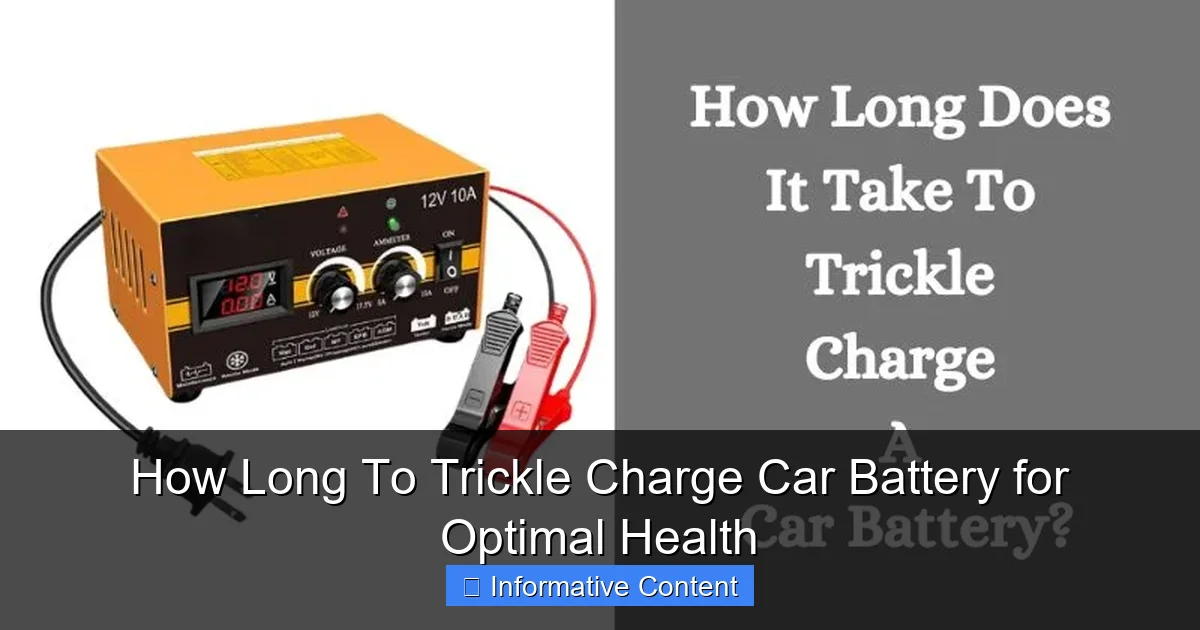
Trickle charging duration depends critically on your battery’s current state and the charger’s intelligence. For optimal long-term health, a smart trickle charger can be left connected indefinitely, as it intelligently monitors and maintains the charge without overcharging. If using an older, non-smart charger, disconnect once fully charged to prevent damage.
Hey there, fellow car enthusiast! Have you ever walked out to your garage, ready to start your day, only to be met with that heartbreaking click-click-click of a dead car battery? It’s a frustrating experience, isn’t it? We’ve all been there, feeling that pang of annoyance as our plans grind to a halt. While jump-starting might get you going in a pinch, it’s often a band-aid solution, and it doesn’t really address the underlying health of your battery.
That’s where the magic of trickle charging comes in. It’s a gentle, consistent way to keep your car’s vital power source in tip-top condition, especially if your car sits unused for periods, or if you make a lot of short trips that don’t allow the alternator to fully replenish the battery. Think of it like a slow, nourishing meal for your battery, rather than a quick, unhealthy snack. But how long should you trickle charge car battery to ensure optimal health without causing harm? That’s the golden question, and it’s what we’re going to explore together today.
Getting this right can significantly extend the life of your battery, save you money on replacements, and most importantly, prevent those unwelcome dead battery surprises. We’ll dive into what trickle charging really means, the different types of chargers available, the factors that influence charging time, and how to do it safely and effectively. So, grab a cup of coffee, and let’s unravel the secrets to keeping your car battery humming with life!
Key Takeaways
- Connect Indefinitely: Modern trickle chargers are safe for continuous, long-term battery connection.
- Monitor Full Charge: Disconnect once your smart charger indicates the battery is fully charged.
- Prevent Discharge: Use trickle charging to maintain charge during storage or infrequent use.
- Avoid Overcharging: Supervise non-smart, older chargers to prevent battery damage.
- Choose Smart Chargers: Invest in smart chargers; they automatically adjust and prevent overcharging.
- Check Battery Health: For optimal health, connect regularly if your car sits unused for weeks.
- Slow and Steady: Trickle charging is a gentle, slow process designed for maintenance.
Quick Answers to Common Questions
How long does it take to fully charge a dead car battery with a trickle charger?
For a deeply discharged car battery, a trickle charger can take anywhere from 24 to 48 hours to bring it back to full capacity. It’s a slow and steady process designed to recondition your battery gently.
Can I leave a trickle charger on my car battery indefinitely?
Yes, modern smart trickle chargers are designed to be left connected for extended periods without harm. They monitor the battery’s charge and automatically switch to a float or maintenance mode, preventing overcharging and keeping your battery topped off.
How often should I trickle charge my car battery for optimal health?
If your car sits for extended periods (weeks or months), trickle charging once a month or leaving it connected continuously is ideal. This routine helps prevent self-discharge and significantly prolongs battery life.
What’s a good duration for a maintenance trickle charge if I just want to top it up?
For regular maintenance, simply leaving a smart trickle charger connected is best, as it will manage the duration itself. If you’re doing a periodic top-up for a vehicle not stored long-term, 12-24 hours is often sufficient to ensure it’s fully conditioned.
How do I know when my car battery is fully charged by a trickle charger?
Most modern trickle chargers have an indicator light that changes color (e.g., from red to green) or displays “full” when the battery is completely charged. Always refer to your specific charger’s manual for its charging status indicators to confirm how long to trickle charge car battery.
📑 Table of Contents
- What is Trickle Charging and Why Does Your Car Battery Need It?
- Understanding Different Types of Chargers: Trickle, Smart, and Maintainers
- The “How Long” Question: Factors Influencing Trickle Charging Duration
- Step-by-Step Guide to Safely Trickle Charge Your Car Battery
- Beyond the Basics: Signs of a Healthy Battery and When to Replace It
- Common Mistakes to Avoid When Trickle Charging
What is Trickle Charging and Why Does Your Car Battery Need It?
Let’s start with the basics. What exactly is trickle charging? In simple terms, it’s the process of supplying a very low, consistent current to your car battery over an extended period. Unlike a rapid charge that pushes a lot of amperage into the battery quickly, a trickle charge is a slow and steady stream of power, typically at 1 to 3 amps.
The Silent Drain on Your Battery
Even when your car is turned off, its battery is slowly discharging. This self-discharge is normal, but modern cars also have numerous systems that draw a small amount of power constantly – things like your alarm system, radio presets, computer memory, and keyless entry. This is often referred to as “parasitic draw.” If your car sits for days or weeks without being driven, or if you only take short trips where the alternator doesn’t have enough time to fully recharge the battery, this constant drain can leave your battery undercharged.
The Benefits of Regular Trickle Charging for Car Battery Health
Keeping your car battery consistently charged offers several significant benefits:
- Prevents Sulfation: When a lead-acid battery discharges, lead sulfate crystals form on the battery plates. If a battery remains discharged for too long, these crystals harden (a process called sulfation), making it harder for the battery to accept and hold a charge. Regular trickle charging helps prevent this damaging buildup, keeping your battery plates healthy and efficient.
- Extends Battery Lifespan: A battery that is routinely kept at a good state of charge lasts longer. Think of it like regularly exercising a muscle; it stays stronger and performs better over time. Avoiding deep discharges and keeping sulfation at bay directly contributes to a longer battery life, saving you money in the long run.
- Ensures Reliable Starts: There’s nothing worse than needing to be somewhere and your car won’t start. A well-maintained battery, thanks to trickle charging, will provide the strong surge of power needed to crank your engine every time, giving you peace of mind and reliable performance.
- Maintains Optimal Performance: Beyond just starting the car, a healthy battery ensures all your car’s electrical systems, from headlights to infotainment, receive stable voltage, contributing to the overall optimal performance of your vehicle.
Understanding Different Types of Chargers: Trickle, Smart, and Maintainers
When you start looking for a charger to keep your car battery in top shape, you’ll encounter a few different types. It’s important to understand the distinctions because the type of charger you use directly impacts how long and how safely you can keep it connected.
Traditional Trickle Chargers: The Old-School Approach
These are the simplest chargers. A traditional trickle charger typically delivers a constant, low-amperage current (e.g., 1-3 amps) to the battery. They don’t have much in the way of sophisticated electronics. While effective for bringing a moderately discharged battery back up to charge, they come with a significant caveat: they can overcharge your battery if left connected for too long after the battery is full. Overcharging can damage the battery by boiling off electrolyte (water) in flooded lead-acid batteries, leading to reduced capacity and a shorter lifespan. This means you need to monitor them closely.
Smart Chargers (Multi-Stage Chargers): The Intelligent Choice
This is where technology really helps us out. Smart chargers are far more advanced than their traditional counterparts. They are often called multi-stage chargers because they go through different charging phases, optimizing the charge for your battery’s specific needs. A typical smart charger will have stages like:
- Bulk Charge: Delivers the maximum safe current to quickly bring the battery’s voltage up.
- Absorption Charge: As the battery approaches full charge, the current is reduced, and the voltage is held constant to safely top off the battery.
- Float/Maintenance Charge: Once the battery is fully charged, the charger drops to a very low, pulsed current, just enough to counteract self-discharge. This is the “trickle” part, and it’s incredibly gentle.
Because they automatically switch to a maintenance or float mode, smart chargers are much safer to leave connected to your car battery for extended periods without fear of overcharging.
Battery Maintainers: Designed for Long-Term Health
Battery maintainers are essentially a specialized type of smart charger, designed specifically for long-term storage and maintenance. They typically have lower amperage outputs (often less than 1 amp) and are specifically engineered to keep a fully charged battery topped off indefinitely. They excel at preventing sulfation and ensuring your battery is always ready to go, even after months of inactivity. If you have a classic car, a motorcycle, or an RV that sits for long stretches, a battery maintainer is your best friend for long-term trickle charge car battery care.
Charger Comparison Table
| Charger Type | Features | Monitoring Needed | Ideal Use Case | Approximate Amperage |
|---|---|---|---|---|
| Traditional Trickle Charger | Constant low current output, basic functionality. | High (must disconnect once fully charged to prevent overcharging). | Infrequent charging of moderately discharged batteries. | 1-3 Amps |
| Smart Charger (Multi-Stage) | Microprocessor-controlled, multiple charging stages (bulk, absorption, float), overcharge protection. | Low (can be left connected indefinitely in float mode). | Regular charging, recovery of deeply discharged batteries, long-term maintenance. | 4-10+ Amps (often with a trickle/float mode at <2 Amps) |
| Battery Maintainer | Very low amperage, specifically designed for long-term float/maintenance charging, typically a type of smart charger. | Very Low (designed to be left connected indefinitely). | Vehicles in long-term storage (seasonal cars, RVs, motorcycles), preventing self-discharge. | 0.75 – 2 Amps |
The “How Long” Question: Factors Influencing Trickle Charging Duration
This is the core question, isn’t it? How long should you trickle charge car battery for optimal health? The honest answer is: it depends. There’s no one-size-fits-all number because several factors come into play. It’s more about achieving a full charge and then maintaining it, rather than a fixed number of hours.
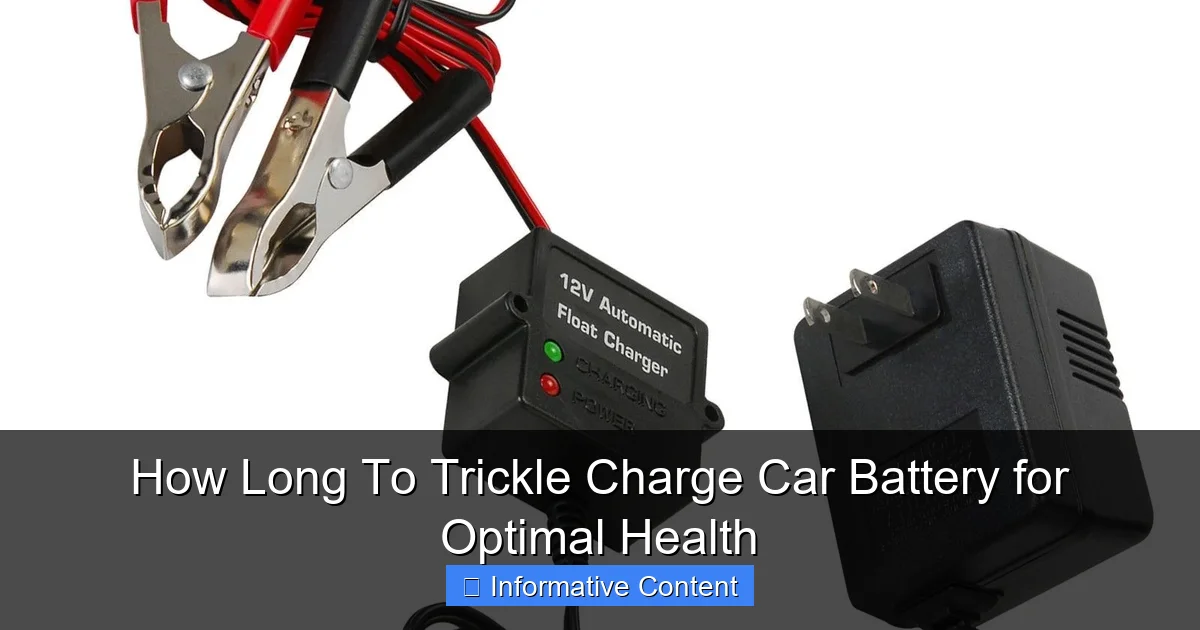
Visual guide about trickle charge car battery
Image source: econosuperstore.com
Battery’s State of Discharge
The most significant factor is how discharged your battery is to begin with. A battery that’s only slightly depleted from a few days of sitting will obviously take much less time to top off than a battery that’s nearly dead and struggling to crank your engine. If your battery is completely flat (below 10.5 volts), a trickle charger might take a very long time, sometimes even days, to bring it back to a usable charge, and it might not fully recover if deeply sulfated.
Battery’s Capacity (Amp-Hours)
Car batteries come in different sizes, measured in amp-hours (Ah). A larger battery (e.g., 100 Ah) simply has more capacity to store energy than a smaller one (e.g., 50 Ah). Consequently, it will take longer to fully charge a higher-capacity battery with the same trickle charger output.
Charger’s Amperage Output
As we discussed, trickle chargers typically put out a low current, often between 1 and 3 amps. A 2-amp charger will charge a battery twice as fast as a 1-amp charger, assuming all other factors are equal. However, remember the “trickle” aspect – the goal isn’t speed, but gentle, sustained charging.
Battery’s Age and Health
An older battery, or one that has been deeply discharged multiple times, might not accept a charge as efficiently as a newer, healthier battery. It might take longer to reach a full charge, and it might not hold that charge for as long. A battery’s internal resistance increases with age and degradation, making the charging process less efficient.
Type of Charger (Traditional vs. Smart/Maintainer)
This is crucial for the “how long” part, especially for unattended charging:
- Traditional Trickle Chargers: If you’re using one of these basic units, you need to monitor the battery’s voltage and disconnect the charger once it reaches full charge (around 12.6-12.8 volts for a 12V lead-acid battery). Leaving it on for more than 24-48 hours, especially after it’s topped off, can lead to overcharging and damage. So, for a traditional trickle charger, the answer to “how long” is: until it’s full, and then promptly disconnect. This might be anywhere from 12-24 hours for a moderately discharged battery, or longer for a very flat one.
- Smart Chargers and Battery Maintainers: This is where the game changes. Once these chargers bring your battery to full capacity, they automatically switch to a “float” or “maintenance” mode. In this mode, they provide just enough current to counteract the battery’s natural self-discharge. This means you can leave a smart charger or battery maintainer connected to your car battery for weeks, months, or even indefinitely without fear of overcharging. For these devices, the answer to “how long” is: as long as you need to keep the battery optimally charged, even permanently.
So, for preventing issues and truly optimizing your car battery health, a smart charger or maintainer is the clear winner because it handles the “how long” question for you.
Step-by-Step Guide to Safely Trickle Charge Your Car Battery
Safety is paramount when working with car batteries. They contain corrosive acid and can produce explosive hydrogen gas. Always prioritize safety first! Here’s how to safely trickle charge car battery:
1. Prioritize Safety First!
- Ventilation: Always charge your battery in a well-ventilated area. Never in an enclosed space.
- Personal Protective Equipment (PPE): Wear safety glasses and gloves to protect your eyes and skin from battery acid.
- No Sparks or Flames: Keep open flames, sparks, and smoking materials far away from the battery.
2. Gather Your Equipment
- Appropriate Charger: A smart charger or battery maintainer is highly recommended.
- Wrench/Socket Set: If you need to remove battery terminals or hold-downs.
- Wire Brush/Battery Terminal Cleaner: To clean corrosion.
- Baking Soda and Water Mixture: To neutralize acid if necessary.
3. Prepare Your Battery
- Locate the Battery: It’s usually under the hood, but sometimes in the trunk or under a seat.
- Clean Terminals: If you see any white or blue-green powdery corrosion on the battery terminals, clean it off with a wire brush and the baking soda/water mixture. Rinse with clean water and dry thoroughly. Good contact is essential for efficient charging.
- Check Water Levels (for flooded lead-acid batteries only): If your battery has removable caps (not all do, especially maintenance-free types), carefully pry them off. If the electrolyte (liquid) level is below the plates, top it up with distilled water only. Do NOT use tap water. Replace the caps.
- Decide to Disconnect: For most trickle charging scenarios with a smart charger, you don’t need to disconnect the battery from the car’s electrical system, especially if you’re just maintaining it. However, if you’re using a traditional charger, or if your car’s electronics are very sensitive, disconnecting the negative terminal from the car might be a safer option to prevent any potential electrical spikes. Consult your car’s manual.
4. Connect the Charger
- Charger OFF: Ensure your charger is unplugged from the wall outlet or turned off before connecting the clamps.
- Positive to Positive: Connect the red positive (+) clamp from the charger to the positive (+) terminal on the battery.
- Negative to Negative (or Chassis): Connect the black negative (-) clamp from the charger to the negative (-) terminal on the battery. If you are charging the battery while it’s still in the car and your car’s manual suggests it, you can sometimes connect the negative clamp to a clean, unpainted metal part of the car’s chassis, away from the battery. This reduces the risk of sparking near potentially explosive battery gases.
- Plug in the Charger: Once both clamps are securely attached, plug the charger into a wall outlet or turn it on.
5. Monitor and Charge
- Smart Charger/Maintainer: Your smart charger or maintainer will typically have indicator lights showing its progress (e.g., charging, fully charged, float/maintain). You can generally leave these connected without worry.
- Traditional Trickle Charger: If using a traditional charger, you’ll need to monitor the charging process. Use a voltmeter to check the battery voltage periodically. Once it reaches around 12.6-12.8 volts and holds steady, the battery is fully charged.
6. Disconnect the Charger
- Charger OFF/Unplug: First, unplug the charger from the wall outlet or turn it off.
- Negative First: Disconnect the black negative (-) clamp from the battery terminal (or chassis).
- Positive Last: Disconnect the red positive (+) clamp from the battery terminal.
- Replace Caps/Covers: If you removed any battery caps or terminal covers, replace them securely.
And that’s it! With these steps, you can safely and effectively trickle charge car battery and help prolong its life.
Beyond the Basics: Signs of a Healthy Battery and When to Replace It
Knowing how to trickle charge car battery is great, but it’s also important to understand what a healthy battery looks and acts like, and when it’s time to let go and get a replacement.
Signs of a Healthy Car Battery
- Quick and Strong Starts: Your engine cranks over briskly and starts almost immediately. There’s no hesitation or sluggishness.
- Bright Headlights: When the engine is off and the car isn’t running, your headlights should still be bright and strong, not dim or fading.
- Stable Voltage: A fully charged 12-volt car battery, when the engine is off and hasn’t been run for a few hours, should read around 12.6 to 12.8 volts with a voltmeter. If it’s consistently lower, even after charging, it might be a sign of a weakening battery.
- No Visible Corrosion or Damage: The battery case should be clean, free of cracks, bulges, or excessive corrosion on the terminals.
Signs of a Failing Car Battery
Unfortunately, batteries don’t last forever. Here are the tell-tale signs that your battery is nearing the end of its life, even with proper trickle charge car battery maintenance:
- Slow Cranking: The engine turns over slowly or with difficulty, especially on cold mornings. This is often the first and most common sign.
- Dim Headlights (when starting): When you try to start the car, the headlights dim significantly.
- Frequent Jumps: If you find yourself needing a jump-start more and more often, it’s a clear sign your battery isn’t holding a charge anymore.
- Warning Lights: Your dashboard might illuminate a battery or charging system warning light.
- Visible Damage: A swollen or bulging battery case can indicate internal damage, often due to overcharging or excessive heat. A rotten egg smell can indicate a leak or internal damage, releasing hydrogen sulfide gas.
- Age: Most car batteries have a lifespan of 3-5 years, depending on climate, usage, and maintenance. If your battery is approaching or past this age, even if it seems okay, it’s wise to consider testing or replacing it proactively.
When to Replace Your Car Battery
Don’t wait until your battery completely dies and leaves you stranded. If you notice any of the failing signs, or if your battery is 4-5 years old, it’s a good idea to have it tested by a professional at an auto parts store or mechanic. Most places offer this service for free. A battery that consistently tests below its rated capacity, even after a full charge, is a candidate for replacement. While regular trickle charge car battery can extend its life, it can’t defy the laws of physics forever. Proactive replacement can save you a lot of hassle and stress down the road.
Common Mistakes to Avoid When Trickle Charging
While trickle charge car battery is a fantastic practice, there are a few pitfalls to steer clear of to ensure you’re doing it safely and effectively. Avoiding these common mistakes will help you get the most out of your battery and charger.
1. Using the Wrong Type of Charger for Long-Term Maintenance
As we discussed, a traditional, unregulated trickle charger is not designed to be left on indefinitely. Leaving one connected to a fully charged battery will lead to overcharging, which can boil off the electrolyte, warp battery plates, and significantly shorten battery life. Always opt for a smart charger or battery maintainer for any charging that will extend beyond a few hours after the battery is full.
2. Ignoring Safety Precautions
Failing to wear safety glasses and gloves, charging in poorly ventilated areas, or having open flames/sparks nearby are serious mistakes. Batteries can produce explosive hydrogen gas and contain corrosive sulfuric acid. A moment of carelessness can lead to serious injury or damage.
3. Connecting the Charger Incorrectly
Reversing the polarity (connecting positive to negative and vice-versa) can cause sparks, damage the charger, damage the battery, or even harm your car’s delicate electronics. Always connect red to positive (+) and black to negative (-) or an appropriate chassis ground. Double-check before plugging in the charger.
4. Not Checking Water Levels (for Flooded Lead-Acid Batteries)
If you have a traditional flooded lead-acid battery (the kind with removable caps), neglecting to check and top off the electrolyte levels with distilled water before and periodically during charging can cause damage. If the plates are exposed to air, they can become sulfated and damaged. However, do NOT do this for sealed, maintenance-free, AGM, or Gel batteries.
5. Assuming All Batteries are the Same
Not all car batteries are created equal. Different battery technologies (flooded lead-acid, AGM, Gel) have different charging requirements. Using a charger or setting not compatible with your battery type can lead to undercharging, overcharging, or damage. Always check your battery type and ensure your charger has the correct settings, if applicable.
6. Underestimating a Dying Battery
While trickle charge car battery can prolong its life, it cannot revive a truly dead or internally damaged battery. If your battery is old, frequently dying, or showing signs of physical damage, a trickle charger might temporarily top it off, but it won’t fix the underlying problem. Don’t rely on trickle charging as a permanent solution for a battery that needs to be replaced.
By being mindful of these common mistakes, you can ensure your trickle charging efforts are beneficial and safe, truly contributing to the optimal health of your car battery.
So, there you have it, fellow car lover! We’ve journeyed through the ins and outs of how long to trickle charge car battery, and hopefully, you now feel much more confident about keeping your car’s power source in prime condition. The key takeaway, if you remember nothing else, is this: for truly optimal battery health and peace of mind, invest in a good quality smart charger or battery maintainer. These intelligent devices take the guesswork out of the “how long” question, allowing you to leave them connected for extended periods without fear of overcharging, gently maintaining your battery at its peak.
Regular trickle charging isn’t just about avoiding the inconvenience of a dead battery; it’s a proactive step in preserving your battery’s lifespan, preventing costly sulfation, and ensuring your vehicle always starts reliably. It’s a small investment of time and a relatively minor expense that pays off handsomely in extending the life of your battery and preventing unexpected breakdowns.
So, go ahead, give your car battery the consistent, gentle care it deserves. Your car will thank you with strong starts and reliable performance, keeping you on the road and enjoying your journeys without a hitch. Happy motoring!
🎥 Related Video: Best battery charging hack for dead batteries!!!!
📺 10 Minute Fix
Charging a dead battery is easy. Connect them in parallel then connect the charger to the know good battery. The charger will …
Frequently Asked Questions
What is trickle charging, and how long does it typically take to fully charge a car battery?
Trickle charging is a slow, low-amperage method of charging a car battery, designed to fully replenish its charge without overheating. For a deeply discharged battery, this process can take anywhere from 12 to 24 hours, or even longer, depending on the battery’s size and the charger’s output current.
Can I leave a trickle charger connected to my car battery indefinitely without harm?
Modern “smart” trickle chargers, often referred to as battery maintainers, are designed to be left connected indefinitely. They monitor the battery’s voltage and automatically switch to a float charge or maintenance mode once full, preventing overcharging. Older, non-smart chargers, however, should not be left connected for excessive periods once the battery is charged, as they can cause overcharging and damage.
How does the initial state of the car battery affect the trickle charging duration?
The initial state of your car battery significantly impacts how long to trickle charge it. A deeply discharged or completely dead battery will require much longer, potentially over 24 hours, to reach a full charge compared to one that is only partially depleted. The trickle charger works slowly to restore the battery’s capacity safely.
What are the signs that my car battery is fully charged after trickle charging?
Most modern trickle chargers come with indicator lights that signal the battery’s status, typically showing green when fully charged or entering a maintenance mode. You can also use a voltmeter to check the battery’s voltage; a healthy, fully charged 12V car battery should read between 12.6V and 12.8V a few hours after charging is complete.
Is there a risk of overcharging or damaging my car battery if I trickle charge for too long?
With older, basic trickle chargers, there is a risk of overcharging and potentially damaging your car battery if left connected for too long after it’s full. However, contemporary smart trickle chargers and battery maintainers incorporate microprocessors that prevent overcharging by cycling on and off or maintaining a safe float voltage, thus protecting your battery’s optimal health.
How frequently should I trickle charge my car battery for optimal health, especially during storage?
For vehicles stored for extended periods (e.g., during winter), connecting a smart trickle charger continuously is ideal for maintaining optimal battery health. For infrequently driven cars, trickle charging once a month for 12-24 hours can prevent sulfation and deep discharge, significantly prolonging the battery’s lifespan.