
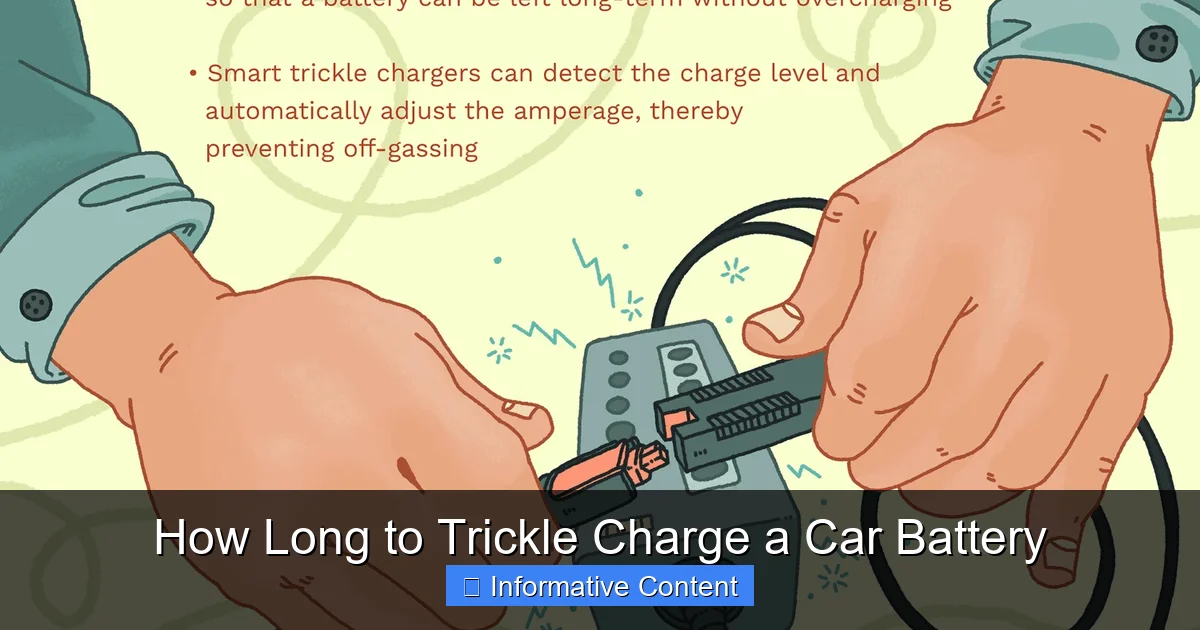
Understanding how long to trickle charge a car battery is crucial for its longevity and performance. While a smart trickle charger can often be left connected indefinitely for maintenance, the duration for a deeply discharged battery depends on its size and condition, typically ranging from 12 hours to several days until fully charged. Always prioritize safety and use the right charger for the job to prevent damage and ensure optimal battery health.
How Long to Trickle Charge a Car Battery
Imagine stepping into your car, turning the key, and… nothing. That familiar click of a dead battery is a frustrating sound no one wants to hear. If you’ve ever found yourself in this situation, or if you simply want to prevent it, you’ve probably heard about trickle charging. It’s a fantastic way to keep your car battery healthy, especially if your vehicle sits idle for extended periods. But then the big question pops up: “How long to trickle charge a car battery?”
It’s not as simple as a one-size-fits-all answer. The ideal duration for trickle charging depends on several factors, from the type of battery you have to how deeply it’s discharged, and even the kind of charger you’re using. Understanding these nuances is key to effectively maintaining your battery without causing harm. In this comprehensive guide, we’ll demystify the process, helping you confidently answer how long to trickle charge a car battery for your specific situation, ensuring your vehicle is always ready to go when you are.
We’ll cover everything from the basics of what trickle charging is and why it’s beneficial, to the different types of chargers available, and the crucial safety precautions you need to take. By the end of this article, you’ll have all the knowledge you need to keep your car battery in tip-top shape, extending its life and saving you from unexpected breakdowns. Let’s dive in and learn how to properly trickle charge a car battery.
Key Takeaways
- Smart Trickle Chargers: Modern smart chargers (often called battery maintainers) can be left connected indefinitely for long-term maintenance, as they automatically monitor and adjust charging cycles to prevent overcharging.
- Deeply Discharged Batteries: For a significantly drained car battery, the trickle charge duration can range from 24 hours to several days, depending on the battery’s capacity, its state of discharge, and the charger’s amperage.
- Battery Type and Condition Matter: Different battery types (standard lead-acid, AGM, Gel) and their current health influence charging speed. Older or damaged batteries may take longer or not hold a charge as effectively.
- Manual vs. Smart Chargers: Basic, non-smart trickle chargers require careful monitoring to prevent overcharging, which can damage the battery. They should generally not be left connected for extended periods once the battery is full.
- Safety First: Always ensure proper ventilation, connect terminals correctly (positive to positive, negative to negative or chassis ground), and follow your charger’s instructions to avoid hazards.
- Regular Maintenance Extends Life: Consistent trickle charging, especially for vehicles stored for long periods, helps prevent sulfation and extends the overall lifespan of your car battery.
- Check Battery Voltage: The most accurate way to determine if your battery is fully charged is by checking its voltage with a multimeter. A fully charged 12V battery should read around 12.6-12.8 volts (or higher, up to 13.2V, immediately after charging).
Quick Answers to Common Questions
Can I leave a trickle charger on indefinitely?
Yes, if it’s a modern “smart” trickle charger or battery maintainer. These devices are designed to monitor the battery’s state and automatically switch to a float or maintenance mode, preventing overcharging and keeping the battery at its optimal voltage.
What’s the difference between a trickle charger and a battery tender?
While often used interchangeably, “battery tender” is a brand name (Battery Tender®) that popularized smart charging technology. Generally, a “trickle charger” can refer to any low-amperage charger, including older manual ones, whereas a “battery tender” or “battery maintainer” specifically implies a smart charger with automatic monitoring and shut-off features.
How do I know when my car battery is fully charged?
The most accurate way is to check the battery voltage with a multimeter. A fully charged 12V lead-acid battery (after disconnecting the charger and letting it rest for a few minutes) should read between 12.6 and 12.8 volts. Smart chargers will also typically have indicator lights that show “fully charged” or “float mode” status.
Is it safe to trickle charge a battery while it’s still in the car?
Yes, it is generally safe to trickle charge a battery while it’s still in the car, provided you follow proper safety precautions. Ensure good ventilation, connect the positive clamp to the positive terminal, and the negative clamp to a good chassis ground point away from the battery.
Can a trickle charger revive a completely dead battery?
A trickle charger can sometimes revive a completely dead battery, but it might take a very long time (several days) and there’s no guarantee if the battery is severely damaged or sulfated. For very flat batteries, a smart charger with a desulfation mode might have better success, but often a faster, higher-amperage charger is needed first to get some initial charge into it before switching to a trickle charge.
📑 Table of Contents
What is Trickle Charging and Why Do It?
Before we get into how long to trickle charge a car battery, let’s clarify what it actually means. Trickle charging refers to providing a very slow, low-amperage charge to a battery over an extended period. Think of it like giving your battery a gentle, steady sip of energy rather than a big gulp. A typical trickle charger will deliver anywhere from 0.5 to 2 amps. This contrasts with a standard battery charger, which delivers higher amperage (e.g., 10-20 amps) for faster, bulk charging of a deeply discharged battery.
The Benefits of a Slow Charge
Why would you choose a slow charge over a fast one? The primary purpose of trickle charging is maintenance. All car batteries naturally lose charge over time, a process called self-discharge. This happens even when your car is completely off, thanks to tiny parasitic draws from systems like the clock, alarm, and computer memory. If your car sits for days, weeks, or even months, this constant drain can slowly kill your battery.
A trickle charger, especially a “smart” one (often called a battery maintainer or tender), counteracts this self-discharge. By keeping the battery topped off at its optimal voltage, it prevents the battery from ever dropping to a dangerously low level. This is critical for several reasons:
* **Prevents Sulfation:** When a lead-acid battery discharges, lead sulfate crystals form on its plates. If left discharged, these crystals harden and accumulate, a process called sulfation, which significantly reduces the battery’s capacity and ability to hold a charge. Trickle charging prevents this by keeping the battery fully charged.
* **Extends Battery Lifespan:** By preventing sulfation and keeping the battery in its ideal state, trickle charging can dramatically extend the overall life of your car battery, saving you money on replacements.
* **Ensures Reliability:** You want your car to start every time you turn the key. A properly maintained battery ensures consistent starting power, giving you peace of mind.
* **Ideal for Stored Vehicles:** If you have a classic car, an RV, a motorcycle, or even a daily driver that sits unused for long stretches, a trickle charger is an indispensable tool.
Factors Influencing Trickle Charge Time
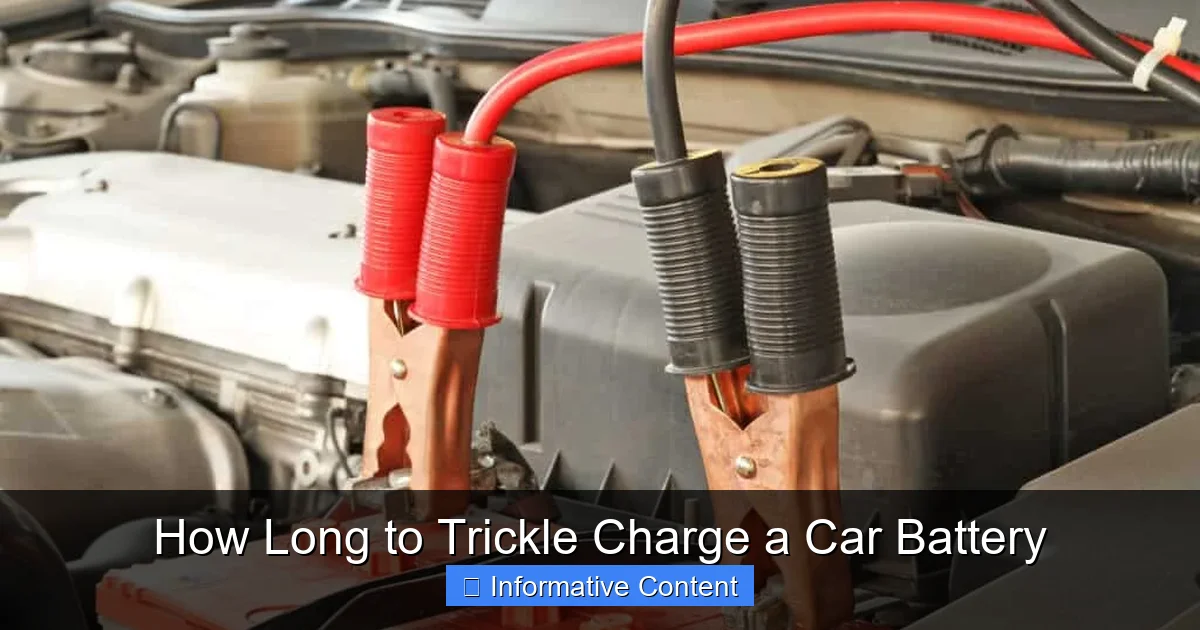
Visual guide about How Long to Trickle Charge a Car Battery
Image source: vehicleanswers.com
The question of how long to trickle charge a car battery doesn’t have a single answer because several factors come into play. Understanding these will help you determine the best approach for your specific situation.
Battery’s State of Charge
This is perhaps the most significant factor.
- Slightly Discharged Battery: If your battery is only slightly low (e.g., your car sat for a week or two), it will take less time to top it off. A smart trickle charger might bring it to full charge in 12-24 hours and then switch to maintenance mode.
- Deeply Discharged Battery: If your battery is significantly drained (e.g., your headlights were left on overnight), it will require a much longer trickle charge. This could take 24-48 hours, or even several days for very large or very flat batteries. It’s important to note that a deeply discharged battery might also have some sulfation, making it harder to fully recover.
Battery Size (Amp-Hour Rating)
Batteries are rated in amp-hours (Ah), which indicates how much current they can deliver over a period. A larger Ah rating means the battery has more capacity and will naturally take longer to fully charge, even with a trickle charge. A typical car battery might range from 40 Ah to over 100 Ah. For instance, a small 40 Ah battery will charge faster than a large 80 Ah battery using the same 1-amp trickle charger.
Battery Type
While the general principle of trickle charging applies to most 12-volt car batteries, there can be slight differences:
- Standard Lead-Acid (Flooded) Batteries: These are the most common and generally respond well to trickle charging.
- AGM (Absorbed Glass Mat) Batteries: These are maintenance-free and handle deep cycles better. They also typically charge faster than flooded batteries and require a slightly different charging voltage, which most smart chargers automatically adjust for.
- Gel Cell Batteries: These are less common in cars but are sensitive to overcharging. A smart charger specifically designed for gel batteries is essential to prevent damage.
Always check your battery’s type and your charger’s compatibility.
Charger Amperage
Trickle chargers typically deliver a low current, often between 0.5 amps and 2 amps. The lower the amperage, the longer it will take to charge the battery. For example, a 0.5-amp charger will take twice as long as a 1-amp charger to deliver the same amount of power. For maintenance, a very low amperage is perfectly fine, as it’s designed for a slow, steady top-off rather than rapid charging.
Charger Type (Smart vs. Manual)
This is perhaps the most critical factor when considering how long to trickle charge a car battery.
- Smart Chargers (Battery Maintainers/Tenders): These are highly recommended. They use microprocessors to monitor the battery’s voltage and condition, automatically adjusting the charge current as needed. Once the battery is full, they switch to a “float” or “maintenance” mode, providing just enough current to counteract self-discharge without overcharging. You can often leave these connected indefinitely.
- Basic/Manual Trickle Chargers: These older models deliver a constant, low current without much monitoring. They do not automatically shut off or switch to float mode. Leaving these connected for too long can overcharge and damage your battery by boiling off the electrolyte or causing plate corrosion. These require careful monitoring and should be disconnected once the battery is fully charged.
General Guidelines for Trickle Charge Duration
Now for the practical part: how long to trickle charge a car battery in various scenarios. Remember, these are general guidelines, and it’s always best to consult your charger’s manual and monitor your battery if possible.
For Maintenance and Storage (Smart Charger)
If you’re using a smart trickle charger or battery maintainer, the answer to how long to trickle charge a car battery is wonderfully simple:
- Indefinitely. Smart chargers are designed to be left connected for weeks, months, or even years. They constantly monitor the battery’s voltage and health, switching between charging, float, and rest modes as needed. This “set it and forget it” functionality makes them ideal for vehicles stored over winter, motorcycles, boats, or RVs.
For a Slightly Discharged Battery (Smart Charger)
If your car battery isn’t completely dead but feels sluggish after your car sat for a couple of weeks, a smart trickle charger can bring it back to full health.
- 12-24 Hours. For a moderately sized car battery (e.g., 60 Ah) with a smart 1-amp trickle charger, you can expect it to reach full charge within 12 to 24 hours. The charger will then automatically switch to maintenance mode.
For a Deeply Discharged Battery (Smart Charger)
This is where the duration extends significantly. If your battery is so flat that your car won’t start, a trickle charge can still be effective, but it will take time.
- 24-48+ Hours, Possibly Several Days. For a deeply discharged battery, especially a larger one, you might need 24 hours to 3 days or more. A very large, very flat battery (e.g., a large RV or truck battery) could even take up to a week with a low-amperage trickle charger.
- Monitor Voltage: The best way to know when it’s done is to check the battery voltage with a multimeter. A fully charged 12V lead-acid battery (including AGM and Gel) should read between 12.6 and 12.8 volts (or slightly higher, up to 13.2V, immediately after the charger is disconnected and surface charge dissipates). The charger’s indicator lights will also tell you when it has reached full charge and switched to float mode.
Using a Basic/Manual Trickle Charger
If you have an older, non-smart trickle charger, you must be much more vigilant about how long to trickle charge a car battery.
- Limited Time, Monitor Closely. These chargers provide a constant current and will overcharge your battery if left connected too long. This can cause gassing, electrolyte loss, and permanent damage.
- Rule of Thumb (Very General): For a moderately discharged battery, perhaps 12-24 hours. For a deeply discharged battery, 24-48 hours. However, you MUST regularly check the battery voltage (every few hours) and disconnect the charger once it reaches 12.6-12.8 volts. Never leave a manual charger unattended for prolonged periods, especially overnight. This is why smart chargers are strongly recommended.
Understanding Your Trickle Charger
Knowing your equipment is vital when considering how long to trickle charge a car battery. Not all chargers are created equal.
Types of Chargers
- Basic Trickle Charger: As discussed, these deliver a constant, low current. They are less expensive but demand more attention from the user. They typically have a simple on/off switch and maybe a basic indicator light.
- Smart Charger (Battery Maintainer/Tender): These are sophisticated devices with microprocessors. They typically go through several charging stages:
- Desulfation (optional): Breaks down lead sulfate crystals.
- Bulk Charge: Delivers maximum current until the battery reaches about 80% charge.
- Absorption Charge: Current decreases as the battery approaches full charge, topping it off.
- Float/Maintenance Charge: Maintains voltage at a safe level (e.g., 13.2-13.8V) by providing minimal current to offset self-discharge.
These chargers often have indicator lights to show the current charging stage or battery status.
Features to Look For
When buying a trickle charger, look for:
- Automatic Shut-off/Float Mode: Essential for safe, long-term connection.
- Multi-stage Charging: Optimizes the charging process for battery health.
- Reverse Polarity Protection: Prevents damage if you connect the clamps incorrectly.
- Spark Proof: Reduces the risk of igniting hydrogen gas.
- Battery Type Selection: Some advanced chargers allow you to select the battery type (e.g., standard, AGM, Gel) for optimized charging.
A good smart charger takes the guesswork out of how long to trickle charge a car battery, allowing you to focus on other things.
Safety Precautions and Best Practices
No matter how long you plan to trickle charge a car battery, safety should always be your top priority. Batteries contain corrosive acid and produce explosive hydrogen gas.
Ventilation is Key
Always charge batteries in a well-ventilated area. Hydrogen gas, which is highly flammable, can accumulate if ventilation is poor. Avoid charging in enclosed spaces like a small garage with the door shut.
Proper Connection Order
This is crucial to prevent sparks:
- Connect Positive First: Connect the red (+) clamp of the charger to the positive (+) terminal of the battery.
- Connect Negative Last: Connect the black (-) clamp to a grounded metal part of the car’s chassis, away from the battery and fuel lines. This creates a safer ground path, preventing potential sparks directly near the battery where hydrogen gas might be present. If charging a battery removed from the car, connect the black clamp to the negative (-) terminal of the battery last.
- Disconnect in Reverse: When finished, disconnect the negative (black) clamp first, then the positive (red) clamp.
Monitor the Battery
- Check for Heat: If the battery gets excessively hot during charging, disconnect the charger immediately. This could indicate an internal problem with the battery.
- Look for Swelling or Leaks: Any signs of physical damage, swelling, or electrolyte leaks mean the battery is compromised and should not be charged.
- With Manual Chargers: As mentioned, regularly check the voltage and disconnect the charger once full to prevent overcharging.
Avoid Overcharging
Overcharging is detrimental to a battery. It can cause:
- Electrolyte Boil-off: For flooded batteries, this means the water in the electrolyte evaporates, exposing the plates and causing damage.
- Internal Damage: Overcharging generates excessive heat, which can warp plates and shorten battery life.
- Safety Hazard: Excessive gassing increases the risk of explosion.
This is precisely why investing in a smart charger that prevents overcharging is highly recommended when you consider how long to trickle charge a car battery.
Manufacturer Guidelines
Always refer to your car’s owner’s manual and the specific instructions provided with your battery and trickle charger. They often contain vital information tailored to your equipment.
Conclusion
Understanding how long to trickle charge a car battery is an essential skill for any vehicle owner, offering a simple yet powerful way to extend your battery’s life and ensure reliable starts. While the exact duration varies based on factors like battery size, discharge level, and charger type, the golden rule remains: use a smart trickle charger for optimal safety and convenience.
With a smart charger, you can often leave it connected indefinitely for maintenance, enjoying peace of mind that your battery is always perfectly topped off. For deeply discharged batteries, be prepared for a longer charging cycle, potentially spanning a few days. Remember to prioritize safety by ensuring good ventilation and proper connection procedures. By following these guidelines, you’ll master the art of trickle charging, keeping your car battery healthy, dependable, and ready for whatever journey lies ahead. Invest in your battery’s future – it’s an investment in your peace of mind on the road.
Frequently Asked Questions
What amperage is considered a trickle charge?
A trickle charge typically refers to a very low amperage, generally ranging from 0.5 amps to 2 amps. This slow, steady current is ideal for maintaining a battery’s charge over extended periods or gently recharging a slightly discharged battery.
Does trickle charging damage a battery?
No, when done correctly with a smart charger, trickle charging does not damage a battery; in fact, it helps prolong its life. However, using a basic, non-smart trickle charger without monitoring can lead to overcharging and damage the battery.
How often should I trickle charge my battery if my car sits for a long time?
If your car sits for an extended period (more than a week or two), it’s best to keep a smart trickle charger connected continuously. This ensures the battery remains at optimal voltage, preventing self-discharge and sulfation, thus maximizing battery lifespan.
Can I use a regular car battery charger as a trickle charger?
Some multi-mode battery chargers have a low-amperage “maintenance” or “trickle” setting, which effectively allows them to function as a trickle charger. However, a basic, high-amperage charger without these specific modes should not be used as it can overcharge and damage the battery if left connected for too long.
What does “float mode” mean on a battery charger?
Float mode is a stage in smart battery charging where the charger maintains a constant, low voltage (typically around 13.2-13.8 volts for a 12V battery) with minimal current. This gently offsets the battery’s natural self-discharge, keeping it fully charged without overcharging.
What are the signs of an overcharged battery?
Signs of an overcharged battery can include a distinct rotten egg smell (due to hydrogen sulfide gas), a bulging or distorted battery case, excessive heat, or leaking electrolyte. If you notice any of these, disconnect the charger immediately and safely handle the battery.