
How long you need to charge a car battery depends on several factors, including the charger’s amperage, the battery’s size, and its current state of discharge. Generally, a fully discharged car battery can take anywhere from 4 to 24 hours to fully recharge using a standard charger. Understanding these variables ensures proper charging, prolonging battery life and preventing damage.
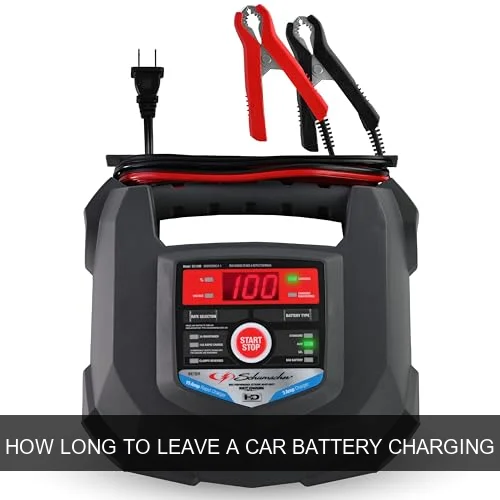
Image source: Media-amazon
📋 Table of Contents
- 🔹 Introduction: Unraveling Car Battery Charging Times
- 🔹 How Long to Leave a Car Battery Charging? A Direct Answer
- 🔹 Why Understanding Charging Time is Important
- 🔹 Key Factors Influencing Car Battery Charging Time
- 🔹 The Charging Process Explained: How it Works
- 🔹 Different Types of Car Battery Chargers and Their Impact
- 🔹 Practical Charging Scenarios and Estimated Times
- 🔹 Common Mistakes to Avoid When Charging a Car Battery
- 🔹 Tips for Safe and Effective Car Battery Charging
- 🔹 Frequently Asked Questions (FAQ)
- 🔹 Conclusion: Charge Smart, Drive Confident
Introduction: Unraveling Car Battery Charging Times
Ever found yourself with a dead car battery and wondered, “How long do I actually need to leave this thing charging?” It’s a common question, and getting the answer right is more important than you might think. Charging a car battery correctly can mean the difference between getting back on the road smoothly and potentially damaging your battery or even your vehicle’s electrical system.
In this article, we’re going to dive deep into understanding how long to leave a car battery charging. We’ll explore the various factors that influence charging times, demystify the process, and offer practical advice to help you keep your battery in top shape. You’ll learn about different types of chargers, what to look out for, and common pitfalls to avoid. Our goal is to provide you with clear, helpful information so you can charge your car battery with confidence.
How Long to Leave a Car Battery Charging? A Direct Answer
The duration for charging a car battery varies significantly based on its discharge level, size (amp-hour rating), and the charger’s amperage. A completely dead 12-volt car battery typically requires 4-8 hours with a 10-amp charger, or 12-24 hours with a slower 2-amp “trickle” charger, to reach a full charge. Modern smart chargers often adjust automatically and indicate when charging is complete.
Why Understanding Charging Time is Important
Knowing how long to leave a car battery charging isn’t just about getting your car started; it’s about maintaining the health and longevity of your battery. Here’s why this knowledge is crucial:
- Prevents Overcharging: Leaving a battery connected to a standard charger for too long can lead to overcharging. This can cause the battery’s internal components to overheat, evaporate electrolyte (the liquid inside the battery), and permanently reduce its capacity and lifespan.
- Ensures a Full Charge: An undercharged battery won’t provide reliable power and can quickly become problematic again. Proper charging ensures the battery reaches its optimal voltage and charge capacity, ready to perform when needed.
- Safety: Overcharging can be dangerous, potentially causing the battery to swell, leak, or even explode in extreme cases due to excessive gas buildup. Understanding correct charging procedures helps prevent these hazards.
- Maximizes Battery Lifespan: Batteries have a finite number of charge cycles. Properly charging them, without over or undercharging, helps maximize those cycles and extends the overall life of the battery, saving you money in the long run.
Key Factors Influencing Car Battery Charging Time
Several variables come into play when determining how long you need to charge a car battery. Understanding these helps you estimate the time more accurately:
Battery’s State of Discharge
This is perhaps the biggest factor. A battery that’s only slightly drained from leaving your lights on for a short period will charge much faster than one that’s completely dead and won’t even crank the engine.
- Slightly Discharged: A few hours might be enough.
- Moderately Discharged: Perhaps 4-8 hours.
- Deeply Discharged (Dead): Could take 12-24 hours or even more with a slow charger.
Charger’s Amperage (Output Current)
Chargers come in various current ratings, measured in amps (A). A higher amperage means a faster charge, but also greater risk if not monitored or if the battery isn’t designed for fast charging.
- Trickle Chargers (1-2 Amps): These are very slow, designed for long-term maintenance or very gentle charging. A dead battery could take 24-48 hours.
- Standard Chargers (4-10 Amps): These are common for home use. A dead battery usually takes 8-24 hours.
- Fast Chargers (15-30 Amps): These can charge a battery more quickly, sometimes in 3-6 hours, but should be used with caution as they can generate heat.
- Jump Starters (High Amperage, but for starting only): These provide a brief, very high burst of current to start the car, not to fully charge the battery.
Battery’s Size (Amp-Hour Rating – Ah)
Car batteries are rated in Amp-hours (Ah), which indicates how much current they can deliver over a certain time. A larger Ah battery takes longer to charge than a smaller one, assuming the same level of discharge.
- A typical car battery might be 40-100 Ah.
- The formula for estimating charge time is roughly:
(Battery Ah / Charger Amps) * 1.25(the 1.25 accounts for charging inefficiencies).
Battery’s Age and Condition
An older battery, or one that has been deeply discharged multiple times, might not hold a charge as well or charge as efficiently as a newer, healthier battery. Sulfation, a common issue in older or neglected batteries, can hinder the charging process.
Battery Type
Most car batteries are lead-acid (flooded, AGM, or Gel). While charging principles are similar, some advanced chargers have settings for different battery types to optimize the charge and prevent damage.
The Charging Process Explained: How it Works
When you connect a car battery to a charger, you’re essentially reversing the chemical reaction that occurs during discharge. Here’s a simplified breakdown:
- Connecting the Charger: You connect the positive (+) terminal of the charger to the positive (+) terminal of the battery, and the negative (-) to the negative (-).
- Current Flow: The charger sends a direct current (DC) into the battery.
- Chemical Reaction: Inside the battery, the electrical energy is converted back into chemical energy. Lead sulfate crystals on the plates are converted back into lead dioxide (on the positive plate), lead (on the negative plate), and sulfuric acid in the electrolyte.
- Voltage Increase: As the battery accepts the charge, its voltage gradually rises. A fully charged 12-volt lead-acid battery should read around 12.6 to 12.8 volts when resting.
- Smart Charger Behavior: Modern “smart” or “automatic” chargers don’t just dump current. They go through a multi-stage charging process:
- Bulk Stage: The charger delivers its maximum current to bring the battery up to about 80% charge relatively quickly.
- Absorption Stage: The current decreases, and the voltage holds steady to bring the battery to 100% charge slowly and safely.
- Float Stage: Once fully charged, the charger reduces the current to a very low level, just enough to maintain the charge without overcharging. This is why you can leave smart chargers connected for extended periods.
Different Types of Car Battery Chargers and Their Impact
The type of charger you use plays a significant role in how long you should leave a car battery charging and the safety of the process.
- Manual Chargers: These deliver a constant current regardless of the battery’s state. You must monitor these closely and disconnect them once the battery is charged to prevent overcharging. Not recommended for beginners or long-term connection.
- Automatic/Smart Chargers (Maintainers): These are the most common and recommended type. They sense the battery’s voltage and adjust the current accordingly, typically moving through bulk, absorption, and float stages. They automatically shut off or switch to a maintenance mode once the battery is full, making them safe to leave connected for extended periods, even weeks or months.
- Trickle Chargers: A specific type of low-amperage automatic charger (usually 1-2 amps). Ideal for maintaining a battery over long periods, like during winter storage, but very slow for recharging a dead battery.
- Battery Desulfators: Some chargers include a desulfation mode, which attempts to break down lead sulfate crystals that build up on plates, potentially improving the performance of older, sulfated batteries. This process itself doesn’t directly impact charging time but aims to improve the battery’s ability to accept a charge.
Practical Charging Scenarios and Estimated Times
Let’s look at some common situations to get a better idea of how long to leave a car battery charging:
| Scenario | Charger Type/Amperage | Estimated Charging Time | Notes |
|---|---|---|---|
| Slightly discharged (e.g., dome light left on for an hour) | 5-10 amp Smart Charger | 2-4 hours | Battery voltage might be around 12.2V-12.4V. |
| Moderately discharged (e.g., lights left on overnight, slow crank) | 5-10 amp Smart Charger | 4-8 hours | Battery voltage might be around 12.0V-12.2V. |
| Deeply discharged / Dead battery (no crank, voltage below 11.8V) | 10 amp Smart Charger | 8-12 hours | May require a “charge mode” on some chargers for very low voltage. |
| Deeply discharged / Dead battery | 2 amp Trickle/Maintenance Charger | 24-48 hours | Very slow but gentle. Ideal if you’re not in a hurry or for maintenance. |
| Maintaining a stored vehicle battery | 1-2 amp Battery Maintainer | Indefinitely | These are designed to stay connected, keeping the battery topped up without overcharging. |
Note: These are estimates. Actual times can vary based on the specific battery and charger. Always refer to your charger’s instructions.
Common Mistakes to Avoid When Charging a Car Battery
Even with good intentions, it’s easy to make mistakes. Here are some common ones to watch out for:
- Overcharging with a Manual Charger: This is a big one. Leaving a manual charger connected too long can damage the battery.
- Undercharging: Disconnecting the charger too early means the battery isn’t fully revitalized, leading to poor performance and potentially shortening its lifespan.
- Not Checking Water Levels (Flooded Batteries): Before charging a conventional flooded lead-acid battery, always check the electrolyte levels. If low, top up with distilled water. Charging a battery with low electrolyte can cause damage.
- Charging in an Unventilated Area: Batteries can produce hydrogen gas during charging, which is highly flammable. Always charge in a well-ventilated space.
- Incorrect Connections: Reversing the positive and negative terminals can damage both the battery and the charger, and potentially your car’s electronics. Always double-check.
- Using the Wrong Charger: Trying to “fast charge” a small battery with a high-amp charger, or attempting to revive a totally dead battery with only a trickle charger when you’re in a hurry.
- Ignoring Battery Temperature: If the battery feels hot to the touch during charging, stop immediately. Heat is a sign of a problem, often overcharging or an internal fault.
Tips for Safe and Effective Car Battery Charging
To ensure a safe and effective charging experience, follow these practical tips:
- Read the Manuals: Always consult both your car’s owner’s manual and the battery charger’s instruction manual. They contain specific safety precautions and operating procedures.
- Work in a Ventilated Area: Ensure good airflow to disperse any hydrogen gas that might be produced.
- Wear Safety Gear: Gloves and eye protection are a must to protect against battery acid.
- Inspect the Battery: Before charging, check for any visible damage, cracks, or leaks. Ensure terminals are clean and free of corrosion.
- Check Electrolyte Levels (Flooded Batteries Only): If your battery has removable caps, check the fluid levels. If they’re low, add distilled water until the plates are covered. Do NOT use tap water.
- Connect Correctly: Connect the positive (+) charger clamp to the positive (+) battery terminal, and the negative (-) charger clamp to the negative (-) battery terminal. For safety, some advise connecting the negative clamp to an unpainted metal part of the car chassis away from the battery, especially if charging the battery in the vehicle.
- Plug in Charger Last: Once the clamps are securely attached, then plug the charger into the power outlet.
- Monitor the Process: If using a manual charger, keep an eye on the voltage and disconnect when fully charged. Smart chargers will handle this automatically.
- Disconnect Safely: Unplug the charger from the wall first, then remove the negative (-) clamp, followed by the positive (+) clamp.
- Don’t Rush Deeply Discharged Batteries: If a battery is very low, resist the urge to use the highest amperage setting immediately. A slower charge is often healthier for deeply discharged batteries.
Frequently Asked Questions (FAQ)
What is the ideal voltage for a fully charged car battery?
A fully charged 12-volt car battery should ideally read between 12.6 to 12.8 volts when resting (not under load and having rested for a few hours after charging/driving).
Can I leave a battery charger on overnight?
Yes, if you are using a modern “smart” or “automatic” battery charger. These chargers are designed to detect when the battery is full and will switch to a maintenance or “float” mode to prevent overcharging. You should never leave a manual charger on overnight.
How can I tell if my car battery is fully charged?
Most smart chargers have an indicator light (often green) that signals when charging is complete. Alternatively, you can check the battery’s resting voltage with a multimeter. A reading of 12.6 volts or higher, after the battery has rested for a few hours, generally indicates a full charge.
What happens if I overcharge my car battery?
Overcharging can cause the electrolyte to boil off, damaging the battery’s internal plates due to excessive heat. This leads to a permanent reduction in battery capacity, sulfation, and significantly shortens the battery’s lifespan. In extreme cases, it can cause swelling, leaking, or even rupture due to hydrogen gas buildup.
Can I charge my car battery while it’s still in the car?
Yes, you can charge a car battery while it’s still installed in the vehicle. Just make sure your charger is set to the correct voltage (usually 12V), ensure good ventilation, and be careful with connections to avoid sparks near the battery, especially if it’s producing gas.
Conclusion: Charge Smart, Drive Confident
Understanding how long to leave a car battery charging is a fundamental part of responsible vehicle ownership. It’s not just about getting your car started in a pinch; it’s about safeguarding your battery’s health, extending its lifespan, and ensuring overall safety. We’ve explored that the “right” amount of time isn’t a single number, but rather a dynamic estimate based on your battery’s condition, its size, and the type of charger you’re using.
By opting for a smart charger, understanding the factors at play, and following basic safety guidelines, you can approach battery charging with confidence. Remember, a little patience and correct procedure can save you a lot of hassle and expense down the road. Keep these tips in mind, and you’ll be well-equipped to keep your car battery charged and ready for whatever journey lies ahead.