
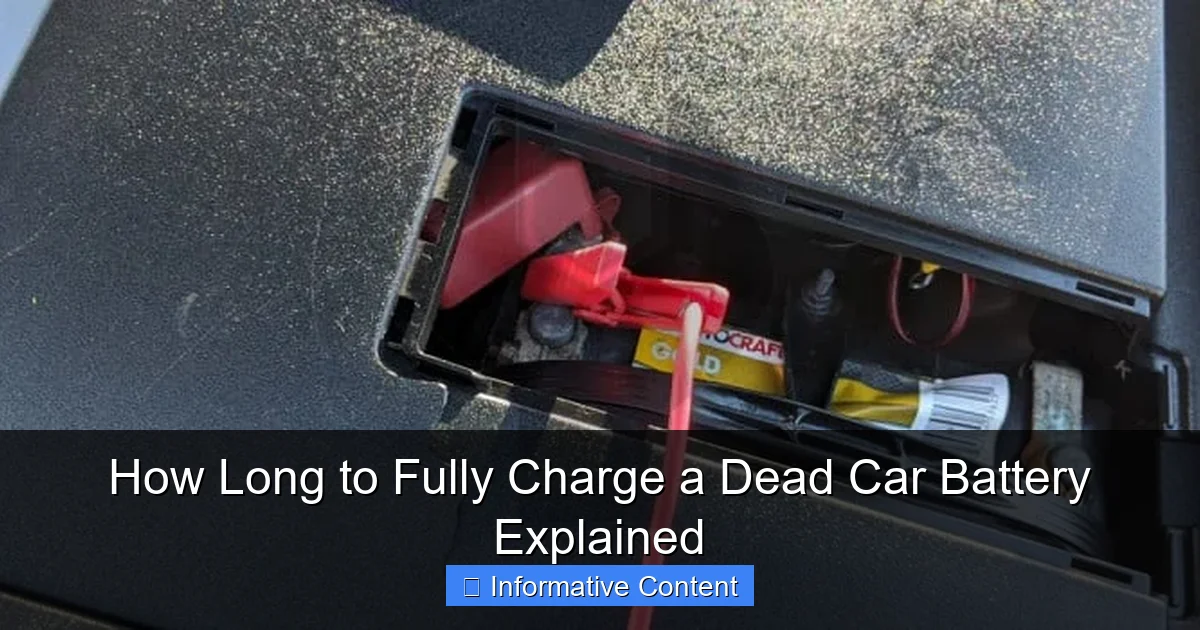
Fully charging a dead car battery is rarely a quick fix, typically taking anywhere from 4 to 24 hours depending on several key factors. The battery’s capacity (Ah), the charger’s amperage (A), and its discharge level are crucial determinants; a powerful 10-amp charger might restore a moderately depleted battery in 6-10 hours, whereas a low-amp “trickle” charger could take significantly longer. Always use a smart charger to prevent overcharging and ensure optimal battery health.
You know that sinking feeling, right? You hop into your car, turn the key, and instead of the reassuring rumble of the engine, you’re met with a chilling silence or perhaps just a faint, sad click. Yep, your car battery is dead. It’s a frustrating, inconvenient, and all-too-common scenario that leaves many of us asking the immediate, pressing question: “How long to fully charge a dead car battery?”
If you’ve ever found yourself stranded, perhaps late for work or an important appointment, you’ve probably wished for a magic button that could instantly bring your battery back to life. While we don’t have that magic button (yet!), understanding the charging process and how long it truly takes can save you a lot of stress and even prevent future battery woes. It’s not as simple as flipping a switch, and there are several factors that play a huge role in determining how long to fully charge a dead car battery.
Think of this post as a chat with a friend who’s been there, done that, and learned a few things along the way. We’ll explore the various elements that influence charging time, break down the different types of chargers, and give you practical tips to get your vehicle back on the road safely. So, let’s dive in and demystify the question of how long to fully charge a dead car battery.
Key Takeaways
- Time Varies Wildly: A common full charge takes 4-24 hours.
- Charger Amperage Matters: Faster charging requires a higher-amp charger.
- Assess Battery Depth: Deeply dead batteries need longer; some may not recover fully.
- Monitor Charging Closely: Prevent overcharging using a smart charger or voltmeter.
- Prioritize Slow Charging: A slower, trickle charge is best for battery health.
- Avoid Alternator Charging: Your alternator is not designed to recharge a dead battery.
Quick Answers to Common Questions
How long does it usually take to fully charge a dead car battery?
Generally, using a standard car battery charger, it can take anywhere from 4 to 24 hours to fully charge a dead car battery, depending on its size and how deeply discharged it is. For a completely flat battery, expect it to be on the longer end of that spectrum.
Does the type of charger affect how long it takes?
Absolutely! A slower, trickle charger might take 24-48 hours or even longer to fully charge a dead car battery, while a more powerful smart charger can often get the job done in 4-8 hours. The right charger makes a big difference in charge time.
Can I speed up the process if I’m in a hurry?
While some chargers offer a “fast charge” mode, using it too frequently or on a very deeply discharged battery can potentially shorten your battery’s lifespan. For optimal battery health and to know exactly how long to fully charge a dead car battery, a slower, steady charge is usually best.
What factors determine how long it will take to fully charge my car battery?
Several factors influence the charging time, including the battery’s size (Ah rating), its current state of discharge, the charger’s amperage output, and even the ambient temperature. A larger, emptier battery with a smaller charger will take significantly longer.
Is it possible to overcharge a car battery, and how does that relate to charging time?
Modern smart chargers have overcharge protection, but older or simpler chargers can damage a battery if left connected for too long. This is why it’s crucial to understand how long to fully charge a dead car battery and monitor the process, or use an automatic charger that stops when full.
📑 Table of Contents
- The Many Factors at Play: Why There’s No Simple Answer
- Understanding Your Charger: Types and Their Impact
- The Charging Process: Stages of Rejuvenation
- Estimating Charging Time: Formulas and Practical Scenarios
- Safety First: Essential Tips for Charging Your Battery
- When to Know Your Battery is Fully Charged (and What to Do Next)
- Conclusion: Patience and Knowledge are Key
The Many Factors at Play: Why There’s No Simple Answer
When you ask how long to fully charge a dead car battery, it’s like asking “how long is a piece of string?” The answer depends on a multitude of variables. It’s not a one-size-fits-all situation, and understanding these factors is key to setting realistic expectations.
Battery’s State of Health
This is arguably the most critical factor. Is your battery merely discharged from leaving your headlights on, or is it an older battery nearing the end of its life, perhaps suffering from sulfation? A battery that’s only partially discharged and in good health will charge much faster than one that’s completely dead and degraded. A battery that has been deeply discharged multiple times will also take longer and may not ever reach its full capacity again.
Battery Type
Most modern cars use conventional lead-acid batteries, but there are also Absorbent Glass Mat (AGM) and Gel batteries, and increasingly, Lithium-Ion for some high-performance or electric vehicles. Each type has different charging characteristics. AGM batteries, for instance, can typically accept a higher charge current and therefore might charge faster than a traditional flooded lead-acid battery, but they also require a charger designed for their specific needs. Understanding your battery type is important when considering how long to fully charge a dead car battery.
Charger Type and Amperage
This is a big one. Battery chargers come in various “amps.” A higher amperage charger will, generally speaking, charge your battery faster than a lower amperage one. We’ll get into the different types in detail soon, but for now, just know that a 2-amp trickle charger will take significantly longer to charge a dead car battery than a 10-amp or 20-amp smart charger.
Battery Size (Ah Rating)
Batteries are rated in Amp-hours (Ah), which indicates how much current they can deliver for a certain period. A larger battery (e.g., 100Ah for a truck) will take longer to charge than a smaller one (e.g., 40Ah for a small car), even with the same charger. The more capacity it has, the more “juice” it needs to fill up.
Ambient Temperature
Batteries are sensitive to temperature. Charging a battery in very cold conditions can significantly slow down the charging process and can even be detrimental to the battery if done incorrectly. Ideal charging temperatures are usually between 32°F (0°C) and 122°F (50°C). Extreme cold can reduce a battery’s ability to accept a charge, extending how long to fully charge a dead car battery.
Understanding Your Charger: Types and Their Impact
Choosing the right charger is crucial, not just for speed but also for the health and longevity of your battery. Let’s look at the common types and how they affect how long to fully charge a dead car battery.
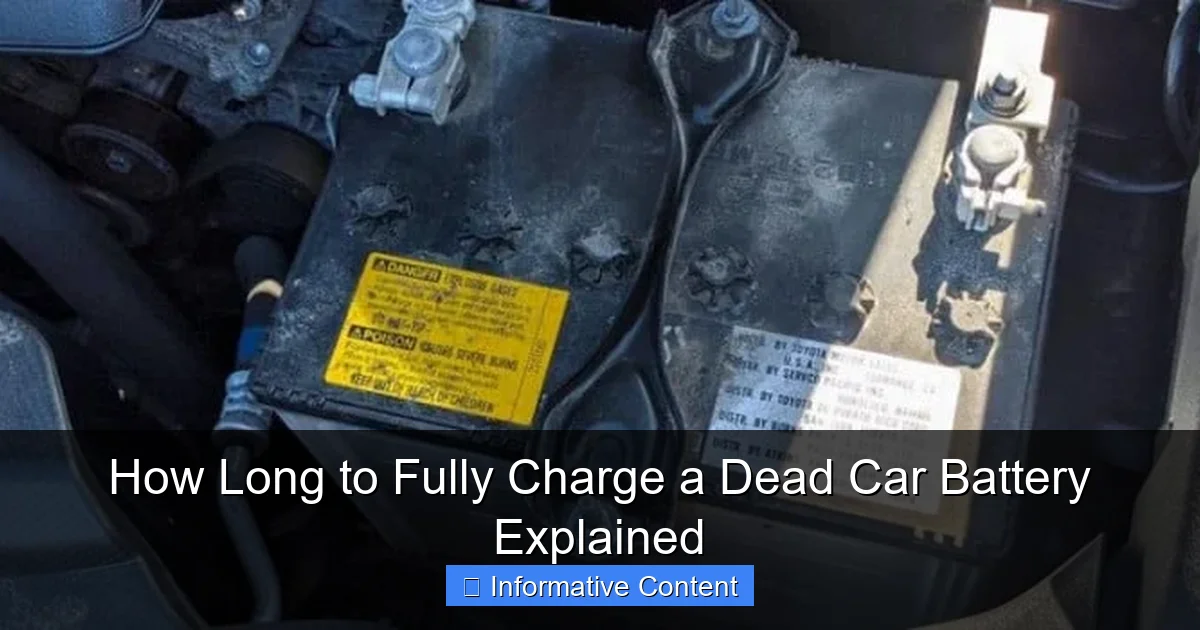
Visual guide about fully charge dead car battery
Image source: youcanic.com
Trickle Chargers (Low Amperage)
These typically range from 1 to 2 amps. They are designed for slow, long-term maintenance charging, ideal for vehicles stored for extended periods, like classic cars, motorcycles, or RVs during winter. While they can charge a dead battery, it will take a very, very long time – often 24-48 hours or even more for a truly dead car battery. They are gentle but incredibly slow for initial charging.
Standard Battery Chargers (Medium Amperage)
These are your go-to chargers for most situations, typically ranging from 4 to 15 amps. They strike a good balance between charging speed and battery safety. A 10-amp charger is a popular choice for home use. With one of these, you can expect a significantly faster charging time compared to a trickle charger, often anywhere from 6 to 12 hours for a moderately discharged battery, and perhaps longer for a completely dead one. This is often the type people think of when they ask how long to fully charge a dead car battery.
Smart/Automatic Chargers
These are my personal favorites and highly recommended. Smart chargers (which often fall into the medium to high amperage range, 4-20+ amps) can detect your battery’s type and condition, then automatically adjust the charging voltage and current through various stages. They prevent overcharging, which is critical for battery life, and often have modes for deeply discharged or sulfated batteries. Many can act as both a quick charger and a trickle charger. They provide the most efficient and safest way to address the question of how long to fully charge a dead car battery.
Jump Starters with Charging Function
Some portable jump starters also come with a charging function, usually at a low to medium amperage. While they are primarily designed to give your car enough juice to start quickly, some can also slowly recharge your battery over several hours. However, their primary purpose isn’t always full battery charging, so don’t rely on them for regular, comprehensive battery maintenance.
The Charging Process: Stages of Rejuvenation
Understanding the stages of charging helps you appreciate why it takes time and why smart chargers are so effective. This isn’t just about dumping electricity into a battery; it’s a careful, multi-step process.
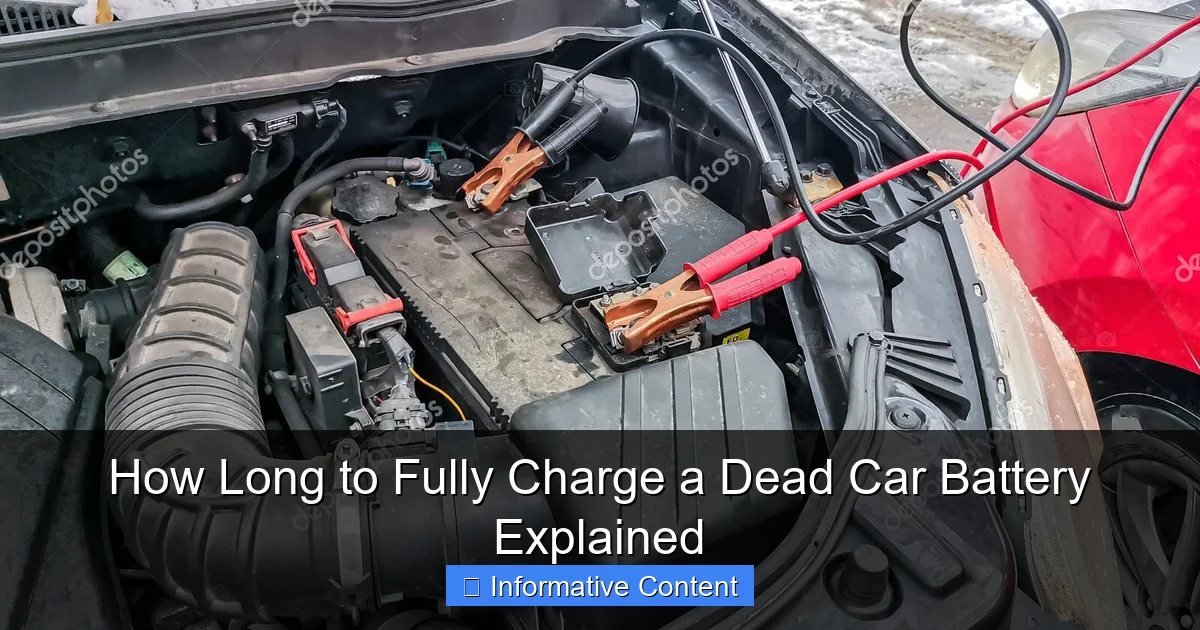
Visual guide about fully charge dead car battery
Image source: st2.depositphotos.com
Bulk Charge (Rapid Filling)
This is the first and fastest stage. The charger delivers its maximum current to the battery until it reaches about 80% of its full charge. During this phase, the battery’s voltage steadily increases. If your battery is completely dead, this stage will consume the majority of the total charging time.
Absorption Charge (Topping Off)
Once the battery reaches about 80% charge, the charger reduces the current while maintaining a constant, higher voltage. This allows the battery to absorb the remaining 20% more slowly and safely, preventing overheating and gassing. This stage ensures the battery is fully charged without overstressing it. This slower “topping off” phase is essential for battery longevity and achieving a true 100% charge, impacting how long to fully charge a dead car battery.
Float Charge (Maintenance)
Once the battery is fully charged, a smart charger will switch to a float charge. This maintains the battery at a slightly lower, constant voltage, just enough to counteract self-discharge without overcharging. It’s like keeping a water bottle topped up with a tiny, continuous drip. This stage is why you can leave smart chargers connected for extended periods without harm.
Estimating Charging Time: Formulas and Practical Scenarios
While an exact time for how long to fully charge a dead car battery is hard to pinpoint without knowing all the variables, we can use a basic formula as a starting point. Keep in mind that this is an estimate and real-world conditions will always vary.
The Basic Calculation
A very simplified formula to estimate charging time is:
Charging Time (Hours) = Battery Capacity (Ah) / Charger Amperage (A)
However, this formula needs a crucial adjustment: you need to account for charging efficiency and the fact that you’re not always charging from 0% to 100% in a linear fashion. Batteries aren’t 100% efficient at accepting a charge; there’s always some energy lost as heat. A common efficiency factor is around 85-90%, meaning you need to put in about 10-15% more energy than the battery’s rated capacity.
Real-World Considerations (Efficiency Loss)
A more realistic formula would be:
Charging Time (Hours) = (Battery Capacity (Ah) / Charger Amperage (A)) * 1.15 (for 85% efficiency)
Let’s also assume that a “dead” car battery still has about 20% residual charge to simplify, meaning you’re charging 80% of its capacity.
Practical Examples for Different Chargers/Batteries
Let’s consider a common 60 Ah (Amp-hour) car battery, which is pretty typical for many sedans.
- With a 2-amp Trickle Charger:
- Charging 80% of 60 Ah = 48 Ah
- (48 Ah / 2 A) * 1.15 = 24 * 1.15 = 27.6 hours.
- Expect: Roughly 24-36 hours, or even longer for a truly depleted battery.
- With a 10-amp Standard Charger:
- Charging 80% of 60 Ah = 48 Ah
- (48 Ah / 10 A) * 1.15 = 4.8 * 1.15 = 5.52 hours.
- Expect: Roughly 5-8 hours.
- With a 20-amp Fast Charger:
- Charging 80% of 60 Ah = 48 Ah
- (48 Ah / 20 A) * 1.15 = 2.4 * 1.15 = 2.76 hours.
- Expect: Roughly 3-4 hours. Keep in mind that very fast charging can sometimes reduce battery life if not managed by a smart charger.
These numbers give you a much better idea of how long to fully charge a dead car battery in different scenarios. Remember, these are estimates for bringing a typical car battery from dead to fully charged. A slightly discharged battery will, of course, charge faster.
Estimated Charging Times for a 60Ah Car Battery (from ~20% charge)
Here’s a quick reference table based on the calculations above, assuming an 85% charging efficiency:
| Charger Amperage | Approximate Charging Time (Hours) | Notes |
|---|---|---|
| 2 Amps (Trickle) | 24 – 36+ hours | Best for maintenance, very slow for a dead battery. |
| 5 Amps (Standard) | 10 – 15 hours | Good for overnight charging, balances speed and battery health. |
| 10 Amps (Standard/Smart) | 5 – 8 hours | Popular choice, good balance of speed and safety. |
| 20 Amps (Fast/Smart) | 3 – 4 hours | Faster, but ensure it’s a smart charger to protect the battery. |
Safety First: Essential Tips for Charging Your Battery
Charging a car battery involves electricity and potentially volatile gases. Safety should always be your top priority. Don’t rush, and always follow your charger’s instructions. When thinking about how long to fully charge a dead car battery, remember that doing it safely is more important than doing it quickly.
Proper Ventilation
As lead-acid batteries charge, they can produce hydrogen gas, which is highly flammable. Always charge your battery in a well-ventilated area – ideally outdoors or in an open garage. Never charge a battery in an enclosed space.
Eye Protection and Gloves
Battery acid is corrosive. Always wear safety glasses and gloves to protect your eyes and skin from accidental splashes or fumes.
Connecting and Disconnecting Safely
- Ensure the Charger is Off: Before connecting or disconnecting, make sure your battery charger is unplugged or switched off.
- Connect the Positive First: Connect the red positive (+) clamp to the positive (+) terminal on the battery.
- Connect the Negative Second (Ground): Connect the black negative (-) clamp to a clean, unpainted metal part of your car’s frame, away from the battery and fuel lines. If charging the battery outside the car, connect the negative clamp to the negative terminal of the battery.
- Plug in the Charger: Once connections are secure, plug in and turn on the charger.
- Disconnect in Reverse: When finished, turn off and unplug the charger first, then disconnect the negative clamp, followed by the positive clamp.
Monitoring the Battery
While charging, especially with older, non-smart chargers, periodically check the battery for signs of overheating (hot to the touch), swelling, or excessive gassing (a strong rotten egg smell). If you notice any of these, immediately stop charging and let the battery cool down. These are signs of a potentially damaged or failing battery, and it’s something to keep in mind when considering how long to fully charge a dead car battery.
When to Know Your Battery is Fully Charged (and What to Do Next)
You’ve patiently waited, followed all the steps, and now you want to know: Is it done? Here’s how to tell and what to do once it is.
Charger Indicators
Most modern smart chargers will have indicator lights or a digital display to show the charging status. They’ll often have a “charging” light, a “fully charged” light, or a percentage display. Trust these indicators, as they are designed to tell you exactly when the multi-stage charging process is complete. This is the simplest way to know how long to fully charge a dead car battery has taken.
Using a Voltmeter
If your charger doesn’t have an indicator, or if you want to double-check, you can use a digital voltmeter. A fully charged 12-volt car battery should read around 12.6 to 12.8 volts (after resting for a few hours post-charge). A reading below 12.4 volts suggests it’s not fully charged or has internal issues. Always remove the charger and let the battery rest for an hour or two before taking a voltage reading for the most accurate result.
What if it Doesn’t Hold a Charge? (Time for a New Battery)
You’ve charged it for the recommended time, your charger says it’s full, and the voltmeter confirms it’s at 12.6V. But then, after a short drive or even just sitting for a day or two, your car is dead again. This is a strong indicator that your battery has reached the end of its life. Internal damage, like severe sulfation or a shorted cell, means it can no longer hold a charge effectively. No amount of charging will fix this, and it’s time to invest in a new battery. Sometimes, the answer to how long to fully charge a dead car battery is: “It can’t be.”
Conclusion: Patience and Knowledge are Key
So, how long to fully charge a dead car battery? As we’ve explored, there’s no single answer, but rather a range of possibilities influenced by your battery’s condition, its size, and the type of charger you’re using. From a leisurely 36 hours with a trickle charger to a quicker 3-4 hours with a powerful smart charger, patience and understanding are your best allies.
The next time you face a dead car battery, you’ll be equipped with the knowledge to make an informed decision. Remember to prioritize safety, choose the right charger for your needs, and follow the steps for a successful charge. Most importantly, don’t forget that consistent battery maintenance and checking your battery’s health periodically can help you avoid that dreaded dead battery scenario altogether. Keep your car’s heart healthy, and you’ll keep cruising along the road with confidence!
🎥 Related Video: How Long Does It Take to Charge a Battery?
📺 Jack Of All Trades Master of None
An easy way calculate how long it will take to charge a battery.
Frequently Asked Questions
How long does it typically take to fully charge a dead car battery?
The time required to fully charge a dead car battery can vary significantly. Generally, it can take anywhere from 4 to 24 hours, depending on several factors like the charger’s amperage and the battery’s capacity.
What factors influence how long it takes to fully charge a dead car battery?
Key factors include the amperage rating of your charger, the Amp-Hour (Ah) capacity of the battery itself, and the depth of its discharge. A lower amperage charger will take longer, and larger batteries or those completely dead will require more time to fully charge.
Does the type of car battery charger affect how long it takes to fully charge a dead battery?
Yes, absolutely. A basic trickle charger (1-2 amps) can take 24-48 hours or even longer to fully charge a dead car battery, whereas a faster smart charger (10-15 amps) might accomplish the task in 4-8 hours. Always choose a charger appropriate for your battery size and desired charging speed.
How can I tell when my dead car battery is fully charged?
Most modern smart chargers have indicator lights that show when the battery is fully charged, often switching to a float or maintenance mode. You can also use a multimeter to check for a stable voltage reading around 12.6 to 12.8 volts after the charger is disconnected and the battery has rested for an hour.
Is it safe to leave a car battery charger connected overnight to fully charge a dead battery?
If you have a modern smart charger with automatic shut-off or maintenance modes, it is generally safe to leave it connected overnight. These chargers prevent overcharging by switching to a trickle or float charge once the battery is fully charged, protecting it from damage.
What if my dead car battery won’t fully charge even after several hours?
If your battery isn’t taking a full charge after the recommended time, it might be too old, sulfated, or internally damaged. In such cases, the battery may need to be replaced, as it can no longer effectively hold a charge or be fully revived.