
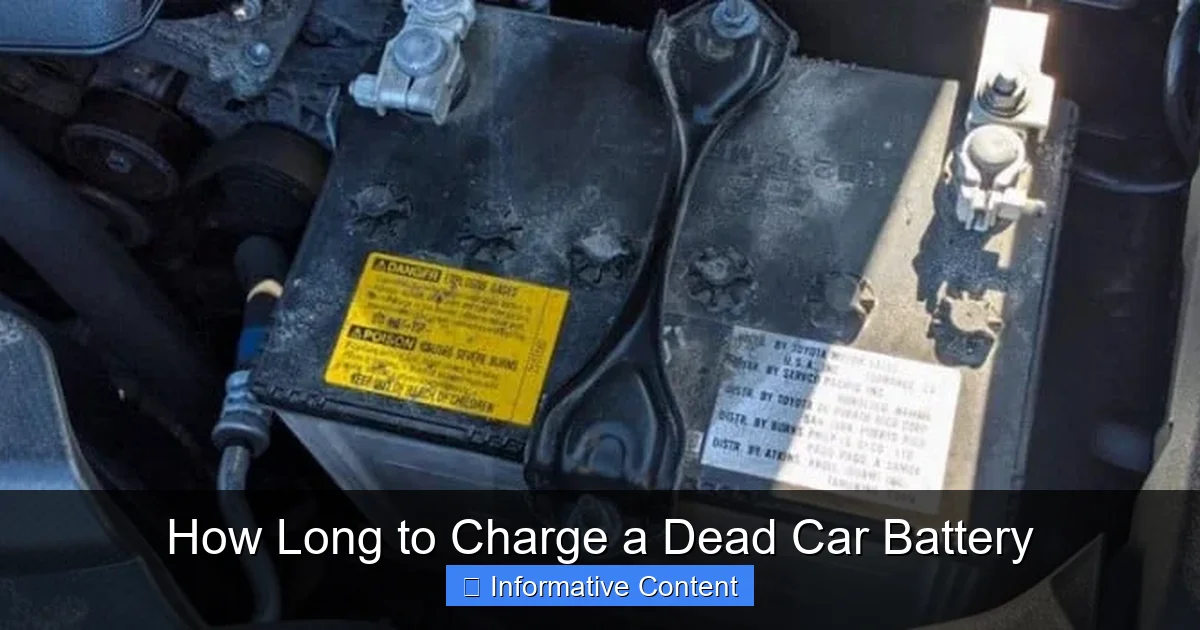
The time it takes to charge a dead car battery varies greatly, primarily depending on the charger type (trickle, standard, or smart), the battery’s size (Ah rating), and its state of discharge. While a smart charger might fully revive a moderately drained battery overnight, a trickle charger could take days, and a severely depleted battery might need professional attention or replacement. Always prioritize safety and follow your charger’s instructions for optimal results.
There’s a special kind of dread that washes over you when you turn the key, and all you get is a disheartening click, or worse, absolute silence. A dead car battery. It happens to the best of us, often at the least convenient times. Maybe you left your lights on, the cold weather took its toll, or perhaps your battery is simply reaching the end of its life.
Once you’ve identified the culprit, the natural next question is: “How long to charge a dead car battery?” It’s a common query, but unfortunately, there isn’t a simple, single answer. The truth is, the charging time for a dead car battery is influenced by a handful of factors, from the type of charger you’re using to the condition of the battery itself. In this comprehensive guide, we’ll dive deep into everything you need to know to get your battery back up and running safely and efficiently.
Understanding these variables will not only help you estimate the time required but also ensure you’re performing the charging process safely and effectively. Let’s demystify the art and science of car battery charging so you can avoid future roadside surprises and keep your vehicle reliably starting.
Key Takeaways
- No Single Answer: The exact time to charge a dead car battery varies widely based on several factors, so there isn’t a one-size-fits-all answer.
- Charger Type Matters Most: Different chargers (trickle, standard, smart) have vastly different amperage outputs, directly impacting how long it takes to charge.
- Battery Condition is Crucial: A completely dead battery, especially an old one, will take longer to charge and might not hold a charge as effectively as a partially drained, newer battery.
- Safety First: Always wear safety gear, ensure proper ventilation, and connect the charger correctly to prevent accidents or damage.
- Monitor the Process: Smart chargers often indicate charge status, but for basic chargers, regular monitoring of voltage or electrolyte levels (if applicable) is advisable.
- Consider Battery Health: If a battery repeatedly dies or struggles to hold a charge, it might be nearing the end of its lifespan and recharging might only be a temporary fix.
- Consult Your Manuals: Always refer to your car’s owner’s manual and the battery charger’s instructions for specific recommendations and safety guidelines.
Quick Answers to Common Questions
How do I know if my car battery is fully charged?
Many smart chargers have indicator lights that show when the battery is fully charged. Alternatively, you can use a multimeter to check the voltage; a fully charged 12-volt car battery should read between 12.6 and 12.8 volts after resting for an hour.
Can I overcharge a car battery?
Yes, traditional or trickle chargers without automatic shut-off can overcharge a battery, leading to damage, reduced lifespan, and potentially hazardous gassing. Smart chargers are designed to prevent overcharging by switching to a float or maintenance mode once the battery is full.
Is it safe to leave a car battery charger on overnight?
If you are using a smart (automatic) battery charger, it is generally safe to leave it on overnight as these chargers monitor the battery and stop charging when full. However, avoid doing this with basic trickle or manual chargers due to the risk of overcharging.
What if my battery dies repeatedly after charging?
If your battery repeatedly dies even after a full charge, it likely indicates that the battery is old, damaged, or your car’s charging system (alternator) is faulty. Have your battery and charging system tested by a professional to determine the root cause.
Does a bigger battery take longer to charge?
Yes, a car battery with a higher Amp-hour (Ah) rating has a larger capacity, meaning it will generally take longer to fully charge compared to a smaller capacity battery, assuming the same charger output.
📑 Table of Contents
Understanding Your Car Battery and Why It Dies
Before we talk about how long to charge a dead car battery, it’s helpful to understand what a car battery does and why it might give up the ghost in the first place. Your car’s battery is typically a 12-volt lead-acid battery, responsible for providing the initial burst of power to start the engine and powering essential electrical components when the engine isn’t running.
The Basics of a 12V Battery
A car battery stores chemical energy and converts it into electrical energy. When your car is running, the alternator recharges the battery, replenishing the energy used during startup and powering the vehicle’s electrical system. When the engine is off, the battery continues to supply power to things like the radio, clock, and alarm system, albeit at a very low rate. This constant small drain is normal, but excessive drain or insufficient recharging can lead to a dead battery.
Common Culprits Behind a Dead Battery
- Lights Left On: The most classic reason. Interior lights, headlights, or even trunk lights left on overnight can quickly drain a battery.
- Parasitic Drain: Some electrical components might continue to draw power even when the car is off, slowly killing the battery. This could be due to a faulty component or aftermarket accessories.
- Extreme Temperatures: Both extreme cold and extreme heat can significantly impact battery performance and lifespan. Cold weather reduces the battery’s cranking power, making it harder for the engine to start and requiring more battery output.
- Infrequent Driving: If your car sits for long periods, the battery doesn’t get a chance to be fully recharged by the alternator, leading to a gradual discharge.
- Faulty Charging System: A failing alternator won’t properly recharge the battery, leaving it undercharged.
- Old Age: Car batteries have a finite lifespan, typically 3-5 years. As they age, their ability to hold a charge diminishes.
The Different Types of Battery Chargers
The type of charger you use is arguably the most significant factor in determining how long to charge a dead car battery. Each type operates differently and delivers power at varying rates.

Visual guide about How Long to Charge a Dead Car Battery
Image source: youcanic.com
Trickle Chargers (Slow and Steady)
Trickle chargers deliver a very low amperage (typically 1-2 amps) continuously. They are designed for long-term maintenance charging, ideal for keeping a battery topped off during storage. While they can charge a dead battery, it will take a very long time – potentially days. They don’t typically have automatic shut-off features, so there’s a risk of overcharging if left unattended for too long, which can damage the battery.
Standard Chargers (Moderate Speed)
These chargers offer a higher amperage output (typically 4-10 amps) and are suitable for recharging a dead battery more efficiently than a trickle charger. They often have manual settings for different charge rates. You’ll need to monitor the battery’s voltage to prevent overcharging, as many don’t automatically stop charging once full.
Smart Chargers (Optimal and Safe)
Smart chargers (also known as automatic or intelligent chargers) are generally the best option for recharging a dead car battery. They incorporate microprocessors that monitor the battery’s condition and adjust the charging voltage and current accordingly. They often feature multi-stage charging cycles (desulfation, bulk charge, absorption, float), optimizing the charging process for safety and battery longevity. Most importantly, they automatically switch to a “float” or maintenance mode once the battery is fully charged, preventing overcharging. This makes them safer for overnight or extended charging.
Jump Starters (Temporary Boost)
While not a charger in the traditional sense, a jump starter provides a quick burst of power to get your engine running. It doesn’t actually charge your battery; instead, it provides enough energy for the starter motor. Once the car is running, your alternator takes over to recharge the battery. However, if your battery is truly dead or old, relying solely on the alternator might not fully revive it, and you’ll still need to address the underlying issue.
Factors Influencing Charging Time
Beyond the charger type, several other variables play a critical role in determining how long to charge a dead car battery effectively and safely.
Battery’s State of Discharge
This is straightforward: a completely dead battery (e.g., below 10.5 volts) will take significantly longer to charge than one that’s merely run down a bit (e.g., 11.5 volts). The more deeply discharged the battery, the more energy it needs to absorb.
Battery’s Amp-Hour (Ah) Rating
Every car battery has an Amp-hour (Ah) rating, which indicates how much current it can deliver over a certain period. A typical car battery might be rated at 40-100 Ah. A battery with a higher Ah rating simply has a larger capacity, meaning it will take longer to fully charge compared to a smaller capacity battery, assuming the same charger output.
Charger’s Amperage Output
The higher the charger’s amperage (A) output, the faster it can replenish the battery’s charge. A 10-amp charger will charge a battery roughly twice as fast as a 5-amp charger, all other factors being equal. However, charging too quickly with high amperage can generate excessive heat and potentially damage the battery, especially if it’s deeply discharged or old. Smart chargers manage this automatically.
Battery Age and Condition
An older battery, or one that has been deeply discharged multiple times, might be sulfated internally. Sulfation occurs when lead sulfate crystals build up on the battery plates, reducing its capacity and ability to accept a charge. Such batteries will take longer to charge, might never reach full capacity again, and may struggle to hold a charge once removed from the charger.
Temperature
Batteries charge more efficiently in moderate temperatures. Charging in extremely cold conditions can slow down the chemical reaction within the battery, increasing charging time and potentially causing damage if the charger isn’t temperature-compensated. Conversely, charging in very hot conditions can also be detrimental.
Calculating and Estimating Charge Time
While a precise calculation is difficult due to the many variables, we can provide some useful estimates for how long to charge a dead car battery.
A Simple Formula (Theoretical)
A rough theoretical formula for calculating charge time is:
Charge Time (hours) = Battery Ah / Charger Amps
However, this formula doesn’t account for charging inefficiencies (which can be up to 10-20%), the battery’s state of discharge, or its age. To be more realistic, you might add an extra 10-20% to the calculated time.
Example: A 50 Ah battery charged by a 10-amp charger might theoretically take 50 Ah / 10 A = 5 hours. Accounting for inefficiency, it could be closer to 5.5 to 6 hours.
Real-World Scenarios and Estimates
- Completely Dead Battery (below 10.5V):
- With a 1-2 amp trickle charger: Expect 24-48+ hours, potentially even longer. This is only recommended for long-term maintenance, not for reviving a dead battery quickly.
- With a 4-6 amp standard/smart charger: Typically 10-12 hours, sometimes up to 24 hours for a very large or deeply discharged battery.
- With a 10-12 amp fast charger (often smart): Generally 4-8 hours for most standard car batteries.
- Partially Drained Battery (e.g., 11.5-12.0V):
- With a 4-6 amp standard/smart charger: 4-6 hours.
- With a 10-12 amp fast charger: 2-4 hours.
Why “Overnight” is Often a Good Bet (for Smart Chargers)
For most typical scenarios with a moderately drained battery and a good quality smart charger (4-12 amps), charging overnight (8-12 hours) is often sufficient. Smart chargers, as mentioned, will automatically detect when the battery is full and switch to a maintenance mode, preventing overcharging. This makes them ideal for set-it-and-forget-it convenience, especially when you’re unsure exactly how long to charge a dead car battery for.
Step-by-Step Guide to Safely Charging Your Battery
Safety is paramount when working with car batteries. They contain corrosive acid and produce explosive hydrogen gas during charging. Always follow these steps carefully.
Safety First!
- Wear Protective Gear: Always put on safety glasses and chemical-resistant gloves.
- Ensure Ventilation: Charge the battery in a well-ventilated area to dissipate hydrogen gas. Avoid enclosed spaces like garages without open windows or doors.
- No Sparks or Flames: Keep open flames, sparks, and smoking materials away from the battery.
- Read Manuals: Always consult your battery charger’s manual and your vehicle’s owner’s manual for specific instructions.
Connecting the Charger
- Turn Off Everything: Ensure your car’s ignition is off and all accessories are turned off.
- Identify Terminals: Locate the positive (+) and negative (-) terminals on your car battery. The positive terminal is usually larger and marked with a plus sign, often with a red cap or cable. The negative is smaller, marked with a minus sign, and usually has a black cable.
- Connect Positive: Attach the red (positive) clamp from the charger to the positive (+) terminal on the battery.
- Connect Negative: Attach the black (negative) clamp from the charger to a clean, unpainted metal part of the car’s frame or engine block, *away* from the battery. This helps prevent sparks near the battery where hydrogen gas might accumulate. Some chargers might advise connecting directly to the negative terminal; follow your charger’s specific instructions.
- Plug In Charger: Only after both clamps are securely attached should you plug the charger into a wall outlet.
- Select Settings: If your charger has settings (e.g., 6V/12V, amperage rate, battery type), select the appropriate ones for your battery (usually 12V and the recommended amperage).
Monitoring the Process
Once charging begins, monitor the battery. Smart chargers will usually have indicator lights to show the charging status (charging, fully charged, fault). For basic chargers, you might periodically check the battery’s voltage with a multimeter. Avoid touching the battery or terminals while charging. If you notice any hissing, boiling, or a strong sulfur smell, disconnect the charger immediately and inspect the battery for damage.
Disconnecting Safely
- Unplug Charger: First, unplug the battery charger from the wall outlet.
- Remove Negative: Disconnect the black (negative) clamp from the car’s frame/engine block.
- Remove Positive: Disconnect the red (positive) clamp from the positive (+) battery terminal.
- Secure Battery: Ensure the battery is properly secured in its tray.
What to Do If Your Battery Won’t Hold a Charge
Sometimes, even after following all the steps on how long to charge a dead car battery, your battery still struggles. This often signals a deeper issue.
Testing Battery Voltage
After charging, let the battery rest for an hour, then check its voltage with a multimeter. A fully charged 12-volt car battery should read around 12.6 to 12.8 volts. If it’s significantly lower or quickly drops after charging, it might not be holding a charge.
Signs of a Failing Battery
- Slow Cranking: The engine turns over slowly or with difficulty.
- Dim Lights/Flickering Dash: Headlights or dashboard lights appear dim, especially during startup.
- Corrosion: Excessive corrosion around the battery terminals can indicate leakage or a poor connection.
- Swollen Battery Case: A bulging or cracked battery case is a clear sign of internal damage and warrants immediate replacement.
- Frequent Recharges: If you find yourself needing to recharge the battery often, its capacity is likely diminished.
When to Replace Instead of Recharge
If your battery is several years old, shows signs of physical damage, consistently fails to hold a charge after a full recharge, or if your car’s charging system (alternator) is confirmed to be working correctly but the battery still dies, it’s almost certainly time for a replacement. Trying to endlessly recharge a failing battery is not only frustrating but can also put a strain on your car’s electrical system.
Conclusion
Knowing how long to charge a dead car battery isn’t a fixed science, but by understanding the key factors – your charger type, the battery’s condition, its capacity, and the ambient temperature – you can make informed decisions. A quality smart charger often makes the process safest and most efficient, typically allowing an overnight charge for most dead batteries.
Always prioritize safety: wear protective gear, ensure good ventilation, and follow the specific instructions of your charger and vehicle. If your battery repeatedly gives up the ghost despite proper charging, it’s a clear signal that it’s time for a replacement. With this knowledge, you’re now better equipped to tackle a dead car battery, keeping you on the road and avoiding those unexpected clicks of silence.
🎥 Related Video: How Long Does It Take to Charge a Battery?
📺 Jack Of All Trades Master of None
An easy way calculate how long it will take to charge a battery.
Frequently Asked Questions
How long does it take for an alternator to recharge a dead battery?
While an alternator will start recharging a battery once the car is running, it’s primarily designed to maintain a charge, not fully revive a deeply dead battery. It could take several hours of driving for a severely drained battery to reach a full charge from the alternator alone, and it might not ever fully recover its original capacity without a dedicated charger.
Can I charge my car battery with a trickle charger?
Yes, you can charge a car battery with a trickle charger, but it will take a very long time, often 24-48 hours or more, for a dead battery. Trickle chargers are best suited for maintaining an already charged battery over long periods of storage rather than quickly reviving a dead one.
What voltage should a dead car battery show?
A car battery is considered truly dead or deeply discharged if its voltage drops below 10.5 volts. A fully charged 12-volt car battery should ideally read between 12.6 and 12.8 volts when at rest.
What are the signs of a bad car battery that won’t hold a charge?
Signs of a failing battery include slow engine cranking, dim headlights or interior lights, the “check engine” or battery light coming on, corrosion on the terminals, a bulging battery case, or a strong sulfur smell. If these symptoms persist after charging, your battery is likely nearing its end.
Is it better to charge a car battery slowly or quickly?
Slow charging (with a lower amperage) is generally gentler on the battery and can help extend its lifespan, especially for deeply discharged batteries. While fast charging can get you back on the road quicker, it can generate more heat and potentially stress the battery if not managed by a smart charger.
Do I need to disconnect the battery from the car before charging?
For most modern cars and smart chargers, you do not need to disconnect the battery from the car. However, always ensure the ignition is off and all accessories are off. Some older car models or specific charger types might recommend disconnecting, so always refer to your vehicle and charger manuals.