Understanding how long to charge a car battery isn’t a simple answer, as it depends on several key factors. These include the battery’s current state of charge, its capacity, and the type of charger you’re using. For optimal safety and battery health, using a smart charger is highly recommended.
How Long to Charge a Car Battery
Have you ever walked out to your car, turned the key, and been met with that dreaded slow grind or, worse, absolute silence? A dead car battery is a frustrating experience many drivers face. When this happens, your first thought is usually, “How long to charge a car battery so I can get back on the road?”
The truth is, there isn’t a single, simple answer to that question. The time it takes to fully charge a car battery can vary quite a bit. It depends on several important factors, from how “dead” your battery is to the type of charger you’re using. But don’t worry, we’re here to break down everything you need to know about charging your car battery safely and effectively. We’ll guide you through the process, help you understand the variables, and make sure you feel confident the next time you need to give your battery a boost.
Let’s dive in and demystify the process of charging a car battery, ensuring you understand not just how long it takes, but also how to do it right for optimal battery life and your own safety.
Key Takeaways
- Charging Time Varies Widely: How long to charge a car battery depends heavily on its current discharge level, its capacity (Ah rating), and the amperage output of your charger.
- Smart Chargers are Your Best Friend: Invest in a smart, multi-stage battery charger or maintainer. These devices automate the charging process, prevent overcharging, and are safest for your battery’s long-term health.
- Basic Calculation for Estimation: A rough estimate is Battery Capacity (Ah) / Charger Amps = Hours. However, add 10-20% to account for charging inefficiencies and the multi-stage nature of modern chargers.
- Deeply Discharged Batteries Take Longer: A completely dead 60 Ah car battery might take anywhere from 12 to 24 hours (or even more) with a standard 4-amp household charger.
- Safety is Paramount: Always charge your car battery in a well-ventilated area, wear eye protection, avoid sparks near the battery, and ensure you connect the charger terminals correctly (positive to positive, negative to ground/engine block).
- Maintain, Don’t Just Recharge: For vehicles stored for long periods, a battery maintainer (trickle charger) is crucial to keep the battery topped up without overcharging.
- Know When to Replace: If your car battery frequently dies, struggles to hold a charge, or is older than 3-5 years, it might be time for a replacement rather than just another recharge.
Quick Answers to Common Questions
How long does a 60 Ah car battery take to charge with a 5 amp charger?
A 60 Ah car battery charging from completely dead with a 5 amp charger would take approximately 12 hours (60 Ah / 5 A = 12 hours). Factoring in charging efficiency, it might take closer to 14-15 hours.
Is it safe to leave a car battery on charge overnight?
Yes, if you are using a smart charger or a battery maintainer. These devices are designed to automatically switch to a float mode once the battery is fully charged, preventing overcharging and damage. Never leave an old, manual charger unattended or connected overnight.
How do I know if my car battery is fully charged?
A smart charger will usually indicate a full charge with a green light or a “fully charged” message. You can also test with a voltmeter; a fully charged 12-volt battery should read between 12.6 and 12.8 volts (with the charger disconnected).
Can I charge my car battery too fast?
Charging a battery too fast (using a very high amperage charger on a small or weak battery) can generate excessive heat, boil the electrolyte, and potentially damage the battery’s internal plates, shortening its lifespan. It’s best to use a charger appropriate for your battery’s size or a smart charger that regulates current.
What voltage should a fully charged 12-volt car battery be?
A fully charged 12-volt car battery should measure between 12.6 and 12.8 volts when resting (i.e., not connected to a charger or actively powering anything) at room temperature.
📑 Table of Contents
Understanding Your Car Battery: The Basics
Before we talk about charging times, it’s helpful to know a little bit about what you’re charging. Most car batteries are 12-volt lead-acid batteries, although there are a few variations.
Types of Car Batteries
While the internal chemistry differs, most passenger vehicles use one of two main types:
- Flooded Lead-Acid Batteries: These are the most common and often the most affordable. They contain a liquid electrolyte solution that needs to be checked and topped up with distilled water periodically (if they are not “maintenance-free”).
- Absorbed Glass Mat (AGM) Batteries: These are a step up. They use a special fiberglass mat to absorb the electrolyte, making them spill-proof and more vibration resistant. AGM batteries generally charge faster and last longer than traditional flooded batteries.
Regardless of the type, they all store energy through a chemical reaction and release it as electricity to start your car and power its accessories.
How Batteries Lose Charge
Car batteries can lose charge for several reasons:
- Parasitic Drain: Even when your car is off, some components (like the clock, radio presets, or alarm system) draw a tiny amount of power. Over time, this “parasitic drain” can kill a battery.
- Leaving Lights On: An obvious culprit, leaving headlights or interior lights on can drain a battery quickly.
- Short Trips: If you only drive short distances, your alternator might not have enough time to fully recharge the battery after starting the car.
- Cold Weather: Extreme cold significantly reduces a battery’s capacity and makes it harder for the engine to start, demanding more from the battery.
- Age: Batteries simply wear out over time, becoming less efficient at holding a charge.
Battery State of Charge
A “dead” battery isn’t always at zero volts. For a 12-volt battery:
- Fully Charged: Around 12.6 to 12.8 volts.
- Partially Discharged: Between 12.0 and 12.4 volts. This is often when you start to notice slow cranking.
- Deeply Discharged/Dead: Below 12.0 volts. At 10.5 volts or lower, the battery is considered completely discharged and may even be permanently damaged if left in this state for too long.
The more discharged your battery is, the longer it will take to charge it back to full capacity.
Factors Influencing Charging Time
So, how long to charge a car battery really boils down to a few key variables. Think of it like filling a bucket: how full it is, how big the bucket is, and how fast the water is flowing.
Battery’s Current State of Charge
This is arguably the biggest factor. A battery that’s only slightly drained will charge much faster than one that’s completely dead. If your battery voltage is at 12.4V, it has about 80% charge. If it’s at 12.0V, it’s closer to 25% charged. The further away from full charge, the more energy needs to be put back in.
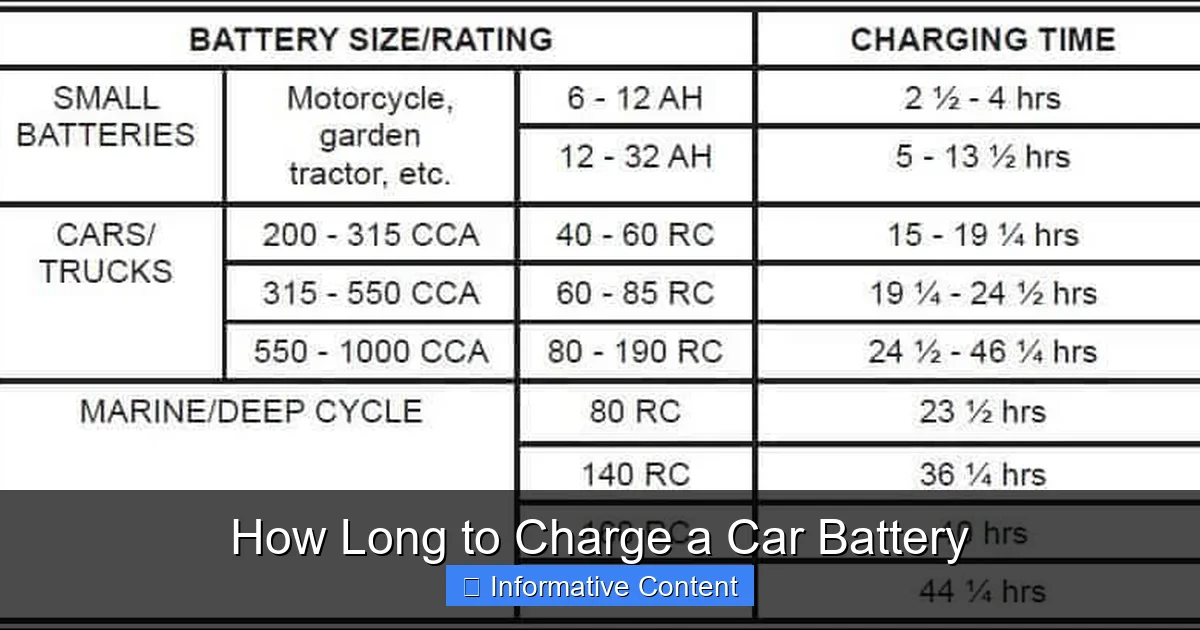
Visual guide about How Long to Charge a Car Battery
Image source: cdn.shortpixel.ai
Battery Capacity (Ah Rating)
Car batteries are rated in Amp-hours (Ah). This number tells you how much energy the battery can store. A typical car battery might be rated anywhere from 40 Ah to 100 Ah. A 60 Ah battery can theoretically deliver 60 amps for one hour, or 1 amp for 60 hours. A higher Ah rating means a larger “fuel tank” for electricity, which will take longer to fill up, all else being equal. Knowing your battery’s Ah rating (usually printed on the label) is crucial when asking how long to charge a car battery.
Charger Output (Amperage)
Battery chargers come in different “strengths,” measured in amps. A 2-amp charger is slow, a 10-amp charger is moderate, and a 20-amp charger is quite fast. The higher the amperage, the quicker your battery will charge. However, using too high an amperage on a small battery or for too long can damage it, especially if you’re not using a smart charger.
- Trickle Chargers: 1-2 amps. Designed for long-term maintenance.
- Standard Chargers: 4-15 amps. Common for home use.
- Fast Chargers: 20-50+ amps. For quicker recovery, often found in workshops.
Battery Type
As mentioned, AGM batteries tend to accept charge more efficiently and often charge faster than conventional flooded lead-acid batteries. However, they also often require chargers with specific AGM settings to ensure proper charging voltage.
Temperature
Batteries charge less efficiently in cold temperatures. If you’re charging your battery in a cold garage in winter, it will take longer to reach a full charge compared to charging it in a warmer environment.
Battery Age and Health
An older, weaker battery that has lost some of its capacity due to age or sulfation (a common process where lead sulfate crystals build up on the plates) will take longer to charge and may never reach its original full capacity. In some cases, it might not hold a charge at all, regardless of how long you try to charge it.
Types of Car Battery Chargers and Their Impact
The type of charger you use plays a significant role in how long to charge a car battery and how safely that charging happens.
Trickle Chargers
These are low-amp chargers (typically 1-2 amps). They’re designed to maintain a battery’s charge over long periods, like when a car is stored for the winter. They are very slow to charge a dead battery and are not suitable for quickly bringing a deeply discharged battery back to life. A trickle charger might take days to fully charge a dead battery, and it lacks the advanced monitoring of a smart charger, risking overcharging.
Standard Manual Chargers
These older chargers usually offer a constant current at a specific amperage (e.g., 6 amps or 10 amps). You need to monitor these carefully, as they don’t automatically stop charging when the battery is full. Overcharging can severely damage your battery, leading to reduced lifespan or even dangerous overheating. This is why most people don’t use these anymore.
Smart Chargers / Maintainers (Recommended)
These are the best choice for most car owners. Smart chargers are multi-stage, meaning they adjust the charging current and voltage based on the battery’s state of charge. They typically go through bulk, absorption, and float stages:
- Bulk Stage: Delivers maximum current to quickly bring the battery up to about 80% charge.
- Absorption Stage: Reduces current and maintains a constant voltage to safely bring the battery to 100%.
- Float Stage: Once full, it switches to a low voltage “float” charge to maintain the battery without overcharging, making it safe to leave connected indefinitely.
Smart chargers also often have safety features like spark protection, reverse polarity protection, and automatic shut-off if something goes wrong. When wondering how long to charge a car battery, a smart charger often simplifies the question by telling you when it’s done.
Jump Starters
It’s important to note that a jump starter is *not* a battery charger. It provides a quick burst of power to start your engine, allowing your car’s alternator to then recharge the battery. It won’t fully charge your battery on its own.
Calculating “How Long to Charge a Car Battery”
Let’s get down to the numbers. While a smart charger often tells you when it’s done, it’s good to understand the basic math.
The Basic Formula
A simple way to estimate is:
Battery Capacity (Ah) / Charger Amperage (A) = Approximate Hours to Full Charge
However, this formula assumes 100% charging efficiency and that you’re charging from completely dead. Batteries are not 100% efficient at accepting charge; there’s always some energy lost as heat. You should typically add about 10-20% to this calculation to get a more realistic time.
Real-World Adjustments and Examples
Let’s use an example:
Imagine you have a 60 Ah car battery that is completely dead (0% charge).
- Using a 4-amp smart charger:
60 Ah / 4 Amps = 15 hours. Add 10-20% for efficiency: 15 * 1.2 = 18 hours.
So, a 60 Ah battery might take approximately 15-20 hours to fully charge with a 4-amp smart charger.
- Using a 10-amp smart charger:
60 Ah / 10 Amps = 6 hours. Add 10-20% for efficiency: 6 * 1.2 = 7.2 hours.
With a 10-amp charger, it could take roughly 6-8 hours to fully charge a car battery of the same size.
What if the battery isn’t completely dead?
If your 60 Ah battery is only 50% discharged (meaning you need to put 30 Ah back in):
- Using a 4-amp smart charger:
30 Ah / 4 Amps = 7.5 hours. Add 10-20% for efficiency: 7.5 * 1.2 = 9 hours.
So, about 7.5-9 hours to bring it back to full.
Remember, these are estimates. A good smart charger will tell you when it’s finished, often with an indicator light. This is why knowing how long to charge a car battery is much easier with modern equipment.
Best Practices for Safe and Effective Battery Charging
Charging a car battery involves electricity and chemicals, so safety is paramount. Follow these steps to ensure a safe and effective charging process.
Safety First!
- Ventilation: Always charge in a well-ventilated area. Batteries can produce hydrogen gas, which is highly flammable.
- Eye Protection: Wear safety glasses or goggles. Battery acid can cause serious eye injuries.
- No Sparks: Avoid creating sparks near the battery, especially when connecting or disconnecting the charger. This means no smoking, and ensure your tools don’t accidentally short across the terminals.
- Gloves: Consider wearing gloves to protect your hands from battery acid.
Connect Correctly
- Turn off everything: Ensure your car is off, and the charger is unplugged from the wall outlet.
- Connect positive: Attach the red (positive, +) clamp of the charger to the positive (+) terminal of the battery.
- Connect negative: Attach the black (negative, -) clamp of the charger to an unpainted metal part of the car’s frame or engine block, away from the battery. This reduces the risk of sparks near the battery itself. *If charging the battery outside the car, connect the black clamp to the negative terminal of the battery.*
- Plug in charger: Only after all clamps are securely attached, plug the charger into the electrical outlet.
- Select settings: If your charger has settings for battery type (e.g., standard, AGM, Gel) or amperage, select the appropriate ones.
Monitoring the Process
If you’re using a smart charger, it will typically have indicator lights that show its progress (e.g., charging, fully charged, fault). For manual chargers, you might need to periodically check the battery voltage with a multimeter. Never leave a manual charger unattended for extended periods.
When to Stop Charging
For smart chargers, they will automatically switch to a “float” or “maintenance” mode, or simply indicate “charged.” You can leave them connected without worry. For manual chargers, stop charging when the battery voltage reaches around 12.6-12.8 volts. Overcharging can boil the electrolyte and damage the battery.
Maintaining Your Battery’s Health
- Keep terminals clean: Corroded terminals can prevent a good charge. Clean them regularly with a battery terminal brush and a baking soda-water solution.
- Check electrolyte levels (if applicable): For non-sealed flooded batteries, periodically check the fluid levels and top up with distilled water if needed (never tap water).
- Use a maintainer for storage: If you store your vehicle for weeks or months, a battery maintainer is essential to keep the charge topped off and prevent sulfation. This dramatically extends battery life.
When to Replace Rather Than Recharge
Sometimes, no matter how long to charge a car battery, it just won’t hold a charge. This means it’s time for a replacement.
Signs of a Dying Battery
- Slow Engine Crank: The most common sign. Your engine turns over slowly, especially on cold mornings.
- Dim Lights: Headlights or interior lights appear dim when the engine isn’t running.
- Frequent Recharging: You find yourself needing to jump-start or recharge the battery often.
- Battery Light On: Your dashboard battery warning light illuminates.
- Bloated or Leaking Case: Visible damage to the battery case indicates a serious internal problem.
Battery Age
Most car batteries last between 3 to 5 years. If your battery is in this age range and showing signs of weakness, a replacement is likely overdue. Beyond 5 years, batteries are living on borrowed time.
Professional Testing
If you’re unsure, most auto parts stores offer free battery testing. They can perform a “load test,” which puts a strain on the battery to see how well it holds up under demand, giving a more definitive answer than just voltage readings.
Conclusion
So, how long to charge a car battery? As we’ve seen, it’s not a single number but a range influenced by many factors. From the battery’s capacity and state of discharge to the type of charger you use, each element plays a role. However, the good news is that with the right knowledge and tools, it’s a perfectly manageable task.
Remember to prioritize safety by working in a well-ventilated area, wearing eye protection, and connecting your charger correctly. Investing in a high-quality smart charger or maintainer is highly recommended, as these devices take the guesswork out of the equation and protect your battery from overcharging, ultimately extending its life.
By understanding these principles, you’ll not only know how long to charge a car battery but also how to maintain its health, prevent unexpected breakdowns, and ensure your vehicle is always ready to go when you are. Happy driving!
🎥 Related Video: How Do I Recharge My Car Battery | How Long To Charge A Car Battery At 2 AMPS
📺 JP Auto & Fleet Services
How Do I Recharge My Car Battery | How Long To Charge A Car Battery At 2 Amps …
Frequently Asked Questions
How long does it take to charge a completely dead car battery?
Charging a completely dead car battery can take anywhere from 12 to 24 hours with a standard household charger (around 4-6 amps). The exact time depends on the battery’s capacity (Ah rating) and the charger’s output amperage, plus factors like battery age and ambient temperature.
Can I charge my car battery with a trickle charger? How long does it take?
Yes, you can charge a car battery with a trickle charger, but it will be very slow. Trickle chargers typically output 1-2 amps, so charging a deeply discharged battery can take several days. They are best used for maintaining an already charged battery over long periods of storage.
Do I need to disconnect the car battery from the car before charging?
It’s generally recommended to disconnect the negative terminal of the battery from your car’s electrical system before charging to protect sensitive electronics from potential voltage spikes. However, many modern smart chargers are safe enough to use with the battery connected, especially when following all safety instructions.
What is the difference between charging a standard battery and an AGM battery?
AGM batteries generally charge faster and more efficiently than standard flooded lead-acid batteries. Many smart chargers have specific “AGM” settings that provide a slightly different charging voltage profile, which is crucial for optimal charging and longevity of an AGM battery. Always check your charger’s settings and your battery’s specifications.
How often should I charge my car battery if I don’t drive frequently?
If you don’t drive your car often (e.g., once a week or less), it’s highly recommended to use a battery maintainer or smart charger connected constantly. This keeps the battery topped off and prevents it from slowly discharging, which significantly extends its lifespan and ensures it’s always ready to start.
What happens if I overcharge a car battery?
Overcharging a car battery can cause significant damage. It can lead to the electrolyte boiling off, which corrodes the internal components and warps the battery plates. This reduces the battery’s capacity, shortens its lifespan, and in extreme cases, can cause the battery to swell, leak, or even explode due to the buildup of hydrogen gas.