
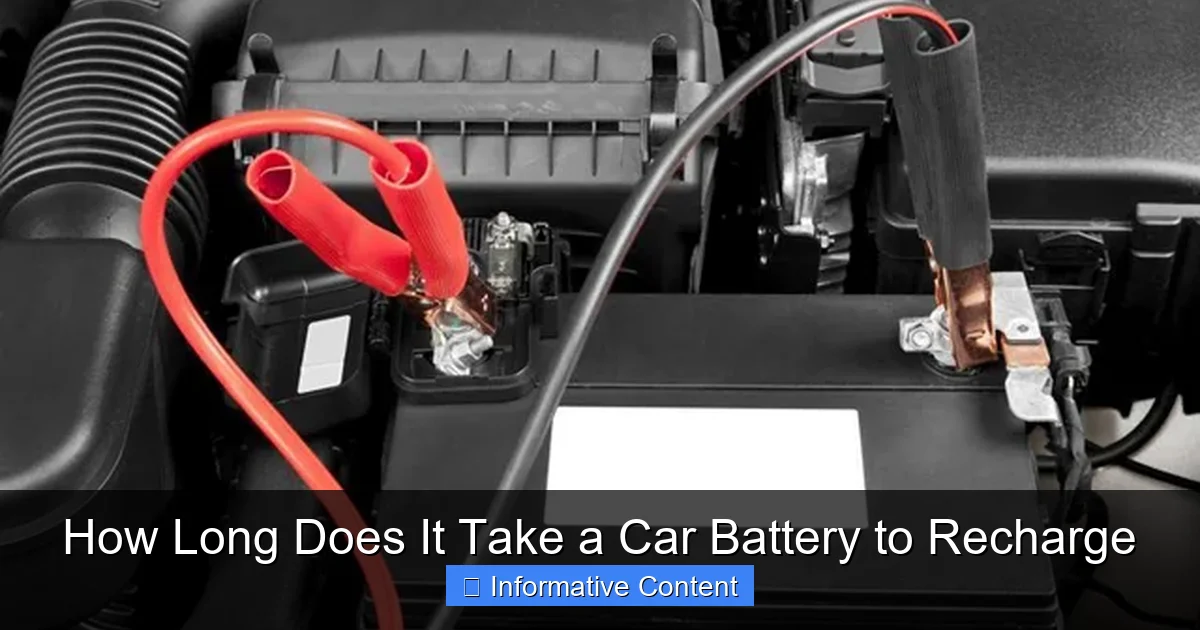
When your car battery dies, you’re often left wondering how long does it take a car battery to recharge? The answer isn’t always simple, as it depends on several key factors like the charger’s amperage, the battery’s current state of charge, and its overall capacity. A standard recharge can range from a few hours for a slightly drained battery to 24 hours or more for a completely flat one, emphasizing the need for the right charger and patience.
There’s nothing quite like that sinking feeling when you turn the key, and all you get is a slow groan or, worse, absolute silence from under the hood. A dead car battery is a common inconvenience, leaving many drivers scrambling for a solution. Once you’ve managed to get a jump start, or perhaps even towed your car home, the big question looms: how long does it take a car battery to recharge?
It’s a question that doesn’t have a single, simple answer, much like asking “how long does it take to cook dinner?” It depends on the meal, doesn’t it? Similarly, recharging a car battery depends on several critical factors, from the type of charger you’re using to the battery’s current condition and its overall capacity. Understanding these elements isn’t just about getting your car started again; it’s about properly caring for your battery to extend its life and avoid future breakdowns.
In this comprehensive guide, we’ll demystify the process of recharging a car battery. We’ll explore the various methods available, delve into the science behind the scenes, and provide practical estimates so you can confidently answer the question: how long does it take a car battery to recharge? Let’s get your vehicle back on the road and give you the knowledge to handle future battery hiccups with ease.
Key Takeaways
- Variability is Key: The time it takes to recharge a car battery isn’t fixed; it heavily depends on the charger’s output, the battery’s capacity, and how deeply discharged it is.
- Charger Amperage Matters Most: Higher amperage chargers (e.g., 10A-20A) recharge batteries much faster than lower amperage trickle chargers (e.g., 1A-2A), which are best for maintenance.
- State of Charge is Crucial: A completely dead battery will take significantly longer to recharge than one that’s only partially drained. Expect 12-24 hours for a very flat battery with a standard charger.
- Battery Capacity Plays a Role: Larger batteries (higher Amp-hour, Ah ratings) require more charging time to reach full capacity compared to smaller ones, assuming the same charger.
- Driving is a Slow Recharge: While your alternator recharges the battery as you drive, it’s typically a slow process and not ideal for a deeply discharged battery; a dedicated charger is more efficient.
- Safety and Smart Charging are Paramount: Always follow safety guidelines when charging and consider using a “smart charger” that prevents overcharging and optimizes the recharge process for battery longevity.
- Look for Signs of a Dying Battery: If your battery repeatedly drains or won’t hold a charge, recharging might only be a temporary fix; it could be time for a replacement.
Quick Answers to Common Questions
How long does it take to fully recharge a dead car battery with a 10A charger?
For a completely dead car battery, expect it to take approximately 12 to 24 hours to fully recharge using a standard 10-amp charger. This duration accounts for the battery’s deep discharge and charging inefficiencies.
Can I recharge a car battery by just driving around?
While your car’s alternator does recharge the battery as you drive, it’s not ideal for a deeply discharged battery. It typically requires at least 30-60 minutes of continuous driving at highway speeds to put a significant charge back in, and it might not fully recharge a very low battery.
Is it safe to leave a car battery charger on overnight?
If you have a modern “smart charger” or “automatic battery charger,” it is generally safe to leave it on overnight, as these chargers automatically switch to a maintenance or float mode once the battery is full, preventing overcharging. However, older, non-automatic chargers should be monitored and disconnected once the battery is fully charged to avoid damage.
How do I know when my car battery is fully recharged?
Most smart chargers will have an indicator light or display that shows “full” or “charged.” You can also check the battery’s voltage with a multimeter; a fully charged 12-volt battery should read between 12.6 and 12.8 volts (with no load) after the charger has been disconnected for a few minutes.
What is the difference between a trickle charger and a standard charger?
A trickle charger delivers a very low current (typically 1-2 amps) and is best for maintaining a battery’s charge over long periods. A standard charger delivers a higher current (typically 4-10 amps or more) and is designed to actively recharge a depleted battery more quickly. Trickle chargers are too slow for a dead battery, while standard chargers may overcharge if not automatic.
📑 Table of Contents
The Basics: Understanding Your Car Battery and How It Works
Before we talk about how long does it take a car battery to recharge, let’s quickly understand what we’re dealing with. Your car battery is more than just a box under the hood; it’s a crucial component that kickstarts your engine and powers your vehicle’s electrical systems when the engine isn’t running.
What is a Car Battery?
Most car batteries are 12-volt lead-acid batteries, composed of six individual cells, each producing about 2.1 volts. These cells contain lead plates submerged in an electrolyte solution of sulfuric acid and water. When you start your car or use accessories, a chemical reaction occurs, generating electricity. This process discharges the battery.
How a Battery Discharges and Recharges
When your car’s engine is running, the alternator takes over the job of powering the vehicle’s electrical systems and, importantly, recharging the battery. The alternator converts mechanical energy from the engine into electrical energy, reversing the chemical reaction within the battery. This cycle of discharge and recharge is fundamental to your battery’s operation. However, factors like leaving lights on, extreme temperatures, or just plain old age can cause the battery to discharge faster than it can be recharged, or even completely drain it.
Factors Affecting Battery Life
Several elements influence how long a battery lasts and how well it recharges. Extreme hot or cold weather can significantly impact battery performance and lifespan. Frequent short trips don’t allow the alternator enough time to fully recharge the battery, leading to a gradual decline in charge. Age is also a major factor; most car batteries last between three to five years before they start losing their ability to hold a charge effectively.
Different Ways to Recharge a Car Battery
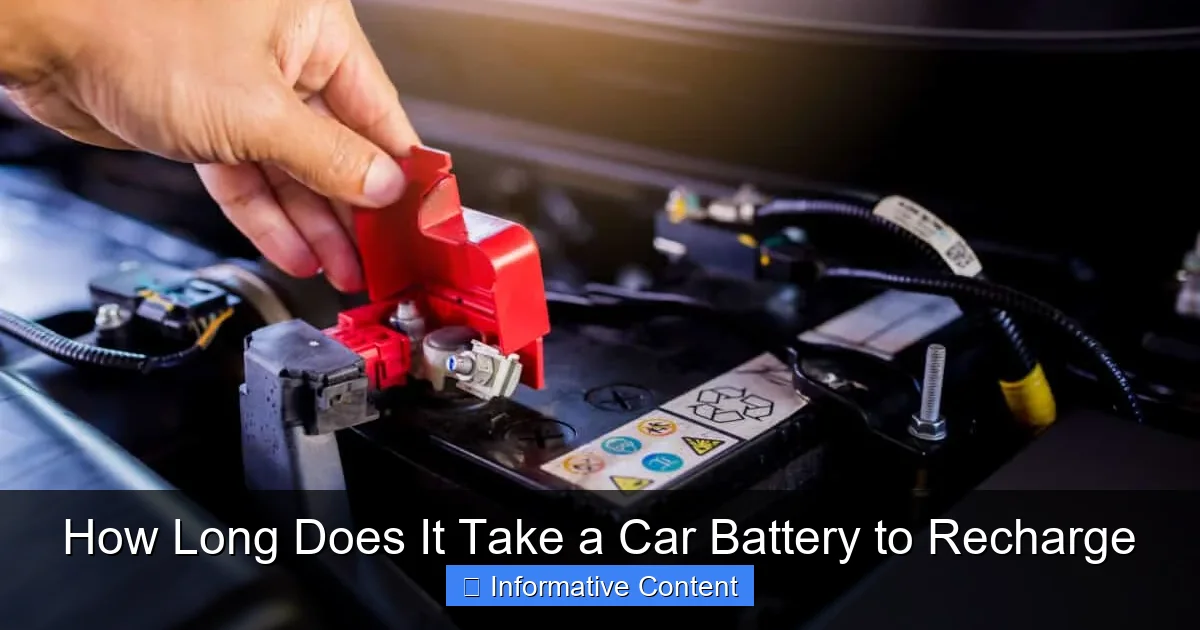
Visual guide about How Long Does It Take a Car Battery to Recharge
Image source: vehicleanswers.com
When your battery is low, there are a few common ways people try to get some juice back into it. Some are quick fixes, while others are designed for a thorough recharge. Knowing the differences is key to understanding how long does it take a car battery to recharge.
Driving Your Car
Many people assume that simply driving their car for a while will fully recharge a dead battery. While your car’s alternator does recharge the battery as you drive, it’s not the most efficient method for a deeply discharged battery. It takes a considerable amount of driving – typically at highway speeds for at least 30 minutes to an hour – to put a significant charge back into a depleted battery. If the battery is completely flat, the alternator might struggle or even become overworked trying to recharge it, potentially leading to premature wear on the alternator itself. Driving is a good way to maintain a healthy charge, but not always the best way to get a car battery to recharge from empty.
Using a Portable Jump Starter
A portable jump starter is a fantastic tool for getting your car running again quickly. It provides a burst of power directly to your starter motor, bypassing the dead battery temporarily. However, it’s important to understand that a jump starter does *not* recharge your car battery. It simply gives it enough power to start the engine. Once the engine is running, your alternator takes over. You’ll still need to drive for a while or connect a dedicated charger to truly replenish the battery’s charge.
Using a Battery Charger
This is the most effective and safest way to ensure a full and proper recharge for your car battery. Battery chargers come in various types and amperages, each designed for different situations. We’ll dive deeper into this in the next section, as it’s the primary method to consider when asking how long does it take a car battery to recharge. Using a dedicated charger allows for a controlled and complete charging cycle, which is much healthier for your battery in the long run.
The Heart of the Matter: Recharge Times with a Dedicated Charger
Now, let’s get down to the core question: how long does it take a car battery to recharge when using a proper battery charger? The answer hinges on three main variables: the charger’s amperage, the battery’s current state of charge, and its overall capacity.
Charger Types and Amperage
Battery chargers are typically rated by their amperage (A) output. This indicates how much current they can deliver to the battery.
- Trickle Chargers (1-2 Amps): These deliver a very low, slow charge. They are ideal for maintaining a battery’s charge over long periods (e.g., during winter storage) and preventing self-discharge. They are not designed to quickly recharge a dead battery. If you were to use one to recharge a dead battery, it could take days.
- Standard Chargers (4-10 Amps): These are common household chargers. A 4-amp charger might take 12-24 hours to recharge a moderately discharged battery, while a 10-amp charger could do it in 6-12 hours. They offer a good balance between speed and battery health.
- Rapid Chargers (15-20 Amps or Higher): These chargers deliver a high current, significantly reducing recharge time. A 20-amp charger might recharge a moderately discharged battery in 2-6 hours. While faster, consistently using high-amp chargers can generate more heat and potentially shorten battery life if not managed by a “smart” charging system.
- Smart Chargers/Maintainers: Many modern chargers are “smart chargers.” They monitor the battery’s condition, adjust the charging voltage and amperage accordingly, and automatically switch to a maintenance (trickle) mode once the battery is full. This prevents overcharging and optimizes battery health.
Battery State of Charge
This is perhaps the most critical factor. How “dead” is your battery?
- Slightly Drained (e.g., after leaving lights on for a short time, 75% charged): This type of battery will require the least amount of time to recharge. With a standard 10-amp charger, you might be looking at just 2-4 hours.
- Moderately Drained (e.g., struggling to start, 50% charged): This is a common scenario. With a 10-amp charger, expect 6-12 hours for a full recharge. With a lower 4-amp charger, it could easily be 12-24 hours.
- Deeply Discharged/Completely Dead (e.g., no lights, no sound, 0-25% charged): This is where patience is key. A completely dead battery will take the longest time to recharge. Using a 10-amp charger, it could take 12-24 hours or even more. A 4-amp charger might struggle to bring it back to life or take 24-48 hours, sometimes longer.
Battery Capacity (Ah Rating)
Car batteries are rated in Amp-hours (Ah), which indicates how much current they can deliver for a certain period. A typical car battery might have a capacity of 40-60 Ah (for smaller cars) or 70-100 Ah (for larger vehicles, trucks, or SUVs). The higher the Ah rating, the more “juice” the battery can hold, and therefore, the longer it will take to recharge from a given state of discharge with a given charger.
The basic calculation for recharge time is:
Recharge Time (Hours) = (Battery Ah / Charger Amps) x 1.25 (to account for charging inefficiencies)
Let’s look at some practical examples to see how long does it take a car battery to recharge:
Example 1: Slightly Drained Battery (50 Ah, 25% discharged, so needs 12.5 Ah) with a 10A Charger
* Ah to replenish: 50 Ah * 0.25 = 12.5 Ah
* Calculation: (12.5 Ah / 10 A) * 1.25 = 1.25 * 1.25 = ~1.56 hours.
* Reality Check: You’d likely charge it for 2-4 hours to ensure a complete top-off and account for the initial trickle stage.
Example 2: Moderately Drained Battery (60 Ah, 50% discharged, so needs 30 Ah) with a 10A Charger
* Ah to replenish: 60 Ah * 0.50 = 30 Ah
* Calculation: (30 Ah / 10 A) * 1.25 = 3 * 1.25 = ~3.75 hours.
* Reality Check: For a more robust recharge to full capacity, expect 4-8 hours.
Example 3: Deeply Discharged/Completely Dead Battery (70 Ah, 80% discharged, so needs 56 Ah) with a 10A Charger
* Ah to replenish: 70 Ah * 0.80 = 56 Ah
* Calculation: (56 Ah / 10 A) * 1.25 = 5.6 * 1.25 = ~7 hours.
* Reality Check: For a truly flat battery, especially if it’s been sitting for a while, it’s safer to assume 12-24 hours, even with a 10A charger, to ensure a complete and healthy recharge cycle. The charger may also start at a lower rate if the battery is very low.
Remember, these are estimates. Factors like battery age, temperature, and the specific charging algorithm of your charger can slightly alter these times. Always prioritize a slow, steady charge for battery health over a rapid, potentially damaging one, especially for very low batteries.
Optimizing the Recharge Process and Ensuring Safety
Knowing how long does it take a car battery to recharge is just one part of the equation. Doing it safely and effectively is just as important.
Choosing the Right Charger
If you don’t already have one, invest in a good quality “smart charger” or “automatic battery charger.” These chargers are designed to monitor the battery’s voltage and adjust the charging current accordingly. They often have multiple stages (desulfation, bulk charge, absorption, float) to ensure a complete and healthy recharge without the risk of overcharging. Many also include a “maintenance mode” which is perfect for keeping your battery topped off during periods of inactivity.
Safety First!
Working with car batteries involves electricity and corrosive chemicals, so safety is paramount.
- Ventilation: Always charge in a well-ventilated area. Batteries can produce hydrogen gas, which is highly flammable.
- Eye Protection: Wear safety glasses to protect your eyes from splashes of battery acid.
- Gloves: Consider wearing gloves to protect your hands.
- No Sparks: Avoid creating sparks near the battery, especially when connecting or disconnecting the charger. Always connect the charger to the battery first, then plug the charger into the wall. When disconnecting, unplug from the wall first, then disconnect from the battery.
- Read the Manual: Always follow the specific instructions provided with your battery charger and your vehicle’s owner’s manual.
Preparing the Battery
Before connecting the charger:
- Clean Terminals: Use a wire brush to clean any corrosion or dirt from the battery terminals. Clean connections ensure efficient current flow.
- Check Fluid Levels (if applicable): If you have a non-sealed, serviceable battery, check the electrolyte levels. If low, top up with distilled water (never tap water) to the marked level. Wear gloves and eye protection. Most modern car batteries are sealed and maintenance-free, so this step won’t apply.
Monitoring the Process
Many smart chargers have indicator lights or digital displays that show the charging status. A fully charged 12-volt battery should read around 12.6 to 12.8 volts (with no load). Once your charger indicates a full charge, or the voltage reading is stable at this level, your battery is likely fully recharged.
Preventing Overcharging
Overcharging is a significant killer of car batteries. It causes the battery’s electrolyte to boil, leading to water loss, plate damage, and ultimately, a reduced lifespan. This is why a smart charger is so valuable, as it automatically stops charging or switches to a maintenance float mode once the battery is full. If you’re using an older, non-automatic charger, you must monitor the battery’s voltage and disconnect it once it’s fully charged.
When Recharging Isn’t Enough: Signs of a Dying Battery
Sometimes, even after a full recharge, your battery problems persist. This is a strong indicator that your battery might be at the end of its life and needs to be replaced, not just recharged.
Slow Cranking Engine
If your engine turns over slowly or struggles to start, especially in cold weather, it’s a classic sign of a weakening battery. Even after a complete recharge, if it quickly returns to this state, the battery cells are likely failing to hold a charge.
Dim Lights/Electrical Issues
Before starting the car, if your headlights are dim, the radio struggles to come on, or other electrical components are acting strangely, it suggests the battery isn’t providing adequate power. If these issues return shortly after recharging, it’s a red flag.
Dashboard Warning Lights
Many modern vehicles have a battery warning light on the dashboard (often shaped like a battery). If this light stays on, it indicates a problem with the charging system, which could be the battery, the alternator, or a wiring issue.
Physical Signs
Visually inspect your battery. Look for any signs of swelling or bloating in the battery case, which can indicate internal damage or overheating. Leaks around the terminals or a sulfur smell are also bad signs.
Battery Age
Most car batteries have a lifespan of 3 to 5 years. If your battery is approaching or past this age range, it’s more susceptible to failure, even if it appears to recharge temporarily. Regular testing at an auto parts store can confirm its health.
If you find yourself repeatedly asking how long does it take a car battery to recharge because it keeps dying, it’s probably time to invest in a new one. A dead battery can leave you stranded, so replacing a failing one proactively is always a smart move.
Conclusion
Understanding how long does it take a car battery to recharge is more than just a quick measurement; it’s about grasping the interplay of battery capacity, state of discharge, and charger amperage. While driving your car provides a slow top-up, a dedicated, smart battery charger is the most effective and safest way to bring a depleted battery back to full health. For a moderately drained battery, you might be looking at 4 to 12 hours with a standard charger, but a completely flat battery could easily take 12 to 24 hours or even longer.
Always prioritize safety during the charging process, and remember that sometimes, even the most thorough recharge isn’t enough to revive a dying battery. By following the guidelines in this article, you’ll not only know how long does it take a car battery to recharge but also gain the confidence to manage your car’s power source effectively, ensuring reliability and extending the life of your battery. Happy driving!
🎥 Related Video: Best battery charging hack for dead batteries!!!!
📺 10 Minute Fix
Charging a dead battery is easy. Connect them in parallel then connect the charger to the know good battery. The charger will …
Frequently Asked Questions
What factors determine how long does it take a car battery to recharge?
Several key factors determine how long it takes a car battery to recharge: the amperage (output) of your battery charger, the current state of discharge of the battery (how dead it is), and the overall Amp-hour (Ah) capacity of the battery itself.
Can a car battery be recharged too quickly?
Yes, charging a car battery too quickly with excessively high amperage can generate excessive heat, potentially damaging the battery plates and shortening its overall lifespan. It’s generally better to use a charger with an appropriate amperage for the battery size and condition, or a smart charger that regulates the current.
What voltage should a fully charged 12V car battery show?
A fully charged 12-volt car battery, when disconnected from the charger and allowed to rest for a few minutes (no load), should typically show a voltage reading between 12.6 and 12.8 volts. Anything significantly lower indicates it’s not fully charged or is losing its ability to hold a charge.
How often should I recharge my car battery if I don’t drive frequently?
If you don’t drive your car frequently, it’s a good idea to connect it to a smart charger or battery maintainer at least once a month, or continuously if the car is stored. This prevents self-discharge and ensures the battery remains in optimal condition, extending its life.
Can I use a battery charger while the battery is still connected to the car?
Yes, you can typically use a battery charger while the battery is still connected to the car, but it’s crucial to ensure all accessories and the ignition are turned off. For safety, always connect the positive charger clamp to the positive battery terminal, and the negative charger clamp to a ground point on the engine block or chassis, away from the battery itself, unless your charger’s manual specifies otherwise.
What are the signs that my car battery cannot be recharged and needs replacement?
Signs that your car battery might be beyond recharging include persistent slow cranking after a full charge, dimming lights despite a full charge, physical signs like a swollen battery case or leaks, and if the battery is consistently failing to hold a charge despite proper charging attempts. If your battery is also older than 3-5 years, replacement is often the best solution.