
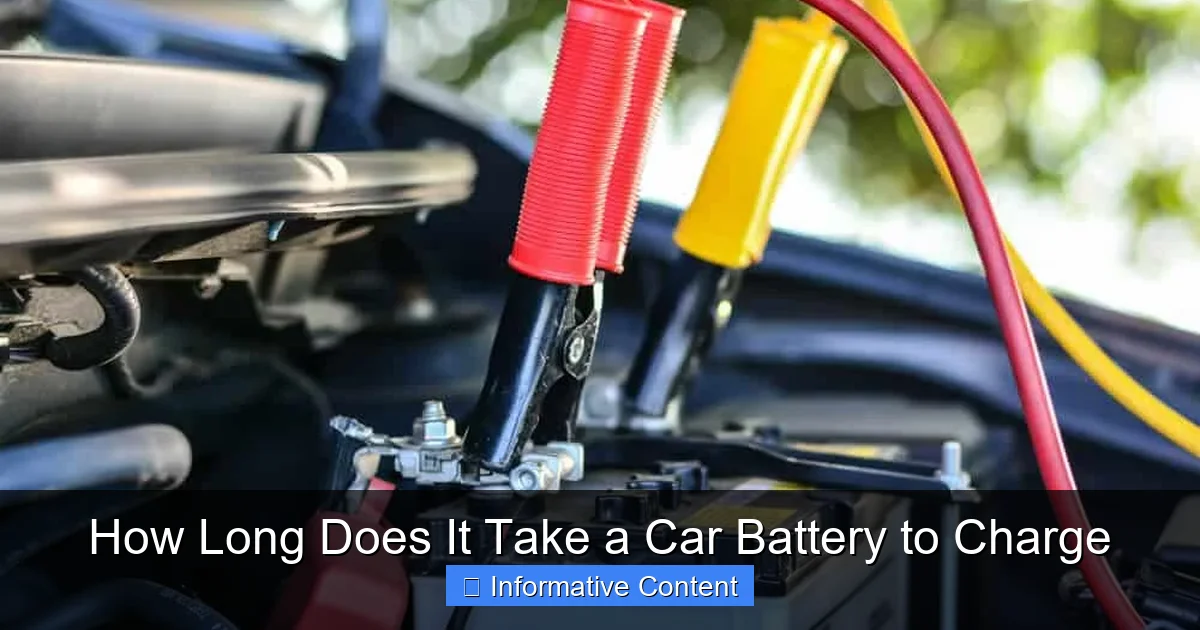
Understanding how long it takes a car battery to charge is crucial for any car owner. The time can vary significantly, ranging from as little as 1-4 hours with a rapid charger to 12-24 hours or more with a trickle charger, depending on the battery’s state of discharge, capacity, and the charger’s amperage. Factors like battery age and health, as well as ambient temperature, also play a vital role in the overall charging process and efficiency.
There’s nothing quite like the sinking feeling you get when you turn the key, and all you hear is a sad click, or worse, absolute silence. A dead car battery is a common inconvenience that most drivers will experience at some point. It leaves you stranded, scratching your head, and often wondering: “How long does it take a car battery to charge?”
The answer, as with many things automotive, isn’t a simple one-size-fits-all number. It depends on a variety of factors, from the type of charger you’re using to the condition of your battery. But don’t worry, we’re here to demystify the process. In this comprehensive guide, we’ll explore everything you need to know about charging your car battery, helping you get back on the road safely and efficiently.
Understanding these variables is key to not only charging your battery effectively but also for maintaining its health in the long run. Let’s dive in and explore the nuances of car battery charging times, so you’re prepared the next time your vehicle decides to take an unexpected power nap.
Key Takeaways
- Charging Time Varies Widely: The exact duration for how long does it take a car battery to charge depends significantly on its current state of discharge, its capacity (Ah), and the power output (amperage) of the charger being used.
- Charger Type is Key: Trickle chargers (low amperage, 1-2 amps) can take 12-24+ hours for a full charge. Smart/automatic chargers (4-10 amps) typically charge in 4-12 hours. Rapid chargers (15+ amps) might only need 1-4 hours, but use these with caution.
- Battery’s State of Discharge: A deeply discharged battery (e.g., below 10.5 volts) will naturally require much more time and a more careful charging approach to reach full capacity compared to one that’s only partially drained.
- Battery Health and Age Matter: Older, worn-out, or damaged batteries may charge very slowly, never reach full charge, or might not accept a charge at all, regardless of the charger used. Sometimes, a battery won’t hold a charge due to internal damage.
- Driving Recharges Too: After a jump-start, driving your car for at least 30-60 minutes at highway speeds can help the alternator recharge a partially drained battery. However, relying solely on the alternator for a deeply dead battery isn’t ideal for the battery or the alternator’s lifespan.
- Safety First: Always follow charger instructions, work in a well-ventilated area, wear safety glasses, and ensure correct polarity when connecting charger terminals to prevent accidents, sparks, or damage.
- Preventative Maintenance is Best: Regular battery checks, keeping terminals clean and tight, ensuring your car is driven frequently, and periodically testing your battery’s voltage can significantly extend its life and reduce the need for frequent emergency charging.
Quick Answers to Common Questions
Can I overcharge a car battery?
Yes, older or basic chargers can overcharge a battery, leading to damage from excessive heat and gassing. Modern smart chargers are designed to prevent overcharging by switching to a maintenance or float mode once the battery is full.
How long should I drive after a jump-start?
After a jump-start, you should drive your car for at least 30-60 minutes at highway speeds to allow the alternator to recharge the battery to a sufficient level. However, a dedicated charger is recommended for a full and proper charge.
Is it okay to leave a trickle charger on indefinitely?
Modern trickle chargers, often called “battery tenders,” are designed to be left on indefinitely as they switch to a float mode once the battery is fully charged, maintaining its voltage without overcharging. Older, unregulated trickle chargers might not be safe for long-term continuous use.
How do I know if my car battery is bad or just needs a charge?
If your battery won’t hold a charge even after an extended charging period, or if it quickly drains again after starting, it’s likely bad. You can also test its voltage with a multimeter; a healthy fully charged battery reads 12.6V-12.8V. Most auto parts stores can perform a free load test to determine its health.
Does cold weather affect battery charging?
Yes, cold weather significantly reduces a battery’s ability to accept and deliver a charge. Charging a very cold battery is less efficient and can even be damaging. It’s often recommended to warm a cold battery indoors before attempting a full charge.
📑 Table of Contents
Understanding Your Car Battery and How It Charges
Before we talk about charging times, it helps to understand what a car battery actually does and how it works. Most modern cars use a 12-volt lead-acid battery, often referred to as an SLI (Starting, Lighting, Ignition) battery. Its primary job is to provide a surge of power to start the engine, and then to stabilize the voltage for the car’s electrical systems once the engine is running. Once the engine starts, the alternator takes over, continuously recharging the battery as you drive.
The Basics of Battery Power
A car battery stores energy through a chemical reaction between lead plates and sulfuric acid. When you use the battery, this reaction generates electricity. When you charge it, the process reverses, replenishing the chemical energy. Batteries are rated in Amp-hours (Ah), which indicates how much current they can deliver over a certain period. For example, a 50 Ah battery can theoretically deliver 5 amps for 10 hours, or 10 amps for 5 hours. This capacity directly impacts how long does it take a car battery to charge.
Why Batteries Die
Batteries can die for several reasons. Leaving headlights on, a faulty alternator, parasitic drains (components drawing power even when the car is off), extreme temperatures, or simply old age can all lead to a discharged battery. The deeper the discharge, the more effort and time it will take to bring it back to full health. A completely dead battery might struggle to hold a charge, or might even be unrecoverable, depending on its condition.
Key Factors Influencing Car Battery Charging Time
When you ask, “how long does it take a car battery to charge?” you’re asking about a dynamic process. Several critical factors come into play, each significantly affecting the duration.
Visual guide about How Long Does It Take a Car Battery to Charge
Image source: automotiveplanner.com
Battery’s State of Discharge
This is perhaps the most significant factor. Is your battery completely dead, or just a bit low? A battery that has been drained from 12.6 volts (fully charged) down to 12.0 volts (50% charged) will naturally take far less time to top up than one that’s dropped to 10.5 volts (completely dead). A deeply discharged battery requires more time and a gentler charging approach to prevent damage.
- Slightly Discharged (12.4V-12.0V): A few hours.
- Moderately Discharged (12.0V-11.5V): 4-8 hours, depending on charger.
- Deeply Discharged (below 11.5V): 8-24+ hours, often requiring a smart charger with a ‘recovery’ mode.
Battery’s Capacity (Amp-Hours – Ah)
Larger batteries, often found in trucks, SUVs, or luxury vehicles, have higher Amp-hour ratings. A battery with an 80 Ah capacity will take longer to charge than a 40 Ah battery, assuming the same state of discharge and charger output. Think of it like filling a bigger bucket with water – it simply holds more, so it takes longer to fill. Most passenger car batteries typically range from 40 Ah to 70 Ah.
Charger Type and Amperage
The power output of your battery charger, measured in amps, is another crucial element. Chargers come in various strengths:
- Trickle Chargers (1-2 amps): These are slow and steady, ideal for long-term maintenance charging or for very deeply discharged batteries that need a gentle start. They can take 12-24+ hours to fully charge a standard car battery.
- Smart/Automatic Chargers (4-10 amps): These are the most common type for home use. They charge faster than trickle chargers and often have built-in microprocessors that monitor the battery’s state and adjust the charge rate. Most average car batteries will fully charge in 4-12 hours with these.
- Rapid/Fast Chargers (15+ amps, up to 40 amps): These can charge a battery in a few hours (1-4 hours typically). However, using high amperage can generate heat and potentially shorten the battery’s lifespan if not managed properly by a smart charger. Use these with caution and only if your battery is in good health.
Battery’s Age and Health
An older battery, typically past 3-5 years, or one that has been previously damaged (e.g., from deep discharges or physical trauma), won’t charge as efficiently as a new, healthy one. It might take longer, not reach full capacity, or even refuse to accept a charge altogether. Internal resistance increases with age, making the charging process less effective. If your battery constantly struggles to hold a charge, it might be time for a replacement, regardless of how long you try to charge it.
Temperature
Extreme temperatures, especially cold, can affect how long does it take a car battery to charge. Cold weather reduces the battery’s chemical activity, making it less efficient at accepting a charge. Charging a very cold battery can also be risky, as it might not accept a charge properly, leading to potential damage. It’s often recommended to warm up a very cold battery indoors before attempting to charge it.
Different Charging Methods and Their Timelines
Now that we understand the factors, let’s look at the practical aspects of how long does it take a car battery to charge using different methods.
Using a Dedicated Car Battery Charger (Home/Garage)
This is the safest and most effective way to fully charge a dead or low car battery. Always follow the manufacturer’s instructions for your specific charger, and ensure you’re working in a well-ventilated area.
Trickle Chargers (1-2 Amps)
- How they work: These deliver a low, constant current. They are excellent for maintaining a fully charged battery during long periods of storage (e.g., for seasonal vehicles) or for very gently bringing back a deeply discharged battery.
- Typical Charging Time: For a standard car battery, expect 12 to 24 hours, or even longer if the battery is severely discharged. They are too slow for an immediate fix.
- Best for: Maintenance, slow recovery of deeply discharged batteries (if they are still viable).
Smart/Automatic Chargers (4-10 Amps)
- How they work: These are the most popular choice for home use. They monitor the battery’s voltage and charge state, adjusting the current as needed. They typically go through stages: bulk charge, absorption charge, and float charge. Many also have desulfation modes for old batteries.
- Typical Charging Time: A moderately discharged battery (e.g., 50% charged) will generally take 4 to 8 hours to reach full charge. A deeply discharged battery might take 8 to 12 hours, or even more for larger batteries.
- Best for: General charging, periodic maintenance, and efficient recovery of most discharged batteries. They often automatically switch to a trickle/float mode once full, preventing overcharging.
Rapid/Fast Chargers (15-40 Amps)
- How they work: These deliver a high current, designed for quick recovery. Some also have engine start features.
- Typical Charging Time: For a standard car battery, a rapid charger can bring a deeply discharged battery to a usable state within 1 to 4 hours. However, charging too quickly with high amperage can generate significant heat, which can damage the battery internally over time.
- Best for: Emergency situations when you need to get back on the road quickly, assuming your battery is otherwise healthy. Use with caution and ideally choose a smart rapid charger that manages the current effectively.
Safety Tips for Home Charging:
- Always connect the positive (+) charger clamp to the positive (+) battery terminal first, then the negative (-) charger clamp to a ground point on the engine block or car chassis (away from the battery and fuel line), never directly to the negative terminal of the battery if charging while still in the car. This prevents sparks near battery gases. If charging the battery outside the car, connect negative to negative.
- Ensure good ventilation to dissipate hydrogen gas produced during charging.
- Wear eye protection and gloves.
- Keep the charger away from flammable materials.
- Never charge a visibly damaged, frozen, or leaking battery.
Jump-Starting and Then Driving
A jump-start provides an immediate burst of power to get your engine running. However, it does not fully charge your battery. Once your car is running, your alternator takes over the job of recharging the battery.
- How it works: Another vehicle or a portable jump starter supplies enough initial current to crank your engine. Once started, your car’s alternator begins to recharge the drained battery.
- Typical Recharging Time (via driving): After a successful jump-start, you’ll need to drive your car for at least 30-60 minutes, preferably at highway speeds (or at least consistently above idle) to allow the alternator sufficient time to replenish some of the battery’s charge. For a truly deeply dead battery, this might only get it to a functional level, not a full charge.
- Considerations: Relying solely on your alternator to fully charge a deeply dead battery can put excessive strain on the alternator, potentially shortening its lifespan. It’s always best to follow up a jump-start with a full charge using a dedicated battery charger if possible.
Professional Service
If you’re unsure about how long does it take a car battery to charge or if your battery simply isn’t holding a charge after trying to revive it, it might be time to visit a mechanic. They have specialized equipment to test the battery’s health, measure its cold cranking amps (CCA), and diagnose if the battery is truly dead or if there’s another issue with your car’s charging system (like a failing alternator).
Is Your Battery Actually Charging? Signs and Symptoms
How can you tell if your efforts are actually working and how long does it take a car battery to charge effectively? Here are a few indicators:
Charger Indicators
Most modern smart chargers have LED indicators that tell you the charging status. They might show “charging,” “charged,” “fault,” or a percentage of charge. Always refer to your charger’s manual for specific light meanings.
Voltage Readings
Using a multimeter, you can check the battery’s voltage. A fully charged 12-volt car battery should read around 12.6 to 12.8 volts when the engine is off and the charger is disconnected (after resting for a few hours). If the voltage slowly climbs while charging, it’s a good sign. If it stays consistently low or doesn’t rise, there might be an issue with the battery or charger.
Engine Starts Stronger
The most practical test is trying to start your car. If the engine cranks vigorously and starts without hesitation after a few hours of charging, your battery is likely in good shape and has accepted the charge. If it still cranks slowly or not at all, the battery might be beyond recovery or not fully charged yet.
Tips for Maintaining Battery Health to Avoid Frequent Charging
The best way to manage how long does it take a car battery to charge is to minimize how often you need to do it. Proactive maintenance can significantly extend your battery’s lifespan and reliability.
Drive Regularly
Short, infrequent trips don’t allow your alternator enough time to fully recharge the battery. If you primarily make short drives, consider taking a longer trip (30+ minutes) at highway speeds once a week or so, or use a trickle charger periodically.
Keep Terminals Clean and Tight
Corrosion (a white, powdery substance) on battery terminals can impede the flow of electricity, making it harder for the battery to charge and discharge efficiently. Clean them regularly with a wire brush and a baking soda solution. Ensure the terminal connections are tight.
Check Fluid Levels (for non-sealed batteries)
If you have a traditional flooded lead-acid battery (not a maintenance-free or AGM type), periodically check the electrolyte levels and top up with distilled water if needed. Low fluid levels expose the lead plates, leading to sulfation and reduced capacity.
Avoid Deep Discharges
Repeatedly letting your battery go completely dead significantly shortens its lifespan. If you know you’ll be storing your car for an extended period, use a battery tender or trickle charger to keep it topped up.
Test Your Battery Annually
Many auto parts stores offer free battery testing. This can help you understand your battery’s health and potential remaining lifespan, allowing you to replace it before it leaves you stranded.
Conclusion
So, how long does it take a car battery to charge? As we’ve seen, there’s no single answer, but rather a range that depends on your battery’s condition, its capacity, and the type of charger you employ. From a quick 1-hour boost with a rapid charger to a leisurely 24-hour trickle charge, the timeline varies considerably. The most common scenario, using a smart charger for a moderately discharged battery, usually falls within a 4 to 12-hour window.
Remember, while understanding charging times is important, prioritizing battery health through regular maintenance and avoiding deep discharges is even more crucial. A well-maintained battery will serve you reliably for years, minimizing those frustrating moments of a dead car and the need to ask how long does it take a car battery to charge in the first place. Stay safe, drive smart, and keep your battery in top shape!
🎥 Related Video: Best battery charging hack for dead batteries!!!!
📺 10 Minute Fix
Charging a dead battery is easy. Connect them in parallel then connect the charger to the know good battery. The charger will …
Frequently Asked Questions
What’s the difference between a jump-start and charging?
A jump-start provides an immediate surge of power from an external source (another car or jump pack) to get your engine running. Charging, on the other hand, is a slower process using a battery charger to replenish the chemical energy within the battery itself, bringing it back to full capacity.
Can I charge my car battery with a solar charger?
Yes, small solar chargers (often called solar maintainers) can be used to trickle charge or maintain a car battery, especially for vehicles stored outdoors. However, they are typically low-amperage and will take a very long time to fully charge a deeply discharged battery; they are better suited for maintenance.
How often should I charge my car battery if I don’t drive much?
If you don’t drive your car regularly (e.g., less than once a week or only for very short trips), it’s a good idea to connect it to a smart battery tender or trickle charger every few weeks, or continuously if possible, to keep it topped up and prevent deep discharge.
What are the signs of a fully charged car battery?
A fully charged 12-volt car battery will typically show a voltage reading of 12.6 to 12.8 volts after resting for a few hours (not immediately after charging). Modern smart chargers will usually indicate “charged” or switch to a float/maintenance mode.
Is it safe to charge a car battery indoors?
Yes, it can be safe to charge a car battery indoors if the area is very well-ventilated to disperse any hydrogen gas produced during charging, which is flammable. Always avoid charging in enclosed, unventilated spaces like a small closet or living area, and never near open flames or sparks.
Can a completely dead car battery be recharged?
A completely dead car battery (often reading below 10.5 volts) can sometimes be recharged, especially with a smart charger that has a “recovery” or “desulfation” mode. However, if the battery is old or deeply sulfated, it may not accept a charge, or it might charge but fail to hold a charge for long, indicating it needs replacement.