
Charging a dead car battery isn’t a one-size-fits-all answer; it critically depends on the charging method and battery’s condition. While a jump-start can get you going in minutes, fully recharging an empty battery with a standard charger can take anywhere from 4 to 24 hours, or even longer for severely depleted batteries. Maintaining the correct voltage and amperage is key to avoiding damage and ensuring a complete, healthy charge.
That sinking feeling. You turn the key, and instead of the familiar roar of your engine, you get… nothing. Maybe a click, maybe a pathetic whine, or perhaps just silence. A dead car battery is a universal experience, a minor automotive crisis that most drivers will face at some point. It’s frustrating, inconvenient, and often leaves you wondering, “Okay, it’s dead, now what?”
One of the most common questions that immediately pops into mind, once the initial panic subsides, is: One of the most common questions that immediately pops into mind, once the initial panic subsides, is: how long does a dead car battery take to charge? It’s a question without a single, simple answer, unfortunately. The time it takes can vary wildly depending on several crucial factors, from how truly “dead” your battery is to the type of charger you’re using. But don’t worry, we’re here to break it all down for you, like a seasoned mechanic chatting over coffee. Understanding the nuances of car battery charging isn’t just about getting back on the road quicker; it’s about protecting your battery, ensuring its longevity, and making informed decisions. So, let’s dive deep into the world of automotive power, exploring everything you need to know about bringing a lifeless battery back to life, and exactly how long does a dead car battery take to charge in various scenarios. For a moderately discharged or dead car battery, a standard 4-amp charger can take anywhere from 10-24 hours to fully replenish its charge. The exact time depends on how deeply discharged the battery is. Absolutely! Using a higher-amperage “fast charger” (10-20 amps) can significantly reduce the time, potentially charging your dead car battery in 2-4 hours, though it’s generally not recommended for regular use as it can stress the battery. After a successful jump-start, driving for at least 30 minutes to an hour at highway speeds is usually enough for your alternator to give a decent charge to your dead car battery. However, a full charge often requires more time or a dedicated charger. If your dead car battery is beyond simply needing a charge and tests as faulty or unable to hold a charge, it’s likely time for a replacement. No amount of charging will revive a truly failed battery. Several factors affect charging time, including the battery’s size and age, the charger’s amperage, and how deeply discharged the dead car battery actually is. Colder temperatures can also slow down the charging process. Before we talk about charging, let’s quickly understand what your car battery actually does. It’s not just a fancy brick; it’s the heart of your car’s electrical system, especially when it comes to getting things started. Primarily, your car battery provides a jolt of high-amperage current to start your engine. This initial burst of power kicks over the starter motor, which in turn gets the engine spinning. Once the engine is running, the alternator takes over, powering the car’s electrical systems and recharging the battery. Your battery also acts as a stabilizer for the car’s electrical system, ensuring consistent voltage for all components, from your radio to your headlights, even when the engine isn’t running. A dead battery doesn’t always mean a faulty battery. Often, it’s simply a lack of charge. Here are some of the usual suspects: So, you’re asking, how long does a dead car battery take to charge? The answer is complex because several key factors come into play. It’s not a one-size-fits-all situation. Visual guide about dead car battery charging time Image source: deltrixchargers.com This is perhaps the biggest factor. Is your battery merely discharged enough that it can’t start the engine (e.g., 50% charge), or is it completely, utterly flat (e.g., below 10% charge)? A battery that’s just a little low will obviously take much less time to charge than one that’s been drained to the point of not even being able to light a dash indicator. A truly “dead” battery, especially one that has been left flat for an extended period, might even be beyond saving or take an exceptionally long time to accept a charge. Just like a bigger fuel tank takes longer to fill, a larger car battery takes longer to charge. Battery capacity is typically measured in Amp-hours (Ah) or by its Cold Cranking Amps (CCA), which indicates its ability to start an engine in cold weather. A small car battery might be 40-50 Ah, while a large truck battery could be 80-100 Ah or more. A 60Ah battery will take roughly twice as long to charge as a 30Ah battery with the same charger. This is critical. Chargers come in different amperages (A), which dictates how quickly they can replenish your battery’s charge. The higher the amperage of your charger, the faster it will deliver current, and thus, the faster your battery will theoretically charge. An older battery, or one that has been deeply discharged multiple times, will not accept or hold a charge as efficiently as a new, healthy battery. Sulfation (a buildup of lead sulfate crystals on the battery plates) increases with age and deep discharges, reducing the battery’s capacity and making it harder to charge. If your battery is nearing the end of its life, it might never fully charge or hold that charge for long, no matter how long does a dead car battery take to charge. Temperature plays a role too. Batteries charge more efficiently in moderate temperatures. In very cold weather, the chemical reactions inside the battery slow down, meaning it will take longer to charge. Conversely, charging a battery in extremely hot conditions can also be detrimental. Now that we know the factors, let’s look at the practical side of things: how long does a dead car battery take to charge with different methods? Visual guide about dead car battery charging time Image source: cdn.hackaday.io Jump starting your car isn’t about fully charging your dead battery; it’s about giving it just enough juice to get the engine running. Once your engine is on, your car’s alternator takes over. You’ll typically need to drive the car for at least 20-30 minutes, or even an hour, for the alternator to put a decent amount of charge back into a moderately discharged battery. For a truly dead battery, relying solely on the alternator after a jump can be taxing and might not bring it back to a full, healthy state. The car usually starts within a minute or two of being connected to a donor battery, but how long does a dead car battery take to charge *fully* from the alternator varies greatly. This is the most effective and safest way to charge a dead car battery. Chargers come in various amperages, and the calculation is fairly straightforward (though approximate): However, this formula assumes 100% efficiency, which isn’t realistic. You also need to account for the battery not being completely empty and the charger reducing its output as the battery fills up. A good rule of thumb is to add 20-30% to the calculated time for real-world scenarios. Let’s consider a common 60 Ah (Amp-hour) car battery: Most modern battery chargers are “smart” chargers. They automatically detect the battery’s voltage and charge level, then adjust the charging current and voltage accordingly. They typically go through several stages: bulk charge, absorption charge, and float charge. This multi-stage process ensures efficient and safe charging, preventing overcharging. If you’re asking how long does a dead car battery take to charge when you’re not in a rush, or for long-term storage, a trickle charger or battery maintainer (typically 1-2 amps) is your friend. These chargers are designed for very slow, gentle charging and maintaining a battery’s full charge over extended periods (e.g., during winter storage for a classic car or motorcycle). While they *can* charge a dead battery, it will take a very, very long time – often days – and it’s generally better to start with a higher amperage charger if the battery is truly dead, then switch to a maintainer once it’s mostly charged. Some chargers offer “fast charge” modes or very high amperage settings (e.g., 50A or even an engine start mode of 100A+). While these can get your engine started in minutes, relying on them to fully charge a deeply dead battery for hours can be risky. High charging currents generate heat, which can damage the battery’s internal components, reduce its lifespan, and potentially cause gassing or even explosions in extreme cases (though modern chargers have safety features). It’s best to use fast charging only when absolutely necessary and always follow the charger’s instructions carefully. Here’s a rough idea of how long does a dead car battery take to charge, based on charger amperage for a common 60 Amp-hour (Ah) battery: Note: These are approximations. Actual times will vary based on battery health, initial charge level, and temperature. Once your car is running, either by jump-starting it or with a charger, your alternator takes over. But how effective is it at charging a truly dead battery? The alternator is an electrical generator driven by the engine’s accessory belt. It converts mechanical energy into electrical energy, which powers your car’s electrical systems (lights, radio, wipers, etc.) and, crucially, recharges your battery. It’s designed to maintain your battery’s charge, not to resurrect a completely flat one. Technically, yes, an alternator can eventually charge a dead battery. However, it’s not its primary job, and it’s not the most efficient or safest method. If your battery is completely flat, asking the alternator to fully recharge it is like asking a marathon runner to sprint the entire race. It puts a significant strain on the alternator, which can lead to premature wear and tear. Furthermore, it might take a very long time (several hours of driving) to put a decent charge back into a truly dead battery, and even then, it might not bring it back to a full, healthy 100% state. It’s much better to use a dedicated battery charger to fully replenish a dead battery. If you find yourself constantly asking, “how long does a dead car battery take to charge?” because it keeps dying, your alternator might be the problem. Look for these signs: Sometimes, no matter how long does a dead car battery take to charge, it just won’t hold the charge anymore. At this point, charging becomes a temporary band-aid, and replacement is the only real solution. Most car batteries last between 3 to 5 years. This can vary based on climate (hot climates are harder on batteries), driving habits, and maintenance. Once a battery goes beyond this age range, its internal components degrade, and its ability to hold a charge significantly diminishes. Keep an eye out for these indicators that your battery might be on its last legs: While a new battery is an expense, it’s often far less costly and less stressful than being stranded with a dead one. If your battery is old and showing signs of decline, investing in a new one is a wise preventive measure. Trying to squeeze every last drop of life out of a dying battery often leads to more inconvenience and potential damage to other electrical components. Prevention is always better than cure. By taking a few simple steps, you can extend your battery’s life and avoid the frustration of a dead battery. Make sure you drive your car regularly, for at least 20-30 minutes at highway speeds. This allows the alternator enough time to fully recharge the battery after starting and helps maintain its health. Short trips don’t give the alternator enough time to work its magic. Inspect your battery terminals periodically for corrosion. A buildup of white or bluish powder can hinder electrical flow. Clean the terminals with a wire brush and a mixture of baking soda and water. Ensure all connections are tight and secure. Some older or specific types of lead-acid batteries (not maintenance-free ones) have caps that allow you to check the electrolyte levels. If the levels are low, carefully top them off with distilled water (never tap water). Always wear protective eyewear and gloves. Try not to let your battery die completely. Each deep discharge takes a toll on the battery’s lifespan. If you leave lights on or have a parasitic drain, address it promptly. If you store your car for extended periods (weeks or months), connect it to a battery maintainer. These low-amperage chargers will keep your battery topped off without overcharging, preventing it from going flat. This is particularly useful in knowing how long does a dead car battery take to charge if you want to avoid it ever being completely dead. Many auto parts stores offer free battery and charging system tests. It’s a quick way to gauge your battery’s health and catch potential issues before they leave you stranded. Get it tested once a year, especially before winter. So, how long does a dead car battery take to charge? As we’ve explored, there’s no single magic number. It’s a blend of factors: how depleted your battery is, its size and age, the type of charger you’re using, and even the temperature around it. A quick jump-start might get you going in minutes, but a full, healthy charge could take anywhere from a few hours with a strong charger to an entire day (or more!) with a slower, gentler one. The key takeaway is patience and using the right tool for the job. While a fast charger might seem appealing when you’re in a hurry, a slower, multi-stage “smart” charger is generally better for your battery’s long-term health. And remember, sometimes charging isn’t enough; if your battery is old or repeatedly dies, it might be time for a replacement. By understanding these dynamics and following some simple maintenance tips, you can extend your battery’s life and significantly reduce the chances of ever having to ask, “how long does a dead car battery take to charge?” again.
📺 Jack Of All Trades Master of None
An easy way calculate how long it will take to charge a battery. A completely dead car battery typically takes between 4 to 24 hours to fully charge using a standard 4-10 amp car battery charger. The exact time depends on the battery’s capacity (Amp-hour rating), its current state of discharge, and the charger’s output. Several factors affect the charging duration, including the battery’s Amp-hour (Ah) rating, its current state of discharge, the ambient temperature, and the specific output (amperage) of your battery charger. A larger battery or a lower amperage charger will naturally take longer to achieve a full charge. A trickle charger (1-2 amps) can take 24-48 hours or even longer to fully charge a completely dead car battery due to its very low output. A faster charger (10 amps or more) can significantly reduce this time, potentially charging the battery in 4-8 hours, but should be monitored to prevent overcharging. After a jump start, you generally need to drive for at least 30 minutes to an hour at highway speeds to allow your alternator to sufficiently recharge a mostly dead car battery. For a deeply discharged battery, a longer drive or subsequent use of a dedicated battery charger is often recommended to ensure a complete charge. Most modern battery chargers have an indicator light that changes color or shows “full” when the charging cycle is complete. You can also use a multimeter to check the voltage; a fully charged 12V car battery should read around 12.6 to 12.8 volts when the engine is off and hasn’t been recently driven. If your dead car battery doesn’t hold a charge or quickly dies again after several hours of charging, it likely indicates the battery is internally damaged or has reached the end of its lifespan. In such cases, the battery usually needs to be replaced rather than simply recharged, as it can no longer store power effectively.Key Takeaways
Quick Answers to Common Questions
How long does it usually take to charge a dead car battery with a typical charger?
Can I speed up the charging process for my dead car battery?
If I jump-start my car, how long do I need to drive to charge the dead car battery?
What if my car battery is completely dead and won’t even hold a charge?
What factors influence how long it takes to charge a dead car battery?
📑 Table of Contents
Understanding Your Car Battery: More Than Just a Box of Power
What Exactly Does a Car Battery Do?
Common Reasons for a Dead Battery
Factors Influencing Car Battery Charging Time
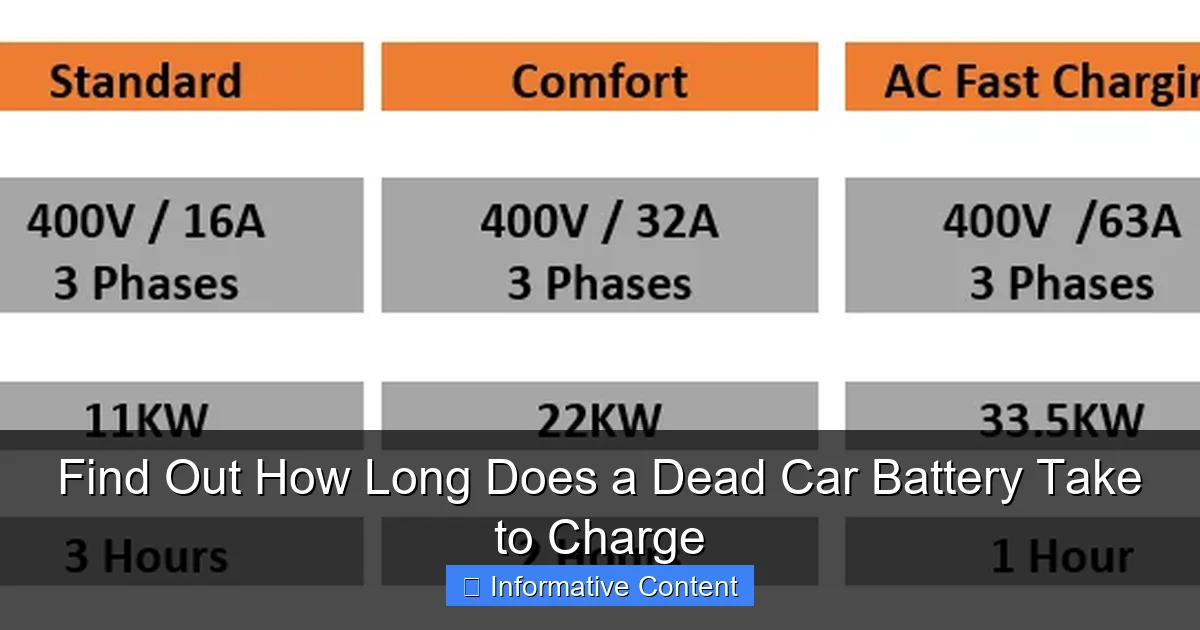
How Dead Is “Dead”?
Battery Size and Capacity
Type of Charger Used
Battery’s Age and Health
Ambient Temperature
Different Charging Methods and Their Timelines
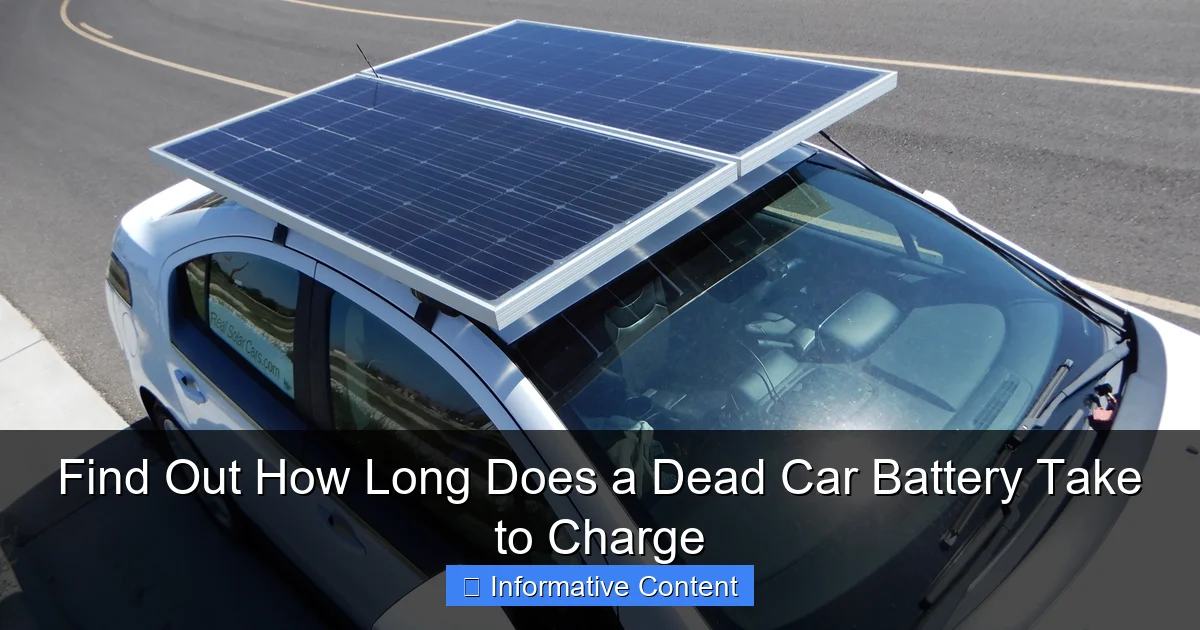
Jump Starting: A Quick Fix, Not a Full Charge
Using a Standard Car Battery Charger: The Most Common Approach
Charging Time (Hours) = Battery Capacity (Ah) / Charger Amperage (A)The Role of a Trickle Charger or Battery Maintainer
Fast Chargers and Their Risks
Quick Guide: Estimated Charging Times for a 60Ah Battery
Charger Amperage Estimated Charging Time (from ~20% charge) Best Use Case 1-2 Amps (Trickle/Maintainer) 30-45 hours Battery maintenance, very slow charging of slightly low battery, long-term storage. 4 Amps (Standard Charger) 15-20 hours Overnight charge for moderately dead battery. Safe and gentle. 10 Amps (Standard/Mid-Range Charger) 6-10 hours Faster recovery for a dead battery; good balance of speed and safety. 20 Amps (Fast Charger) 3-5 hours When time is of the essence; usually has automatic shut-off to prevent overcharging. Engine Start (>50 Amps) Minutes (to start engine) Emergency starting. Not for full charging; use only briefly. The Role of Your Alternator: Charging on the Go
How the Alternator Works
Can My Alternator Fully Charge a Dead Battery?
Signs of a Failing Alternator
Beyond Charging: When to Replace Your Battery
Average Battery Lifespan
Warning Signs of a Dying Battery
The Cost-Benefit of Replacement
Essential Tips for Battery Longevity and Health
Regular Driving
Keep It Clean
Check Water Levels (for non-sealed batteries)
Avoid Deep Discharges
Use a Maintainer for Storage
Get It Tested Periodically
Conclusion
🎥 Related Video: How Long Does It Take to Charge a Battery?
Frequently Asked Questions
How long does a dead car battery take to charge with a standard charger?
What factors influence how long it takes to charge a dead car battery?
How long does it take to charge a dead car battery with a trickle charger versus a faster charger?
How long do I need to drive to charge a dead car battery after a jump start?
How do I know when my dead car battery is fully charged?
What if my dead car battery won’t hold a charge after several hours?