
Hybrid car batteries are ingeniously recharged by the vehicle itself through multiple dynamic internal mechanisms, eliminating the need for external plugging. The gasoline engine acts as a generator, converting fuel into electricity to directly charge the battery or assist in propulsion. Furthermore, a crucial process called regenerative braking captures energy typically lost during deceleration and braking, transforming it back into usable electricity to replenish the battery, significantly boosting efficiency.
Hey there, fellow car enthusiast! Have you ever found yourself at a red light, watching your hybrid car seamlessly switch from gasoline power to electric, and thought, “Wow, how does it do that? And more importantly,
For many of us, the idea of a car that partially powers itself seems like something out of a sci-fi movie. We’re used to filling up with gas or, more recently, plugging in an all-electric vehicle. But hybrids occupy a unique space, offering a blend of traditional and futuristic tech. They promise better fuel economy and reduced emissions without the range anxiety of an EV, largely thanks to their clever battery charging mechanisms. Understanding
So, let’s pull back the curtain and clearly explain the magic behind your hybrid’s power source. We’re going to dive deep into the smart ways these cars keep their electric batteries topped up, ensuring a smooth, efficient, and surprisingly self-sufficient driving experience. Get ready to understand the ingenious systems that answer the question:
Key Takeaways
- Regenerative Braking Recovers Energy: Captures kinetic energy, recharging the battery when slowing down.
- Engine Charges Battery Automatically: The gasoline engine acts as a generator, topping up the battery.
- No External Charging Required: Standard hybrids self-charge; you never plug them in.
- Computer Manages Charging Smartly: Optimizes power flow for efficiency and battery longevity.
- Charging Boosts Fuel Economy: Repurposes wasted energy, reducing gasoline consumption significantly.
- Seamless Power Transitions: Experience smooth shifts between electric, gas, and charging modes.
- Battery Always Stays Charged: Your hybrid continuously recharges its battery while driving.
Quick Answers to Common Questions
Do I need to plug in a hybrid car to charge its battery?
For a standard hybrid car (HEV), absolutely not! These vehicles efficiently manage their own power, meaning you never have to worry about plugging them in to charge.
So, how does the battery charge in a hybrid car without a plug?
Great question! The battery primarily charges through two clever methods: regenerative braking and by the car’s gasoline engine acting as a generator when needed.
What exactly is “regenerative braking”?
Regenerative braking is a smart system that captures kinetic energy usually lost during deceleration and braking, converting it back into electricity to replenish your hybrid car’s battery. It’s like recycling energy!
Does the gasoline engine actually help charge the battery?
Absolutely! When driving, the gasoline engine can not only power the wheels but also act as a generator to actively help charge the battery in your hybrid car, especially at cruising speeds or when the battery’s charge is low.
Can the hybrid battery ever completely run out of charge while I’m driving?
No, you don’t need to worry about that. The car’s computer system constantly monitors and manages the battery’s charge level, ensuring it always has enough power to assist the engine and never fully depletes.
📑 Table of Contents
- The Core Concept: What Powers a Hybrid and Why Charging Matters
- Regenerative Braking: The “Free Energy” System
- The Gasoline Engine’s Role in Battery Charging
- Exploring Different Hybrid Architectures and Their Charging Nuances
- Intelligent Battery Management Systems: The Brains Behind the Charge
- Practical Tips for Maximizing Your Hybrid’s Battery Life and Efficiency
- Conclusion
The Core Concept: What Powers a Hybrid and Why Charging Matters
Before we explore the “how,” let’s quickly touch on the “what” and “why.” A hybrid car is essentially a team effort between a gasoline engine and an electric motor (or sometimes multiple motors). They work in harmony, switching roles or combining forces to power the wheels, depending on the driving conditions. This synergy is what makes hybrids so efficient, but it all hinges on a well-maintained and properly charged electric battery.
The Synergy of Electric and Gasoline Power
Think of your hybrid as having two hearts. One is the familiar internal combustion engine, burning gasoline to create power. The other is an electric motor, drawing energy from a high-voltage battery. The beauty of a hybrid is its ability to decide which “heart” to use, or even both simultaneously, for optimal performance and fuel economy. At low speeds, often the electric motor takes over, providing silent, emission-free propulsion. When you need more power, like accelerating onto a highway, the gasoline engine kicks in to assist. This constant dance between the two power sources is made possible because the electric battery is always ready to supply power.
Why Battery Health is Crucial
The high-voltage battery in your hybrid isn’t just a power source; it’s the central hub for energy management. It stores the electrical energy needed to power the electric motor, but it also acts as a reservoir for energy recuperated from other systems. If this battery isn’t efficiently charged and discharged, the entire hybrid system loses its effectiveness. A healthy battery means your car can maximize its electric-only driving, reduce reliance on the gasoline engine, and ultimately deliver on its promise of better fuel efficiency. So, understanding
Regenerative Braking: The “Free Energy” System
This is arguably the most fascinating and impactful way
Visual guide about hybrid car battery charging
Image source: car-images.bauersecure.com
How Kinetic Energy Becomes Electrical Energy
When you take your foot off the accelerator or press the brake pedal in a traditional car, friction brakes slow the vehicle down, generating heat – a pure waste of energy. In a hybrid, a significant portion of that kinetic energy (the energy of motion) is captured. Here’s how it works:
- Instead of solely relying on friction brakes, the electric motor reverses its function and acts as a generator.
- As the wheels turn the motor, it creates electrical resistance, which helps slow the car down.
- This electrical energy is then sent to the high-voltage battery, effectively recharging it.
- Only when more braking force is needed, or at very low speeds, do the traditional friction brakes fully engage.
It’s like having a tiny power plant built right into your braking system! This process is a huge contributor to
Practical Benefits in City Driving
Regenerative braking is particularly effective in stop-and-go traffic and city driving. Every time you slow down for a traffic light, stop sign, or just ease off the accelerator, your hybrid is recuperating energy. This constant regeneration means the battery is frequently topped up, allowing the electric motor to be used more often. This directly translates to:
- Better Fuel Economy: Less reliance on the gasoline engine means fewer trips to the pump.
- Reduced Brake Wear: Because the electric motor does much of the initial braking, your traditional brake pads and rotors last significantly longer, saving you money on maintenance.
Feeling the Difference: A Driver’s Perspective
You might even feel regenerative braking at work. In some hybrids, particularly plug-in models with stronger regeneration settings, lifting your foot off the accelerator might feel like a gentle braking sensation. This is the car actively recovering energy. Many hybrids also have an energy flow display on the dashboard that shows you exactly when energy is being sent back to the battery during braking. It’s a satisfying visual cue that your car is being incredibly efficient and actively managing
The Gasoline Engine’s Role in Battery Charging
While regenerative braking is fantastic, it can’t always do all the heavy lifting, especially on long highway drives where braking is infrequent. This is where the gasoline engine steps in to ensure
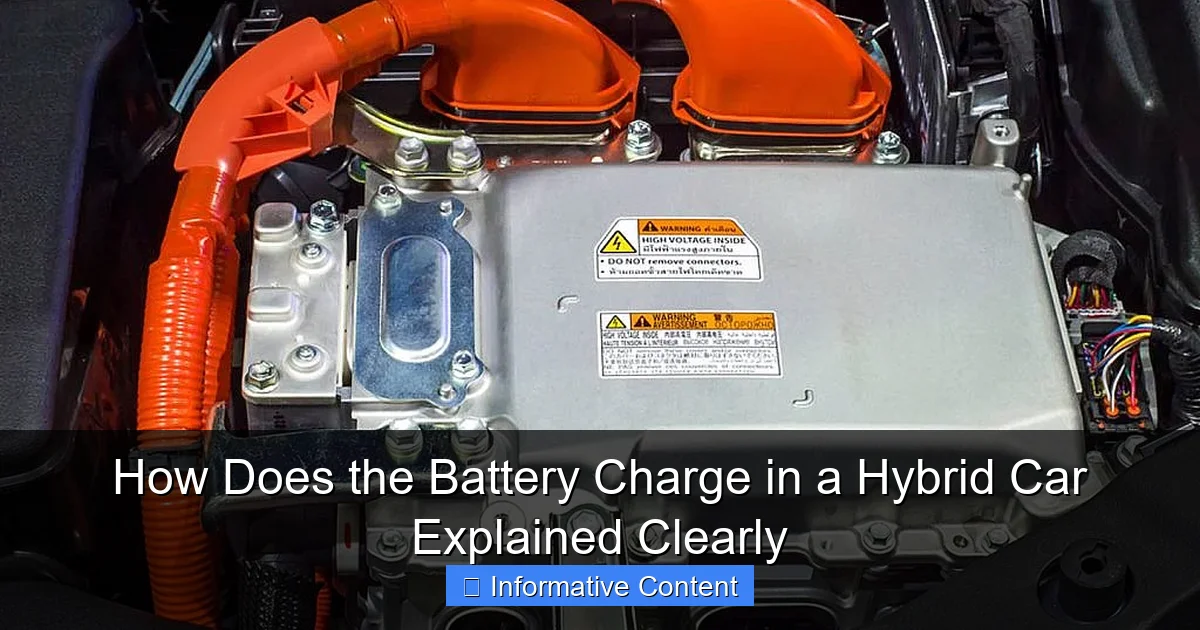
Visual guide about hybrid car battery charging
Image source: d2hucwwplm5rxi.cloudfront.net
The Engine as a Generator: Series Hybrid Explained
In some hybrid designs, particularly “series hybrids” (though less common in mainstream passenger cars now, older extended-range EVs like the Chevy Volt used a similar principle when the battery was depleted), the gasoline engine’s primary job isn’t to directly power the wheels. Instead, it acts purely as a generator. Here’s the simplified breakdown:
- The gasoline engine runs to spin a generator.
- This generator produces electricity.
- The electricity can then either power the electric motor directly or charge the high-voltage battery.
- The wheels are always driven by the electric motor.
This setup allows the engine to run at its most efficient RPM (revolutions per minute) to generate electricity, which is then used to keep the battery charged and propel the car. This is a very direct answer to
Power-Split Devices: Parallel and Series-Parallel Hybrids
Most modern full hybrids (like the Toyota Prius, for example) use a “series-parallel” or “power-split” hybrid system. This is where things get really clever. A special planetary gear set allows the gasoline engine, electric motor(s), and wheels to all be connected in a way that allows for incredible flexibility. In these systems, the engine can:
- Directly power the wheels: Just like a conventional car.
- Charge the battery: The engine can simultaneously power a generator to send electricity to the battery.
- Assist the electric motor: Both engine and motor work together to power the wheels.
This dynamic interplay ensures that no matter the driving condition, the system can efficiently manage power flow and continuously address
When Does the Engine Charge the Battery?
The car’s sophisticated computer brain constantly monitors battery charge levels, driving conditions, and driver input to decide when the engine should charge the battery. This often happens:
- When the battery’s state of charge drops below a certain threshold: The system will activate the engine to bring the battery back up to an optimal level, even if the car is stationary or cruising.
- During cruising speeds: On the highway, when the engine is running efficiently to maintain speed, it can spare some power to run a generator and top up the battery.
- To prepare for future demand: If the car anticipates a need for more electric power (e.g., approaching a downhill section where regenerative braking will be effective, or preparing for city driving after a highway stretch), it might proactively charge the battery.
It’s a testament to the intelligent design of these vehicles that they autonomously manage
Exploring Different Hybrid Architectures and Their Charging Nuances
Not all hybrids are created equal! The term “hybrid” encompasses a range of technologies, each with slightly different approaches to
Mild Hybrids (MHEV): Subtle Electric Boost
Mild hybrids are the entry point into the hybrid world. They typically use a smaller electric motor and battery pack, usually 48-volt systems, that primarily assist the gasoline engine. The electric motor can:
- Provide a small boost during acceleration.
- Allow for longer engine shut-off periods when idling or coasting (more advanced start/stop systems).
- Assist with regenerative braking to recoup some energy.
In a mild hybrid, the electric motor can’t power the car on its own for any significant distance or speed. The charging of the battery in a mild hybrid car is almost exclusively handled by regenerative braking and the gasoline engine acting as a generator. It’s about efficiency assistance rather than full electric propulsion.
Full Hybrids (HEV): The Self-Charging Workhorses
These are what most people think of when they hear “hybrid car” – models like the Toyota Prius, Honda Insight, or Ford Fusion Hybrid. Full hybrids have larger batteries and more powerful electric motors than mild hybrids. They can:
- Drive solely on electric power for short distances at lower speeds (typically up to 25-40 mph, for a mile or two).
- Combine electric and gasoline power for stronger acceleration.
- Operate in various modes depending on driving conditions.
The key characteristic of a full hybrid is that it’s truly “self-charging.” It relies on a combination of regenerative braking and the gasoline engine running a generator to keep its battery topped up. You never plug it in. This is the classic example of
Plug-in Hybrids (PHEV): The Best of Both Worlds and External Charging
Plug-in hybrids, like the Toyota RAV4 Prime, Hyundai Santa Fe Plug-in Hybrid, or Volvo S60 Recharge, offer the most electric range among hybrids. They have significantly larger batteries than full hybrids, allowing them to travel much farther on electric power alone (often 20-50 miles, sometimes more). Here’s what makes them different:
- External Charging: This is the big differentiator. PHEVs can be plugged into an external power source (a standard household outlet or a dedicated EV charging station) to fully charge their larger battery packs. This allows for daily commutes to be done entirely on electric power.
- Internal Charging Still Present: Even though you can plug them in, PHEVs still employ regenerative braking and can use their gasoline engine to charge the battery, just like a full hybrid. This ensures that even if you can’t plug in, or if your electric range runs out, the car still functions as an efficient full hybrid.
So, for a PHEV, the answer to
| Hybrid Type | Primary Internal Charging Methods | External Charging Option? | Key Benefit |
|---|---|---|---|
| Mild Hybrid (MHEV) | Regenerative Braking, Gasoline Engine (as generator) | No | Basic efficiency boost, enhanced start/stop |
| Full Hybrid (HEV) | Regenerative Braking, Gasoline Engine (as generator) | No | Significant fuel economy, short electric-only drives |
| Plug-in Hybrid (PHEV) | Regenerative Braking, Gasoline Engine (as generator) | Yes (Household outlet, Level 2 charger) | Extended electric-only range, option for internal/external charging |
Intelligent Battery Management Systems: The Brains Behind the Charge
All these clever charging methods wouldn’t work seamlessly without a super-smart Battery Management System (BMS). This isn’t just a simple on/off switch; it’s the sophisticated brain that constantly monitors, controls, and optimizes
Optimizing Charge and Discharge Cycles
Hybrid batteries aren’t like your smartphone battery that you charge to 100% and drain to 0%. They operate within a much narrower “sweet spot” of charge. For example, a hybrid battery might only ever charge to 80% and discharge to 20%, even though it has a higher actual capacity. The BMS ensures this precise range is maintained. This approach is critical for:
- Longevity: Keeping the battery away from its extreme charge levels significantly extends its lifespan.
- Efficiency: It ensures there’s always room to accept regenerated energy and always enough power available for acceleration.
The BMS constantly decides whether to charge, discharge, or hold the current state of charge based on real-time data from hundreds of sensors. It’s the hidden hero in answering
Protecting the Battery for Longevity
Beyond just managing charge levels, the BMS protects the battery from all sorts of potential harm:
- Temperature Control: Hybrid batteries are sensitive to extreme temperatures. The BMS monitors battery temperature and activates cooling or heating systems (liquid cooling, air cooling) to keep it within an optimal operating range.
- Cell Balancing: Batteries are made up of many individual cells. Over time, some cells might charge or discharge slightly differently. The BMS actively balances these cells, ensuring they all work uniformly, which prevents premature aging of weaker cells.
- Overcharge/Over-discharge Protection: It prevents the battery from being charged too much or drained too low, both of which can cause permanent damage.
This protective layer is why hybrid batteries often last for many years and hundreds of thousands of miles, far exceeding initial expectations.
Real-time Monitoring and Driver Feedback
The BMS also communicates critical information to the car’s central computer and, in turn, to you, the driver. On your dashboard, you’ll often see an energy flow diagram showing:
- When the electric motor is powering the wheels.
- When the gasoline engine is running.
- When regenerative braking is sending power back to the battery.
- The current state of charge of the high-voltage battery.
This real-time feedback not only satisfies your curiosity about
Practical Tips for Maximizing Your Hybrid’s Battery Life and Efficiency
Understanding
Driving Habits for Optimal Regenerative Braking
Since regenerative braking is a huge source of battery charging, driving smoothly can significantly improve your efficiency:
- Anticipate Traffic: Look far ahead and try to coast to a stop rather than braking sharply. This allows the regenerative braking system more time to convert kinetic energy back into electricity.
- Gentle Braking: Apply the brakes smoothly and gradually. This keeps the car in regenerative braking mode for longer before the friction brakes engage. Heavy, sudden braking relies more on traditional brakes and wastes more energy.
- Downhill Coasting: On long descents, instead of riding your brakes, gently modulate the accelerator and brake to maximize regenerative braking and recharge your battery. Many hybrids will show the battery charging during these times, a clear indication of
how does the battery charge in a hybrid car through gravity!
Understanding Your Hybrid’s Energy Flow Display
Your hybrid’s dashboard often features a detailed energy flow display. Make it your friend! Observing this display will show you:
- When your car is running on electric power alone.
- When the gasoline engine is assisting or taking over.
- When energy is flowing back into the battery from regenerative braking or the engine.
By watching this, you can learn to modify your driving style to keep the car in electric mode longer, maximize regeneration, and truly grasp the dynamic process of
Regular Maintenance and Battery Health Checks
While hybrid batteries are designed for longevity, proper maintenance is still key:
- Follow Manufacturer’s Schedule: Adhere to your car’s recommended service intervals. This ensures all systems, including the hybrid components, are checked.
- Keep Cooling Vents Clear: Hybrid batteries often have dedicated cooling vents (usually in the rear cabin or trunk area). Ensure these are not blocked by luggage or debris, as proper airflow is crucial for battery temperature management and overall health.
- Diagnostic Scans: If you ever notice a warning light related to your hybrid system, have it checked promptly. Early diagnosis can prevent bigger issues.
A well-maintained hybrid system ensures that the intricate dance of
Conclusion
So, there you have it! The next time you’re driving your hybrid, you’ll know that its seemingly magical ability to power itself isn’t magic at all, but rather a brilliant orchestration of engineering. From the clever capture of kinetic energy through regenerative braking to the gasoline engine acting as an on-demand generator, and the vigilant oversight of the Battery Management System, every component plays a crucial role in
Whether you own a mild hybrid assisting your drive, a full hybrid confidently self-charging as you navigate the city, or a plug-in hybrid offering the flexibility of external charging alongside its internal systems, the core principles remain the same. These vehicles are designed to be efficient, intelligent, and surprisingly self-sufficient.
Understanding these mechanisms not only demystifies your car but also empowers you to drive in a way that maximizes its potential, saving you fuel and extending the life of your vehicle. It’s a truly elegant solution to efficient transportation, constantly working to ensure your journey is as smooth and economical as possible. I hope this clear explanation has answered all your questions about
🎥 Related Video: How Do Hybrid Electric Cars Work?
📺 History of Simple Things
Hybrid vehicles are everywhere, but how do they actually work? From their seamless transition between gasoline and electric …
Frequently Asked Questions
How does the battery charge in a hybrid car?
Hybrid cars primarily charge their high-voltage battery through two main methods: regenerative braking and the gasoline engine. The car’s intelligent system continuously manages these processes to keep the battery at an optimal charge level without external plugging.
Do I need to plug in my hybrid car to charge its battery?
No, traditional “self-charging” hybrid cars do not require external plugging to charge their batteries. Their batteries are automatically recharged by the car’s own systems, including the gasoline engine and energy recovered during braking. Only Plug-in Hybrid Electric Vehicles (PHEVs) typically need to be plugged in to fully charge their larger batteries.
What role does regenerative braking play in charging the hybrid battery?
Regenerative braking is a crucial method for charging the hybrid battery. When you slow down or apply the brakes, the electric motor acts as a generator, converting kinetic energy that would otherwise be lost as heat back into electricity. This electricity is then stored in the high-voltage battery, efficiently recouping energy.
Does the gasoline engine help to charge the hybrid car’s battery?
Yes, the gasoline engine plays a significant role in charging the hybrid car’s battery. When the battery charge level drops below a certain point, or under specific driving conditions, the engine can run an internal generator to produce electricity. This ensures the battery remains sufficiently charged to power the electric motor when needed.
How do hybrid cars prevent their batteries from overcharging?
Hybrid cars employ sophisticated battery management systems (BMS) to prevent overcharging. The BMS constantly monitors the battery’s state of charge, temperature, and voltage, regulating the incoming power from both regenerative braking and the gasoline engine. This ensures the battery operates within its safe parameters, protecting its longevity and performance.
Is the hybrid battery constantly charging while I drive?
The hybrid battery isn’t necessarily *constantly* charging, but its charge level is continually managed by the car’s system. The car’s computer decides when to engage regenerative braking or use the engine to generate power based on driving conditions and the battery’s current state of charge. This dynamic process optimizes fuel efficiency and battery life.