
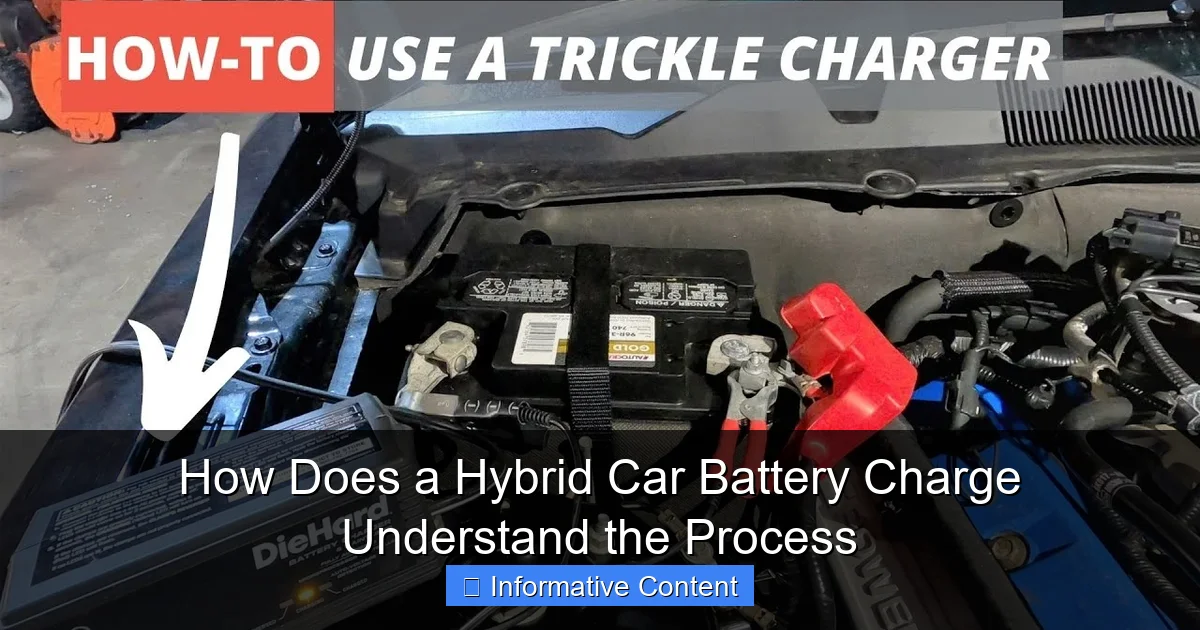
A hybrid car battery primarily charges itself dynamically through two ingenious methods: regenerative braking and the internal combustion engine acting as a generator, negating the need for external plug-in charging. When decelerating or braking, the electric motor captures kinetic energy and converts it into electricity for storage, while the gasoline engine can also generate power to replenish the battery, ensuring constant efficiency and extended electric driving capability.
How Does a Hybrid Car Battery Charge Understand the Process
Hey there, fellow car enthusiast! Have you ever wondered about the magic happening under the hood of a hybrid car? It’s a bit like having a silent, efficient partner working tirelessly to save you fuel and reduce emissions. But for many, the inner workings, especially
When I first started looking into hybrids, I admit, I felt a little lost. Terms like “regenerative braking” and “power split device” sounded like something out of a sci-fi movie. But once you break it down, it’s truly ingenious. The confusion often stems from the fact that hybrids aren’t just one thing; they come in various forms, and each manages its energy a little differently. However, the fundamental principles of
Today, let’s pull back the curtain and explore this process together. Think of me as your guide, simplifying the jargon and giving you a clear picture of what’s happening beneath your car’s sleek exterior. By the end of this, you’ll not only understand
Key Takeaways
- Regenerative Braking Powers Up: Deceleration converts kinetic energy into battery charge.
- Engine Acts as a Generator: The gasoline engine charges the battery too.
- Hybrids Self-Charge Continuously: No need for external plug-in to recharge.
- Computer Manages Charging: Optimize power delivery and battery health.
- Excess Engine Power Stored: Converts surplus engine energy into electrical charge.
- Energy Recovery is Key: Maximizes efficiency by reusing generated power.
- Battery Never Fully Drains: The system maintains an optimal charge level.
Quick Answers to Common Questions
Do I need to plug in a hybrid car to charge its battery?
Nope, most conventional hybrid cars are self-charging! You don’t need to plug them in; the system handles the hybrid car battery charge automatically as you drive.
How does a hybrid car battery charge while I’m driving?
Your hybrid car’s gasoline engine can act as a generator to replenish the battery while driving. It’s a smart system that keeps the hybrid car battery charge optimized for efficiency.
Does braking help charge the battery?
Absolutely! Hybrid cars use a clever feature called regenerative braking. Instead of just wasting energy as heat, braking converts kinetic energy back into electricity to charge the hybrid car battery.
What about when the car is idling or coasting?
Even then, your hybrid is working smart! The engine or even the wheels can generate electricity to top up the battery, ensuring your hybrid car battery charge is ready for electric-only driving.
Can a hybrid car battery ever completely run out of charge?
Not typically in normal operation! The car’s computer constantly manages the hybrid car battery charge, making sure there’s always enough power for both electric assistance and to restart the engine if needed.
📑 Table of Contents
- The Core Components: What Makes a Hybrid Tick?
- Regenerative Braking: Capturing Lost Energy
- Charging On the Go: The Engine’s Role
- The Different Flavors of Hybrid Charging (and Battery Management)
- Intelligent Power Management: The Brains Behind the Charge
- Maintaining Your Hybrid Battery: Longevity Tips
- Conclusion
The Core Components: What Makes a Hybrid Tick?
Before we dive into
Internal Combustion Engine (ICE)
This is the familiar gasoline engine, similar to what you’d find in a conventional car. In a hybrid, its primary role is still to provide power to the wheels. However, it also plays a crucial part in
Electric Motor(s)
Hybrid cars typically feature one or more electric motors. These motors are incredibly versatile. They can drive the wheels, assist the gasoline engine, and, most importantly for our discussion, act as generators. When the car decelerates or brakes, these motors switch roles and become generators, converting kinetic energy back into electricity to charge the battery. This is a key aspect of
The High Voltage (HV) Battery Pack
This is the star of our show, the power reservoir for the electric motor. Unlike the small 12-volt battery that starts your conventional car, the HV battery in a hybrid is much larger, operates at a higher voltage (often hundreds of volts), and stores significant energy. It’s designed to withstand frequent charging and discharging cycles. Understanding its capacity and state of charge is vital to grasp
Power Split Device (or Similar Transmission System)
This is the ingenious “brain” that connects the engine, electric motors, and wheels in many full hybrids, like those from Toyota. It’s essentially a planetary gear set that can seamlessly blend power from the engine and electric motor, or even direct engine power solely to the generator for charging. It’s this device that allows the hybrid system to dynamically manage power flow, including directing power to charge the battery. This smooth orchestration is fundamental to
Inverter/Converter
Electricity comes in different forms: direct current (DC) and alternating current (AC). The hybrid battery stores energy as DC, but the electric motor often uses AC. The inverter converts DC from the battery to AC for the motor, and vice-versa when the motor acts as a generator. The converter adjusts voltage levels between the battery and other components. These devices are the unsung heroes, ensuring that energy can flow correctly throughout the system, making the charging process possible.
Regenerative Braking: Capturing Lost Energy
One of the most remarkable and efficient ways
The Magic of Deceleration
Think about driving a conventional car. When you lift your foot off the accelerator or press the brake pedal, the car slows down. This slowing is primarily due to friction from the brake pads, which generates heat – essentially throwing away the kinetic energy that was moving your car. It’s like climbing a hill just to roll down the other side with the brakes on, wasting all that potential energy.
In a hybrid, things are different. When you ease off the accelerator or apply the brakes gently, the electric motor(s) reverse their function. Instead of drawing power to move the wheels, they start to resist the motion of the wheels. This resistance helps slow the car down, just like traditional brakes, but with a clever twist.
How Kinetic Energy Becomes Electrical Energy
As the wheels turn the motor, the motor acts like a generator. It takes the kinetic energy (the energy of motion) from the car and converts it into electricity. This newly generated electricity is then sent directly to the high-voltage battery pack, topping it up. It’s an incredibly efficient way to recover energy that would otherwise be lost. This entire process is a prime example of
Imagine you’re riding a bicycle downhill. Instead of just coasting, imagine your bike had a small generator connected to the wheels. As you roll, that generator produces electricity, perhaps powering a light. Regenerative braking is exactly like that, but on a much larger scale, and it’s a core mechanism for
Practical Tip: Smooth Driving Maximizes Regenerative Braking
To get the most out of regenerative braking and maximize your fuel efficiency, try to drive smoothly. Anticipate stops and begin to slow down gently rather than braking hard at the last minute. This allows the regenerative braking system more time to convert kinetic energy into electrical energy, feeding more power back into the battery. Hard braking still uses the traditional friction brakes, which are necessary for quick stops, but gentle deceleration is where the hybrid battery truly shines in its charging capabilities.
Charging On the Go: The Engine’s Role
While regenerative braking is fantastic for city driving and stop-and-go traffic, it’s not the only way
When the Engine Becomes a Generator
In a hybrid, the gasoline engine isn’t just about moving the car forward. It’s also designed to be a highly efficient electricity generator. The car’s intelligent control unit constantly monitors the battery’s charge level and the driving conditions. If the battery needs a boost, and the engine is operating in an efficient range (e.g., cruising steadily), a portion of its power can be diverted to spin one of the electric motors, effectively turning it into a generator.
This means your car’s engine can be simultaneously propelling the vehicle and charging the battery. It’s a bit like having a tiny power plant on board. The engine runs at its most efficient RPM to produce electricity, which is then stored in the high-voltage battery. This ensures that there’s always enough power for the electric motor to assist acceleration or allow for all-electric driving at lower speeds. This continuous top-up is a critical part of
Optimizing Efficiency for Battery Charging
The beauty of this system lies in its optimization. The hybrid control unit will try to run the engine at its “sweet spot” – the RPM range where it’s most fuel-efficient – even if it’s just generating electricity for the battery. This prevents the engine from working too hard or running inefficiently, which would waste fuel. For example, if you’re driving uphill and the battery is low, the engine might not just power the wheels, but also dedicate some of its power to charging the battery for future use.
This dynamic interplay is why hybrids often achieve excellent fuel economy even on highway drives, contrary to the common misconception that they only save fuel in the city. The engine intelligently manages its output, providing power when needed and also acting as a consistent source for
The Different Flavors of Hybrid Charging (and Battery Management)
Not all hybrids are created equal, and the way
Full Hybrids (HEV): Self-Charging Wonders
Full hybrids, like many Toyota Prius models, are the classic “self-charging” hybrids. They rely entirely on the engine and regenerative braking to replenish their battery. You never need to plug them in. Their batteries are typically smaller than those in plug-in hybrids, designed for frequent, quick charges and discharges. The system constantly monitors energy flow to decide
Mild Hybrids (MHEV): A Helping Hand
Mild hybrids use a smaller electric motor and battery system, primarily to assist the gasoline engine and enable features like enhanced start-stop functionality. The electric motor can provide a small boost during acceleration and captures energy through regenerative braking. However, it cannot power the car solely on electricity for any significant distance. The engine is still the dominant power source, and the battery is mostly charged by regenerative braking and a small generator attached to the engine. The question of
Plug-in Hybrids (PHEV): Grid Power and Beyond
Plug-in hybrids offer the best of both worlds. They have a larger battery pack and a more powerful electric motor, allowing them to travel significant distances (e.g., 20-50 miles) purely on electric power. But here’s the key difference: they can be plugged into an external power source (like a wall outlet or charging station) to fully charge their batteries, just like an all-electric car. Once the electric range is depleted, they operate like a full hybrid, using the engine and regenerative braking to extend their range and charge the battery. So, for a PHEV,
Here’s a quick overview of the primary charging methods for each type:
| Hybrid Type | Primary Charging Method(s) | External Charging Needed? |
|---|---|---|
| Full Hybrid (HEV) | Regenerative braking, Internal Combustion Engine (ICE) acting as a generator | No |
| Mild Hybrid (MHEV) | Regenerative braking, Engine-driven generator (for small boosts) | No |
| Plug-in Hybrid (PHEV) | External power source (wall outlet/charger), Regenerative braking, Internal Combustion Engine (ICE) acting as a generator | Yes (for full electric range) |
Intelligent Power Management: The Brains Behind the Charge
Behind the seamless operation of a hybrid vehicle, there’s a highly sophisticated computer system known as the Hybrid Control Unit (HCU). This unit is the true genius behind
The Hybrid Control Unit (HCU)
The HCU is constantly receiving data from various sensors throughout the vehicle: your accelerator pedal position, brake pedal input, vehicle speed, engine RPM, battery state of charge, ambient temperature, and even road conditions. It processes all this information in real-time, making thousands of decisions per second.
Its primary goal is to maximize efficiency and performance while maintaining the battery’s health. It decides when to use electric power, when to use gasoline power, when to combine them, and crucially,
Deciding When and How to Charge
The HCU makes complex calculations to determine the most optimal way to charge the battery. For instance:
- During Deceleration: If you lift off the accelerator, the HCU instructs the electric motor to switch to generator mode, initiating regenerative braking to recover energy and send it to the battery.
- During Cruising: If the battery’s charge drops below a certain level while you’re driving steadily, the HCU might slightly increase the engine’s output to spin the generator and charge the battery, even if the engine isn’t directly needed for propulsion at that moment. This is done in the most fuel-efficient way possible.
- During Idling/Stop: In some hybrids, the engine might shut off when you’re stopped, conserving fuel. If the battery needs charging, or if the climate control needs power, the HCU might briefly restart the engine to top up the battery.
- Optimizing Engine Load: Sometimes, the HCU will allow the engine to briefly operate at a slightly higher load than needed for propulsion, just to run the generator and charge the battery. This “load leveling” ensures the engine spends more time in its most efficient operating window, even if it means generating a little extra electricity. This is a subtle yet powerful aspect of
how does a hybrid car battery charge intelligently.
Practical Tip: Trust the System
As a driver, you don’t need to worry about
Maintaining Your Hybrid Battery: Longevity Tips
Now that we’ve thoroughly explored
Regular Service Matters
Just like your conventional car needs oil changes and tire rotations, your hybrid requires specific maintenance checks. During routine service, technicians will often inspect the hybrid system, including the battery. They can check the battery’s health, cooling system (which is vital for battery longevity), and overall performance. Following the manufacturer’s recommended service schedule is the single best thing you can do to ensure your battery, and indeed your entire hybrid system, functions optimally for years to come. This ensures all components involved in
Driving Habits for Battery Health
Believe it or not, your driving style can subtly impact battery longevity. While the HCU does an excellent job of managing the battery, consistently extreme driving (e.g., very aggressive acceleration and braking) can put more stress on the battery over time. Smoother acceleration and taking advantage of regenerative braking not only improves your fuel economy but also places less strain on the battery by reducing rapid charge/discharge cycles.
- Gentle Acceleration: Avoid “pedal to the metal” starts when not necessary.
- Smooth Braking: As discussed, this maximizes regenerative braking, which is a gentle form of charging.
- Avoid Extreme Temperatures: While modern hybrids have sophisticated battery cooling/heating systems, prolonged exposure to extreme hot or cold temperatures can eventually impact battery life. Parking in the shade in summer or a garage in winter can offer a small benefit.
Understanding Battery Degradation
All batteries, whether in your phone, laptop, or hybrid car, experience some level of degradation over time. This means their ability to hold a full charge or deliver full power gradually diminishes. Hybrid batteries are no exception, but they are designed to degrade very slowly. Many hybrid batteries are warranted for 8-10 years or 100,000-150,000 miles, with some states offering even longer warranties. Modern hybrid batteries also typically use only a fraction of their total capacity (e.g., 20-80%) to avoid overcharging or over-discharging, which significantly extends their lifespan. So, while your battery might not perform exactly as it did on day one, it will continue to function reliably for many years, seamlessly managing
Conclusion
So there you have it! The seemingly complex question of
You don’t need to understand every electron’s journey to appreciate the ingenuity. What truly matters is knowing that your hybrid is a smart, self-sufficient vehicle that efficiently manages its own power. It’s a testament to how far automotive technology has come, offering a greener, more economical way to drive without the need for constant plugging in (unless you opt for a PHEV, of course!).
Understanding
🎥 Related Video: How Do Hybrid Electric Cars Work?
📺 History of Simple Things
Hybrid vehicles are everywhere, but how do they actually work? From their seamless transition between gasoline and electric …
Frequently Asked Questions
How does a hybrid car battery charge without plugging it in?
A conventional hybrid car battery primarily charges through two internal methods: regenerative braking and the gasoline engine. Unlike electric vehicles or plug-in hybrids, they do not require an external power source to replenish their battery.
Does regenerative braking play a role in how a hybrid car battery charges?
Yes, regenerative braking is a crucial method for how a hybrid car battery charges. When you lift your foot off the accelerator or apply the brakes, the electric motor acts as a generator, converting kinetic energy from the car’s motion back into electricity. This electricity is then stored in the battery.
Can the gasoline engine charge the hybrid car battery?
Absolutely. The gasoline engine in a hybrid car can directly charge the battery, especially when the vehicle is cruising or idling. It powers a generator that produces electricity to replenish the battery, ensuring there’s always enough charge for the electric motor to assist.
When does a hybrid car battery typically get charged during driving?
A hybrid car battery typically gets charged whenever you decelerate, brake, or when the gasoline engine is running efficiently. The car’s intelligent power management system continuously monitors the battery level and charges it as needed during various driving conditions to maintain optimal performance.
Do I need to plug in a hybrid car to charge its battery?
For a standard (non-plug-in) hybrid car, no, you do not need to plug it in to charge its battery. The vehicle’s internal systems, including regenerative braking and the gasoline engine, handle the entire charging process automatically as you drive. This is a key difference from Plug-in Hybrid Electric Vehicles (PHEVs) or Battery Electric Vehicles (BEVs).
Does my driving style affect how my hybrid car battery charges?
Yes, your driving style can certainly affect how your hybrid car battery charges and its overall efficiency. Smoother acceleration and more gradual braking allow for more effective regenerative braking, maximizing the energy captured and stored in the battery. Aggressive driving might lead to less efficient charging and more reliance on the gasoline engine.