
10 Best Automotive Battery Chargers for Reliable 6V and 12V Charging

A dead battery rarely announces itself in advance. It shows up as a slow crank on a cold morning, a dashboard that stays dark, or a powersport vehicle that sat untouched all winter. A good automotive battery charger prevents that scenario or fixes it quickly, and the right one depends on the battery chemistry, the vehicle type, and how often the battery gets used.
Charging technology has moved well past the old-style trickle charger that just pushes current until someone unplugs it. Modern smart chargers read battery voltage, adjust amperage automatically, and switch to a float or maintenance mode once the battery reaches full charge. Some add desulfation cycles to break down crystal buildup on old plates, and temperature compensation to avoid overcharging in summer heat or undercharging in winter cold. Matching the charger’s amperage and battery-chemistry support to the actual battery is more important than chasing the highest amp rating on the shelf.
Before buying, check the battery type (standard flooded, AGM, gel, or lithium LiFePO4), the battery’s amp-hour capacity, and whether the vehicle needs occasional maintenance or a fast recovery charge. A 1A charger suits a motorcycle battery left on a shelf for months; a 20A unit suits a large truck or marine battery that needs to charge quickly. Engine-start models add jump-starting capability but weigh more and cost more. The comparisons below break down amperage, chemistry compatibility, and safety features across ten chargers to help match a model to a specific garage.
Best for daily-driver maintenance: NOCO GENIUS10
Best for smaller batteries and budget garages: NOCO GENIUS5
Best for fast charging large batteries: Schumacher SC1280
Best for emergency engine starting: Schumacher SC1445
Best for long-term motorcycle storage: Battery Tender Plus
Best for professional-grade versatility: Clore Automotive PL2320
Best for quick engine starts with repair modes: TowerTop 25A Charger
Best for combined charging and diagnostics: Schumacher SC1281
Best for lithium-compatible garage use: CRAFTSMAN CMXCESM258
Best for small, seasonal batteries: NOCO GENIUS1
NOCO GENIUS10 10A Smart Battery Charger

This charger suits owners who want one unit that handles daily-driver batteries, seasonal storage, and lithium packs without buying multiple devices.
Pros
- Supports lead-acid and LiFePO4 batteries up to 230Ah
- Temperature compensation and desulfation built in
- Force Mode charges batteries down to zero volts
Cons
- 10A output charges large batteries slower than 15A or 20A units
- Higher price than basic trickle chargers
- Single-bank design limits it to one battery at a time
The GENIUS10 covers 6V and 12V lead-acid batteries alongside lithium-ion packs, making it suitable for cars, motorcycles, RVs, and boats alike. Its thermal sensor adjusts charging automatically for ambient temperature, which matters for garages that swing from freezing to hot in a single year.
Force Mode lets it attempt a charge on batteries that read zero volts, a feature many automatic chargers skip for safety reasons. At 10A, full recovery from deep discharge takes longer than with higher-amperage units, but the compact housing and mounting bracket make it easy to leave installed long-term.
NOCO GENIUS5 5A Smart Battery Charger

This model fits owners with smaller batteries or lighter charging needs who still want NOCO’s temperature compensation and desulfation features.
Pros
- Compact and lightweight at 1.6 pounds
- Handles lead-acid and lithium batteries up to 120Ah
- Safe for indefinite connection as a maintainer
Cons
- 5A output is limited for large truck or marine batteries
- No engine-start or boost function
- Slower recovery on deeply discharged batteries than 10A models
The GENIUS5 shares the GENIUS10’s smart charging profile in a smaller package, making it a fit for sedans, motorcycles, and lawn equipment rather than heavy-duty trucks. It reads batteries down to 1 volt and includes Force Mode for zero-volt recovery.
At 5A, charging a mid-size car battery from empty can take most of a day, so it works best as a maintainer or for smaller-capacity batteries. The mounting bracket and eyelet terminals make repeat use simple for a single vehicle kept in one spot.
Schumacher SC1280 15A Charger and Maintainer

Owners who need faster charging for larger batteries without stepping up to an engine-start unit will find the SC1280 a practical middle ground.
Pros
- 15A rapid charge mode speeds up recovery
- Reverse polarity protection prevents accidental damage
- Built-in battery tester checks health before problems occur
Cons
- No lithium (LiFePO4) compatibility listed
- Lacks engine-start or jump capability
- Heavier and bulkier than compact maintainers
The SC1280 targets DIYers who want rapid charging alongside automatic maintenance. Its 15A rate charges standard, AGM, gel, and deep-cycle batteries noticeably faster than 5A or 10A chargers, while the 3A maintain mode prevents overcharging once the battery is full.
Reverse clamp protection stops the unit from operating if the cables are connected backward, a helpful safeguard for less experienced users. It lacks lithium support, so LiFePO4 owners need a different model.
Schumacher SC1445 Wheeled 250A Starter/Charger
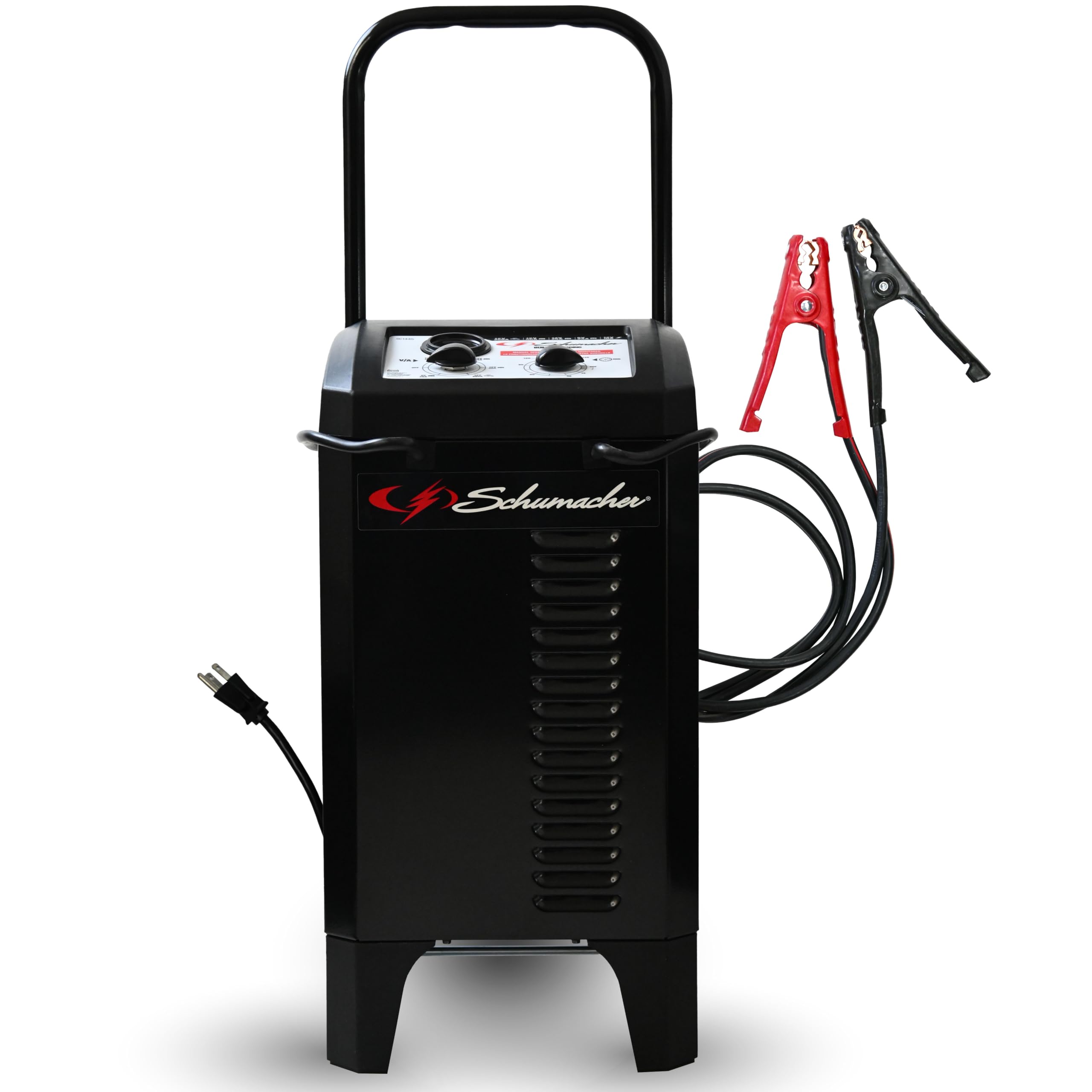
Garages that need serious cranking power for large engines should consider the SC1445 over any automatic maintainer.
Pros
- 250A engine start handles large batteries in trucks and RVs
- Manual timer gives precise control over charge duration
- Wheeled steel case improves mobility and durability
Cons
- Manual operation requires the user to set and monitor timing
- No automatic shutoff like smart chargers offer
- Heavy at nearly 29 pounds, less portable than smaller units
This is a manual charger, meaning the operator sets the amperage and a timer rather than letting the unit decide when to stop. That suits experienced users comfortable monitoring charge progress, but it carries more risk of overcharging for those unfamiliar with battery charging basics.
The 250A engine start delivers serious cranking assistance for large vehicles, and the 50A boost charge speeds up recovery for dead batteries. The analog ammeter and retractable handle make it practical for a working garage, though it demands more hands-on attention than the smart chargers above.
Battery Tender Plus 12V 1.25A Maintainer

This maintainer is built for long-term storage rather than quick charging, making it well-suited to motorcycles, ATVs, and seasonal vehicles.
Pros
- 4-step charging program protects battery health over time
- Quick-disconnect harness simplifies repeated hookups
- Backed by a 10-year manufacturer warranty
Cons
- 1.25A output is too low for reviving a fully dead car battery quickly
- No engine-start or high-amp boost function
- Limited to 12V batteries only, no 6V support
At 1.25A, the Battery Tender Plus is a maintainer rather than a rapid charger. It keeps a battery topped off during off-season storage without the risk of overcharging that older trickle chargers carried.
The quick-disconnect harness is a practical touch for motorcycle and ATV owners who need to unplug and ride without fumbling with clamps each time. It will not bring a severely drained battery back quickly, so pair it with a higher-amp charger for that job.
Clore Automotive PL2320 20A Smart Charger

Technicians and heavy-duty users benefit from the PL2320’s three selectable amp rates and stable power-supply mode.
Pros
- 2/10/20A selectable rates cover light maintenance to fast charging
- Power-supply mode holds system voltage steady during service work
- Multi-phase charging suits flooded, AGM, gel, and marine batteries
Cons
- No listed lithium (LiFePO4) support
- Basic accessory set compared to some competitors
- Bulkier than dedicated maintainers for casual users
The PL2320 is aimed at professional and semi-professional use, with a power-supply mode that keeps a vehicle’s electrical system stable while a technician works on it, such as during memory-sensitive repairs. That feature is uncommon among consumer-grade chargers.
Selecting between 2A, 10A, and 20A gives flexibility across a range of battery sizes, from small powersport batteries to larger marine units. It does not list lithium compatibility, so LiFePO4 owners should look elsewhere.
TowerTop 25A Smart Charger with Engine Start
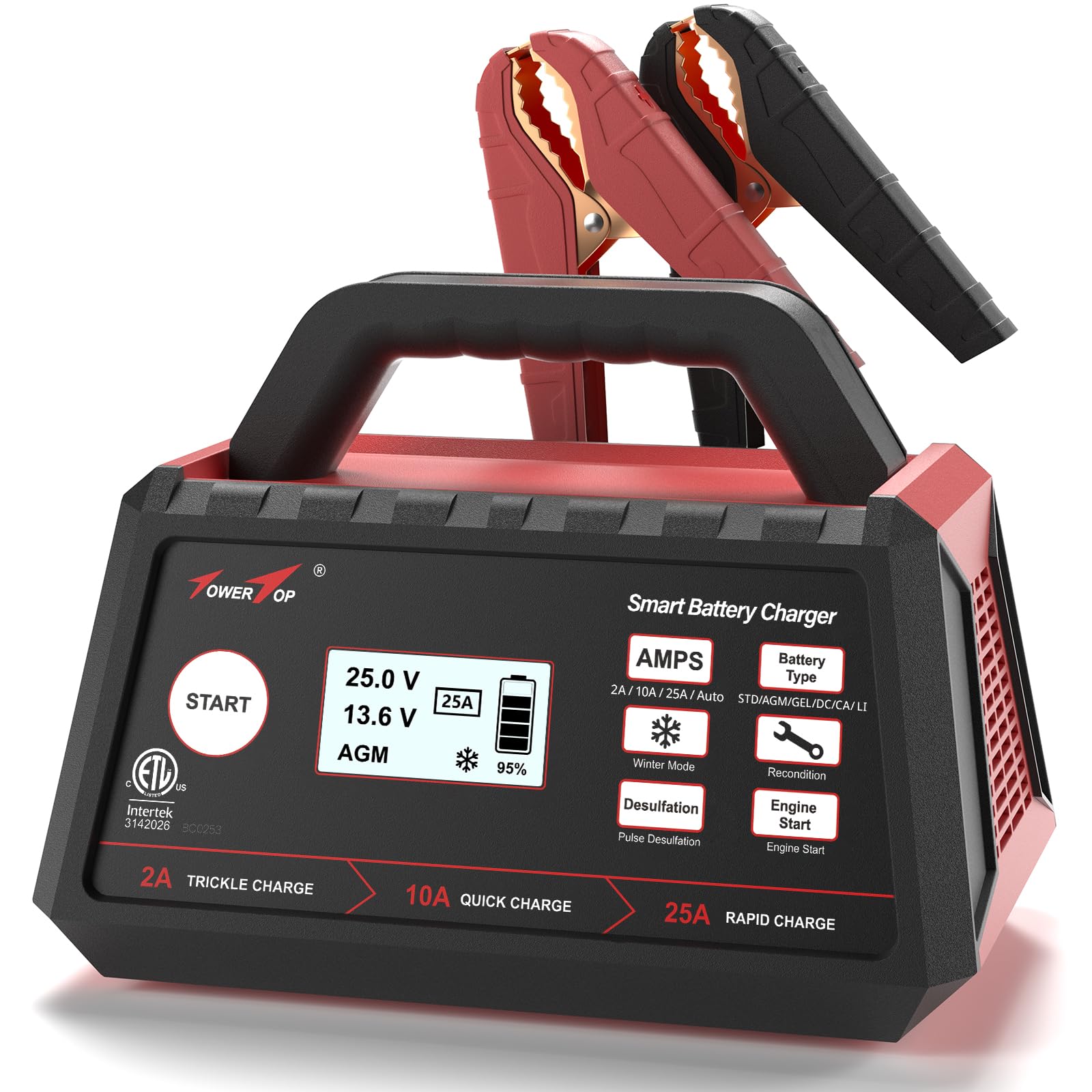
This charger appeals to owners who want fast charging, an LCD display, and a modest engine-start boost in one 12V unit.
Pros
- 25A max charge rate fills a 100Ah battery in under four hours
- 100A engine start helps activate a battery before starting
- 8-stage charging includes desulfation and repair modes
Cons
- 12V only, no 6V battery support
- Engine-start current is modest compared to dedicated jump starters
- Cannot recover completely drained batteries per manufacturer notes
The TowerTop charger’s HD display shows charging stage in real time, which takes the guesswork out of monitoring progress compared to LED-only indicators. Its 25A rate is among the fastest in this lineup for 12V lead-acid batteries.
Winter Mode adds extra voltage for cold-weather charging, and the repair mode targets sulfated batteries specifically. The 100A engine-start feature helps with weak batteries but is not a substitute for a full jump-starter on a completely dead one.
Schumacher SC1281 6A Charger with 100A Engine Start
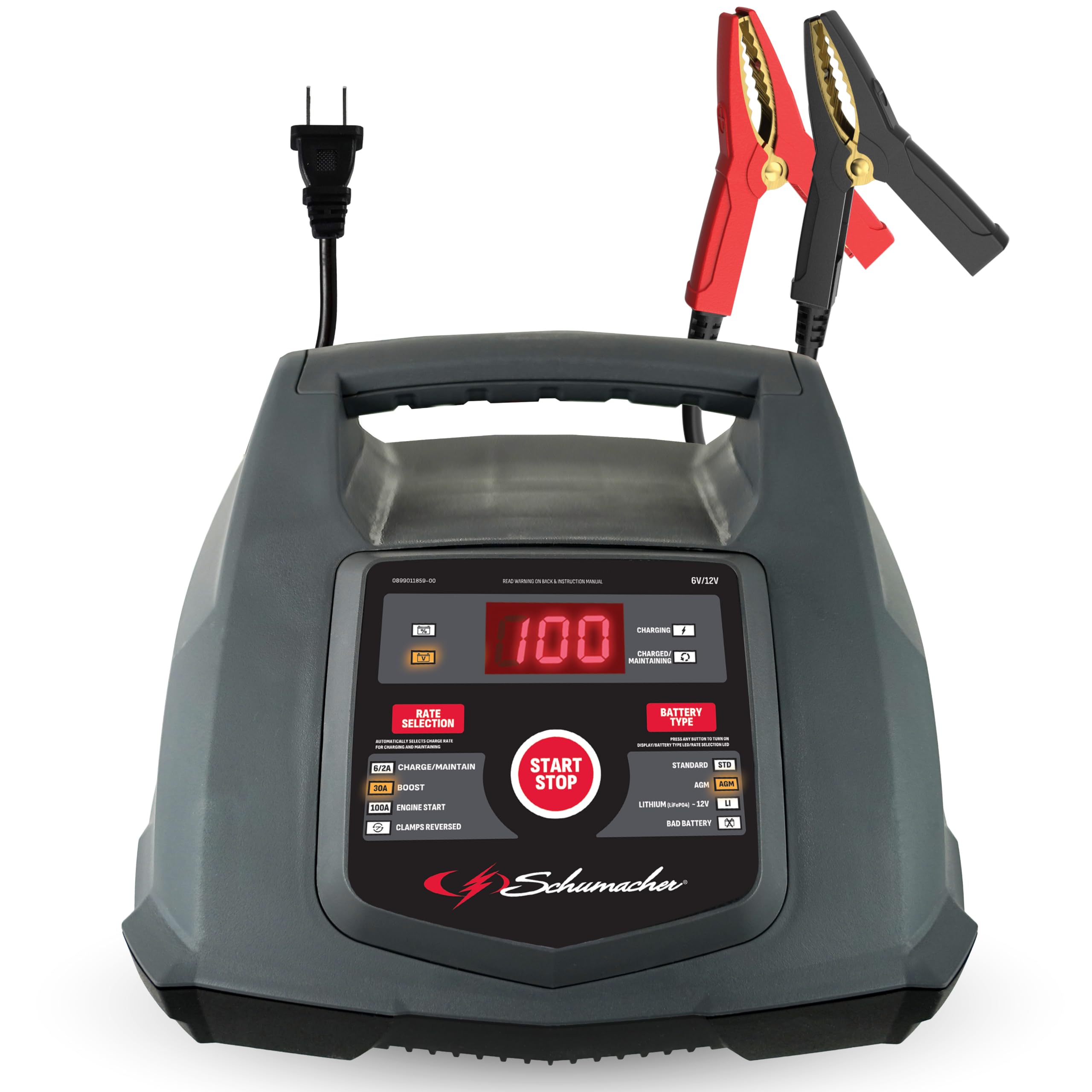
This 5-in-1 unit suits owners who want charging, maintenance, and emergency engine starting from a single device.
Pros
- 100A engine start assists with weak or partially dead batteries
- Built-in battery and alternator tester aids diagnostics
- Supports 6V and 12V lead-acid plus 12V lithium batteries
Cons
- Starts in boost mode by design, requiring attention when first powered on
- Heavier at 12.7 pounds than compact chargers
- US-plug only, unsuitable for 240V regions without a converter
The SC1281 combines a modest 6A charge/maintain mode with a 100A engine-start function and 12A to 30A boost charging for faster recovery. The built-in alternator tester is a useful diagnostic extra not found on simpler chargers.
Some owners note the unit powers on in boost mode initially, so reading the manual before first use matters. For anyone wanting charging and occasional starting help in one device, it covers both roles reasonably well.
CRAFTSMAN CMXCESM258 12A Charger and Maintainer
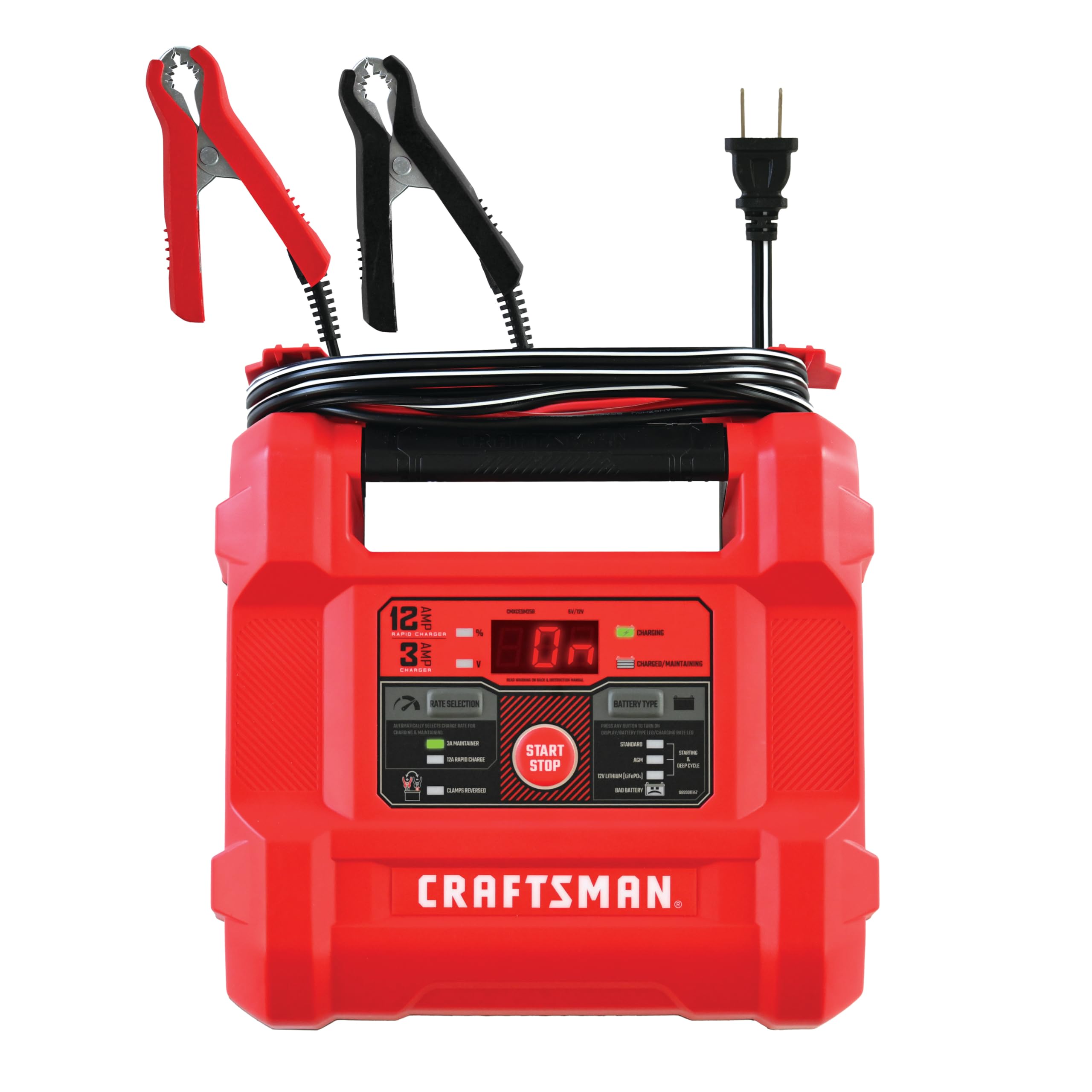
This charger fits owners who want lithium compatibility and a straightforward digital interface without paying for engine-start hardware.
Pros
- Supports standard, AGM, deep-cycle, and 12V lithium (LiFePO4) batteries
- 12-foot combined cable and cord reach for flexible garage placement
- Reverse hook-up protection and digital display included
Cons
- No engine-start or boost function
- 2-year warranty is shorter than NOCO’s 3-year coverage
- 12A rate is moderate compared to 15A or 20A chargers
The CMXCESM258 offers a 12A rapid charge alongside 3A (12V) and 2A (6V) maintain modes, giving reasonable flexibility for different battery sizes. Its lithium compatibility is worth noting since several competitors in this price range skip LiFePO4 support entirely.
The digital display and push-button controls keep operation simple, and the reverse hook-up protection guards against wiring mistakes. It is a charger and maintainer only, so drivers needing a jump-start function will need a separate device.
NOCO GENIUS1 1A Smart Battery Charger

This is the smallest charger in NOCO’s GENIUS lineup, suited to small batteries and seasonal equipment rather than daily-driver cars.
Pros
- Compact wall-plug design saves space
- Supports lead-acid and lithium batteries up to 30Ah
- Same desulfation and temperature compensation as larger GENIUS models
Cons
- 1A output is too slow for larger automotive batteries
- No engine-start or boost capability
- Best suited to small equipment, not trucks or SUVs
The GENIUS1 works well for motorcycle, ATV, lawn equipment, or small marine batteries left unused for extended periods. Its direct wall-plug design skips the bulkier AC cable found on the GENIUS5 and GENIUS10.
Force Mode still allows charging from zero volts, and the thermal sensor adjusts for temperature just like its larger siblings. For anything bigger than a small powersport battery, the 1A rate will feel slow, and a 5A or 10A model is a better match.
Buying Guide
Match Amperage to Battery Size and Use Case
Charging amperage determines both speed and suitability. A higher amp rating charges faster but can be excessive for small batteries, while a low amp rating protects small batteries but takes far longer on large ones.
| Charger Output | Best Suited For |
|---|---|
| 1A – 1.25A | Motorcycle, ATV, lawn equipment, long-term maintenance |
| 5A – 6A | Cars, small trucks, seasonal storage with occasional charging |
| 10A – 12A | Daily drivers, SUVs, faster recovery from partial discharge |
| 15A – 20A | Larger batteries, trucks, marine batteries, quicker full charges |
| Engine-start (100A+) | Emergency starting assistance alongside charging |
Confirm Battery Chemistry Compatibility
Standard flooded, AGM, gel, and deep-cycle batteries each have different charging curves. Lithium (LiFePO4) batteries need a charger explicitly rated for them, since standard lead-acid charging profiles can undercharge or damage lithium cells. Always check the charger’s supported chemistries against the battery’s label before connecting.
Automatic vs. Manual Operation
Automatic chargers monitor voltage and switch between charging stages without user input, then drop to float or maintenance mode once full. Manual chargers rely on the operator to set amperage and time, offering more control but more risk of overcharging if left unattended. Beginners and long-term maintenance benefit from automatic units; experienced users doing frequent battery work may prefer manual control.
Consider Engine-Start and Boost Features
Some chargers include engine-start functions rated in amps (such as 100A or 250A) to help crank an engine with a weak battery. These are not a full substitute for a dedicated jump starter on a completely dead battery, but they add convenience for marginal starting issues.
Safety Features Worth Checking
- Reverse polarity protection: Prevents the charger from operating if clamps are connected backward.
- Temperature compensation: Adjusts charging voltage based on ambient temperature to avoid overcharging in heat or undercharging in cold.
- Desulfation mode: Uses pulse charging to break down sulfation crystals on aging battery plates, restoring some lost capacity.
- Automatic shutoff or float mode: Lets the charger stay connected indefinitely without overcharging the battery.
Portability and Mounting
Compact chargers with mounting brackets suit dedicated maintenance in one location, while wheeled units with handles suit garages that need to move a charger between vehicles. Weight ranges widely across this category, from under two pounds for small maintainers to nearly 30 pounds for wheeled engine-start units.
FAQs
What amperage charger do I need for my car battery? Most passenger cars do well with a 5A to 10A charger for routine maintenance and moderate recovery. Trucks, SUVs, and larger batteries benefit from 12A to 20A for faster charging, while motorcycles and small powersport batteries are better matched to 1A to 1.25A chargers to avoid overcharging.
Can I leave a smart charger connected indefinitely? Automatic chargers with float or maintenance mode are designed for long-term connection, monitoring voltage and adjusting output to prevent overcharging. Manual chargers, including timer-controlled models, should not be left unattended since they lack automatic shutoff.
Is a battery charger the same as a jump starter? No. A charger restores a battery’s charge over time, typically minutes to hours depending on amperage, while a jump starter provides an instant burst of current to start an engine immediately. Some chargers include an engine-start feature, but it works best on batteries that are weak rather than fully dead.
Do I need a charger rated for AGM or lithium batteries? Yes, if the vehicle uses an AGM or LiFePO4 battery. Charging profiles differ across chemistries, and using a charger not rated for the battery type can result in incomplete charging or reduced battery lifespan.
What does desulfation mode actually do? Desulfation uses pulse charging to break down sulfate crystals that build up on battery plates over time, particularly in batteries left partially discharged for extended periods. It can restore some capacity in moderately sulfated batteries but will not revive a battery with significant internal damage.
Do I need a 6V charging mode? Only if the vehicle or equipment uses a 6V battery, common in some classic cars and select powersport or lawn equipment. Most modern cars, trucks, and motorcycles use 12V systems.
Conclusion
Picking the right automotive battery charger comes down to matching amperage, chemistry support, and features to the battery in question rather than choosing the highest-rated unit available. A motorcycle or ATV battery left in storage needs a low-amp maintainer like the NOCO GENIUS1 or Battery Tender Plus, while a truck or marine battery calls for 15A to 20A output like the Schumacher SC1280 or Clore PL2320.
Owners who anticipate needing occasional emergency starting assistance should look at engine-start models such as the Schumacher SC1281 or SC1445, keeping in mind these supplement rather than replace a dedicated jump starter. Lithium battery owners need to confirm LiFePO4 compatibility specifically, since not every charger in this category supports it.
Checking the battery’s chemistry, capacity, and typical use pattern before buying prevents both wasted money on oversized equipment and frustration from a charger too weak for the job.
