
Your Guide How Do You Charge a Hybrid Car Battery Safely

Most hybrid cars actually charge their batteries automatically through the engine and regenerative braking, requiring no external plug-in. However, for Plug-in Hybrid Electric Vehicles (PHEVs), safe external charging is paramount: always use manufacturer-approved equipment, ensure proper ventilation, and thoroughly inspect all cables and ports for damage before connecting to a Level 1 or Level 2 charger. Adhering to these guidelines ensures a secure and efficient charging process.
Hey there, fellow explorer of the automotive world! If you’re like many people, the world of hybrid cars can feel a bit like a mystery wrapped in an enigma. We’ve all heard the buzz about better fuel economy and a greener footprint, but when it comes to the nitty-gritty of how do you charge a hybrid car battery, things can get a little confusing. Do you just fill it with gas and hope for the best? Do you need a special plug? Is it like a fully electric car, or something else entirely?
You’re not alone in these questions. The term “hybrid” itself covers a range of technologies, and understanding each one is key to knowing how do you charge a hybrid car battery. Some hybrids practically charge themselves, while others invite you to plug them into the grid. It’s a common misconception that all hybrids need external charging, and that’s precisely what we’re going to clear up today. Think of me as your friendly guide, here to demystify the process and ensure you feel confident and safe about powering your eco-friendly ride.
Whether you’re considering buying a hybrid, just bought one, or are simply curious, this guide will walk you through everything you need to know. We’ll break down the different types of hybrids, explore the various charging methods, and share practical tips for keeping your battery healthy and your journeys smooth. So, let’s buckle up and dive into the fascinating world of hybrid car battery charging!
Key Takeaways
- Understand your hybrid type: Only PHEVs connect to an external power source for charging.
- Use approved equipment: Always utilize manufacturer-recommended charging cables and stations.
- Ensure a safe environment: Charge in a dry, well-ventilated area, free of flammable materials.
- Inspect equipment regularly: Check cables and connectors for damage before every use.
- Consult your owner’s manual: Follow all manufacturer-specific charging instructions meticulously.
- Avoid unsafe extensions: Never use standard extension cords; they pose significant fire risks.
- Prioritize safety always: Disconnect power source before handling any car connections.
Quick Answers to Common Questions
Do I actually need to plug in my hybrid car?
For most standard (self-charging) hybrids, the answer is no! They recharge their battery automatically through regenerative braking and the gasoline engine, so you don’t need to manually think about *how do you charge a hybrid car battery*.
So, what about Plug-in Hybrids (PHEVs)? Do they need charging?
Yes, absolutely! If you own a PHEV, you’ll need to plug it in to utilize its all-electric driving range, similar to an electric car. This is primarily *how do you charge a hybrid car battery* when it’s a plug-in model.
Where can I charge my Plug-in Hybrid?
You have great flexibility! Most PHEV owners charge at home using a standard 120V outlet (Level 1) or a faster 240V charger (Level 2), and you can also utilize public charging stations.
How long does it typically take to fully charge a PHEV battery?
Charging times vary by model and charger type, but with a Level 2 charger, many PHEVs can fully charge in 2-4 hours. Even a standard home outlet will get the job done overnight, making *how do you charge a hybrid car battery* quite convenient.
What happens if I forget to charge my Plug-in Hybrid?
No stress at all! If your PHEV’s battery runs low or isn’t charged, the gasoline engine will seamlessly kick in and power the car, ensuring you can keep driving without interruption. So, while knowing *how do you charge a hybrid car battery* is useful, forgetting to plug in won’t leave you stranded.
📑 Table of Contents
- Understanding the Hybrid Spectrum: Not All Hybrids Are Created Equal
- The Core Question: How Do You Charge a Plug-in Hybrid Car Battery?
- Charging Your PHEV at Home: Convenience at Your Fingertips
- Charging On The Go: Public Stations for Your PHEV
- Maximizing Your Hybrid’s Battery Life and Efficiency
- Understanding PHEV Charging Times & Costs: A Quick Glance
- Conclusion: Powering Your Hybrid with Confidence
Understanding the Hybrid Spectrum: Not All Hybrids Are Created Equal
Before we can truly answer “how do you charge a hybrid car battery,” we need to understand that “hybrid” is a broad term. It’s like saying “fruit” – an apple is very different from a watermelon, even though both are fruits. The same goes for hybrids. They all combine a gasoline engine with an electric motor and battery, but the size of that battery and how it’s used varies significantly.
Mild Hybrids (MHEV): The Subtle Boost
Mild hybrids are the entry point into the hybrid world. They feature a small electric motor and battery that primarily assist the gasoline engine. This setup helps with acceleration, allows for smoother engine stop-start functions, and improves fuel efficiency slightly compared to a conventional gasoline car. The electric motor can’t power the car on its own for any significant distance, nor does it offer a noticeable electric-only driving range.
- How do you charge a hybrid car battery in an MHEV? The answer is simple: you don’t. Mild hybrid batteries are exclusively charged through regenerative braking and the gasoline engine itself. When you slow down or coast, the electric motor acts as a generator, converting kinetic energy back into electricity to top up the battery. The engine also sends power to the battery when needed. There’s no external plug, no charging stations, and no extra steps for you to take. Just drive it like a regular car, and it handles the battery charging automatically.
Full Hybrids (FHEV): The Original Power Couple
Full hybrids, often called “self-charging hybrids,” are what most people think of when they hear “hybrid car.” The Toyota Prius is a classic example. These vehicles have a larger battery and a more powerful electric motor than mild hybrids. This allows them to drive short distances (usually at lower speeds) solely on electric power, turn off the gasoline engine more frequently, and provide a more substantial boost to fuel economy.
- How do you charge a hybrid car battery in an FHEV? Just like mild hybrids, full hybrids are designed to be self-sufficient. Their batteries are charged entirely by the gasoline engine and, crucially, by regenerative braking. Every time you lift your foot off the accelerator or press the brake pedal, the car captures energy that would otherwise be lost as heat and sends it back to the battery. You never plug a full hybrid into an electrical outlet. The system intelligently manages the battery charge to optimize performance and efficiency, all behind the scenes.
Plug-in Hybrids (PHEV): The Best of Both Worlds
Now we come to the type of hybrid that does require external charging: the plug-in hybrid (PHEV). These vehicles bridge the gap between full hybrids and pure electric vehicles. PHEVs feature a significantly larger battery pack and often more powerful electric motors compared to mild or full hybrids. This allows them to travel a substantial distance (typically 20 to 50 miles, sometimes more) purely on electric power, making them incredibly versatile.
- How do you charge a hybrid car battery in a PHEV? This is where the “plug-in” part comes in! PHEVs can be plugged into an external electricity source to replenish their battery, much like an electric car. They also benefit from regenerative braking and can use their gasoline engine to generate electricity, just like full hybrids. However, to maximize their electric range and fuel efficiency, regular external charging is essential. This duality is why many consider PHEVs the best of both worlds – electric driving for daily commutes and gasoline for longer trips without range anxiety.
The Core Question: How Do You Charge a Plug-in Hybrid Car Battery?
Since mild and full hybrids manage their own battery charging, the real focus of “how do you charge a hybrid car battery safely” boils down to plug-in hybrids (PHEVs). If you own a PHEV, or are thinking about getting one, understanding its charging needs is paramount. The good news is, it’s very similar to charging a fully electric vehicle, just usually with smaller batteries and therefore faster charging times.
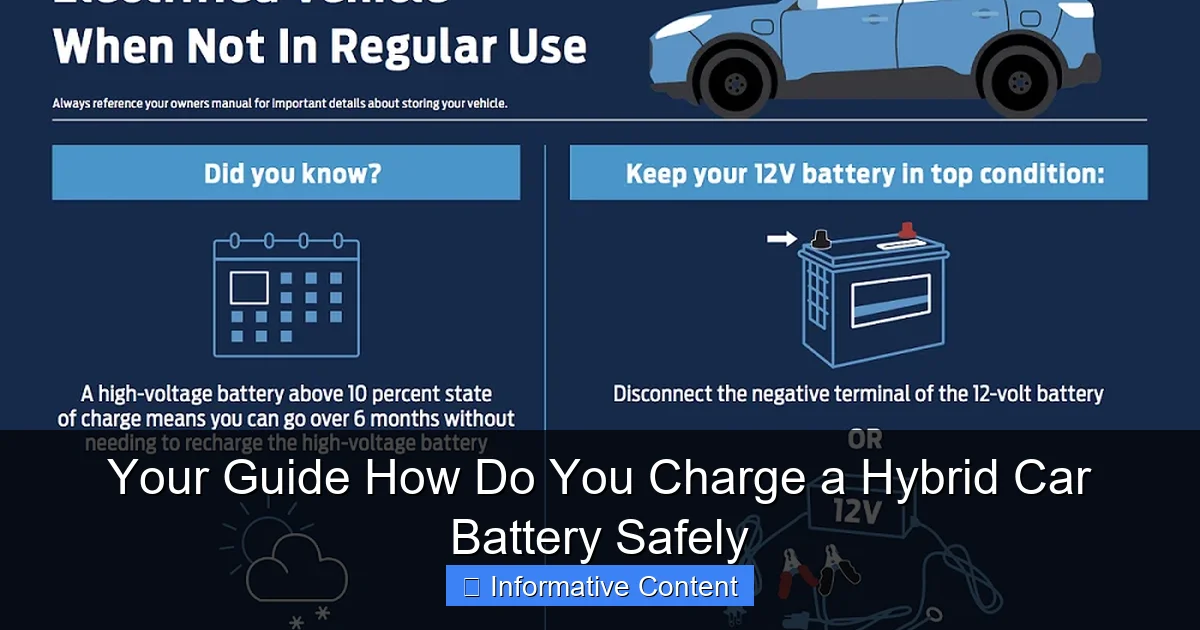
Visual guide about hybrid car battery charge
Image source: carpro.com
The charging port on a PHEV is typically located on the fender, front grille, or sometimes where a fuel cap would normally be. You simply open the port cover, plug in the charging cable, and the car does the rest. Most PHEVs come with a charging cable that works with standard household outlets, and you can also purchase or use public charging stations for faster charging.
Charging Your PHEV at Home: Convenience at Your Fingertips
For most PHEV owners, home charging is the most convenient and cost-effective way to keep their battery topped up. Imagine waking up every morning to a “full tank” of electricity, ready to tackle your daily commute without touching a drop of gasoline. This daily routine makes understanding how do you charge a hybrid car battery at home incredibly important.
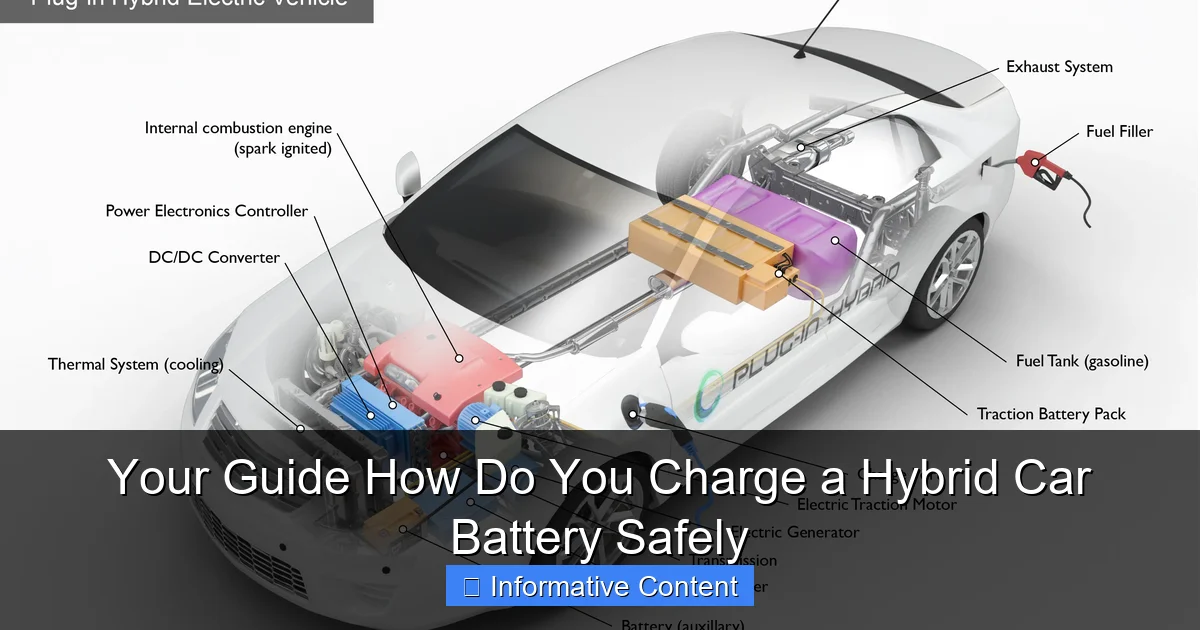
Visual guide about hybrid car battery charge
Image source: afdc.energy.gov
Level 1 Charging: The Standard Wall Outlet (120V)
This is the simplest form of charging and it’s universally accessible. Every PHEV comes with a charging cable (often called a “trickle charger” or “occasional use charger”) that plugs into a standard 120-volt (V) household outlet, just like a lamp or your phone charger. Think of it as plugging into any three-prong wall socket in your garage or driveway.
- Pros:
- Universal Accessibility: If you have a standard outlet, you can charge your PHEV. No special equipment or installation required.
- No Cost for Equipment: The cable usually comes with the car.
- Simplicity: It’s as easy as plugging in an appliance.
- Cons:
- Very Slow: This is the main drawback. Level 1 charging adds about 2-5 miles of electric range per hour. For a PHEV with a 30-mile electric range, a full charge could take 6-12 hours or even longer.
- Limited Utility for High Mileage: If you drive a lot of electric miles daily, Level 1 might not fully recharge your battery overnight.
Practical Tip: Level 1 is perfect for overnight charging if your daily electric driving needs are modest. It’s also a great option for “opportunity charging” – plugging in whenever you’re parked for a few hours. Just make sure the outlet and circuit you’re using are in good condition and not overloaded with other appliances. Always use the charging equipment provided by the manufacturer or a certified aftermarket product for safety.
Level 2 Charging: The Sweet Spot for Home (240V)
If you want faster home charging for your PHEV, Level 2 is the way to go. This type of charging uses a 240V outlet, similar to what powers large appliances like electric clothes dryers or ovens. It requires the installation of a dedicated charging station (often called an EVSE – Electric Vehicle Supply Equipment) by a qualified electrician.
- Pros:
- Significantly Faster: Level 2 charging typically adds 10-25 miles of electric range per hour, meaning most PHEVs can be fully charged in 2-4 hours. This makes it ideal for daily use, even if you drive many electric miles.
- Convenience: Faster charging means less waiting and more electric driving.
- Future-Proofing: If you ever upgrade to a fully electric car, your Level 2 setup will still be perfectly usable.
- Cons:
- Installation Cost: You’ll need to purchase an EVSE (costs vary, typically $400-$800) and pay for professional installation (can range from a few hundred to over a thousand dollars, depending on your home’s electrical panel and wiring needs).
- Requires Dedicated Circuit: An electrician will need to install a new circuit and possibly upgrade your electrical panel.
Practical Tip: Many utility companies offer rebates or incentives for installing Level 2 chargers, so check with yours! Consider smart chargers that can schedule charging for off-peak hours (when electricity rates are lower) or even communicate with your utility for grid management. This makes how do you charge a hybrid car battery not just easy, but also smart and economical.
Charging On The Go: Public Stations for Your PHEV
While home charging is the backbone for most PHEV owners, public charging stations offer flexibility for longer trips or if you don’t have access to home charging. The landscape of public charging is rapidly expanding, making it easier than ever to find a spot to plug in. Understanding these options is crucial for knowing how do you charge a hybrid car battery away from home.
Public Level 2 Charging Stations
These are the most common type of public charging stations you’ll encounter. You’ll find them in a wide variety of locations:
- Workplaces
- Shopping centers and grocery stores
- Public parking garages and lots
- Hotels and restaurants
- Car dealerships
They operate on the same 240V principle as home Level 2 chargers, offering similar charging speeds (2-4 hours for a full PHEV charge). Many networks, like ChargePoint, Electrify America, EVgo, and SemaConnect, operate these stations. You typically use a smartphone app or an RFID card to initiate and pay for charging.
- Finding Them: Apps like PlugShare, Google Maps, and your car’s navigation system are excellent tools for locating public charging stations. They often show real-time availability and pricing.
- Cost: Pricing varies widely. Some stations are free (often at workplaces or businesses encouraging patronage), while others charge per kilowatt-hour (kWh) consumed, per minute plugged in, or a flat session fee. It’s always a good idea to check the pricing before you plug in.
Practical Tip: Integrate public charging into your errands. If you’re going to be at the grocery store for an hour or at the gym for two, find a Level 2 charger and top up your battery. It’s a great way to extend your electric range without going out of your way.
DC Fast Charging (DCFC): Is It For PHEVs?
This is an important point for PHEV owners to understand: most plug-in hybrids are NOT compatible with DC fast charging (DCFC) stations. DC fast chargers deliver electricity at much higher voltages and currents (typically 400V or 800V) to rapidly charge large EV batteries.
PHEV batteries are significantly smaller than those in pure EVs and are generally not designed to handle the intense power of DCFC. Trying to use a DCFC with an incompatible PHEV won’t work, and in some rare cases, could potentially damage your car’s charging system (though modern cars usually have safeguards). There are a few newer, premium PHEV models that are starting to offer limited DCFC compatibility, but they are the exception, not the rule.
Clarification: If your PHEV does support DCFC, it will have a specific charging port for it (e.g., CCS or CHAdeMO, though CCS is more common in newer vehicles). Always check your vehicle’s owner’s manual or manufacturer specifications to confirm compatibility. For the vast majority of PHEVs, Level 1 and Level 2 charging are your only options for external power.
Maximizing Your Hybrid’s Battery Life and Efficiency
Beyond knowing how do you charge a hybrid car battery, it’s also important to understand how to get the most out of your hybrid’s battery, regardless of whether it’s a mild, full, or plug-in hybrid. Proper usage and a few smart habits can significantly impact your car’s efficiency and the longevity of its battery pack.
The Magic of Regenerative Braking
This is a fundamental technology in all hybrids. Instead of simply wasting energy as heat when you brake, regenerative braking converts your car’s kinetic energy back into electricity, which is then stored in the battery. It’s a remarkable way to recover energy that would otherwise be lost.
- Practical Tip: You can maximize regenerative braking by driving smoothly. Avoid sudden acceleration and hard braking. Instead, anticipate stops, lift your foot off the accelerator earlier, and allow the car to coast and regenerate power. Many hybrids have a power flow display that shows you when the battery is being charged via regeneration – try to keep that flow active as much as possible!
Keeping Your PHEV Battery Healthy
While hybrid batteries are incredibly robust and designed to last the life of the vehicle, a few habits can help ensure optimal performance, especially for PHEVs that are externally charged:
- Avoid Extreme States of Charge: Try not to leave your PHEV’s battery at 100% charge or completely depleted for extended periods (e.g., days or weeks). The car’s battery management system will usually have buffers to prevent overcharging or deep discharge, but it’s good practice. For daily use, charging to 80-90% is often recommended if your car allows you to set a charge limit, and then fully charging only when you need the full range for a trip.
- Moderate Temperatures: Extreme hot or cold temperatures can stress batteries. While your car has sophisticated thermal management systems, parking in shade on a hot day or in a garage during a deep freeze can offer some protection.
- Regular Driving: Batteries, like people, don’t like to sit idle for too long. If you’re going away for an extended period, try to leave your PHEV with a mid-range charge (e.g., 50%) rather than completely full or empty.
Understanding Your Hybrid’s Display
Most modern hybrids come with intuitive displays that show you crucial information about your power usage and battery status. Take some time to understand:
- Energy Flow Diagrams: These animations show whether power is coming from the engine, battery, or being sent back to the battery. It’s a great visual tool to help you drive more efficiently.
- Battery State of Charge: Know how much electric range you have left.
- Fuel Economy Readings: Monitor your real-time and average fuel consumption to see the direct impact of your driving habits and charging strategy.
These displays make it easier to understand not just how do you charge a hybrid car battery, but also how your driving influences its performance and efficiency.
Understanding PHEV Charging Times & Costs: A Quick Glance
To give you a clearer picture of the practical differences, here’s a general comparison of charging methods for a typical plug-in hybrid with, say, a 10-15 kWh battery and 30-40 miles of electric range. Remember, specific times and costs will vary by vehicle model, battery size, electricity rates, and charger output.
| Charging Level | Power Output | Charge Time (for 30-mile range PHEV) | Typical Cost per Charge (rough estimate, varies by electricity rates) | Best Use Case |
|---|---|---|---|---|
| Level 1 (120V) | 1.4 kW | ~7-10 hours | $1.50 – $2.50 | Overnight charging, occasional top-ups, most affordable |
| Level 2 (240V, Home) | 3.7 kW – 11 kW | ~2-4 hours | $1.50 – $2.50 | Daily full charges, primary home charging, faster convenience |
| Level 2 (240V, Public) | 3.7 kW – 11 kW | ~2-4 hours | $2.00 – $6.00 (varies by network/pricing model) | Opportunity charging while out, supplementing home charging |
| DC Fast Charge (DCFC) | 50 kW+ | N/A (Generally not compatible with PHEVs) | N/A | Not applicable for most PHEVs |
This table helps illustrate why Level 2 home charging is often the “sweet spot” for PHEV owners – it balances speed with cost-effectiveness and provides daily convenience.
Conclusion: Powering Your Hybrid with Confidence
So, how do you charge a hybrid car battery? As we’ve explored, the answer really depends on the type of hybrid you have. For mild and full hybrids, the vehicle takes care of everything automatically through regenerative braking and the gasoline engine. You just drive, and it charges itself – no external plugs involved.
For plug-in hybrids (PHEVs), external charging is key to maximizing your electric driving range and fuel savings. Whether you opt for the simple overnight convenience of Level 1 charging, the faster daily recharge of a professionally installed Level 2 home charger, or utilize public Level 2 stations while you’re out and about, the options are flexible and accessible. By understanding these differences and adopting smart charging habits, you can confidently and safely power your hybrid vehicle, making the most of its efficiency and environmental benefits.
The world of hybrid vehicles is designed to make your life easier and your driving greener. With this guide, you now have the knowledge to navigate hybrid charging like a pro. Happy driving, and enjoy the journey with your intelligently powered hybrid!
🎥 Related Video: How to charge 12v battery on your hybrid car.
📺 TmT Toyota mechanic Tips
Frequently Asked Questions
Do I need to externally charge a hybrid car battery?
For most traditional (self-charging) hybrid cars, you do not need to externally charge the battery; it recharges itself through the gasoline engine and regenerative braking. However, if you own a Plug-in Hybrid Electric Vehicle (PHEV), then external charging is required to utilize its all-electric range.
How do you charge a Plug-in Hybrid (PHEV) car battery safely?
Charging a PHEV battery is similar to an electric vehicle. You connect a charging cable from your vehicle’s charging port to a power source, which can be a standard household outlet (Level 1) or a dedicated charging station (Level 2). Always follow your car’s manual and use approved equipment to ensure safety.
What types of chargers can I use to charge my hybrid car battery?
For Plug-in Hybrids (PHEVs), you can typically use Level 1 (120V standard home outlet) or Level 2 (240V dedicated charger) charging equipment. Level 1 offers slower charging but is universally accessible, while Level 2 provides faster charging and is ideal for daily use at home or public stations. DC fast charging is generally not available or necessary for hybrid car batteries.
How long does it take to fully charge a hybrid car battery?
The time it takes to fully charge a hybrid car battery (specifically a PHEV) varies based on its battery size and the charger level. A Level 1 charger can take several hours (e.g., 8-12 hours for a full charge), while a Level 2 charger can reduce this significantly, often fully charging the battery in 2-4 hours. Consult your car’s specific model information for precise charging times.
Can a traditional, non-plug-in hybrid car battery be externally charged?
No, a traditional (non-plug-in) hybrid car battery cannot be externally charged as it does not have a charging port. These vehicles are designed to recharge their batteries automatically through regenerative braking, which captures energy during deceleration, and by using the gasoline engine as a generator. The system efficiently manages the battery’s charge on its own.
Is it safe to charge a hybrid car battery at home?
Yes, it is generally very safe to charge a hybrid car battery (PHEV) at home, provided you use the correct equipment and follow manufacturer guidelines. Modern charging systems are equipped with safety features to prevent overcharging and electrical issues. Always ensure your home electrical system can handle the load, especially for Level 2 charging.