
Figuring out exactly how long to charge a car battery depends on several key factors, including how drained the battery is, its overall capacity, and the power output of your charger. Generally, a deeply discharged battery might take anywhere from 4 to 24 hours to fully recharge using a standard charger. This guide will help you understand these variables and ensure you charge your battery safely and effectively.
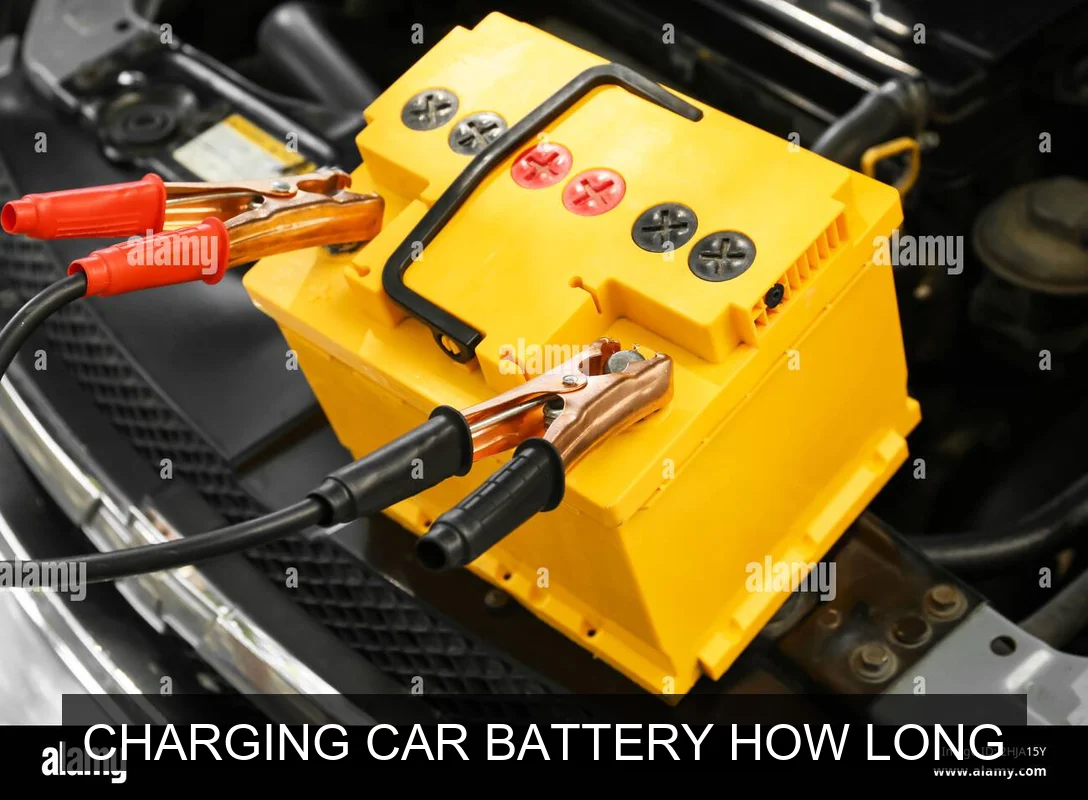
Image source: Alamy
📋 Table of Contents
- 🔹 Understanding Car Battery Charging Time
- 🔹 Introduction: Why Knowing Charging Times Matters
- 🔹 What Influences How Long a Car Battery Takes to Charge?
- 🔹 How Long Does it Actually Take to Charge? (Practical Scenarios)
- 🔹 The Science Behind Car Battery Charging
- 🔹 Why Knowing “Charging Car Battery How Long” is Crucial
- 🔹 Common Mistakes to Avoid When Charging Your Car Battery
- 🔹 Best Practices for Safe and Effective Battery Charging
- 🔹 Real-Life Examples of Charging Scenarios
- 🔹 Frequently Asked Questions
- 🔹 Conclusion: Keeping Your Car Powered Up
Understanding Car Battery Charging Time
When you’re trying to revive a drained car battery, the question of “how long do I need to charge it?” is often the first thing that comes to mind. Generally, charging a deeply discharged car battery with a typical 10-amp charger can take anywhere from 4 to 12 hours. However, this is just a rough estimate. The exact time depends on several factors, including the battery’s current charge level, its total capacity, and the specific output of the charger you’re using. A slow trickle charge might take 24 hours or more, while a faster charge could be just a few hours. Modern “smart” chargers often handle the timing automatically, stopping when full.
Introduction: Why Knowing Charging Times Matters
There’s nothing quite like the sinking feeling of a car that won’t start. Often, the culprit is a dead or weakened car battery. While jump-starting can get you going, properly recharging the battery is crucial for its longevity and your peace of mind. Knowing how long to charge a car battery isn’t just about getting your car started again; it’s about maintaining battery health, preventing damage, and ensuring reliable performance. Overcharging or undercharging can both cause issues, so understanding the process is key. This article will break down all the things that impact charging time and give you practical insights to keep your car’s power source in top shape.
What Influences How Long a Car Battery Takes to Charge?
Think of charging a car battery like filling a water bucket. How long it takes depends on how empty the bucket is, how big the bucket is, and how fast the water flows from the tap. Car batteries are similar. Several factors play a big role in determining the charging duration:
Battery State of Charge
This is perhaps the most obvious factor. A battery that’s only slightly drained will take much less time to charge than one that’s completely dead. Most car batteries are considered “dead” around 10.5 to 11.8 volts. A fully charged battery typically reads around 12.6 to 12.8 volts.
Battery Capacity (Ah)
Battery capacity is measured in Amp-hours (Ah). This number tells you how much energy the battery can store. A larger Ah rating means the battery can hold more charge, and therefore, it will take longer to fill up compared to a smaller capacity battery, assuming the same level of discharge and charger output.
- A typical compact car battery might be around 40-50 Ah.
- Larger sedans or SUVs often use 60-70 Ah batteries.
- Trucks and commercial vehicles can have 100 Ah batteries or more.
Charger Output (Amps)
The charger’s output, measured in Amperes (amps), dictates how quickly it can deliver power to the battery. A higher amp charger will, naturally, charge the battery faster than a lower amp charger.
- Trickle chargers: Usually 1-2 amps, ideal for long-term maintenance.
- Standard chargers: Typically 4-15 amps, good for regular charging.
- Fast chargers/Boosters: Can range from 20-50 amps, sometimes even higher, for quick boosts or jump-starting.
Battery Type
While most cars use lead-acid batteries, there are different types, and some charge a little differently:
- Flooded (Wet Cell) Lead-Acid: The most common type, usually charges well.
- Absorbent Glass Mat (AGM): Charges faster than flooded batteries and handles discharge better.
- Gel Cell: More sensitive to overcharging and requires a specific charger setting; charges slower.
Modern “smart” chargers can often detect the battery type and adjust accordingly.
Battery Age and Health
An older, worn-out battery with internal damage or sulfation won’t hold a charge as effectively or accept a charge as quickly as a new, healthy one. It might take longer to appear charged but won’t deliver the same performance or lifespan.
How Long Does it Actually Take to Charge? (Practical Scenarios)
Let’s look at some real-world examples to help answer “charging car battery how long” more concretely. Remember, these are estimates.
| Charger Type / Output | Battery Condition (Approximate) | Estimated Charging Time (Typical 60 Ah Battery) |
|---|---|---|
| 1-2 Amp Trickle Charger | Slightly discharged (e.g., car sat for a week) | 12-24+ hours |
| Deeply discharged (e.g., lights left on overnight) | 24-48+ hours (not ideal for dead batteries) | |
| 4-10 Amp Standard Charger | Slightly discharged | 4-8 hours |
| Deeply discharged | 8-12 hours | |
| 15-20 Amp Fast Charger | Slightly discharged | 2-4 hours |
| Deeply discharged | 4-8 hours (monitor closely) |
Calculating a Rough Estimate
You can get a rough estimate using a simple formula, though it doesn’t account for charging efficiency losses (which are typically around 10-20%):
Charging Time (Hours) = (Battery Ah / Charger Amps) * 1.2 (for efficiency loss)
For example, a 60 Ah battery that’s half-discharged (meaning it needs 30 Ah) with a 6 amp charger:
(30 Ah / 6 Amps) * 1.2 = 5 hours * 1.2 = 6 hours
This calculation is a starting point. Real-world conditions and smart chargers will adjust.
The Science Behind Car Battery Charging
To really understand charging times, it helps to know a little about what’s going on inside the battery.
Chemical Process
Car batteries, typically lead-acid, work through a reversible chemical reaction. When the battery discharges, lead sulfate forms on the plates. When you charge the battery, electrical energy reverses this process, converting the lead sulfate back into lead and lead dioxide, and restoring the sulfuric acid. This process isn’t perfectly efficient; some energy is lost as heat.
Charging Stages
Modern “smart” battery chargers don’t just pump electricity in at a constant rate. They often use a multi-stage charging process, which is why charging car battery how long can vary even with the same battery and charger:
- Bulk Stage: This is where the charger delivers maximum current to bring the battery up to about 80% charged. This is the fastest stage.
- Absorption Stage: Once the battery reaches around 80%, the charger reduces the current and maintains a constant voltage. This slows down the charging rate and prevents overcharging as the battery gets closer to full.
- Float Stage: When the battery is fully charged, the charger switches to a very low, constant voltage “float” charge. This maintains the battery at 100% without overcharging, counteracting self-discharge. Many modern chargers can stay connected indefinitely in this mode.
These stages ensure a safe and complete charge, maximizing battery life.
Why Knowing “Charging Car Battery How Long” is Crucial
Understanding the duration for charging a car battery is important for several practical reasons:
- Prevents Overcharging: While smart chargers mitigate this, knowing typical times helps you avoid leaving an older, non-smart charger connected for too long, which can damage the battery.
- Avoids Undercharging: Removing a charger too soon means the battery isn’t fully restored, which can lead to sulfation and reduced capacity over time.
- Extends Battery Life: Proper charging cycles are vital for getting the most life out of your battery. Consistently undercharging or overcharging shortens its lifespan significantly.
- Ensures Reliability: A fully charged battery provides reliable starts and power for your vehicle’s electrical systems.
- Safety: Overcharged batteries can overheat, potentially swell, or even vent flammable gases, posing a safety risk.
Common Mistakes to Avoid When Charging Your Car Battery
Even a simple task like charging a battery can go wrong if you’re not careful. Here are some common pitfalls:
- Ignoring Safety Precautions: Always wear eye protection and gloves. Charge in a well-ventilated area to dissipate any hydrogen gas that might be released.
- Improper Connections: Connecting the positive (+) and negative (-) terminals incorrectly can cause sparks, damage the battery, or harm the charger. Always connect positive to positive, negative to negative (or a ground point on the car if the battery is still installed).
- Using the Wrong Charger: Trying to use a charger designed for a small motorcycle battery on a large car battery will take forever and might not even work. Conversely, using a charger with too high an amp output on a small battery can damage it if it’s not a smart charger.
- Overcharging Old Batteries: Older batteries are more susceptible to damage from overcharging, especially if they are not the sealed type. Always monitor them if using a basic charger.
- Charging a Frozen Battery: Never try to charge a frozen battery. It can explode. Let it thaw completely first.
- Charging a Damaged Battery: If a battery is visibly cracked, leaking, or swollen, do not attempt to charge it. It’s unsafe and likely beyond repair.
Best Practices for Safe and Effective Battery Charging
To ensure you’re doing it right, follow these tips:
- Read Your Charger’s Manual: Every charger is a little different. Understand its features and settings.
- Follow Connection Order: Connect the positive (+) clamp to the positive terminal first, then the negative (-) clamp to the negative terminal (or a clean, unpainted metal part of the car chassis, away from the battery, if the battery is still in the car).
- Ensure Ventilation: Charge batteries in an open, airy space to prevent gas buildup.
- Monitor the Battery: Especially with older, non-smart chargers, periodically check the battery for signs of overheating or swelling.
- Clean Terminals: Corroded terminals can prevent a good connection and hinder charging. Clean them with a wire brush before charging.
- Choose the Right Charger: Use a charger appropriate for your battery’s size and type. A smart charger is generally the safest and most convenient option.
- Don’t Rush It (Usually): For most charging needs, a slower charge (5-10 amps) is gentler on the battery and helps extend its lifespan compared to very fast charging.
Real-Life Examples of Charging Scenarios
Let’s consider a few situations to bring “charging car battery how long” to life:
Scenario 1: Lights Left On Overnight
Your headlights were accidentally left on, and your 65 Ah battery is completely dead. You have a 10-amp smart charger. This battery needs about 65 Ah of charge. With the 10-amp charger, and accounting for efficiency, it will likely take 8-10 hours to reach full charge, with the smart charger automatically tapering off current as it fills up.
Scenario 2: Car Sitting for a Month
Your 50 Ah compact car battery has slowly discharged over a month of not being driven, dropping to about 50% charge (needing about 25 Ah). You connect a 4-amp “maintenance” charger. This will be a slow, gentle charge, likely taking around 7-8 hours to bring it back to full, then switching to float mode.
Scenario 3: Quick Boost for a Barely Drained Battery
You left the radio on for an hour, and the car cranks slowly but won’t start. Your 70 Ah battery is only slightly drained. Using a 20-amp fast charger, you might get enough charge to start the car in as little as 30 minutes to an hour. To fully restore it, however, you’d want to leave it on longer or switch to a lower amperage setting for the final stages.
Frequently Asked Questions
Can you overcharge a car battery?
Yes, you absolutely can overcharge a car battery, especially with older, non-smart chargers. Overcharging can cause the battery’s electrolyte to boil, leading to water loss, plate damage, and a shorter battery lifespan. Modern “smart” chargers have circuitry that prevents overcharging by switching to a float mode once the battery is full.
Is it better to slow charge or fast charge a car battery?
Generally, a slow charge (using a lower amperage charger) is better for the long-term health and lifespan of your car battery. It’s gentler on the battery’s internal components. Fast charging should be used sparingly and only when necessary, as it can generate more heat and potentially stress the battery.
How often should I charge my car battery if my car sits?
If your car sits for extended periods (more than a week or two), it’s a good idea to connect it to a trickle charger or battery maintainer. This device will keep the battery topped up without overcharging, preventing natural self-discharge. Checking and charging once a month for a few hours with a standard charger can also work.
What’s the difference between a car battery charger and a jump starter?
A car battery charger slowly replenishes the battery’s stored energy over several hours, aiming for a full charge. A jump starter (or battery booster) provides a very high surge of current for a short time, just enough to start the engine when the battery is dead, but it doesn’t actually charge the battery fully.
How do I know my car battery is fully charged?
Most modern “smart” battery chargers will have an indicator light or display that tells you when the battery is fully charged. If you’re using an older charger or want to verify, you can check the battery voltage with a multimeter. A fully charged 12-volt car battery should read around 12.6 to 12.8 volts (or higher) shortly after the charger is disconnected.
Conclusion: Keeping Your Car Powered Up
Understanding charging car battery how long isn’t just a technical detail; it’s a practical skill that helps you maintain your vehicle and avoid inconvenient breakdowns. We’ve seen that the duration isn’t a fixed number but depends on a careful balance of the battery’s state, its capacity, and the charger’s output. While modern smart chargers take a lot of the guesswork out of the process, knowing the underlying principles empowers you to make informed decisions.
By using the right charger, following safety guidelines, and understanding the factors at play, you can ensure your car battery stays healthy, lasts longer, and provides reliable power whenever you need it. A little patience and the right knowledge go a long way in keeping your car’s heart beating strong.