A fully charged 12-volt car battery typically rests between 12.6 and 12.8 volts when the engine is off and the battery has settled. Understanding this crucial voltage range helps you assess your battery’s health, prevent unexpected breakdowns, and ensure your vehicle starts reliably every time. This article breaks down everything you need to know about car battery voltage.
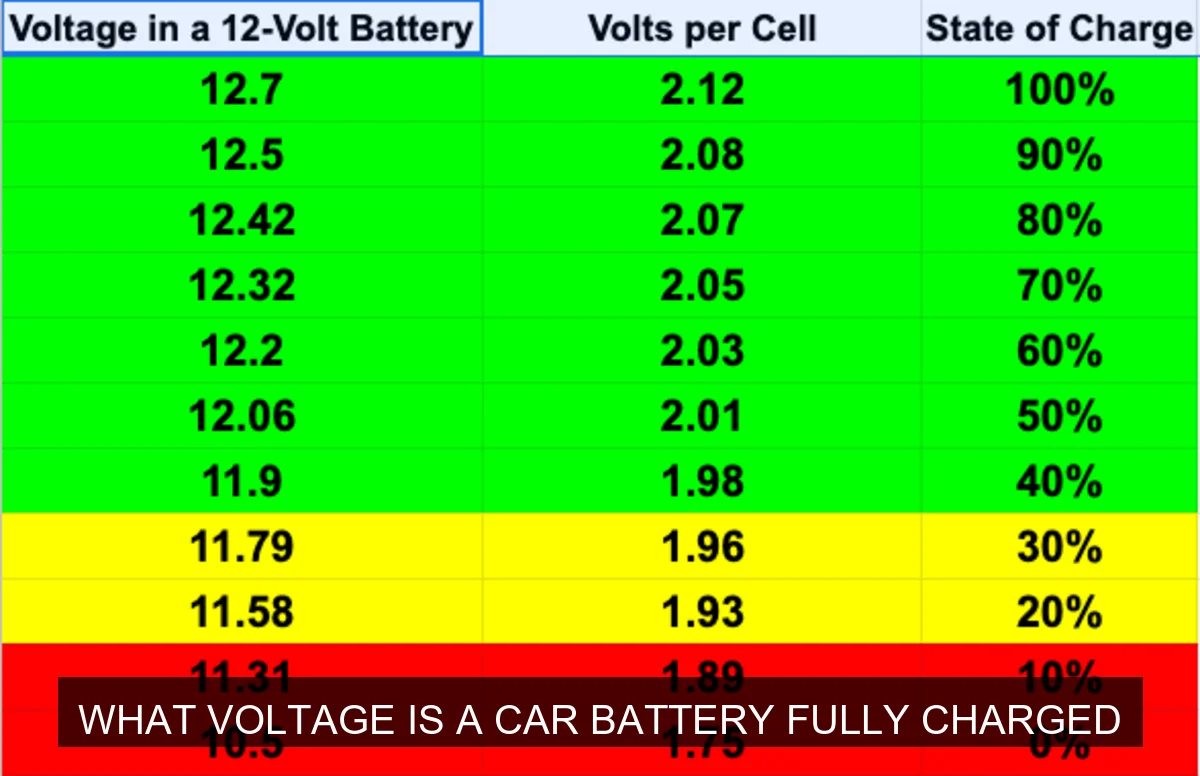
Image source: Saymedia-content
📋 Table of Contents
- 🔹 Introduction: Unpacking Car Battery Voltage
- 🔹 What is Car Battery Voltage, Anyway?
- 🔹 The Magic Number: What Voltage is a Car Battery Fully Charged?
- 🔹 Why Understanding Car Battery Voltage Matters
- 🔹 How to Check Your Car Battery’s Voltage
- 🔹 Understanding Voltage Readings: What Do They Mean?
- 🔹 Common Mistakes and Misconceptions About Car Battery Voltage
- 🔹 Tips for Maintaining Optimal Car Battery Health
- 🔹 Real-Life Scenarios: Voltage in Action
- 🔹 Frequently Asked Questions (FAQ)
- 🔹 Conclusion
A fully charged 12-volt car battery typically measures between 12.6 and 12.8 volts when the engine is off and the battery has rested for several hours. This resting voltage provides an accurate snapshot of its charge level, ensuring your car has enough power to start reliably.
Introduction: Unpacking Car Battery Voltage
Ever wondered what voltage is a car battery fully charged? It’s a super common question, and one that holds the key to understanding your car’s electrical health. Your car battery is the heart of its electrical system, providing the juice to start the engine and power various components when the engine isn’t running. Knowing its ideal voltage level isn’t just for mechanics; it’s a practical bit of knowledge for any car owner.
In this article, we’ll demystify car battery voltage. We’ll explore what those numbers mean, why they matter, how you can easily check your battery’s charge, and what mistakes to avoid. By the end, you’ll feel much more confident about your car’s power source and ready to tackle simple checks yourself.
What is Car Battery Voltage, Anyway?
Think of voltage as the “electrical pressure” that pushes electricity through a circuit. In a car battery, this pressure is created by a chemical reaction inside. Most cars use a 12-volt battery. This “12-volt” is a nominal value, meaning it’s the general rating, not the exact voltage you’ll always measure.
A typical 12-volt lead-acid car battery is made up of six individual cells, each producing about 2.1 volts when fully charged. These six cells are connected in series, meaning their voltages add up: 6 cells x 2.1 volts/cell = 12.6 volts. So, when you see a reading of 12.6 volts or slightly higher, you’re looking at a battery that’s doing its job perfectly.
It’s important to differentiate between a battery’s resting voltage and its charging voltage. Resting voltage is what we’re focused on when discussing a fully charged battery with the engine off. Charging voltage, which we’ll touch on later, is what your car’s alternator provides while the engine is running.
The Magic Number: What Voltage is a Car Battery Fully Charged?
So, let’s get right to it. For a standard 12-volt lead-acid car battery, a healthy, fully charged resting voltage is:
- 12.6 volts to 12.8 volts
This reading should be taken when the battery has been at rest for at least a few hours, ideally overnight. Why is waiting important? Because when a battery has just been used or charged, it can develop what’s called a “surface charge.” This surface charge can temporarily inflate the voltage reading, making the battery seem more charged than it actually is. Letting it rest allows this surface charge to dissipate, giving you a truer picture of its actual state of charge.
You might occasionally see a reading slightly higher, like 12.9 volts or even 13 volts, right after a long drive. This is often the lingering surface charge. It usually settles back down to that 12.6-12.8V range after a while.
Another factor that can slightly influence voltage readings is temperature. Colder temperatures generally mean a battery holds slightly less charge and its voltage might appear a bit lower, even if it’s technically “full.” However, the 12.6-12.8V range remains the universally accepted benchmark at typical room temperatures.
Why Understanding Car Battery Voltage Matters
Knowing your car battery’s voltage isn’t just trivia; it’s genuinely useful. Here’s why:
- Prevents Unexpected Breakdowns: A battery that consistently reads below 12.4 volts is losing its charge. Catching this early can help you recharge it or address underlying issues before you’re stranded with a car that won’t start.
- Extends Battery Life: Car batteries don’t like to be deeply discharged. Regularly allowing your battery to drop to low voltage levels shortens its overall lifespan. Keeping it fully charged helps it last longer.
- Helps Diagnose Issues: A multimeter reading can be a great first step in troubleshooting car problems. If your battery voltage is low, it might point to a failing alternator (not charging the battery enough) or a parasitic drain (something in your car is using power when it shouldn’t be).
- Ensures Reliable Starting: A fully charged battery provides the strong surge of power needed to crank your engine. If the voltage is too low, the starter motor might struggle, click, or not engage at all.
Checking your battery’s resting voltage is like taking its pulse. It gives you a quick, non-invasive way to understand its health.
How to Check Your Car Battery’s Voltage
Checking your car battery’s voltage is a simple task you can do at home with a common tool called a multimeter. Here are the steps:
- Gather Your Tools: You’ll need a digital multimeter and, for safety, some gloves and safety glasses.
- Ensure Safety: Always wear safety glasses and gloves when working near a car battery. Batteries contain corrosive acid and produce flammable gases.
- Park Safely: Make sure your car is turned off, the engine is cool, and it’s parked on a level surface with the parking brake engaged.
- Let the Battery Rest: For the most accurate reading, let your battery rest for at least 3-4 hours, or ideally overnight, after driving or charging. This helps eliminate any surface charge.
- Set the Multimeter: Turn your multimeter dial to the “DC Voltage” setting (usually marked with a “V” and a straight line with three dots underneath, or just “VDC”). Set the range to 20 volts (or the nearest setting above 12V).
- Connect the Probes:
- Connect the red (positive) lead of the multimeter to the positive (+) terminal of your car battery.
- Connect the black (negative) lead of the multimeter to the negative (-) terminal of your car battery.
Make sure the connections are firm and clean. You’ll see the voltage reading appear on the multimeter’s screen.
- Read the Result: Note the number displayed. This is your battery’s resting voltage.
- Disconnect Safely: Always remove the negative (black) lead first, then the positive (red) lead.
Understanding Voltage Readings: What Do They Mean?
Once you have a voltage reading, what does it actually tell you? Here’s a quick guide to interpret those numbers:
| Voltage Reading (Engine Off) | Approximate State of Charge | Meaning / Action Needed |
|---|---|---|
| 12.6 – 12.8 volts | 100% (Fully Charged) | Excellent! Battery is fully charged and healthy. |
| 12.4 volts | ~75% Charged | Good, but consider a top-up charge if you drive short distances often. |
| 12.2 volts | ~50% Charged | Getting low. You should charge your battery soon. Could struggle to start in cold weather. |
| 12.0 volts | ~25% Charged | Very low. Your battery needs immediate charging. Risk of permanent damage if left discharged. |
| Below 12.0 volts | Discharged / Critically Low | Battery is deeply discharged. It may not be able to start your car. Immediate charging is critical to prevent damage. May need replacement. |
It’s worth noting that these percentages are approximations for a healthy battery. An older battery, even if it shows a full voltage reading, might not have the “oomph” (cranking amps) to start your car, especially in cold weather.
Common Mistakes and Misconceptions About Car Battery Voltage
There are a few pitfalls to avoid when checking or thinking about car battery voltage:
- Checking While the Engine is Running: If you measure your battery voltage with the engine running, you’ll likely see a reading between 13.5 and 14.5 volts. This isn’t the battery’s voltage; it’s the voltage the alternator is putting out to charge the battery and power the car. It tells you your alternator is working, but not the battery’s state of charge.
- Not Letting the Battery Rest: As mentioned, ignoring the surface charge can give you a false sense of security. Always let the battery sit for a few hours after use or charging for an accurate resting voltage.
- Assuming Voltage is the Only Indicator: While voltage is crucial, it’s not the only factor in battery health. A battery might show 12.6V but still be failing if its Cold Cranking Amps (CCA) are too low due to internal damage. A voltage reading is a good starting point, but a professional load test can give a more complete picture, especially for older batteries.
- Thinking a Low Battery is Always “Dead”: A low voltage doesn’t necessarily mean your battery is beyond saving. It might just be discharged and needs a good charge. However, if it repeatedly drains or won’t hold a charge, then it might be truly “dead.”
Tips for Maintaining Optimal Car Battery Health
Keeping your battery fully charged and healthy extends its life and helps avoid frustrating problems. Here are some practical tips:
- Regular Voltage Checks: Make checking your battery’s resting voltage a part of your routine maintenance, perhaps once a month or every few months. This lets you catch issues early.
- Keep Terminals Clean: Corroded battery terminals can prevent a good electrical connection, hindering charging and starting. Clean them regularly with a wire brush and a baking soda/water solution.
- Avoid Deep Discharges: Try not to let your battery discharge below 50% (around 12.2V). Running accessories with the engine off for long periods can quickly drain it.
- Drive Regularly or Use a Maintainer: Short, infrequent drives don’t allow your alternator enough time to fully recharge the battery. If you don’t drive your car often, consider using a battery maintainer or trickle charger to keep it topped up.
- Check Electrolyte Levels (if applicable): For older-style flooded lead-acid batteries, check the water levels periodically and top up with distilled water if needed. Newer AGM or sealed batteries don’t require this.
- Insulate in Extreme Cold: Very cold weather dramatically reduces battery performance. If you live in a cold climate, a battery blanket or warmer can help.
Real-Life Scenarios: Voltage in Action
Let’s look at how knowing “what voltage is a car battery fully charged” can help in everyday situations:
Scenario 1: The Click-No-Start
You hop in your car on a chilly morning, turn the key, and hear only a weak click or nothing at all. Before panicking, you grab your multimeter. You connect it to the battery terminals after letting it sit for an hour, and it reads 11.8 volts. This immediate reading tells you the battery is deeply discharged. You know it’s not “dead” yet, but needs a serious charge or a jump start. You can then investigate *why* it got so low – perhaps you left headlights on, or there’s a slow parasitic drain.
Scenario 2: Post-Alternator Replacement
You recently had your alternator replaced because your battery kept dying. To verify the new alternator is working correctly, you start your car and measure the voltage at the battery terminals while the engine is running. You see a stable reading of 14.2 volts. This indicates the alternator is properly charging the system, giving you peace of mind that your battery issues should be resolved.
Scenario 3: Preparing for a Trip
Before a long road trip, you want to ensure your car is reliable. You check your battery’s resting voltage after it sat overnight. It reads 12.7 volts. This tells you your battery is fully charged and ready for the journey, reducing the risk of a roadside issue.
Frequently Asked Questions (FAQ)
What does “fully charged” truly mean for a car battery?
For a lead-acid car battery, “fully charged” means that the chemical reaction within the battery’s cells has reached its maximum potential, and the electrolyte (acid and water mixture) has reached its highest specific gravity. Each cell is producing its maximum voltage, totaling 12.6 to 12.8 volts for the entire battery.
Can a car battery show 12 volts and still be dead?
Yes, absolutely. A battery showing exactly 12.0 volts is only about 25% charged. While it might still produce a voltage reading, it likely won’t have enough power (cranking amps) to start your car, especially in cold weather. It’s essentially “dead” in terms of its ability to perform its primary function. A battery can also show a healthy voltage but fail under load due to internal damage.
How does temperature affect car battery voltage?
Temperature significantly impacts battery performance. In cold weather, the chemical reactions inside the battery slow down, reducing its available power and often slightly lowering its resting voltage. While a fully charged battery will still be in the 12.6-12.8V range, extremely cold temperatures might push it towards the lower end. Heat can also reduce battery lifespan, as it accelerates internal chemical processes.
Is 13 volts good for a car battery?
If your engine is running and you measure 13 volts (or typically 13.5-14.5 volts), that’s a good sign! It means your alternator is actively charging the battery and powering your vehicle’s electrical system. However, if you measure 13 volts or higher on a battery that has been sitting for several hours with the engine off, it usually indicates a “surface charge” that hasn’t dissipated yet. Let it rest longer, and it should settle back into the 12.6-12.8V range.
What is the difference between open-circuit voltage and charging voltage?
Open-circuit voltage (or resting voltage) is the voltage measured across the battery terminals when it’s not connected to any load and not being charged. This is the voltage we’ve primarily discussed (12.6-12.8V fully charged). Charging voltage is the voltage supplied by the alternator or an external charger when it’s actively recharging the battery. This voltage is typically higher, ranging from 13.5 to 14.5 volts, to overcome the battery’s internal resistance and push current into it.
Conclusion
Understanding what voltage is a car battery fully charged is a fundamental piece of knowledge for any car owner. That sweet spot between 12.6 and 12.8 volts, measured after your battery has had a good rest, is your benchmark for a healthy, ready-to-go power source. Regular voltage checks can act as an early warning system, helping you spot potential problems before they leave you stranded.
Armed with a simple multimeter and the information you’ve learned here, you can confidently monitor your battery’s health, prolong its life, and ensure your car remains a reliable companion. It’s a small effort that yields big returns in peace of mind and fewer roadside worries.