
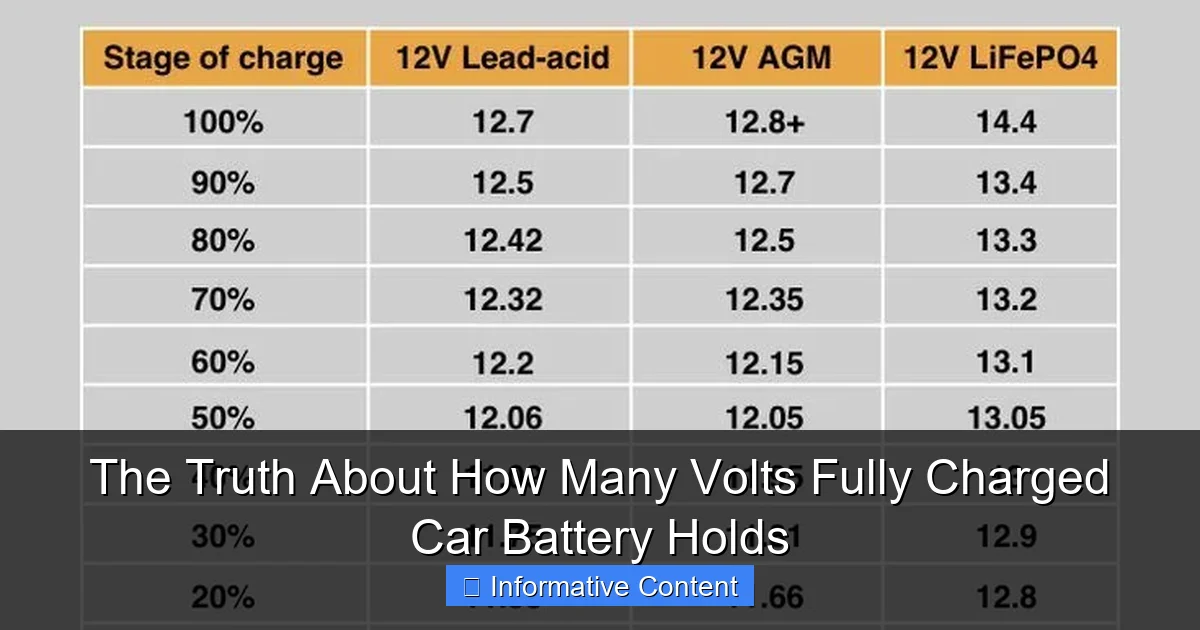
The “truth” is, a fully charged 12-volt car battery actually holds significantly more than 12 volts, typically resting around 12.6 to 12.8 volts. This crucial insight helps diagnose battery health, as anything below 12.4V indicates a need for charging, not a “full” state. Don’t let common misconceptions lead to a dead battery!
The Truth About How Many Volts Fully Charged Car Battery Holds
Picture this: You hop into your car, turn the key, and… nothing. Just a sad click, or perhaps complete silence. We’ve all been there, or at least dreaded being there. It’s a frustrating moment, often leading us to suspect the car battery. But what does a healthy car battery actually look like, electrically speaking? We often hear “12-volt battery,” but is it really just 12.0 volts when it’s in tip-top shape?
If you’ve ever found yourself scratching your head, wondering about the real numbers, you’re not alone. There’s a common misconception that a “12-volt” battery should read exactly 12.0 volts when fully charged. The truth is a little more nuanced, and understanding it can save you a lot of hassle, money, and maybe even a few roadside headaches. Knowing exactly how many volts fully charged car battery should register is a fundamental piece of car maintenance knowledge that every driver can benefit from.
So, let’s pull back the curtain and reveal the real story behind your car battery’s voltage. We’re going to dive deep into what those numbers truly mean, how to get an accurate reading, and what you can do to keep your battery humming along happily. Get ready to demystify one of the most vital components under your hood, and uncover the precise answer to “how many volts fully charged car battery” actually needs to hold for optimal performance.
Key Takeaways
- Fully charged: A 12V car battery is 12.6 to 12.8 volts when fully charged.
- Healthy range: A healthy battery at rest should read 12.4 volts minimum.
- Recharge needed: Below 12.4V means it’s discharged; recharge promptly to prevent damage.
- Engine running: With the engine on, expect 13.7 to 14.7 volts from your alternator.
- Accurate testing: Test battery voltage after resting for several hours for accuracy.
- Maintain voltage: Regularly monitor voltage to extend battery lifespan and prevent issues.
- Warning sign: A consistent drop in voltage may indicate a failing battery or alternator.
Quick Answers to Common Questions
What’s the ideal voltage for a fully charged car battery?
A truly fully charged car battery, when rested (engine off for a few hours), should ideally measure around 12.6 to 12.8 volts. This range indicates optimal health and readiness to start your engine!
Why isn’t a “12-volt battery” exactly 12 volts when fully charged?
Great question! While we commonly call it a 12-volt battery, its internal lead-acid chemistry means that a 100% fully charged car battery actually holds a bit more charge, settling in that 12.6V-12.8V range for peak performance.
What if my battery shows higher than 12.8 volts right after driving?
Don’t panic! Immediately after a drive, your battery might show a slightly higher “surface charge” from the alternator. Let your car battery rest for a few hours, then check again to get an accurate reading of how many volts your fully charged car battery truly holds.
Does temperature affect how many volts a fully charged car battery reads?
Yes, it can a little! Extreme cold can slightly depress the voltage reading, while very hot conditions might slightly elevate it. Always aim for that 12.6V-12.8V sweet spot in moderate temperatures for a reliable reading of your fully charged car battery.
What’s the lowest voltage a “fully charged” car battery can be without concern?
If your car battery consistently reads below 12.4 volts after resting for several hours, it’s not fully charged and might need charging or indicate an underlying issue. For a healthy, fully charged car battery, always aim for 12.6V or higher.
📑 Table of Contents
- The Basics: Understanding Car Battery Voltage
- The Magic Number: How Many Volts Fully Charged Car Battery Actually Is
- Why Isn’t It Exactly 12 Volts? The Role of Chemistry
- What Affects a Fully Charged Car Battery’s Voltage Reading?
- How to Measure Your Car Battery’s Voltage Accurately (and Why It Matters)
- Car Battery Voltage Chart: Understanding Charge Levels
- Beyond the Volts: What a Healthy Car Battery Really Means (and Tips for Longevity)
The Basics: Understanding Car Battery Voltage
Before we can talk about how many volts a fully charged car battery holds, let’s quickly get on the same page about what voltage actually is. Think of electricity like water flowing through a pipe. In this analogy, voltage is the “pressure” that pushes the water through. The higher the voltage, the more pressure, and the more potential electrical energy available to power your car’s components, from starting the engine to running your radio.
What is Voltage, Anyway?
In simple terms, voltage is the difference in electric potential energy between two points. For a car battery, it’s the electrical “push” that sends electrons flowing when you complete a circuit – like when you turn the ignition. Our cars typically use a DC (direct current) system, where the current flows in one direction, generated by the chemical reactions within the battery. Understanding this basic concept is key to grasping why a fully charged car battery doesn’t sit at a perfect “12.0” volts.
The “12-Volt” Misconception
The term “12-volt battery” is an industry standard, a general classification. It implies that the battery operates around the 12-volt mark. However, it’s not a precise measurement of its peak charge. This misconception often leads people to think that if their battery reads 12.0 volts, it’s fully charged. In reality, a car battery reading exactly 12.0 volts is only about 50% charged, and certainly not the answer to how many volts fully charged car battery really holds. It’s a critical difference that can lead to misdiagnosing your battery’s health.
Different Battery Types (Briefly)
While we’re primarily focusing on standard lead-acid car batteries, it’s worth a quick mention that there are different types, such as Absorbed Glass Mat (AGM) and Enhanced Flooded Battery (EFB). These might have slightly different characteristics and charging profiles, but for the most common vehicles, the principles of how many volts a fully charged car battery holds remain largely consistent. Our focus here is on the traditional 12-volt starting, lighting, and ignition (SLI) batteries you find in most passenger cars and light trucks.
The Magic Number: How Many Volts Fully Charged Car Battery Actually Is
Okay, let’s get down to the core question: how many volts fully charged car battery truly holds? If it’s not 12.0, then what is it? The answer might surprise you, but once you understand the chemistry, it makes perfect sense. For a healthy, standard 12-volt lead-acid car battery, you should be looking for a resting voltage higher than 12.0 volts.

Visual guide about fully charged car battery voltage
Image source: climatebiz.com
The Ideal Resting Voltage: 12.6V to 12.8V
When we talk about a fully charged car battery, we’re looking for a resting voltage between 12.6 and 12.8 volts. This is the sweet spot, indicating that your battery’s chemical potential energy is at its maximum. Anything consistently below 12.4 volts generally means the battery is not fully charged and could use some attention. If you’re seeing 12.0 volts, that’s a sign of a significantly depleted battery, not a healthy one.
Surface Charge vs. True Charge
This is a crucial distinction that often trips people up when trying to determine how many volts a fully charged car battery should show. After a long drive or immediately after charging, your battery might show a voltage reading as high as 13.0 to 13.2 volts, or even higher. This is what’s known as “surface charge.” It’s a temporary, superficial voltage that doesn’t accurately reflect the battery’s true state of charge. To get a precise reading of how many volts fully charged car battery truly holds, you need to eliminate this surface charge.
- How to eliminate surface charge: Turn on your headlights for about 2-3 minutes with the engine off, then turn them off. Or simply let the car sit undisturbed for a few hours (ideally 12-24 hours). This allows the surface charge to dissipate, giving you a true resting voltage.
Why Your Car Might Show Higher While Running
You might notice your voltmeter showing something like 13.8 to 14.7 volts when your engine is running. Don’t panic! This is perfectly normal and indicates that your alternator is doing its job. The alternator is essentially a generator that produces electricity to power your car’s electrical systems and, crucially, recharge the battery as you drive. This charging voltage is intentionally higher than the battery’s resting voltage to ensure that current flows into the battery to replenish its charge. So, while your car is running, the voltage will be elevated because it’s actively being charged, which is different from how many volts fully charged car battery holds at rest.
Why Isn’t It Exactly 12 Volts? The Role of Chemistry
To really understand why a fully charged car battery reads above 12.0 volts, we need to peek inside and look at the fascinating chemistry at play. It’s not magic, it’s science! The design of a standard lead-acid battery is what dictates its specific voltage characteristics, explaining precisely how many volts fully charged car battery naturally produces.

Visual guide about fully charged car battery voltage
Image source: cdn.shopify.com
Inside Your Lead-Acid Battery
Most car batteries are lead-acid batteries, composed of several cells connected in series. Each cell typically contains lead plates (one positive, one negative) immersed in an electrolyte solution, which is a mixture of sulfuric acid and water. When the battery discharges, a chemical reaction occurs: lead sulfate forms on the plates, and the sulfuric acid becomes less concentrated. When you charge the battery, this process reverses.
Chemical Reactions and Electron Flow
The voltage a battery produces is a direct result of these chemical reactions. When the battery is fully charged, the chemical potential energy stored within its components is at its peak. This potential energy drives the electrons from the negative terminal to the positive terminal through an external circuit, creating the electrical current your car needs. The specific materials (lead and sulfuric acid) and their interaction determine the voltage output of each cell.
The Six-Cell Design
Here’s the key to understanding the specific voltage. A standard 12-volt car battery is actually made up of six individual cells, each producing approximately 2.1 to 2.2 volts when fully charged. Since these six cells are wired in series, their voltages add up:
- 6 cells * 2.1 volts/cell = 12.6 volts
- 6 cells * 2.2 volts/cell = 13.2 volts (this might be seen as a surface charge or immediately after charging)
This simple multiplication explains why a truly fully charged car battery will consistently show a resting voltage in the 12.6-12.8V range, rather than a flat 12.0V. It’s the cumulative output of its individual, perfectly healthy cells.
What Affects a Fully Charged Car Battery’s Voltage Reading?
Even if you know how many volts a fully charged car battery should ideally have, various factors can influence its actual reading. It’s not always a straightforward number; understanding these influences helps you accurately interpret your battery’s health.
Temperature’s Impact
Temperature plays a significant role in battery performance and voltage readings.
- Cold Weather: In colder temperatures, the chemical reactions inside the battery slow down. This means the battery’s ability to deliver power (Cold Cranking Amps, or CCA) is reduced, and its resting voltage might appear slightly lower even if it’s otherwise well-charged. Starting a car in freezing weather puts a huge strain on the battery.
- Hot Weather: Ironically, hot weather can be even harder on a battery in the long run. High temperatures accelerate the chemical degradation process, shortening the battery’s lifespan. While a battery might show a stable voltage in hot weather, its internal components could be wearing out faster.
Age and Condition of the Battery
Just like us, batteries age! Over time, repeated charging and discharging cycles, along with normal wear and tear, lead to a decline in performance.
- Sulphation: One common issue is sulphation, where lead sulfate crystals build up on the battery plates, reducing their surface area and hindering the chemical reactions. This increases the battery’s internal resistance, making it harder for it to accept a full charge and deliver power. An older, sulphated battery might never reach the ideal 12.6-12.8V even after extensive charging, giving a lower reading for how many volts fully charged car battery can hold.
- Internal Resistance: As batteries age, their internal resistance increases. This means more energy is lost as heat during charging and discharging, resulting in less available power and potentially lower voltage readings.
Parasitic Drains
Even when your car is off, certain components might still draw a small amount of power. This is known as a “parasitic drain.” While a tiny drain is normal (to keep the clock, radio presets, and alarm system active), an excessive drain can slowly deplete your battery, even if it was fully charged initially. This could be due to a faulty component, aftermarket accessories, or even a simple light left on. If your battery voltage consistently drops significantly overnight or over a few days, even after being fully charged, you might have a parasitic drain issue.
Recent Driving or Charging
As we discussed with surface charge, recent activity greatly impacts the immediate voltage reading. If you’ve just driven your car or had it on a charger, the voltage will be temporarily elevated. This is why it’s so important to let the battery rest for several hours before taking a reading if you want to know how many volts fully charged car battery truly possesses at its core.
How to Measure Your Car Battery’s Voltage Accurately (and Why It Matters)
Knowing the ideal voltage is one thing, but being able to measure it accurately is where the rubber meets the road. Getting a precise reading for how many volts fully charged car battery has is a simple but vital maintenance step. It empowers you to monitor your battery’s health and catch potential problems before they leave you stranded.
Tools of the Trade: Multimeter or Voltmeter
You don’t need fancy equipment to measure your battery’s voltage. A basic digital multimeter (DMM) or a dedicated automotive voltmeter will do the trick. These are relatively inexpensive tools, widely available at auto parts stores or electronics retailers, and they’re incredibly useful for various electrical diagnostics around the house and car.
The Importance of a Resting State
We’ve already touched on this, but it bears repeating: for an accurate assessment of how many volts fully charged car battery is holding, it must be in a resting state. This means the engine has been off, and no significant electrical loads have been active for at least 3-4 hours, ideally 12-24 hours. If you’ve just driven the car, let it sit overnight. If you’ve just taken it off a charger, allow it to rest for a similar period, or at least run the headlights for a few minutes to bleed off the surface charge.
Step-by-Step Measurement Guide
Here’s how to check your battery voltage with a multimeter:
- Gather Your Tools: Get your digital multimeter and make sure its battery is charged.
- Ensure Safety: Wear safety glasses and gloves. Though unlikely, a faulty battery can sometimes produce sparks or acid.
- Set the Multimeter: Turn the dial to the DC voltage setting. Look for “VDC” or “V–“. Usually, the 20V range is appropriate for a 12-volt battery.
- Connect the Leads:
- Connect the red (positive) lead of the multimeter to the positive (+) terminal of the battery.
- Connect the black (negative) lead of the multimeter to the negative (-) terminal of the battery.
Ensure a good, clean connection. You might need to gently scrape away any corrosion on the terminals for a better reading.
- Read the Display: The voltage reading will appear on the multimeter’s screen. Note this number.
- Disconnect: Remove the leads in reverse order (negative first, then positive).
This simple process gives you the clear answer to how many volts fully charged car battery is showing right now, in its current state.
Car Battery Voltage Chart: Understanding Charge Levels
Once you have your reading, what does it actually mean? This chart will help you interpret the numbers and understand your car battery’s state of charge, clearly showing how many volts fully charged car battery should achieve, and what other readings signify.
| Resting Voltage Reading (V) | Approximate State of Charge (%) | Battery Condition | Action Recommended |
|---|---|---|---|
| 12.6V – 12.8V | 100% | Fully Charged | Excellent! Your battery is in peak condition. |
| 12.4V | 75% | Good Charge | Still good, but not quite full. Consider a maintenance charge if not driven regularly. |
| 12.2V | 50% | Partially Discharged | Needs charging. May have difficulty starting in cold weather. |
| 12.0V | 25% | Heavily Discharged | Charge immediately. Risk of permanent damage (sulphation) if left discharged. Will struggle to start. |
| Below 12.0V | 0% – 25% | Critically Discharged | Charge immediately and test. Battery might be permanently damaged or unable to hold a charge. Very unlikely to start. |
This table is your quick reference guide for interpreting your multimeter’s reading, directly answering the question of how many volts fully charged car battery needs, and what action to take based on other readings. Remember, these values are for a battery that has been resting for several hours.
Beyond the Volts: What a Healthy Car Battery Really Means (and Tips for Longevity)
While understanding how many volts a fully charged car battery holds is paramount, voltage isn’t the only indicator of a battery’s overall health. A truly healthy battery also needs to be able to deliver ample current (amperage) when needed, especially for starting your engine. A battery can show 12.6V but still be “dead” if it can’t deliver the necessary cranking amps.
Beyond Just Voltage: Cranking Amps and Load Testing
For a complete picture, professionals often perform a load test. This test applies a significant electrical load to the battery for a short period and measures how well the voltage holds up under stress. It assesses the battery’s Cold Cranking Amps (CCA), which indicate its ability to start the engine in cold temperatures. A battery might show a good resting voltage, but if its CCA is low, it could still fail to start your car on a frigid morning. While load testing usually requires specialized equipment, knowing about it helps you understand a more comprehensive battery diagnosis.
Practical Tips for a Longer Battery Life
Want to extend the life of your battery and keep it performing optimally? Here are some simple, practical tips:
- Keep Terminals Clean: Regularly inspect and clean your battery terminals. Corrosion (the white or bluish-green fuzzy stuff) can impede current flow and hinder charging. Use a battery terminal cleaner and a wire brush to keep them sparkling.
- Regular Driving: Batteries love to be used and recharged. Short, infrequent drives don’t allow the alternator enough time to fully recharge the battery, especially if you have many accessories. Take your car for longer drives (at least 20-30 minutes) regularly to ensure a full charge.
- Avoid Deep Discharges: Try to prevent your battery from going completely flat. Each deep discharge cycle reduces the battery’s overall lifespan. If you leave your lights on, get it charged as soon as possible.
- Use a Smart Charger for Storage: If you store your vehicle for extended periods (weeks or months), invest in a “smart” or “trickle” charger/maintainer. These devices keep your battery topped up without overcharging, ensuring that how many volts fully charged car battery holds remains consistent, preventing sulphation.
- Insulate in Extreme Temps: In areas with extreme hot or cold, consider a battery blanket or insulating cover. This can help regulate battery temperature and extend its life.
When to Consider Replacement
Even with the best care, car batteries don’t last forever, typically 3-5 years. Watch out for these signs that your battery might be nearing the end of its life:
- Slow engine crank (it sounds like it’s struggling to turn over).
- Dim headlights when the engine is off but accessories are on.
- Frequent need for jump-starts.
- Warning lights on your dashboard.
- A bulging or cracked battery case.
- A strong, rotten egg smell (indicating a leak or internal damage).
- Consistently low voltage readings, even after charging (e.g., struggling to reach 12.4V, let alone the ideal 12.6-12.8V).
If you’re noticing these symptoms, even if you know how many volts a fully charged car battery should have, it might be time for a professional to test it or consider a replacement.
Understanding how many volts a fully charged car battery needs to achieve is a simple yet powerful piece of knowledge. It allows you to monitor your battery’s health, prevent unexpected breakdowns, and ensure your vehicle starts reliably every time. By paying attention to those voltage numbers and following a few simple maintenance tips, you can extend the life of your battery and enjoy many worry-free miles on the road.
🎥 Related Video: What Voltage Should Car Battery Be?!
📺 Mechanic Mindset
Using the voltmeter to quickly assess the battery state of charge. What voltage should a car battery read?! Link to BUY Ancel …
Frequently Asked Questions
What is the ideal voltage for a fully charged car battery?
A fully charged 12-volt car battery, when at rest and disconnected from any charging source for several hours, should typically read between 12.6 and 12.8 volts. This range indicates that the battery’s chemical processes are at their peak energy storage capacity.
Why isn’t a “12-volt” car battery exactly 12 volts when fully charged?
The term “12-volt” is a nominal designation for car batteries. A truly fully charged lead-acid battery actually produces a higher voltage, usually between 12.6V and 12.8V, due to its internal chemical composition. This higher voltage is necessary to effectively power your vehicle’s electrical system.
How many volts should a car battery hold right after driving or charging?
Immediately after your car has been running or the battery has been on a charger, the voltage might temporarily read higher, often between 13.0 and 13.2 volts. This is due to a “surface charge” that dissipates after the battery has rested for a few hours, settling back into its true fully charged voltage range.
What voltage indicates a healthy, fully charged car battery that’s been resting?
For an accurate assessment of a healthy, fully charged car battery, it should read between 12.6 and 12.8 volts after resting undisturbed for at least 12-24 hours. This resting period allows any surface charge to dissipate, providing a true indication of its state of charge.
What happens if my car battery consistently reads lower than 12.6 volts?
If your car battery consistently reads lower than 12.6 volts after resting, it indicates that it is not fully charged or may be experiencing discharge. Readings below 12.0 volts suggest a significantly discharged battery, which could lead to starting problems and potentially shorten the battery’s lifespan if not recharged promptly.
How can I accurately check how many volts my fully charged car battery has?
To accurately check how many volts your fully charged car battery has, use a digital multimeter. Ensure the battery has rested for at least a few hours (ideally overnight) after being charged or driven to allow any surface charge to dissipate for a true and accurate voltage reading.