
10 Best Auto Battery Chargers for Reliable Charging and Maintenance

A dead car battery rarely announces itself in advance, and the difference between a five-minute fix and a tow-truck call often comes down to whether the right charger is sitting in the garage. Choosing among smart chargers, trickle maintainers, and engine-start units means weighing charging amperage against battery size, checking whether a unit supports AGM or LiFePO4 chemistry, and deciding if features like desulfation or onboard mounting matter for a specific vehicle. For most car and truck owners, a 5-10A smart charger with automatic temperature compensation offers the best balance of charging speed, safety, and battery compatibility.
This roundup compares battery chargers built for daily drivers, motorcycles, boats, and seasonal equipment, focusing on amperage output, battery chemistry support, recovery features, and physical design so readers can match a charger to their specific vehicle and charging habits.
Best for most 12V vehicles: NOCO GENIUS5
Best for cold-weather charging precision: CTEK MXS 5.0
Best for larger batteries and faster charging: NOCO GENIUS10
Best for high-amp fast charging with engine start: TowerTop 25A Charger
Best compact maintainer for motorcycles: Battery Tender Plus
Best for emergency engine starting: Schumacher SC1281
Best value fast charger for large batteries: Schumacher SC1280
Best for multi-vehicle households: NOCO GENIUS2X2
Best budget trickle charger for small batteries: NOCO GENIUS1
Best for permanent onboard installation: NOCO GENIUS2D
NOCO GENIUS5

The GENIUS5 suits drivers who want one charger that handles cars, motorcycles, and small equipment batteries without babysitting.
Pros
- Works with 6V and 12V lead-acid and LiFePO4 batteries
- Thermal sensor adjusts charge rate for ambient temperature
- Force Mode charges batteries down to zero volts
Cons
- 5A output charges larger batteries slowly
- Single-bank design limits it to one battery at a time
At 5 amps, this charger fits batteries up to roughly 120 amp-hours, which covers most sedans, SUVs, and powersport batteries. The desulfation function targets sulfation buildup that shortens battery life, and the safe indefinite-connection design makes it a solid choice for seasonal vehicles left in storage. Its compact housing mounts easily in tight engine bays.
CTEK MXS 5.0

The MXS 5.0 fits owners in cold climates who need dependable charging performance through an 8-step automatic program.
Pros
- 8-step charging cycle tailored for lead-acid and AGM batteries
- Splash, dust, and shock-resistant housing
- Reconditioning mode can revive underperforming batteries
Cons
- 12V only, no 6V or lithium support
- Charging time runs long at 4.3A
CTEK built this charger for reliability rather than speed. The 4.3A output means longer charge cycles, roughly 50 hours for a full charge on a larger battery, but the multi-stage program manages voltage carefully across marine, car, and RV batteries. Its rugged, sealed design holds up in garages, boat decks, or tractor sheds where moisture and dust are common.
NOCO GENIUS10

The GENIUS10 works well for owners with larger batteries or multiple vehicles who want faster charging than a 5A unit provides.
Pros
- 10A output handles batteries up to 230 amp-hours
- Cuts charge time roughly in half versus the GENIUS5
- Same desulfation and Force Mode features as smaller NOCO units
Cons
- Bulkier and heavier than the GENIUS5
- Overkill for small powersport batteries
Doubling the amperage of its sibling model, the GENIUS10 charges a fully depleted battery in about 10 hours rather than eight for a smaller battery on the GENIUS5. Truck, RV, and marine battery owners benefit most from the added power. The same thermal compensation and lithium compatibility carry over, making it a scalable upgrade rather than a different product line.
TowerTop 25A Charger
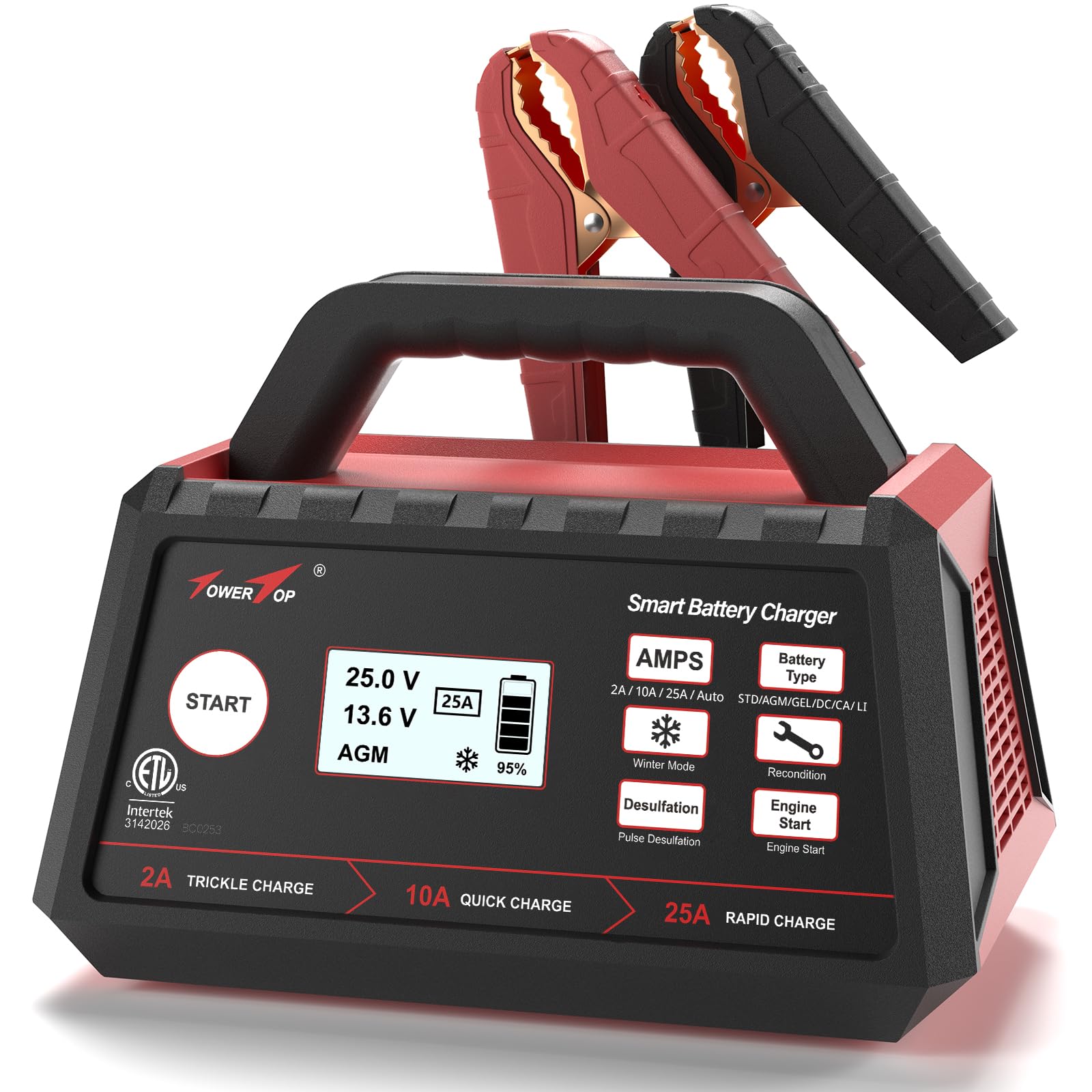
This charger suits drivers who want rapid charging and an occasional engine-start boost in one unit.
Pros
- Adjustable 2A/10A/25A settings plus 100A engine start
- LCD screen shows charging stage and parameters
- Dedicated repair mode for desulfation
Cons
- Engine start is not a substitute for a dedicated jump starter
- Bulkier housing than single-purpose maintainers
Rated to fully charge a 100Ah battery in under four hours at 25A, this charger prioritizes speed. Winter Mode adds extra voltage for cold-weather charging, and multiple safety protections guard against reverse polarity and overcurrent. It works best for owners who need flexibility across small and large batteries in one device.
Battery Tender Plus

The Battery Tender Plus fits motorcycle, ATV, and lawn equipment owners who need a compact maintainer rather than a rapid charger.
Pros
- Long-standing reputation for reliable long-term maintenance
- Quick-disconnect harness simplifies repeated use
- 10-year warranty backs the build quality
Cons
- 1.25A output charges dead batteries slowly
- 12V only, no lithium or 6V support
A 4-step charging program keeps small batteries at proper float voltage without overcharging, which extends battery life on vehicles that sit for weeks. It is not built for fast recovery of a fully dead automotive battery. Riders who want a “set it and forget it” charger for seasonal storage get consistent results from this unit.
Schumacher SC1281
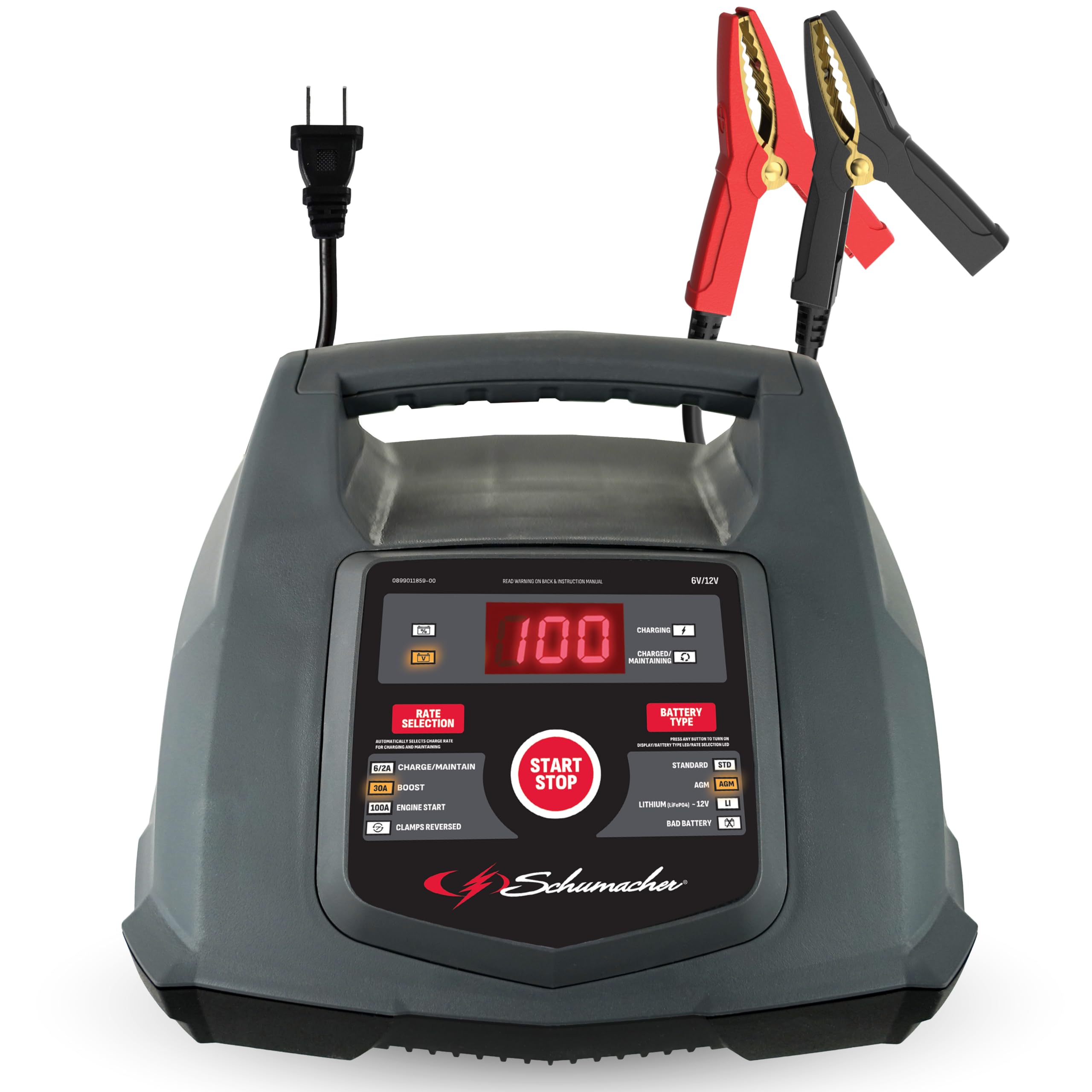
The SC1281 suits drivers who want engine-start capability alongside routine charging in a single unit.
Pros
- 100A engine start helps revive fully dead batteries
- Built-in battery and alternator tester
- Supports 6V, 12V, and lithium batteries
Cons
- Heavier and larger than dedicated maintainers
- 6A charge rate is modest for its size
Boost charging at 30A speeds up recovery before attempting an engine start, and the desulfation mode helps restore older batteries. The alternator tester adds diagnostic value beyond simple charging. Owners who want one tool for starting, charging, and testing get more utility here than from single-function chargers.
Schumacher SC1280

The SC1280 works well for owners who want 15A rapid charging without paying for engine-start hardware.
Pros
- 15A charge rate recovers large batteries quickly
- 3A maintain mode prevents overcharging
- Reverse-clamp protection prevents accidental damage
Cons
- No engine-start function
- Larger footprint than compact maintainers
Microprocessor control adjusts amperage automatically across standard, AGM, gel, and deep-cycle batteries. The desulfation mode targets older batteries showing reduced capacity, and the built-in tester gives a quick health check. This model fits garages that need fast turnaround on multiple vehicles without the bulk of an engine-starting charger.
NOCO GENIUS2X2

The GENIUS2X2 suits households or shops maintaining two vehicles at once from a single charger.
Pros
- Charges two 6V or 12V batteries independently and simultaneously
- Same desulfation and Force Mode features as single-bank NOCO models
- Includes international AC plug adapters
- Higher price than two separate basic maintainers
- Compact wall-plug design needs minimal space
- Supports 6V, 12V, and lithium batteries up to 30Ah
- Same desulfation and thermal compensation as larger NOCO models
Cons
- 1A output makes full charging slow
- Not suited for larger car or truck batteries
This is the smallest charger in the NOCO lineup, built for motorcycles, lawn equipment, and other compact batteries. Its direct wall-plug design skips a separate AC adapter, simplifying setup in tight spaces. Riders storing a bike or ATV over winter get dependable float maintenance without risk of overcharging.
NOCO GENIUS2D

The GENIUS2D suits owners who want a charger permanently mounted under the hood rather than stored separately.
Pros
- Snap-fit mounting bracket allows secure permanent installation
- Short cable runs reduce clutter in the engine bay
- Same thermal compensation and desulfation as portable NOCO units
Cons
- 2A output limits it to smaller 12V batteries
- No 6V or lithium support
Designed for direct-mount use, this charger stays connected to the battery via a short eyelet cable while the charger itself mounts near the battery or fender. It suits generators, boats, and vehicles parked for extended periods where a plug-in connection point is convenient. The 40Ah maximum battery size keeps it out of range for full-size truck batteries.
Buying Guide
Choosing a battery charger comes down to matching amperage, chemistry support, and physical format to the vehicle and how it is used. The features below determine which charger fits a given garage.
Charging Amperage and Speed
Higher amperage charges batteries faster but is not always better. A 1-2A charger works for maintenance on a battery that stays mostly charged, while a fully dead battery needs 10A or higher to recover in a reasonable time.
| Amperage | Best Use | Typical Charge Time (50Ah battery) |
|---|---|---|
| 1-2A | Small batteries, long-term maintenance | 25-50 hours |
| 4-5A | Cars, motorcycles, general use | 10-12 hours |
| 10-15A | Trucks, SUVs, large batteries | 4-6 hours |
| 25A+ | Rapid recovery, shop use | Under 3 hours |
Battery Chemistry Compatibility
Lead-acid, AGM, gel, and lithium (LiFePO4) batteries charge differently, and using the wrong profile can shorten battery life. Confirm a charger explicitly lists support for the battery chemistry in the vehicle before buying, especially for lithium batteries, which need a distinct charge curve from lead-acid types.
Smart Features and Safety
Automatic voltage detection, temperature compensation, and reverse-polarity protection reduce the risk of damaging a battery or charger. Desulfation modes help restore batteries showing reduced capacity from sulfation, though they cannot revive a battery with internal damage or shorted cells.
Format and Portability
- Portable chargers suit owners moving a charger between vehicles.
- Onboard/direct-mount units stay wired to one vehicle permanently for easy seasonal connection.
- Multi-bank chargers maintain two or more batteries at once, useful for households with multiple vehicles.
Engine-Start Capability
Some chargers include a high-amp engine-start function for jumping a dead battery without cables to another car. This adds bulk and cost, and works best as a backup rather than a primary jump-starting method.
FAQs
What amperage charger do I need for a car battery? Most car batteries charge well on a 5-10A charger. Larger truck, RV, or marine batteries benefit from 10-15A for faster recovery, while motorcycles and small equipment batteries do better on 1-2A units to avoid overcharging.
Can I leave a smart charger connected indefinitely? Smart chargers with automatic float or maintenance modes are designed for long-term connection. They monitor voltage and stop charging once the battery reaches full charge, then resume only as needed.
Do I need a special charger for AGM or lithium batteries? AGM batteries generally work with standard lead-acid charging profiles, but lithium (LiFePO4) batteries need a charger that explicitly lists lithium compatibility. Charging lithium batteries on a lead-acid-only charger risks damaging the battery.
Will a battery charger start my car if the battery is completely dead? Only chargers with a dedicated engine-start feature deliver enough current to start an engine directly. Standard maintainers and trickle chargers need time, often several hours, to recover a fully dead battery before the vehicle will start.
What does desulfation mode actually do? Desulfation uses pulse charging to break down sulfate crystals that build up on battery plates over time, which can restore some lost capacity in batteries that have sat unused or been undercharged. It works best on batteries caught early and cannot repair batteries with physical damage.
Conclusion
Matching charger amperage to battery size prevents both slow recovery and unnecessary bulk sitting in a garage. Drivers with a single daily-use vehicle do well with a 5-10A smart charger that includes desulfation and temperature compensation. Owners managing motorcycles, boats, or multiple vehicles benefit from either a compact 1-2A maintainer or a dual-bank charger built for simultaneous charging.
Engine-start models add recovery capability for emergencies but add size and cost that many drivers will not need day to day. Checking battery chemistry compatibility before purchase, particularly for lithium batteries, avoids charging mismatches that shorten battery life. A charger sized correctly for the battery and vehicle keeps maintenance simple and reduces the chance of an unexpected dead battery.