
How to Charge Car Battery Using Charger

Is your car refusing to start? Don’t panic! This comprehensive guide walks you through the essential steps on how to charge your car battery using a charger safely and effectively. You’ll learn about different charger types, crucial safety precautions, proper connection techniques, and monitoring the charging process to get your vehicle back on the road.
There’s nothing quite like the sinking feeling you get when you turn the key in your car’s ignition, and all you hear is a sad click, or worse, nothing at all. A dead car battery is a common inconvenience, but it doesn’t have to ruin your day. With the right tools and a little know-how, you can bring your battery back to life. Learning how to charge your car battery using a charger is a valuable skill that can save you time, money, and a lot of frustration.
Whether you’re dealing with a battery drained from leaving your lights on, or one that’s slowly losing its charge due to age or cold weather, knowing the proper procedure is crucial. This guide will walk you through everything you need to know, from understanding different types of chargers and batteries to the step-by-step process of connecting, charging, and disconnecting safely. We’ll make sure you feel confident and prepared to tackle a flat battery like a pro.
Remember, while the process is straightforward, safety should always be your top priority. Car batteries contain corrosive acid and can produce explosive gases, so a cautious approach is essential. Let’s dive in and learn how to charge your car battery using a charger, making sure you’re equipped with the knowledge to handle this common automotive task safely and effectively.
Key Takeaways
- Safety First: Always prioritize safety by wearing protective gear, ensuring good ventilation, and never allowing battery terminals to touch.
- Understand Your Charger: Differentiate between trickle chargers, smart chargers, and rapid chargers, and choose the right one for your battery type and needs.
- Proper Connection is Key: Connect the positive (red) clamp to the battery’s positive terminal, and the negative (black) clamp to an unpainted metal part of the car chassis, away from the battery, or the negative battery terminal itself if specified by your charger’s manual.
- Follow Charger Instructions: Set the correct voltage (usually 12V) and amperage for your battery, and select the appropriate battery type setting on smart chargers.
- Monitor the Process: Keep an eye on the charger’s indicator lights or display to know when the battery is fully charged, avoiding overcharging.
- Disconnect Safely: Always turn off and unplug the charger before disconnecting the clamps, starting with the negative clamp first.
- Regular Maintenance: To prevent future dead batteries, regularly check battery terminals for corrosion, ensure proper fluid levels (if applicable), and maintain good driving habits.
Quick Answers to Common Questions
Can I charge my car battery while it’s still connected to the car?
Yes, in most cases, you can charge your car battery while it’s still connected to the car. Just ensure the car’s ignition is off and all accessories are turned off to prevent electrical surges or damage. Always follow your charger’s specific instructions.
How do I know when my car battery is fully charged?
Most modern smart chargers have indicator lights or a digital display that will show “charged,” “full,” or switch to a maintenance/float mode when the battery is fully charged. If using a basic charger, you can use a voltmeter to check; a fully charged 12V lead-acid battery should read around 12.6-12.8 volts.
Is it safe to leave a battery charger connected overnight?
It is generally safe to leave a *smart* battery charger or maintainer connected overnight or for extended periods, as they automatically monitor the battery and switch to a float mode to prevent overcharging. However, traditional trickle chargers that don’t have smart features should not be left connected indefinitely as they can overcharge the battery.
What should I do if my battery charger shows a “fault” or “error”?
If your charger shows a fault or error, first check all connections to ensure they are clean and secure. Then, verify that you’ve selected the correct battery type and voltage settings. If the error persists, the battery might be severely discharged (below the charger’s detection threshold) or potentially damaged, requiring professional assessment.
Can I use any car battery charger for any car battery?
While many chargers are universal for 12V car batteries, it’s best to use a charger compatible with your specific battery type (e.g., lead-acid, AGM, gel) and its voltage. Using a charger with incorrect settings, especially for AGM or gel batteries, can damage the battery. Always check your battery type and charger settings.
📑 Table of Contents
Understanding Your Car Battery and Charger
Before you even think about connecting anything, it’s important to understand what you’re working with. Not all batteries are the same, and neither are all chargers. Knowing the basics will help you choose the right tools and ensure a safe and successful charge.
Types of Car Batteries
Most cars today use one of a few common battery types:
- Lead-Acid (Flooded/Wet Cell): These are the most common and traditional car batteries. They contain a liquid electrolyte solution and may have removable caps to check and replenish fluid levels. Many chargers have a specific “wet” or “flooded” setting.
- Absorbed Glass Mat (AGM): A newer technology where the electrolyte is absorbed into fiberglass mats. AGM batteries are maintenance-free, more resistant to vibrations, and handle deeper discharges better. They require specific charging profiles, usually available on smart chargers.
- Gel Cell: Similar to AGM, but the electrolyte is a silica gel. Gel batteries are very resistant to spills and vibrations but are more sensitive to overcharging. They also require specific charging settings, typically a lower voltage than lead-acid or AGM.
It’s vital to know your battery type because using the wrong charging profile can damage the battery or significantly reduce its lifespan. Always check your battery’s label or your car’s manual.
Types of Car Chargers
When you’re ready to charge car battery using charger, you’ll find several types on the market:
- Trickle Chargers: These deliver a low, constant current (usually 1-3 amps) over a long period. They are best for maintaining a charge on batteries stored for extended periods, like those in classic cars or motorcycles. They can be slow to recharge a completely dead battery and might not have advanced safety features.
- Smart Chargers (or Battery Maintainers): These are highly recommended for most users. Smart chargers monitor the battery’s condition and adjust the charging current and voltage as needed. They often have multiple stages (desulfation, bulk, absorption, float) to optimize charging, prevent overcharging, and prolong battery life. They are generally safe to leave connected for long periods. Many smart chargers allow you to select the battery type (e.g., lead-acid, AGM, gel).
- Rapid Chargers (or Fast Chargers): These deliver a high current to quickly recharge a battery, often in a few hours. While convenient, fast charging can generate heat and potentially stress the battery, reducing its lifespan if used too frequently or incorrectly. Some rapid chargers also have a “jump start” feature.
For regular use and battery health, a smart charger is generally the best investment if you want to know how to charge car battery using charger effectively.
Safety First!
Before you even touch your car or charger, let’s talk about safety. This is the most crucial part of learning how to charge car battery using charger. Car batteries contain sulfuric acid, which is corrosive, and produce hydrogen gas, which is highly flammable and explosive. Here’s what you need:
- Eye Protection: Safety glasses or goggles are non-negotiable.
- Hand Protection: Wear heavy-duty gloves to protect against acid splashes.
- Ventilation: Always charge in a well-ventilated area. Never in an enclosed garage with the door shut.
- No Sparks or Flames: Keep cigarettes, lighters, and any source of sparks away from the battery.
- Remove Jewelry: Metal jewelry can conduct electricity and cause severe burns or short circuits.
- Read Manuals: Always read both your car’s owner’s manual and your charger’s instruction manual. They contain specific safety warnings and operating procedures for your particular models.
Taking these precautions seriously will help ensure your safety while you work on how to charge car battery using charger.
Gathering Your Tools and Pre-Charging Checks
Now that you understand the basics and have your safety gear ready, let’s prepare for the charging process.
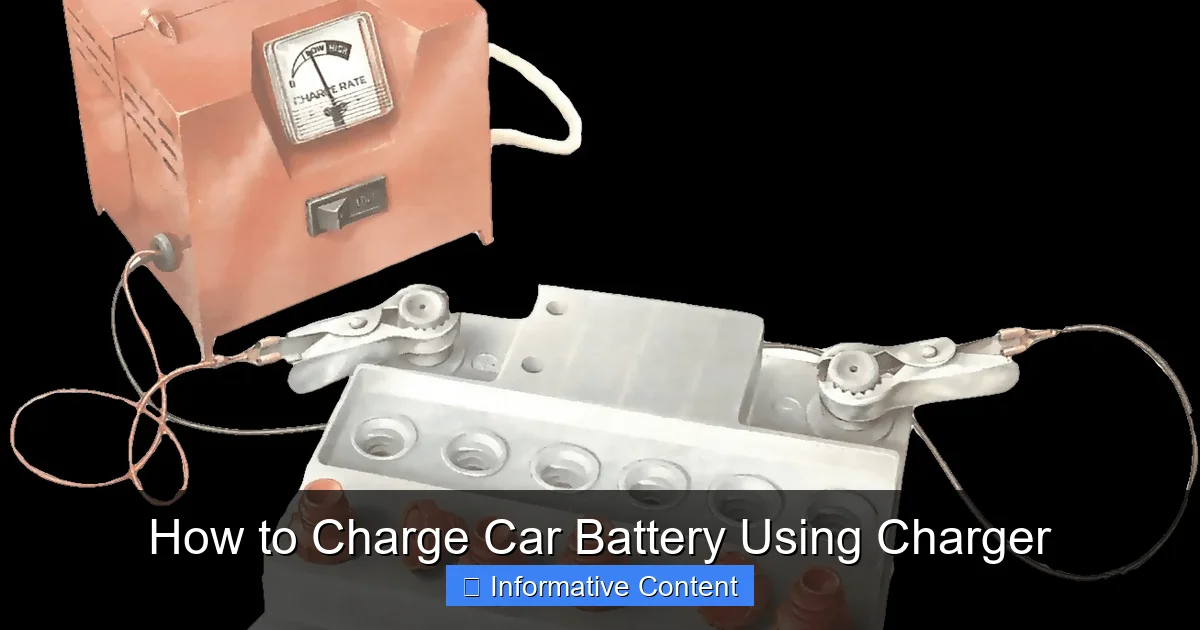
Visual guide about How to Charge Car Battery Using Charger
Image source: howacarworks.com
Essential Equipment List
- Car Battery Charger: The star of the show!
- Safety Glasses/Goggles: As mentioned, mandatory.
- Protective Gloves: Heavy-duty, acid-resistant if possible.
- Wire Brush or Battery Terminal Cleaner: For cleaning corrosion.
- Baking Soda and Water Mixture: To neutralize acid corrosion.
- Old Rags or Paper Towels: For cleaning.
- Battery Terminal Protector Spray (Optional): To prevent future corrosion.
- Voltmeter/Multimeter (Optional but Recommended): To check battery voltage before and after charging.
Inspecting the Battery
Before you connect your charger, give your battery a quick visual inspection:
- Check for Damage: Look for any cracks, bulges, or leaks in the battery casing. If you see significant damage or leaks, do not attempt to charge it. The battery might be irreparable or dangerous.
- Inspect Terminals: Check for corrosion around the battery terminals. Corrosion looks like a fuzzy, white, blue, or green powdery substance. Heavy corrosion can impede the charging process.
- Clean Terminals (if necessary): If corrosion is present, disconnect the battery (negative first, then positive, if removing from the car) and clean the terminals using a wire brush or battery terminal cleaner. You can also mix a paste of baking soda and water (about 1 tablespoon baking soda to 1 cup water) and apply it to the corroded areas. It will fizz as it neutralizes the acid. Rinse with clean water and dry thoroughly with an old rag. Reconnect terminals if you removed them.
- Check Fluid Levels (for Lead-Acid batteries only): If your lead-acid battery has removable caps, carefully twist them off. Ensure the electrolyte level covers the lead plates. If not, add distilled water (never tap water or acid) up to the fill line. Replace caps securely.
Ventilate the Area
We can’t stress this enough when you learn how to charge car battery using charger. Position your car or battery in a well-ventilated area. If you’re in a garage, open the garage door and any windows. This dissipates the hydrogen gas produced during charging, significantly reducing the risk of explosion.
Connecting the Charger – Step-by-Step
This is where the rubber meets the road. Follow these steps precisely to ensure a safe and effective connection. Always make sure your car’s ignition is off and the charger is unplugged from the wall outlet or turned off before connecting the clamps.
Prepare the Vehicle
Make sure your car’s ignition is completely off. Turn off all accessories, including lights, radio, and climate control. Even small draws can affect charging efficiency or cause issues.
Connecting the Positive Terminal (Red to Red)
- Locate the positive (+) terminal on your car battery. It’s usually larger and marked with a plus sign, often covered with a red cap.
- Take the red (positive) clamp from your battery charger.
- Securely attach the red clamp to the positive (+) terminal of your car battery. Ensure a firm, metal-to-metal connection.
Connecting the Negative Terminal (Black to Chassis or Battery)
This step is crucial for safety to avoid sparks near the battery, which could ignite hydrogen gas.
- Locate the negative (-) terminal on your car battery. It’s usually smaller and marked with a minus sign, often covered with a black cap.
- Take the black (negative) clamp from your battery charger.
- Option A (Recommended for most cases): Attach the black clamp to an unpainted metal part of your car’s chassis or engine block, away from the battery and fuel lines. This provides a ground connection. This method minimizes the risk of sparks occurring directly over the battery.
- Option B (If recommended by charger manual or for batteries out of the vehicle): Attach the black clamp directly to the negative (-) terminal of the battery. Some modern smart chargers are designed to be connected this way and are engineered to minimize sparking. Always refer to your charger’s specific instructions.
Once both clamps are securely attached, take a moment to double-check their connections. They should not be loose or wobbly.
Operating Your Car Battery Charger
With the connections made, it’s time to bring the battery back to life. How to charge car battery using charger effectively depends on setting up your charger correctly.
Setting Charger Parameters
Most modern smart chargers will automatically detect the battery voltage. However, if your charger allows manual settings, ensure you select the correct ones:
- Voltage: For standard car batteries, this will be 12 volts (12V).
- Amperage: This determines how quickly the battery charges. For a slow, gentle charge that’s best for battery health, choose a lower amperage (e.g., 2-10 amps). For a quicker charge, you might select a higher setting (e.g., 15-20 amps), but remember this can generate more heat. Smart chargers often adjust amperage automatically.
- Battery Type: If your smart charger has settings for “flooded,” “AGM,” or “gel,” select the one that matches your battery type.
Initiating the Charge
- Once all settings are confirmed and clamps are securely attached, plug your battery charger into a wall outlet.
- Turn on the charger (if it has a power switch).
- Your charger should now begin the charging process. Look for indicator lights or a digital display that confirms it’s working. Some chargers will show “charging,” “bulk,” or an estimated time.
Monitoring the Charging Process
A smart charger will largely manage itself, but it’s still good practice to periodically check on the process:
- Charger Indicators: Most chargers have lights or a screen indicating charging status (charging, charged, fault).
- Battery Condition: Briefly check the battery for any signs of overheating (a hot battery case) or excessive gassing (a strong smell of rotten eggs, which indicates hydrogen sulfide gas, though hydrogen gas itself is odorless). If you notice these, disconnect immediately and consult your charger’s manual.
- Voltage Check (Optional): If you have a multimeter, you can periodically check the battery voltage. A fully charged 12V lead-acid battery should read around 12.6V to 12.8V.
How Long Does It Take?
The time it takes to fully charge a car battery using a charger varies significantly based on several factors:
- Battery Size (Ah): Larger batteries (higher Amp-hour rating) take longer.
- Discharge Level: A completely dead battery will take much longer than one that’s just a bit low.
- Charger Amperage: A 10-amp charger will charge faster than a 2-amp trickle charger.
- Battery Age and Condition: Older or damaged batteries may not hold a charge as well or take longer to charge.
As a general guideline, a 10-amp charger might take 4-8 hours to fully charge a moderately discharged car battery (around 40-60 Ah). A 2-amp trickle charger could take 24-48 hours or even longer for a completely dead battery. Smart chargers will typically indicate when the charge is complete, often switching to a “float” or “maintainer” mode.
Disconnecting the Charger and Post-Charge Tips
Once your battery is fully charged, the job isn’t over. Disconnecting correctly is just as important as connecting properly.
Safely Disconnecting
- Turn Off Charger: Always turn off the battery charger first. If it’s a smart charger with a “float” mode, you can simply unplug it from the wall.
- Unplug from Wall: Disconnect the charger’s power cord from the electrical outlet.
- Remove Negative Clamp: Carefully remove the black (negative) clamp from the car’s chassis or the battery’s negative terminal.
- Remove Positive Clamp: Remove the red (positive) clamp from the battery’s positive terminal.
- Store Charger: Store your charger in a dry, safe place.
Post-Charge Checks
After disconnecting, if you have a voltmeter, check the battery voltage. It should read in the 12.6-12.8V range for a fully charged 12V battery. Re-secure any battery caps, ensure terminals are clean and tight, and put your car back together if you removed anything. Your car should now be ready to start!
Maintaining Your Battery
Learning how to charge car battery using charger is great, but prevention is even better:
- Regular Driving: Take your car for regular drives, especially longer ones, to allow the alternator to fully charge the battery. Short trips might not be enough.
- Check Terminals: Periodically inspect terminals for corrosion and clean them as needed.
- Check Fluid Levels: For flooded lead-acid batteries, check fluid levels every few months and top up with distilled water if necessary.
- Battery Maintainer: If you store your car for extended periods, connect a smart battery maintainer to keep the charge topped off.
- Battery Age: Car batteries typically last 3-5 years. If yours is older, consider having it tested professionally.
Troubleshooting Common Charging Issues
Even when you know how to charge car battery using charger, sometimes things don’t go as planned. Here are a few common issues and what to do:
Charger Not Turning On or Indicating a Fault
If your charger isn’t working, check these:
- Power Outlet: Is the outlet live? Try plugging in another device.
- Charger Fuse: Some chargers have an internal fuse that might have blown. Consult your manual for replacement.
- Connections: Are the clamps securely attached to clean battery terminals and/or a good ground point? A poor connection can prevent charging.
- Battery Condition: If the battery is severely dead (below 10V), some smart chargers might not “recognize” it and refuse to charge. You might need a specialized charger with a “repair” or “boost” mode, or a jump start to bring the voltage up slightly.
Battery Not Holding a Charge
You’ve gone through the process of how to charge car battery using charger, but it dies again quickly:
- Battery Age: The battery might simply be at the end of its life. Older batteries lose their ability to hold a charge.
- Parasitic Drain: Something in your car could be drawing power even when the car is off (e.g., faulty alternator, trunk light, aftermarket electronics). A mechanic can diagnose this.
- Alternator Issue: Your car’s alternator might not be charging the battery while the engine is running. Have your alternator tested.
- Sulphation: If a battery is left discharged for too long, lead sulfate crystals can build up on the plates, reducing capacity. Some smart chargers have a “desulfation” mode, but severely sulfated batteries may be beyond recovery.
Overcharging Concerns
Modern smart chargers are designed to prevent overcharging by switching to a float or maintenance mode once the battery is full. However, older or simpler trickle chargers can overcharge if left connected indefinitely, leading to battery damage (e.g., excessive gassing, electrolyte boiling, shortened lifespan). Always monitor non-smart chargers and disconnect them once the battery is fully charged.
Learning how to charge car battery using charger is a foundational skill for any car owner. By following these steps and prioritizing safety, you can confidently tackle a dead battery and keep your vehicle running smoothly. Remember, a little maintenance goes a long way in preventing future dead battery woes. Stay safe, stay charged, and happy driving!
Frequently Asked Questions
How long does it take to charge a completely dead car battery?
Charging a completely dead car battery can take anywhere from a few hours to over 24 hours, depending on the charger’s amperage and the battery’s capacity and condition. A 10-amp charger might take 6-12 hours for a moderately sized car battery, while a 2-amp trickle charger could take significantly longer.
What is the difference between a car battery charger and a jump starter?
A car battery charger slowly replenishes the battery’s charge over time, while a jump starter provides a quick burst of power to help start a car with a dead battery instantly. Chargers are for maintenance and full recharges, whereas jump starters are for emergency starts.
Can I charge a frozen car battery?
No, you should never attempt to charge a frozen car battery. Charging a frozen battery can be extremely dangerous as the electrolyte could expand, causing the battery to rupture or even explode. Allow the battery to thaw completely at room temperature before attempting to charge it.
Why are sparks sometimes created when connecting a battery charger?
Sparks can occur when completing the electrical circuit, especially if there’s residual voltage or a sudden current flow. This is why it’s recommended to connect the negative clamp to an unpainted metal part of the car chassis away from the battery, reducing the risk of sparks igniting hydrogen gas produced by the battery.
How often should I charge my car battery if I don’t drive frequently?
If you don’t drive your car frequently, it’s a good idea to connect it to a smart battery maintainer or trickle charger once a month, or leave it connected if using a smart charger designed for continuous use. This prevents the battery from discharging and extends its lifespan.
What kind of maintenance does a car battery need?
Car battery maintenance involves regularly checking the battery terminals for corrosion and cleaning them if necessary. For traditional flooded lead-acid batteries, it also means checking the electrolyte levels every few months and topping them up with distilled water when needed. Always ensure the battery is securely mounted.
