Charging a car battery can take anywhere from a few hours to a full day, depending on several key factors. These include how depleted the battery is, its overall health, the amperage of your charger, and the battery’s capacity. A smart charger for a moderately drained battery might take 4-8 hours, while a trickle charger could take 12-24 hours or more.
Have you ever walked out to your car, turned the key, and been met with that dreaded click-click-click, or worse, absolute silence? It’s a frustrating experience, often indicating a dead car battery. Your immediate thought likely turns to getting it charged, but then a crucial question pops into your head: “How long does it take to charge car battery?”
That’s a fantastic question, and one without a single, simple answer. The truth is, the time it takes to fully charge a car battery can vary significantly. It’s not like plugging in your smartphone where you can almost set a timer. Instead, several factors play a vital role in determining how long you’ll be waiting before your car is ready to hit the road again. Understanding these elements can help you manage your expectations and ensure you’re charging your battery safely and effectively.
In this comprehensive guide, we’re going to dive deep into everything you need to know about charging your car battery. We’ll explore the different types of batteries and chargers, the critical factors that influence charging time, provide some general estimates, and even walk you through the safe steps for charging. By the end, you’ll be well-equipped to tackle a flat battery with confidence and clarity.
Key Takeaways
- Charging Time Varies Widely: How long does it take to charge a car battery depends primarily on its state of discharge, the charger’s amperage, and the battery’s capacity and health. There’s no single answer.
- Charger Amperage is Crucial: Higher amperage chargers (like 10-amp) will charge faster than lower amperage trickle chargers (1-2 amp). Always match the charger to the battery type and intended use.
- Battery Health Matters: An old, weak, or damaged battery will take longer to charge, might not hold a charge well, or may not charge at all. Age significantly impacts a battery’s ability to accept and retain power.
- Safety First: Always follow safety precautions when charging a car battery, including wearing eye protection and gloves, ensuring good ventilation, and connecting the charger correctly to prevent sparks.
- Smart Chargers are Recommended: Modern smart or automatic chargers are generally the best choice as they monitor the battery’s condition, prevent overcharging, and switch to a maintenance mode once fully charged.
- Not a Quick Fix for a Dead Battery: While charging can revive a dead battery, it’s not always an instant solution like a jump start. A full charge takes time, and consistent battery issues often point to deeper problems.
Quick Answers to Common Questions
How long does it take to charge a completely dead car battery?
For a completely dead car battery, expect it to take anywhere from 8 to 24 hours with a typical smart charger (4-10 amps), depending on the battery’s size and health. A trickle charger (1-2 amps) could take significantly longer, potentially days.
Can you overcharge a car battery?
Yes, traditional chargers can overcharge a car battery, leading to damage like electrolyte boiling, reduced lifespan, and even battery rupture. However, modern “smart” or “automatic” chargers are designed to prevent overcharging by switching to a maintenance mode once fully charged.
Is it safe to leave a car battery charger on overnight?
If you are using a modern smart or automatic car battery charger, it is generally safe to leave it on overnight. These chargers automatically stop charging once the battery is full and switch to a gentle “float” or maintenance mode, preventing overcharging. Avoid doing this with older, non-smart chargers.
How do I know when my car battery is fully charged?
Most smart car battery chargers have indicator lights that will show when the battery is fully charged, often turning from “charging” to “charged” or “maintain.” Some may also show a voltage reading, with 12.6-12.8 volts typically indicating a full charge for a 12V battery.
Can a car battery be too dead to charge?
Yes, if a car battery has been completely discharged for a long period, especially if it’s an older battery, it can suffer from “sulfation,” where lead sulfate crystals harden on the plates. This can prevent the battery from accepting a charge, making it too dead to recover.
📑 Table of Contents
Understanding Your Car Battery and Charger
Before we talk about how long does it take to charge car battery, let’s quickly understand the key players: your car battery and the charger itself. Knowing a bit about these components will make the rest of the information much clearer.
Types of Car Batteries
Most cars on the road today use 12-volt lead-acid batteries. Within this category, you’ll typically find a few types:
- Flooded Lead-Acid Batteries: These are the traditional car batteries, containing a liquid electrolyte solution. They are robust but can require occasional maintenance (checking electrolyte levels).
- AGM (Absorbent Glass Mat) Batteries: A more modern type, AGM batteries use a glass mat to absorb the electrolyte, making them spill-proof and more resistant to vibration. They often charge faster and last longer than flooded batteries.
- Gel Cell Batteries: Less common in regular cars, gel batteries use a gelled electrolyte. They are very resistant to vibration and deep discharge but can be sensitive to overcharging.
All these batteries have a specific capacity, measured in Amp-hours (Ah). This number tells you how much current the battery can deliver over a certain period. For instance, a 50 Ah battery can theoretically deliver 5 amps for 10 hours. A higher Ah rating means a larger battery that stores more energy.
Types of Car Battery Chargers
Just as there are different batteries, there are also various types of chargers, each affecting how long does it take to charge car battery.
- Trickle Chargers (1-2 Amps): These deliver a very low, constant current. They are best for maintaining a battery’s charge over long periods (like during winter storage) rather than quickly charging a dead battery. They are slow but gentle.
- Smart/Automatic Chargers (3-10 Amps): These are the most common and highly recommended. They monitor the battery’s condition, adjust the charging current as needed, and automatically switch to a “float” or maintenance mode once the battery is full, preventing overcharging. They come in various amperage ratings.
- Rapid Chargers (10+ Amps): Some chargers offer high amperage settings (10 amps, 20 amps, or even higher, often called “engine start” mode). While they can charge a battery faster, using a high amperage charger can sometimes be detrimental to a battery’s lifespan, especially if not used carefully or if the battery is old or damaged.
The amperage (amps) rating of your charger is a critical factor. It tells you how much current the charger can push into the battery. A higher amp charger will, generally speaking, charge the battery faster.
Factors Affecting Charging Time
So, you want to know how long does it take to charge car battery. Here are the key variables that influence the answer:
Battery’s Current State of Charge (How Dead Is It?)
This is perhaps the most significant factor. A battery that’s only slightly discharged (e.g., you left your lights on for an hour) will charge much faster than one that’s completely drained and won’t even power your dashboard lights. A fully discharged battery requires a lot more energy to be replenished.
Battery’s Overall Health and Age
Just like people, batteries age. Over time, their internal chemistry degrades, and they lose capacity. An older battery might take longer to charge, might not reach its full charge potential, and certainly won’t hold a charge for as long as a newer, healthy battery. If your battery is more than 3-5 years old, its performance will likely have started to decline. A battery with internal damage (like a shorted cell) might not charge at all.
Charger’s Amperage (Output)
As mentioned, the charger’s amperage rating directly impacts the charging speed.
- A 1-amp trickle charger will be very slow.
- A 5-amp smart charger will be moderately fast.
- A 10-amp or 15-amp smart charger will be quite fast.
A simple way to estimate is to divide the battery’s Amp-hour (Ah) rating by the charger’s amperage. For example, a 50 Ah battery with a 10-amp charger would theoretically take 5 hours (50 Ah / 10 A = 5 hours) if it were completely empty. However, this is an oversimplification, as batteries don’t charge at a linear rate, and the charging process becomes less efficient as the battery approaches full capacity.
Battery Type and Size (Ah Rating)
Larger batteries with higher Ah ratings naturally take longer to charge than smaller ones, assuming the same charger. An AGM battery might accept a charge faster than a traditional flooded lead-acid battery, but its larger capacity could still mean a longer overall charge time compared to a smaller flooded battery.
Temperature
Extreme temperatures can also influence charging time. In very cold weather, a battery accepts a charge less efficiently, meaning it will take longer to reach full capacity. Conversely, very hot temperatures can also affect charging, though cold is generally more impactful on charging efficiency. Always try to charge your battery in a moderately warm environment if possible.
General Charging Time Estimates
Now for the crucial part: how long does it take to charge car battery in different scenarios? Let’s break down some typical estimates. Remember, these are rough guidelines, and your actual experience may vary.
Using a Trickle Charger (1-2 Amps)
If your battery is completely dead, a 1-2 amp trickle charger will take a very long time – often 12 to 24 hours or even more for a typical car battery. These chargers are designed for maintenance, not rapid recovery. If you’re not in a hurry and want to be gentle on your battery, a trickle charger is a good option for a partially discharged battery overnight. For a severely discharged battery, it might take days to bring it back to a usable level.
Using a Smart Charger (4-8 Amps)
Most smart chargers fall into this range, offering a good balance between speed and battery health.
- For a moderately discharged battery (e.g., lights left on for a while, but not completely dead): Expect 4-8 hours. This is a common scenario.
- For a completely dead battery: This could take anywhere from 8-12 hours, or even longer (up to 24 hours), especially if the battery is large or older. The charger will work harder in the initial stages.
These chargers are ideal because they prevent overcharging, so you can often leave them connected overnight without worry.
Using a Rapid Charger (10-20 Amps, or “Engine Start” Mode)
If you’re in a real rush, some chargers offer higher amperage settings.
- For a moderately discharged battery: You might see a significant charge within 2-4 hours.
- For a completely dead battery: Depending on the battery’s size and condition, it could be ready in 4-8 hours.
A Word of Caution: While faster, high-amperage charging can generate more heat and potentially shorten your battery’s lifespan, especially if done frequently or on an older battery. Only use these settings when necessary, and always monitor the battery for signs of overheating (a strong sulfur smell or a hot casing). “Engine Start” modes are usually for providing a quick burst of power to start the car, not for fully charging the battery over time.
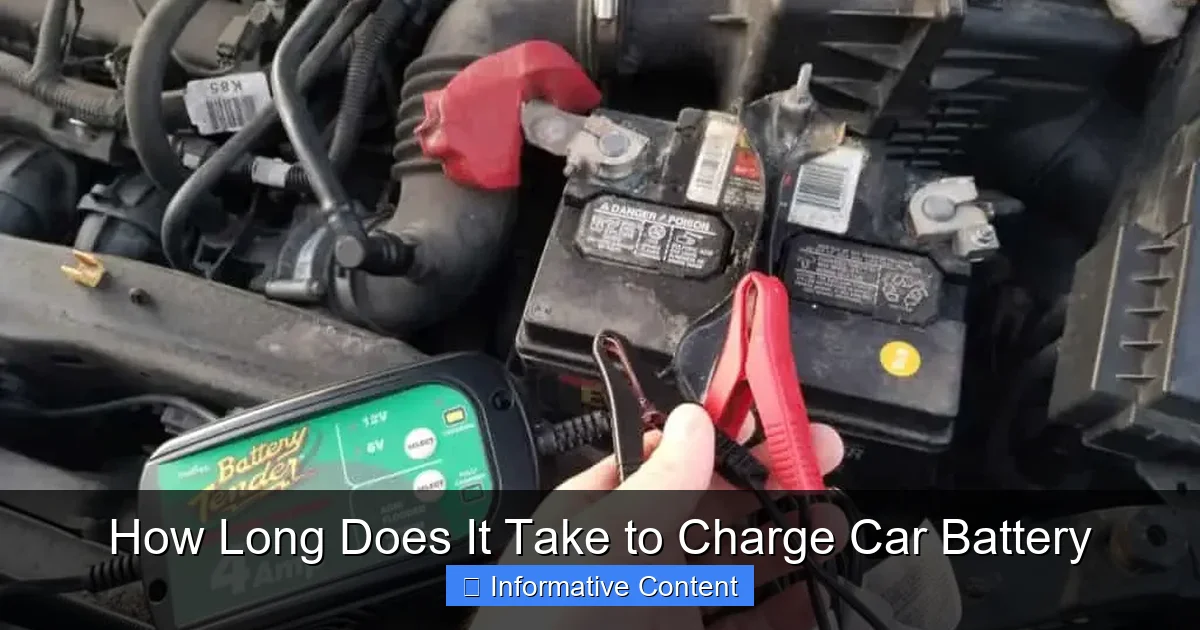
Visual guide about How Long Does It Take to Charge Car Battery
Image source: homebatterybank.com
What About Jump Starting?
It’s important to differentiate between jump starting and charging. Jump starting gives your battery a temporary boost from another car or a jump pack, allowing your engine to crank and start. Once your car is running, your alternator takes over to recharge the battery. However, a short drive after a jump start might only partially replenish a severely drained battery. To fully recharge a dead battery after a jump, you usually need to drive for at least 30-60 minutes, or better yet, put it on a dedicated charger once you get home.
Step-by-Step Guide to Charging Your Car Battery Safely
Safety is paramount when dealing with car batteries, as they contain corrosive acid and produce explosive hydrogen gas. Here’s a safe way to charge your car battery:
1. Gather Your Safety Gear
Before you do anything, put on safety glasses and gloves. Ensure you’re working in a well-ventilated area to disperse any hydrogen gas that might be released. Avoid smoking or open flames near the battery.
2. Locate and Prepare the Battery
Your car battery is usually under the hood, but sometimes it can be in the trunk or under a back seat. Consult your car’s owner’s manual if you’re unsure.
- Turn off your car and remove the key from the ignition.
- Ensure all accessories (lights, radio, etc.) are off.
- Clean any corrosion off the battery terminals with a wire brush if necessary. Ensure a good connection.
3. Connect the Charger
This is a critical step to avoid sparks.
- First, connect the red (positive) clamp of the charger to the positive (+) terminal of your car battery.
- Next, connect the black (negative) clamp of the charger to an unpainted metal surface on your car’s engine block or frame, away from the battery itself. This grounds the circuit and prevents sparks from igniting any hydrogen gas near the battery. *Do NOT connect the black clamp directly to the negative (-) battery terminal, especially with older chargers, as it can cause a spark.*
4. Set the Charger (if applicable)
Plug your charger into an AC power outlet. If your charger has different settings (e.g., battery type, amperage), select the appropriate ones. For most car batteries, “12V” and an “AGM” or “Flooded” setting (if available) are common. Choose an amperage suitable for your battery and how quickly you need it charged. For a standard car battery, a 4-8 amp setting is often a good balance.
5. Monitor the Charging Process
Most smart chargers will have indicator lights showing the charging progress (e.g., “charging,” “fully charged,” “maintain”). Check on the battery periodically. If you notice any hissing, bubbling, or a strong sulfur smell, or if the battery casing becomes very hot, disconnect the charger immediately. This could indicate a problem with the battery or charger.
6. Disconnect the Charger
Once the charger indicates the battery is fully charged (or you’ve reached your desired charging time):
- First, unplug the charger from the AC power outlet.
- Next, remove the black (negative) clamp from the engine block/frame.
- Finally, remove the red (positive) clamp from the positive terminal of the battery.
You’re now ready to attempt starting your car!
Beyond Charging: Maintaining Your Battery’s Health
Knowing how long does it take to charge car battery is useful, but proactive maintenance can prevent you from asking that question in the first place.
Regular Inspections
Periodically check your battery terminals for corrosion (a white or greenish powdery substance). Clean them with a wire brush and a battery terminal cleaner solution (or a baking soda paste) when necessary. Ensure the battery cables are securely attached.
Keep it Charged
Car batteries prefer to be fully charged. Repeatedly allowing your battery to deeply discharge can shorten its lifespan. If your car sits for long periods, consider using a battery tender (a specialized low-amperage smart charger) to keep it topped off.
Drive Regularly and Sufficiently
Short trips don’t allow your alternator enough time to fully recharge the battery, especially after starting the engine. If you mostly make short commutes, try to take a longer drive (30+ minutes) at highway speeds once a week to give your battery a good charge.
Check Your Alternator
If your battery keeps dying even after charging, the problem might not be the battery itself but your car’s charging system. Your alternator is responsible for recharging the battery while the engine runs. A failing alternator won’t properly charge the battery, leading to repeated drain issues.
When to Replace
Even with the best care, car batteries don’t last forever. Most car batteries have a lifespan of 3-5 years. If your battery is struggling to hold a charge, takes longer to charge, or is over five years old, it’s probably time to get it tested and potentially replaced. Many auto parts stores offer free battery testing.
Conclusion
So, how long does it take to charge car battery? As we’ve seen, there’s no single answer, but rather a range of possibilities depending on many factors. From the severity of its discharge to the type and power of your charger, and even the ambient temperature, each element plays a role. A quick estimate could be anywhere from 4-8 hours for a moderately drained battery with a smart charger, extending to 12-24 hours or more for a completely dead battery using a slower charger.
The most important takeaways are to prioritize safety during the charging process and to invest in a good quality smart charger. These devices not only make the process easier and safer but also help extend the life of your battery by preventing overcharging. Beyond that, remember that regular maintenance and understanding your battery’s health are your best defense against unexpected dead battery surprises. Keep these tips in mind, and you’ll keep your car’s heart beating strong for many miles to come!
🎥 Related Video: Best battery charging hack for dead batteries!!!!
📺 10 Minute Fix
Charging a dead battery is easy. Connect them in parallel then connect the charger to the know good battery. The charger will …
Frequently Asked Questions
What amperage charger should I use for my car battery?
For most regular car batteries, a smart charger with an output between 4 and 10 amps is a good choice. Lower amperage (1-2 amps) is ideal for maintenance, while higher amperage (15+ amps) should be used cautiously for quicker charging but can reduce battery lifespan if used too often.
Will a partially charged car battery affect my car’s performance?
A partially charged car battery might not immediately affect your car’s driving performance once the engine is running, as the alternator powers the vehicle. However, it can make starting the car difficult, especially in cold weather, and repeatedly operating with a low charge can shorten the battery’s overall lifespan.
Can I charge my car battery while it’s still in the car?
Yes, you can charge your car battery while it’s still in the car, provided you follow proper safety procedures. Ensure the car is off, the area is well-ventilated, and connect the negative charger clamp to an unpainted metal ground point on the engine block or frame, away from the battery.
How often should I charge my car battery if my car sits idle?
If your car sits idle for extended periods (weeks or months), it’s a good practice to use a battery tender or trickle charger once a month, or continuously, to keep it topped off. This prevents self-discharge and prolongs the battery’s life, ensuring it’s ready when you need it.
What are the signs of an unhealthy battery that won’t hold a charge?
Signs of an unhealthy battery include slow engine cranking, dim headlights when starting, the “check battery” light illuminating on your dashboard, corrosion around the terminals, or a swollen battery case. If your battery repeatedly dies even after charging, it’s likely failing.
Is there a difference in charging time for AGM vs. traditional lead-acid batteries?
AGM batteries generally accept a charge faster than traditional flooded lead-acid batteries because of their lower internal resistance. However, their specific charging time still depends on factors like their capacity (Ah rating), their state of discharge, and the amperage of the charger being used.