A dead car battery can bring your plans to a screeching halt, but knowing how to charge a car battery yourself is a simple yet incredibly useful skill. This detailed guide walks you through everything from understanding your battery and choosing the right charger to performing the charging process safely and effectively. Empower yourself with the knowledge to get your vehicle running again and avoid common pitfalls.
How to Charge a Car Battery
There’s a special kind of dread that sets in when you turn the key, and all you hear is a weak click, or worse, absolute silence. A dead car battery is more than just an inconvenience; it can throw a major wrench in your day, stranding you when you least expect it. But here’s the good news: learning how to charge a car battery yourself is a surprisingly straightforward process that can save you time, money, and a lot of hassle.
Whether you’ve left your lights on, haven’t driven your car in a while, or it’s simply succumbed to the cold weather, a discharged battery is a common issue. Rather than immediately calling for a tow or relying on a jump start, understanding the principles and practical steps of charging your car battery can empower you to handle the situation with confidence. This comprehensive guide will walk you through everything you need to know, from the types of chargers available to critical safety precautions and a step-by-step charging process.
Don’t Get Stranded: The Importance of Knowing How to Charge a Car Battery
Knowing how to charge a car battery isn’t just a handy skill; it’s a fundamental aspect of car ownership that can prevent stress and unexpected expenses. A properly charged battery ensures reliable starts, powers your car’s electrical systems, and generally contributes to the longevity of your vehicle. Neglecting a discharged battery can lead to permanent damage, shortening its lifespan and necessitating an expensive replacement. By learning how to charge a car battery, you take control of a common automotive problem and keep your vehicle running smoothly.
Key Takeaways
- Safety First: Always prioritize safety by wearing protective gear, ensuring good ventilation, and preventing sparks when charging a car battery.
- Choose the Right Charger: Understand the different types of battery chargers (trickle, smart, maintainer) and select one appropriate for your battery’s voltage and condition.
- Inspect Your Battery: Before charging, visually inspect the battery for damage, leaks, or corrosion, as these issues may prevent safe or effective charging.
- Proper Connection is Crucial: Connect charger clamps correctly – positive to positive (red) and negative to negative (black) or a ground point on the engine block/chassis.
- Charge at the Right Rate: Avoid overcharging or charging too quickly; use a smart charger that automatically adjusts the current, or follow the charger’s instructions for manual types.
- Monitor the Process: Periodically check the battery and charger during the process, especially if not using a smart charger, to ensure no overheating or abnormal conditions.
- Know When to Seek Help: If the battery doesn’t hold a charge, shows signs of severe damage, or you’re unsure, it’s best to consult a professional mechanic.
Quick Answers to Common Questions
How long does it take to charge a car battery?
Charging time varies greatly depending on the battery’s size, its state of discharge, and the charger’s amperage. A deeply discharged battery can take 4-12 hours with a typical 10-amp charger, while a slow trickle charger might take 24 hours or more.
Can you overcharge a car battery?
Yes, you can overcharge a car battery, especially with older manual chargers. Overcharging can lead to battery damage, overheating, gassing, and a shortened lifespan. Modern “smart” chargers typically have automatic shut-off or maintenance modes to prevent this.
Can I charge my car battery without disconnecting it from the car?
Yes, most car batteries can be charged while still connected in the vehicle. However, some car manufacturers recommend disconnecting the battery to protect sensitive electronic components from voltage fluctuations. Always check your car’s owner’s manual.
What voltage should a fully charged car battery read?
A fully charged 12-volt car battery should read approximately 12.6 to 12.8 volts after resting for at least an hour or two. If it reads significantly lower, it may not be holding a charge well or might have an internal issue.
Is it safe to charge a car battery indoors?
It is generally safe to charge a car battery indoors *if* the area is very well-ventilated, to dissipate the potentially explosive hydrogen gas released during charging. Never charge a battery in a small, enclosed space, and always keep away from any sources of ignition.
📑 Table of Contents
Understanding Your Car Battery and Its Needs
Before you even think about connecting a charger, it’s vital to understand what kind of battery you have and what it needs. Not all car batteries are created equal, and knowing the specifics will help you choose the right charging method and equipment.
Types of Car Batteries
Most modern cars use 12-volt lead-acid batteries, but even within this category, there are variations:
- Flooded Lead-Acid (Wet Cell): These are the most common and traditional car batteries. They contain a liquid electrolyte solution and often have removable caps for checking fluid levels. They can tolerate a certain degree of deep discharge but benefit from regular maintenance.
- Maintenance-Free (Sealed Lead-Acid): Similar to flooded, but designed so you don’t need to add water. They are sealed, making them less prone to spills and easier to handle.
- Absorbed Glass Mat (AGM): These batteries use glass mats to absorb the electrolyte, making them spill-proof and more resistant to vibration. They charge faster and handle deep cycles better than traditional flooded batteries, making them popular in vehicles with stop-start technology.
- Gel Cell: Less common in standard cars, gel batteries use a silica-based gel to hold the electrolyte. They are very resistant to vibration and spillage but require a specific lower charging voltage to prevent damage.
Knowing your battery type is important, especially for specialized batteries like AGM or Gel, which may require specific charging profiles that many standard chargers don’t offer. Always check your car’s manual or the battery label for this information.
Signs of a Discharged or Dead Battery
It’s not always a sudden silence. Sometimes, a dying battery gives clues:
- Slow Crank: The engine turns over sluggishly when you try to start the car.
- Dim Lights: Headlights, interior lights, or dashboard lights appear dimmer than usual.
- Warning Lights: A battery or charging system warning light might illuminate on your dashboard.
- Clicking Sound: A rapid clicking noise when turning the key, often indicating insufficient power to engage the starter.
- No Power: Complete electrical failure – no lights, no sound, nothing.
If you suspect your battery is simply discharged rather than completely dead or faulty, then charging a car battery is a viable solution.
Choosing the Right Car Battery Charger
The market is full of battery chargers, and picking the right one is crucial for effective and safe charging. Your choice depends on your battery type, how quickly you need a charge, and your budget.
Types of Battery Chargers
- Trickle Chargers: These deliver a low, steady current (typically 1-2 amps) over a long period. They are ideal for maintaining a battery during long-term storage, preventing self-discharge. They are not designed for rapidly bringing a dead battery back to life.
- Battery Maintainers (Smart Chargers): Similar to trickle chargers but more advanced. They monitor the battery’s charge level and automatically switch on and off to keep it at an optimal state without overcharging. Many offer multi-stage charging, which is healthier for the battery. This is often the best choice for charging a car battery that’s been partially discharged.
- Portable Jump Starters: These are not chargers in the traditional sense but rather provide a burst of power to start a car with a dead battery. Some newer models also have a “charge” feature that can slowly add charge, but their primary purpose is jump-starting.
- Automatic/Manual Chargers:
- Automatic Chargers: Most modern chargers are automatic. They detect the battery’s voltage and charge level, then adjust the current and voltage accordingly, stopping when the battery is full. This prevents overcharging and makes them very user-friendly for how to charge a car battery.
- Manual Chargers: These require more attention. You typically set the amperage, and it continues to charge at that rate until you disconnect it. There’s a higher risk of overcharging if not monitored carefully.
Key Features to Look For
When buying a charger, consider these factors:
- Amperage (A): Chargers come in various amp ratings.
- Low Amperage (1-4A): Good for maintenance or slow charging.
- Medium Amperage (5-15A): Suitable for everyday charging of a discharged battery.
- High Amperage (20A+): Often includes a “boost” or “engine start” mode for quick, high-current delivery to help start a car, but should be used carefully for regular charging.
- Voltage (V): Ensure the charger matches your battery’s voltage (typically 12V for cars). Some chargers are multi-voltage (6V/12V).
- Battery Type Compatibility: Look for chargers that explicitly state compatibility with AGM, Gel, or standard flooded batteries, especially if you have one of the specialized types.
- Safety Features: Overcharge protection, reverse polarity protection, spark-proof clamps, and short-circuit protection are essential.
- Display and Indicators: A clear display or LED indicators showing charge status, voltage, and error warnings are helpful.
Essential Safety Precautions Before You Start
Safety is paramount when working with car batteries. They contain corrosive acid and produce explosive hydrogen gas. Ignoring safety steps can lead to serious injury or damage.
Personal Protective Equipment (PPE)
- Eye Protection: Always wear safety glasses or goggles to shield your eyes from acid splashes or flying debris.
- Gloves: Acid-resistant gloves (rubber or nitrile) protect your hands from battery acid.
- Old Clothes: Wear clothes you don’t mind getting dirty or potentially damaged by acid.
Work Environment Safety
- Ventilation: Charge the battery in a well-ventilated area. Batteries release hydrogen gas during charging, which is highly flammable and explosive. Never charge in an enclosed space like a small garage with the door closed.
- No Smoking or Open Flames: Keep all sources of ignition (cigarettes, lighters, sparks) far away from the battery.
- Stable Surface: Place the battery (if removed from the car) on a flat, stable, non-conductive surface like wood or plastic.
- Clear the Area: Remove any metal objects, jewelry, or tools that could accidentally short-circuit the battery terminals.
Battery and Vehicle Specific Checks
- Vehicle Off: Ensure the car’s ignition is off, and all accessories (lights, radio) are turned off.
- Inspect the Battery: Before connecting anything, visually inspect the battery. Look for cracks, leaks, bulging, or excessive corrosion around the terminals. If you see significant damage or leaks, do NOT attempt to charge it. A damaged battery could explode.
- Clean Terminals: If there’s light corrosion, clean the battery terminals and cable clamps with a wire brush and a battery terminal cleaner solution (or a mixture of baking soda and water). A clean connection ensures efficient charging.
- Fluid Levels (for Flooded Batteries): If you have a flooded lead-acid battery with removable caps, check the electrolyte levels. If low, add distilled water (NOT tap water) to cover the plates before charging. Do not overfill.
Step-by-Step Guide: How to Charge a Car Battery Safely
With your equipment ready and safety precautions in place, you’re ready to learn how to charge a car battery. Follow these steps carefully.
Step 1: Park and Prepare Your Vehicle (if charging in-car)
If you’re charging the battery while it’s still in the car:
- Park your car on a level surface in a well-ventilated area.
- Engage the parking brake.
- Turn off the engine, lights, radio, and all other electrical accessories.
- Open the hood and secure it.
Tip: Some manufacturers recommend disconnecting the battery from the car’s electrical system before charging to prevent potential damage to sensitive electronics. Check your car’s owner’s manual for specific recommendations. If you choose to remove the battery, disconnect the negative (black) cable first, then the positive (red) cable. Reinstall in reverse order after charging.
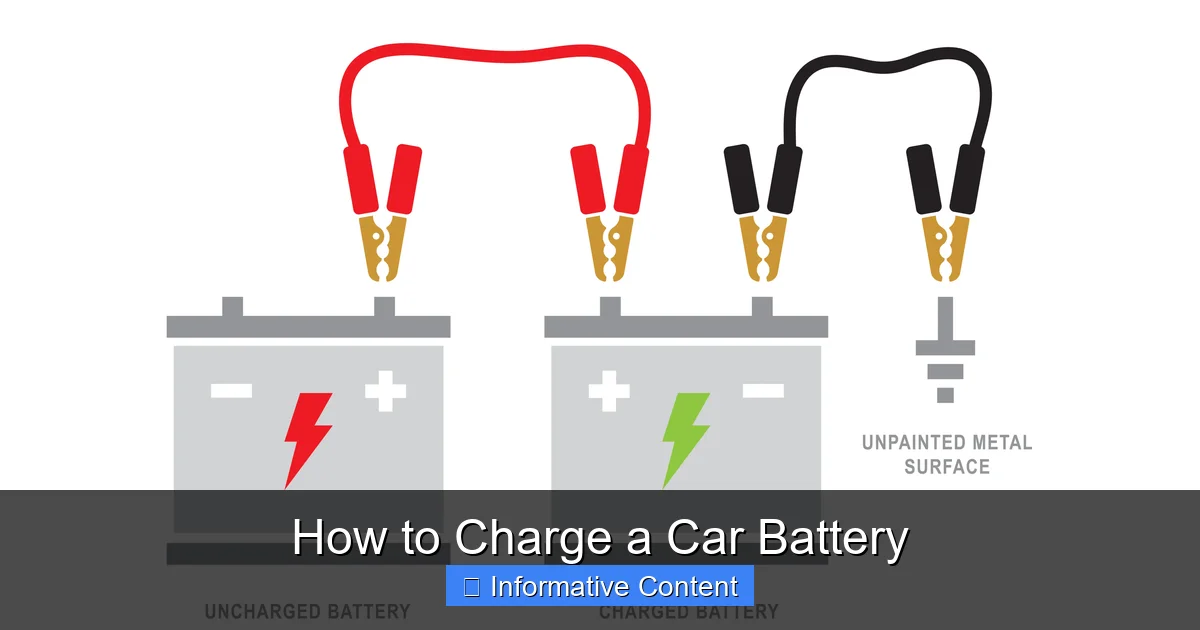
Visual guide about How to Charge a Car Battery
Image source: tontio.com
Step 2: Connect the Battery Charger
This is a critical step where proper connection prevents sparks and potential hazards.
- Connect the Positive Clamp (Red): Locate the positive (+) terminal on your car battery (it’s usually larger and marked with a plus sign, often covered by a red cap). Connect the red positive (+) clamp from the charger firmly to this terminal.
- Connect the Negative Clamp (Black):
- If the battery is still in the car: Connect the black negative (-) clamp from the charger to a clean, unpainted metal part of the car’s chassis or engine block, away from the battery and fuel lines. This provides a good ground connection and minimizes the risk of sparks near the battery’s gas vents.
- If the battery is out of the car: Connect the black negative (-) clamp to the negative (-) terminal on the battery.
- Double-Check Connections: Ensure both clamps are securely attached and won’t easily come loose.
Important: Make sure the charger is OFF or unplugged from the wall outlet BEFORE connecting the clamps to avoid sparks. Never let the positive and negative clamps touch each other.
Step 3: Set Up and Start the Charging Process
Once the clamps are connected:
- Plug In the Charger: Plug the battery charger into a grounded electrical outlet (120V AC).
- Select Settings (if applicable): If your charger has settings for battery type (e.g., standard, AGM, gel) or amperage (e.g., 2A, 10A), select the appropriate ones. For most car batteries, a 10-amp setting is a good balance between speed and battery health. If you’re unsure, a lower amperage (e.g., 2-4A) is safer for a longer charge.
- Turn On the Charger: Switch the charger ON. Many automatic chargers will perform a diagnostic and then begin charging.
Step 4: Monitor the Charging Process
The charging time will vary based on the battery’s discharge level, its capacity, and the charger’s amperage.
- Automatic Chargers: These will typically show indicators for “charging,” “charged,” or “maintain.” They will automatically stop or switch to a maintenance mode when the battery is full.
- Manual Chargers: You’ll need to monitor these more closely. Use a voltmeter to check the battery voltage periodically. A fully charged 12V battery should read around 12.6 to 12.8 volts (after resting for a few hours). Overcharging can damage the battery.
- Observe for Issues: While charging, periodically check the battery for any signs of overheating (hot to the touch), bulging, or strong sulfur smells. If you notice any of these, immediately turn off the charger and disconnect it.
General timeframe: A deeply discharged battery could take 4-12 hours with a typical 10-amp charger. A trickle charger might take 24 hours or more. Always refer to your charger’s manual.
Step 5: Disconnect the Charger Safely
Once the battery is fully charged or you’ve completed the desired charging duration:
- Turn Off the Charger: First, switch off the charger or unplug it from the wall outlet. This prevents sparks when disconnecting.
- Disconnect the Negative Clamp (Black): Disconnect the black negative (-) clamp from the car’s chassis/engine block or the battery’s negative terminal.
- Disconnect the Positive Clamp (Red): Disconnect the red positive (+) clamp from the battery’s positive (+) terminal.
- Replace Terminal Covers: If your battery has terminal covers, replace them.
What to Do After Charging and When to Seek Professional Help
After successfully charging a car battery, there are a few final steps and considerations.
Testing the Battery
After charging, it’s a good idea to let the battery rest for an hour or two. Then, you can test its voltage with a voltmeter. A healthy, fully charged 12V battery should read between 12.6 to 12.8 volts. If it’s significantly lower, the battery might not be holding a charge well.
Reinstalling the Battery (if removed)
If you removed the battery for charging, reinstall it carefully:
- Connect the positive (red) cable to the positive (+) terminal first.
- Connect the negative (black) cable to the negative (-) terminal second.
- Tighten both connections securely.
- Apply anti-corrosion grease or spray to the terminals.
Battery Health and Maintenance
Regularly checking your battery’s health can prevent future breakdowns.
- Keep it Clean: Regularly clean battery terminals to prevent corrosion.
- Check Fluid Levels: For flooded batteries, check and top up electrolyte levels with distilled water periodically.
- Keep it Charged: If you don’t drive your car often, use a battery maintainer to keep it topped up.
When to Consult a Professional
Sometimes, charging a car battery isn’t enough, or it points to a bigger problem.
- Battery Won’t Hold a Charge: If your battery discharges quickly after being fully charged, it likely means the battery is old and can no longer hold a charge effectively.
- Signs of Damage: If the battery shows signs of physical damage (cracks, leaks, bulging) before or after charging, it’s unsafe and needs replacement.
- Persistent Starting Issues: If your car still struggles to start even with a fully charged battery, the issue might be with your car’s alternator (which charges the battery while the car is running) or starter motor.
- Uncertainty: If you’re ever unsure about the process, encounter unexpected problems, or feel uncomfortable working with the battery, it’s always best to seek assistance from a qualified mechanic.
Conclusion
Knowing how to charge a car battery is a valuable skill that can save you from inconvenient situations and potentially extend the life of your vehicle’s battery. By understanding your battery type, selecting the correct charger, adhering strictly to safety protocols, and following the step-by-step connection and charging process, you can confidently bring your dead battery back to life. Remember, patience and caution are key when working with batteries. With this knowledge, you’re not just charging a battery; you’re empowering yourself with practical automotive self-reliance. Drive safe!
🎥 Related Video: How to charge 12v Car Battery
📺 CarHow
Its seen as good practice to connect the black wire second, and to connect it to some bare metal part in the engine.
Frequently Asked Questions
How do I know if my car battery is dead or just discharged?
A discharged battery might still show some dim lights or make a weak clicking sound, indicating it has a little power left. A truly dead battery will show no signs of life—no lights, no sounds, completely unresponsive. A professional diagnostic can definitively tell you if it’s dead or just needs a charge.
What type of charger is best for occasional use?
For occasional use and maintaining battery health, a “smart charger” or “battery maintainer” is highly recommended. These chargers monitor the battery’s state and automatically adjust charging, preventing overcharging and keeping the battery in optimal condition.
Can I use a jump starter to charge my battery?
A jump starter’s primary function is to provide enough power to start a car with a dead battery, not to fully charge it. While some modern jump starters have a slow charging feature, they are generally not as effective or efficient for a complete charge as a dedicated battery charger.
What if my battery gets hot during charging?
A slightly warm battery during charging is normal. However, if the battery becomes excessively hot to the touch, starts bulging, or emits a strong rotten egg smell, immediately turn off and disconnect the charger. These are signs of serious issues, and the battery may be damaged or unsafe.
How often should I charge my car battery if I don’t drive frequently?
If you don’t drive your car regularly (e.g., once a week or less), it’s advisable to connect it to a battery maintainer every few weeks or continuously. This prevents the battery from slowly discharging and extends its overall lifespan.
Do I need to remove the battery from my car to charge it?
No, in most cases, you don’t need to remove the battery from your car to charge it. You can charge it while it’s still installed, as long as you follow the proper safety precautions and connection procedures. However, some manufacturers might recommend removal for specific models.