
10 Best Rated Car Battery Chargers for 2026

A dead battery rarely picks a convenient time to fail. It’s usually a cold morning, a boat that sat all winter, or a motorcycle that hasn’t seen daylight since October. A dependable charger fixes that problem before it happens, keeping batteries topped off and healthy instead of scrambling for jumper cables in a parking lot.
Battery chargers today do more than push electricity into a battery. Modern smart chargers monitor voltage, adjust output automatically, and switch to a gentle float charge once the battery is full. This prevents overcharging, which shortens battery life, and it means a charger can stay connected for weeks or months without damage. Some models add desulfation modes that break down the crystal buildup on battery plates, a common cause of batteries that won’t hold a charge anymore.
Picking the right charger comes down to matching output and features to the job. A small 1-2 amp maintainer is ideal for a motorcycle or seasonal vehicle sitting in storage, while a 15-30 amp charger with engine-start capability suits someone who needs to revive a dead battery fast or jump a stalled truck. Battery chemistry matters too. Lithium (LiFePO4) batteries need a charger built for their specific voltage curve, and using the wrong charger can damage them. The chargers below cover the full range, from pocket-sized trickle chargers to high-output units with built-in jump-start power.
Best for lithium and lead-acid batteries: NOCO GENIUS5
Best for motorcycles and small engines: Battery Tender Plus
Best for fast charging on a budget: Schumacher SC1280
Best for larger batteries and RVs: NOCO GENIUS10
Best for emergency jump-starts: Schumacher SC1281
Best for garage all-rounders: CRAFTSMAN CMXCESM258
Best for battery repair and winter charging: TowerTop 25A Charger
Best budget trickle charger: NOCO GENIUS1
Best for permanent under-hood installation: NOCO GENIUS2D
Best for high-current charging and alternator testing: DEWALT DXAEC100
NOCO GENIUS5

This charger suits anyone who owns a mix of vehicles and wants one unit that handles lead-acid and lithium batteries without guesswork.
Pros
- Works with LiFePO4 lithium batteries up to 120Ah
- Temperature-compensated charging adjusts for hot or cold garages
- Force Mode can revive batteries down to zero volts
Cons
- 5-amp output charges slowly on larger batteries
- Single output port limits it to one vehicle at a time
The GENIUS5 replaces NOCO’s older G3500 with a smaller footprint and more charging power packed inside. Its thermal sensor reads ambient temperature and adjusts the charge profile automatically, which matters in climates with real seasonal swings. A vehicle stored in an unheated garage over winter benefits from this kind of compensation, since a fixed-voltage charger can overcharge in summer heat or undercharge in freezing temperatures.
Its desulfation function uses pulse charging to break down crystal buildup on lead-acid battery plates, a common reason old batteries lose capacity. At 5 amps, it’s not built for emergency speed charging, but for maintaining a fleet of cars, motorcycles, or seasonal equipment, it’s hard to beat for the compact size.
Battery Tender Plus

This is a solid pick for anyone who needs a lightweight, low-amp maintainer for a motorcycle, lawn mower, or ATV that sits for weeks at a time.
Pros
- Quick-disconnect harness makes hookup fast
- 4-step charging program protects battery health
- Long track record with a 10-year warranty
Cons
- 1.25-amp output is too slow for larger car batteries
- No lithium battery compatibility listed
Battery Tender built its reputation on small maintainers, and the Plus model reflects that focus. Its 4-step charging program moves through bulk charge, absorption, float, and maintenance phases automatically, which keeps a battery at full charge without the overcharging risk of a basic trickle charger.
The two-color LED gives a simple status check at a glance. Its low 1.25-amp output means it’s not the right tool for reviving a large, deeply discharged car battery, but for year-round maintenance on a motorcycle or seasonal power equipment, it does the job reliably.
Schumacher SC1280

Drivers who want fast charging without paying for premium branding will find good value here.
Pros
- 15-amp rapid charge speeds up recovery time
- Built-in desulfation mode helps restore older batteries
- Reverse polarity protection prevents accidental damage
Cons
- Bulkier than compact smart chargers
- Charge times still run around 10 hours for full batteries
The SC1280 uses a microprocessor to automatically detect battery type and adjust amperage, switching between a 15-amp rapid charge, a 3-amp maintain mode, and a 2A mode for 6-volt batteries. That flexibility covers everyday cars, marine batteries, and deep-cycle applications.
Some reviewers note the charger’s plastic housing feels less rugged than older Schumacher units, and instructions could be clearer for first-time users. For the price, it delivers dependable charging power and a legitimate desulfation feature that many budget chargers skip.
NOCO GENIUS10

Owners of trucks, RVs, or large marine batteries get a faster charge here without stepping up to a bulky garage charger.
Pros
- 10-amp output handles batteries up to 230Ah
- Same lithium and temperature-compensation features as the GENIUS5
- Compact size compared to older 10-amp chargers
Cons
- Heavier and larger than the GENIUS5
- Still slower than 15-30 amp chargers for dead battery recovery
The GENIUS10 shares its core technology with the GENIUS5, just scaled up for bigger batteries. It supports the same Force Mode for charging batteries down to zero volts and the same precision pulse desulfation.
Anyone maintaining a boat battery, RV house battery, or large truck battery will appreciate the extra amperage over the GENIUS5, since it cuts charge time roughly in half on bigger batteries. It weighs more and costs more than the 5-amp version, so it makes sense mainly for larger battery banks.
Schumacher SC1281
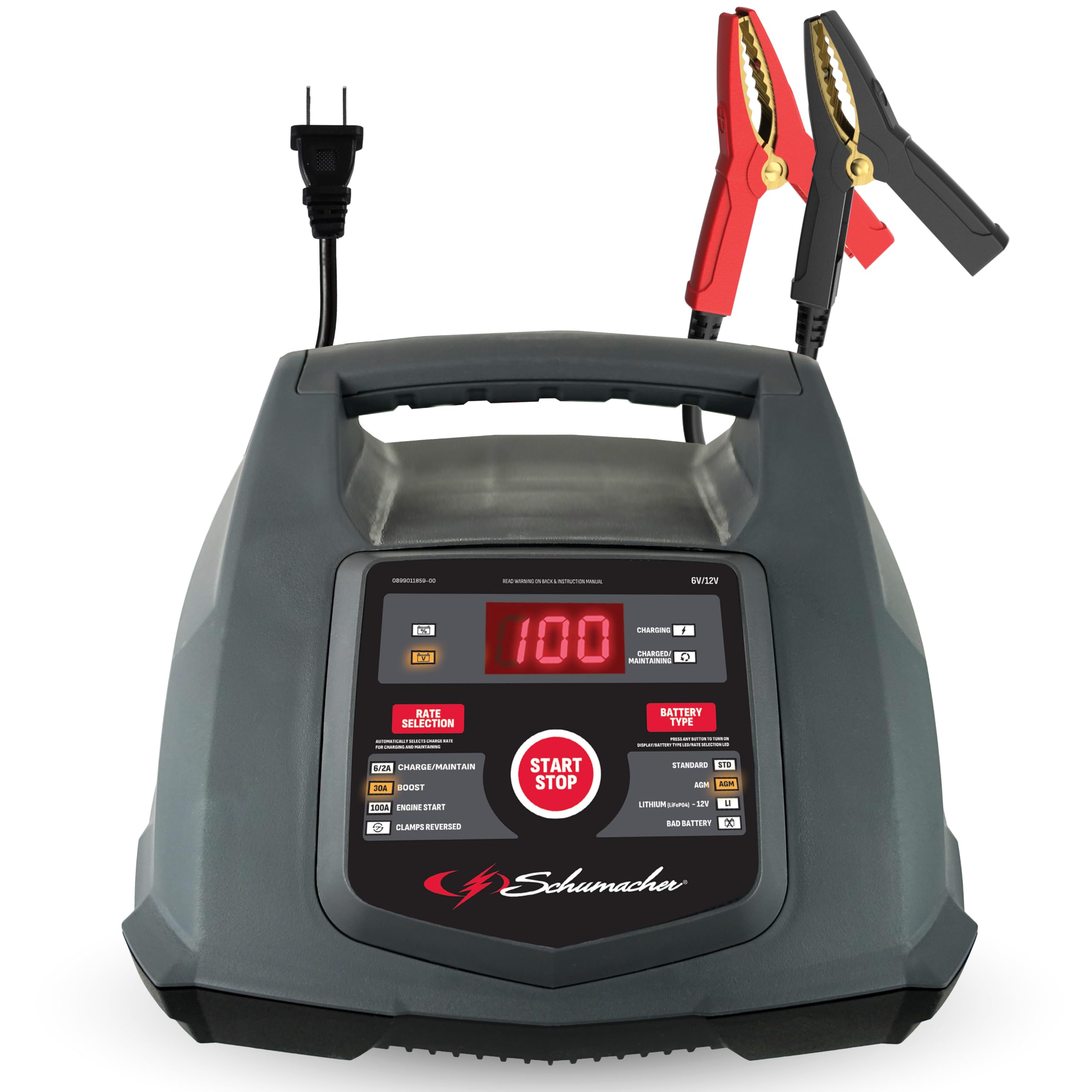
Drivers who need a real jump-start option built into their charger should look at this model.
Pros
- 100-amp engine start gets stalled vehicles running
- Built-in battery and alternator tester
- Supports 6V, 12V, and lithium batteries
Cons
- Starts in boost mode by default, which surprises some users
- Heavier and bulkier than dedicated maintainers
The SC1281 combines a 6-amp charger with a 100-amp engine starter, useful for anyone who occasionally needs to jump a dead battery instead of waiting hours for a slow charge. The built-in alternator tester is a genuine convenience, since it can reveal whether a charging system problem, not just the battery, caused the failure.
Reviewers flag that the unit powers on in boost mode first, which means new users need to actively switch to charge or maintain mode to avoid an unwanted high-current jolt. Read the manual before first use.
CRAFTSMAN CMXCESM258
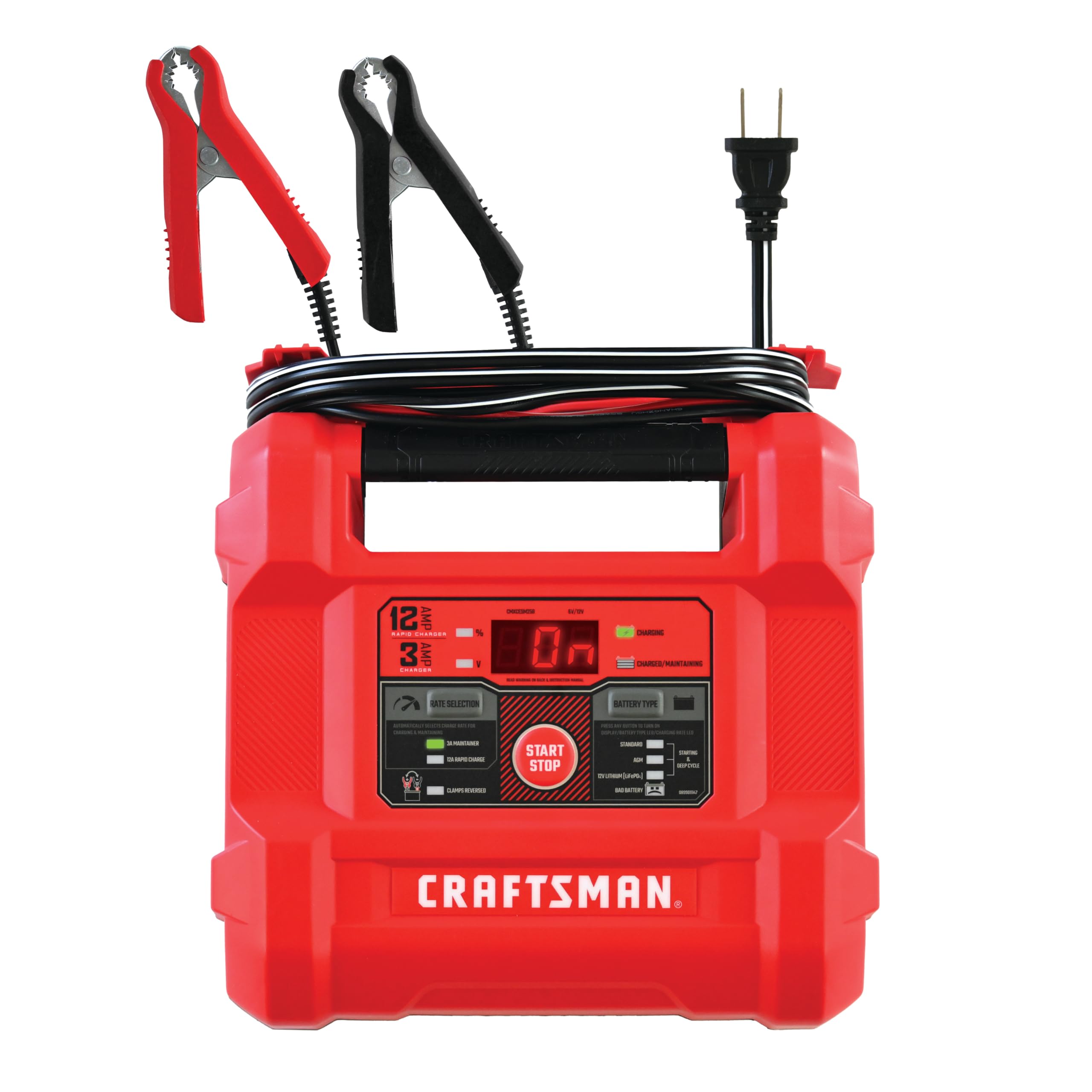
This charger fits a garage that needs one dependable unit for everyday cars, lithium batteries, and deep-cycle equipment.
Pros
- 12-amp rapid charge with automatic voltage detection
- Digital display shows charge status clearly
- Compatible with lithium (LiFePO4) batteries
Cons
- Shorter track record than Schumacher or NOCO in this category
- Two-year warranty is shorter than some competitors
Built by Schumacher under the Craftsman name, the CMXCESM258 brings the same microprocessor-controlled charging logic in a red housing familiar to Craftsman tool owners. It automatically detects 6V or 12V batteries and adjusts amperage, and reverse hook-up protection stops the unit from operating if the clamps get connected backward.
Its 12-foot combined cable reach (6-foot power cord plus 6-foot battery cables) gives enough slack to work in tight garage spaces. It handles standard, AGM, and lithium batteries, making it a flexible option for someone who owns more than one type of vehicle.
TowerTop 25A Smart Charger
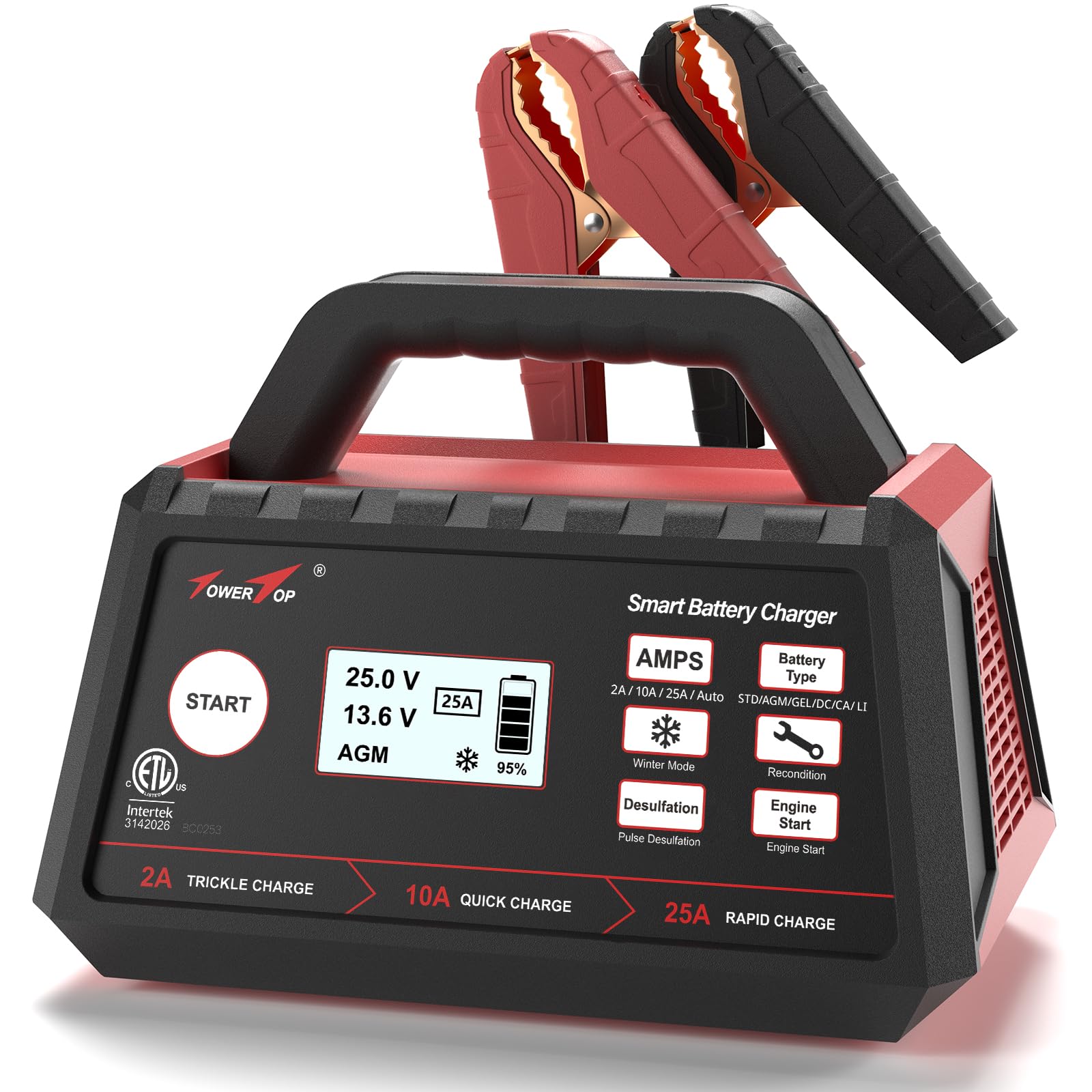
Anyone dealing with an old, sulfated battery or charging in cold weather gets extra tools here that many chargers skip.
Pros
- Dedicated repair mode for reviving weak batteries
- Winter Mode boosts voltage for cold-weather charging
- 100A engine start included for emergency use
Cons
- Screen and interface feel less polished than NOCO or Schumacher
- Some buyers report inconsistent quality control on arrival
The TowerTop charger packs an 8-stage charging process into a unit priced below most premium competitors. Its repair mode targets batteries with sulfation buildup, using a separate button from the standard desulfation cycle, and Winter Mode adds extra charging voltage for batteries in cold garages or unheated barns.
At 25 amps, it charges a 100Ah battery in a few hours, faster than most smart maintainers on this list. It won’t repair a battery that’s completely dead, and a few buyers have reported receiving units that looked previously opened, so it’s worth inspecting the charger closely on arrival.
NOCO GENIUS1

Someone with a small battery, motorcycle, or occasional-use vehicle will find this the simplest, most affordable long-term maintenance option.
Pros
- Small, direct wall-plug design needs no separate AC cord
- Same desulfation and Force Mode tech as larger GENIUS models
- Widely reviewed with a long track record
Cons
- 1-amp output is very slow on anything but small batteries
- No handle or mounting bracket included
The GENIUS1 is NOCO’s entry-level model, built for small batteries up to 30Ah rather than full-size car batteries. Its direct wall-plug design means fewer cables cluttering a garage, which appeals to anyone maintaining a single motorcycle, ATV, or generator battery.
It includes the same thermal-compensated charging and precision pulse desulfation found in NOCO’s larger units, just scaled down. At 1 amp, charging a fully dead battery takes a long time, so it works best as a maintainer for a battery that’s already in reasonable shape.
NOCO GENIUS2D

Anyone who wants a charger permanently wired under the hood, rather than clamped on each time, should consider this direct-mount design.
Pros
- Snap-fit bracket allows permanent under-hood installation
- Same temperature compensation and Force Mode as portable NOCO models
- Compact enough for tight engine bays
Cons
- 2-amp output limits it to batteries up to 40Ah ** Requires drilling or mounting hardware for permanent install
The GENIUS2D solves a specific problem: vehicles that need regular maintenance charging but where connecting clamps every time is inconvenient. Installers mount the bracket near the battery, run the eyelet-terminated cables to the terminals, and simply plug in an extension cord when the vehicle needs a top-off.
This setup suits classic cars, boats, and seasonal equipment kept in a garage with accessible power. Its 2-amp output is enough for maintenance charging but not for reviving a dead battery quickly.
DEWALT DXAEC100

Drivers who want the fastest charging and strongest jump-start power on this list should look here first.
Pros
- 30-amp charging is the fastest of any charger reviewed
- 100-amp engine start with alternator diagnostic check
- LCD display shows charging and maintenance status clearly
Cons
- Mixed reliability reports in customer reviews
- No lithium battery compatibility listed
The DXAEC100 targets buyers who need serious charging speed and emergency starting power in one box. Its alternator check function tests whether a vehicle’s charging system, not just the battery, is the source of a problem, which can save a trip to a mechanic for basic diagnosis.
Reviews are mixed on long-term durability, with some buyers reporting units that stopped working after limited use. For someone who needs high-amperage charging occasionally and wants engine-start capability as a backup, it offers real value, though the reliability variance is worth noting.
Buying Guide
Match Amperage to the Job
Charging amperage determines how fast a battery gets to full charge, and different tasks call for different output levels.
| Use Case | Recommended Amperage | Why |
|---|---|---|
| Motorcycle, ATV, small engine maintenance | 0.75-2A | Prevents overcharging small batteries |
| Daily car or truck battery | 5-10A | Balances speed with battery safety |
| Dead battery recovery | 15-30A | Cuts charge time significantly |
| Emergency starting | Look for engine-start amps (50-100A) | Gets a vehicle running without a full charge |
A charger rated far below a battery’s capacity takes many hours to finish a full charge. One rated far above a small battery’s needs can shorten its lifespan if it lacks smart charge-stage detection.
Check Battery Chemistry Compatibility
Lead-acid batteries (flooded, AGM, gel) and lithium (LiFePO4) batteries need different charge profiles. A charger without a dedicated lithium setting can undercharge or damage a lithium battery over time. Confirm the charger explicitly lists LiFePO4 support before using it on a lithium battery bank.
Look for Smart Charging Features
- Float charging: keeps a full battery topped off without overcharging, safe for long-term storage.
- Desulfation mode: uses pulses to break down sulfate crystals on battery plates, restoring some lost capacity in older batteries.
- Temperature compensation: adjusts voltage based on ambient temperature, important for garages that get very hot or cold.
- Reverse polarity protection: stops the charger from operating if clamps are connected backward, protecting the battery and the charger.
Consider Portability and Mounting
Compact maintainers work well for occasional use and easy storage. Direct-mount chargers wired permanently near the battery save time for vehicles that need frequent maintenance charging, such as boats or seasonal equipment kept in a garage with power access.
Decide If Engine-Start Power Is Worth It
Chargers with built-in engine-start functions (50-100 amps) work as a backup jump starter, useful for anyone who occasionally deals with a fully dead battery. These units tend to be larger and heavier than dedicated maintainers, so they suit a home garage more than a glove compartment.
FAQs
What amperage charger do I need for a car battery? Most car batteries charge safely on 5 to 10 amps for daily maintenance. A 15-30 amp charger works faster for a fully dead battery but should switch to a lower maintenance mode once the battery reaches full charge.
Can I leave a smart charger connected to my battery all the time? Yes, as long as the charger has float charging or a maintenance mode. These chargers monitor voltage and only add current when needed, preventing overcharging during long-term storage.
Do I need a special charger for a lithium battery? Yes. LiFePO4 batteries use a different charge profile than lead-acid batteries. Check the product specifications for explicit lithium compatibility before connecting a charger to a lithium battery.
What does desulfation mode actually do? Desulfation uses pulse charging to break down sulfate crystals that build up on battery plates over time. This buildup is a common reason old batteries lose the ability to hold a charge, and reversing it can restore some lost performance.
Is a charger with engine-start power a replacement for a jump starter? It can work as one, but these units need to be plugged into AC power to deliver a jump-start, unlike portable battery jump starters that run on their own internal battery. They work well in a garage setting but aren’t as portable for roadside use.
How long does it take to fully charge a dead battery? Charge time depends on amperage and battery capacity. A 100Ah battery on a 5-amp charger takes around 20 hours, while the same battery on a 25-30 amp charger finishes in a few hours.
Conclusion
Choosing the right charger starts with matching amperage and features to actual use, not chasing the highest number on the box. A motorcycle or seasonal vehicle needs a small maintainer like the Battery Tender Plus or NOCO GENIUS1, while a truck or RV with a larger battery benefits from the extra output of the GENIUS10 or Schumacher SC1280.
Drivers who deal with dead batteries or need emergency starting power should prioritize the Schumacher SC1281 or DEWALT DXAEC100, both of which combine charging with real jump-start capability. Anyone maintaining a lithium battery bank needs to confirm LiFePO4 compatibility before buying, since not every charger on this list supports it.
A charger that matches the battery type, output needs, and storage habits keeps a vehicle ready to start without unnecessary wear on the battery.