
10 Best Chargers with Alternator Testers for Reliable Battery Charging

A weak battery rarely announces itself before it leaves you stranded. Slow cranking, dim lights, and a check-engine warning can point to a failing battery, a struggling alternator, or both, and a basic charger cannot tell the difference. A charger with a built-in alternator tester closes that gap by measuring cranking performance, charging voltage, and battery condition before you plug in.
The best charger with alternator tester models on the market fall into a few clear categories. Smart maintainers in the 1-5A range suit garages with one or two vehicles that need gentle, long-term care. Higher-output chargers with 30-250A engine-start functions serve shops, fleets, and anyone who needs a jump as often as a charge. Dedicated testers skip charging altogether and focus purely on diagnostics.
Matching amperage, battery chemistry, and testing depth to your specific vehicle mix matters more than chasing the highest feature count on the box. A motorcycle owner needs a different tool than someone maintaining a diesel truck fleet, and a unit that claims to do everything sometimes does one job well and the rest adequately. The comparisons below break down which chargers combine real diagnostic data with dependable charging, and which are better described as a charger with a basic voltage check.
Best for everyday battery diagnostics: FOXWELL BC521
Best for budget-conscious multi-mode charging: KONNWEI KW510
Best for lithium and LifePO4 compatibility: Vector BC15BV
Best for large gas and diesel engines: DEWALT DXAEC100
Best for detailed state-of-health reporting: ANCEL BT521
Best for 6V and 12V farm or classic vehicles: Schumacher SC1308
Best for shop and fleet use: Schumacher SC1325
Best for mixed battery chemistries including NiMH: Mislezy 6V/12V/24V Charger
Best for low-voltage battery recovery: Lancol CAT-500
Best for pure diagnostic testing without charging: TOPDON BT200
FOXWELL BC521 Battery Charger & Tester
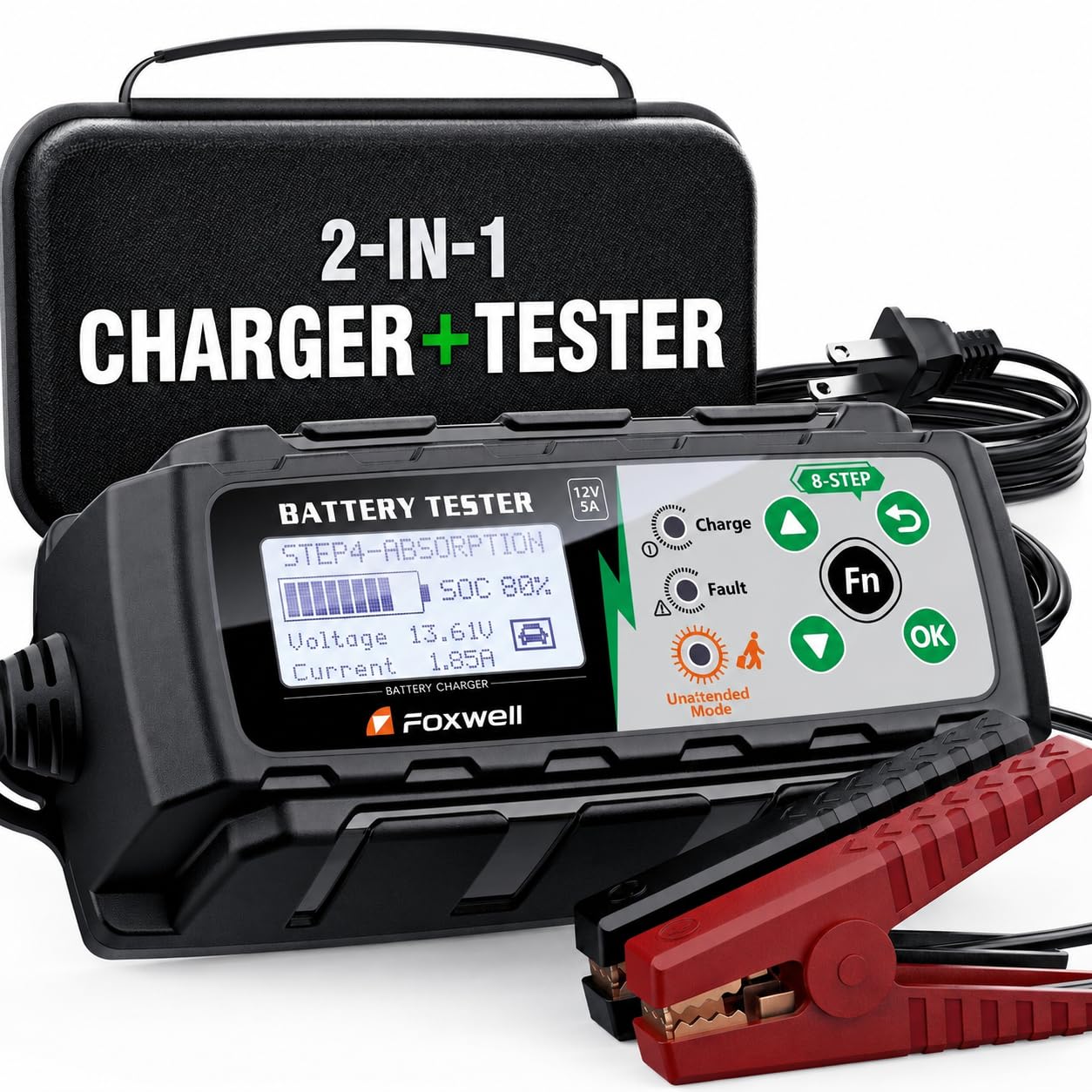
This is a solid pick for owners who want a single 5A tool that tests before it charges and explains what the results mean.
Pros
- Tests CCA, SOH, SOC, and alternator output before charging
- 8-stage charging with pulse repair and automatic maintenance mode
- IP65-rated housing for garage or outdoor use
Cons
- Limited to 12V lead-acid batteries only
- No jump-start function
- Some owners report the automatic desulfation cycle moves through phases quickly
The BC521 positions itself as a diagnostic tool first and a charger second. It reports voltage, internal resistance, and cranking performance on an LCD screen, which helps decide whether a battery needs a charge, a repair cycle, or full replacement. Selectable 1A, 3A, and 5A output covers small motorcycle batteries up to standard car batteries. It is not built for 6V, 24V, or lithium packs, and reviewers note the pulse-repair stage runs on a fixed automatic sequence with limited manual control.
KONNWEI KW510 Battery Charger & Tester

A dependable budget option for anyone who wants a charger, tester, and desulfator in one unit without paying for extra jump-start hardware.
Pros
- Charges batteries as low as 2V, useful for deeply discharged packs
- Runs cranking and charging-system tests alongside charging
- Backed by a two-year manufacturer warranty
Cons
- Bulkier housing than some competitors
- Accuracy on very low CCA batteries varies by owner reports
- Yellow color scheme and button layout feel dated compared to touchscreen rivals
The KW510 covers flooded, AGM flat plate, AGM spiral, and gel batteries rated 100-2000 CCA, which makes it broadly compatible across cars, boats, and lawn equipment. Temperature compensation adjusts charging voltage automatically, and eight separate protection features guard against reverse polarity, overload, and short circuits. Reviewers who use it regularly describe it as reliable for maintaining low-mileage vehicles that lose charge sitting between drives. It does not offer an engine-start function, so a dead battery still needs time on the charger before the vehicle will start.
Vector BC15BV Battery Charger with Engine Start
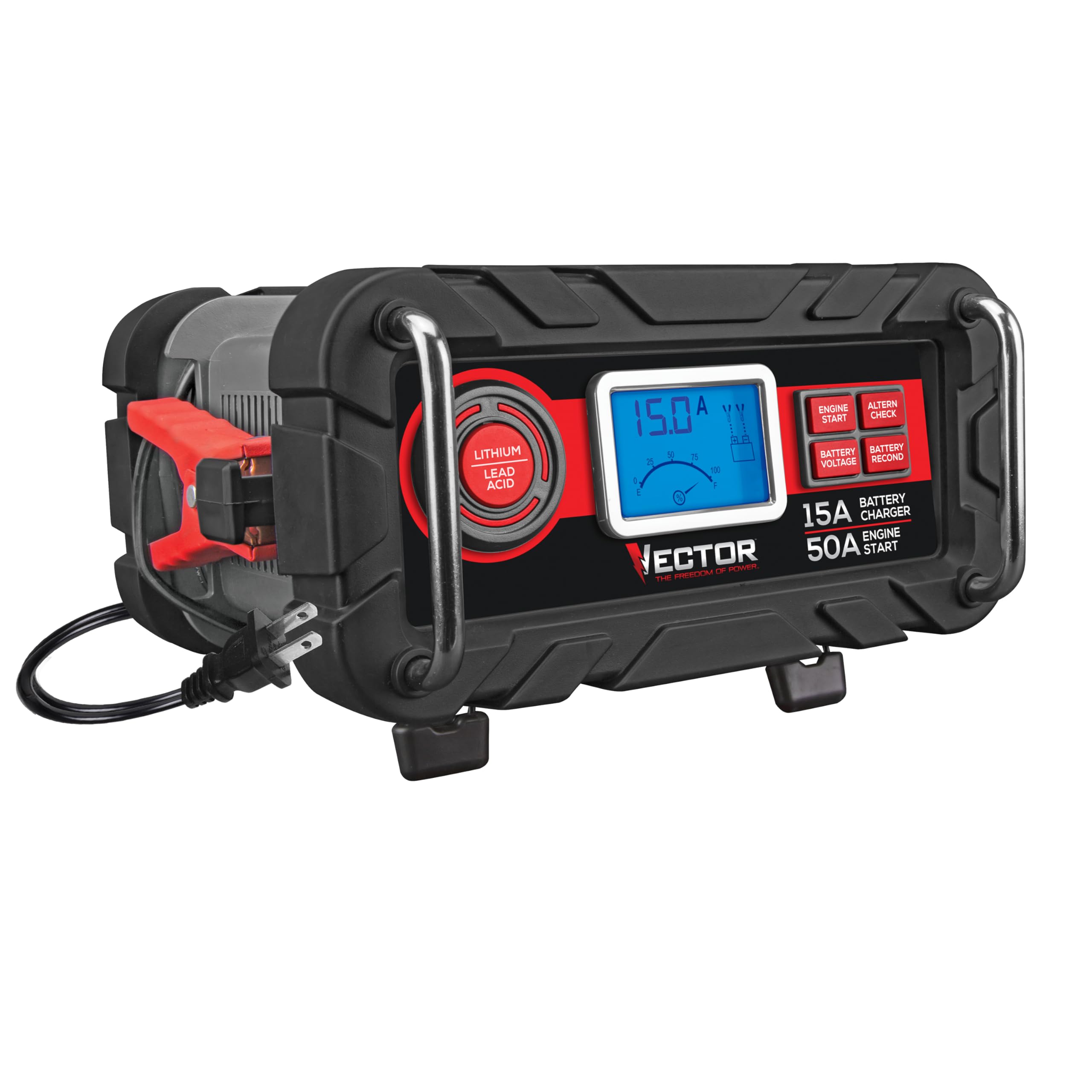
Choose this model for a 15A charger that adds a 50A engine-start boost and covers lithium chemistries alongside standard lead-acid types.
Pros
- 50A engine start can help jump most vehicles up to V8 engines
- Compatible with AGM, GEL, WET, lithium, and LiFePO4 batteries
- Built-in alternator check flags out-of-range charging output
Cons
- Smaller ratings sample than more established competitors
- Voltage meter shows a single reading rather than detailed diagnostic data
- No touchscreen or advanced test reporting
The BC15BV suits drivers who want charging, maintenance, and a jump-start option in one unit rather than carrying separate tools. Electric pulse technology targets sulfate buildup on battery plates, and the 3A maintainer mode keeps a fully charged battery topped off during storage. The alternator check is a pass/fail style indicator rather than a full charging-system report, so pair it with a dedicated tester if precise output numbers matter.
DEWALT DXAEC100 Battery Charger with Engine Start

This unit works well for owners of trucks, RVs, and larger engines who need faster 30A charging plus a 100A start assist.
Pros
- 100A engine start handles 4, 6, and 8-cylinder gas and diesel engines
- Automatic battery reconditioning activates only when needed
- Built-in LED flashlight adds practicality for roadside use
Cons
- Reliability complaints appear in a portion of customer reviews
- Heavier and bulkier than compact smart chargers
- Alternator check gives a basic pass/fail result, not detailed voltage data
The DXAEC100 targets faster charging over gentle maintenance, with 30A output that restores a depleted battery more quickly than 5A units. One-touch operation and a straightforward LCD keep the interface simple. Some reviewers report units failing after limited use, so registering the one-year warranty and testing the charger soon after purchase is worth doing before relying on it for a trip.
ANCEL BT521 Battery Tester & Charger
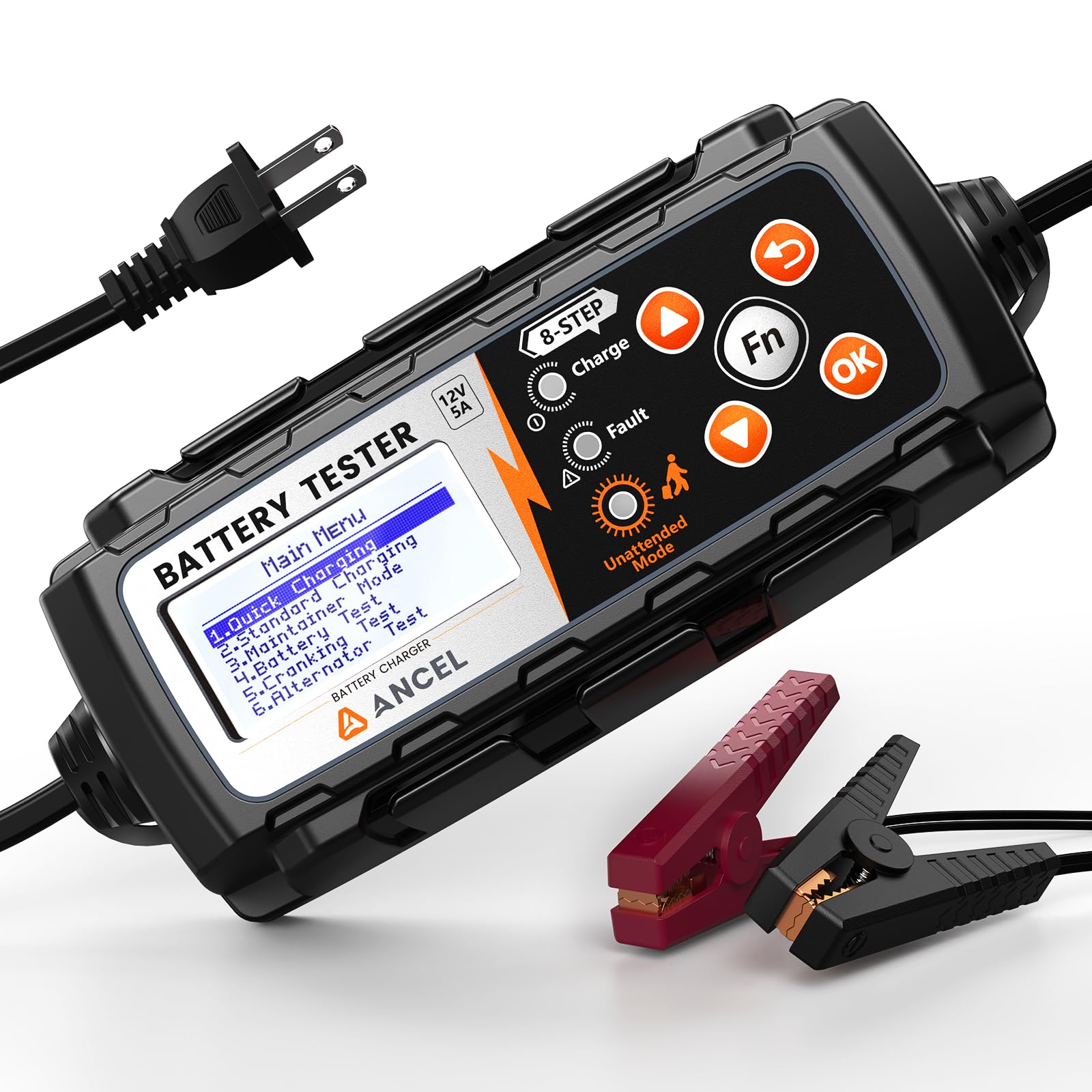
Consider this model for the most detailed diagnostic readout in this lineup, covering SOC, SOH, internal resistance, and both rated and actual CCA.
Pros
- Reports state of charge and state of health alongside CCA figures
- Eight-step process spans desulphation, bulk charge, absorption, and float
- Selectable 1A, 3A, or 5A output fits small and standard batteries
Cons
- Not rated for 6V or lithium batteries
- Newer listing with a smaller review base than some rivals
- Protective case sold separately
The BT521 walks through desulphation, soft start, bulk charge, absorption, an analysis phase, repair, float, and pulse maintenance in sequence. That level of detail helps confirm whether a repair cycle actually improved battery condition rather than just running a generic charge. Unattended mode extends this into long-term storage care for RVs and boats. Reviewers describe the diagnostic output as more thorough than typical for this price range, though the newer listing means less real-world track record than established competitors.
Schumacher SC1308 Battery Charger & Jump Starter

This 6-in-1 unit fits owners who need 6V and 12V compatibility along with a 100A jump-start function in one portable device.
Pros
- Supports both 6V and 12V standard, AGM, and deep-cycle batteries
- 100A engine start plus 30A boost and 6A/2A charge-maintain modes
- Automatic voltage detection switches between 6V and 12V without manual input
Cons
- Built-in tester gives charge level rather than detailed CCA figures
- Heavier than the compact smart-maintainer category
- Desulfation mode has no separate before/after test readout
The SC1308 covers farm equipment, motorcycles, and older 6V vehicles that many 12V-only chargers cannot service. Multi-stage charging and float-mode monitoring extend battery life during storage, and color-coded clamps simplify hookup. The alternator and battery tester confirms charge level and flags electrical problems, though it does not output the granular resistance and SOH figures found on the dedicated testers in this list.
Schumacher SC1325 Wheeled Battery Charger & Starter
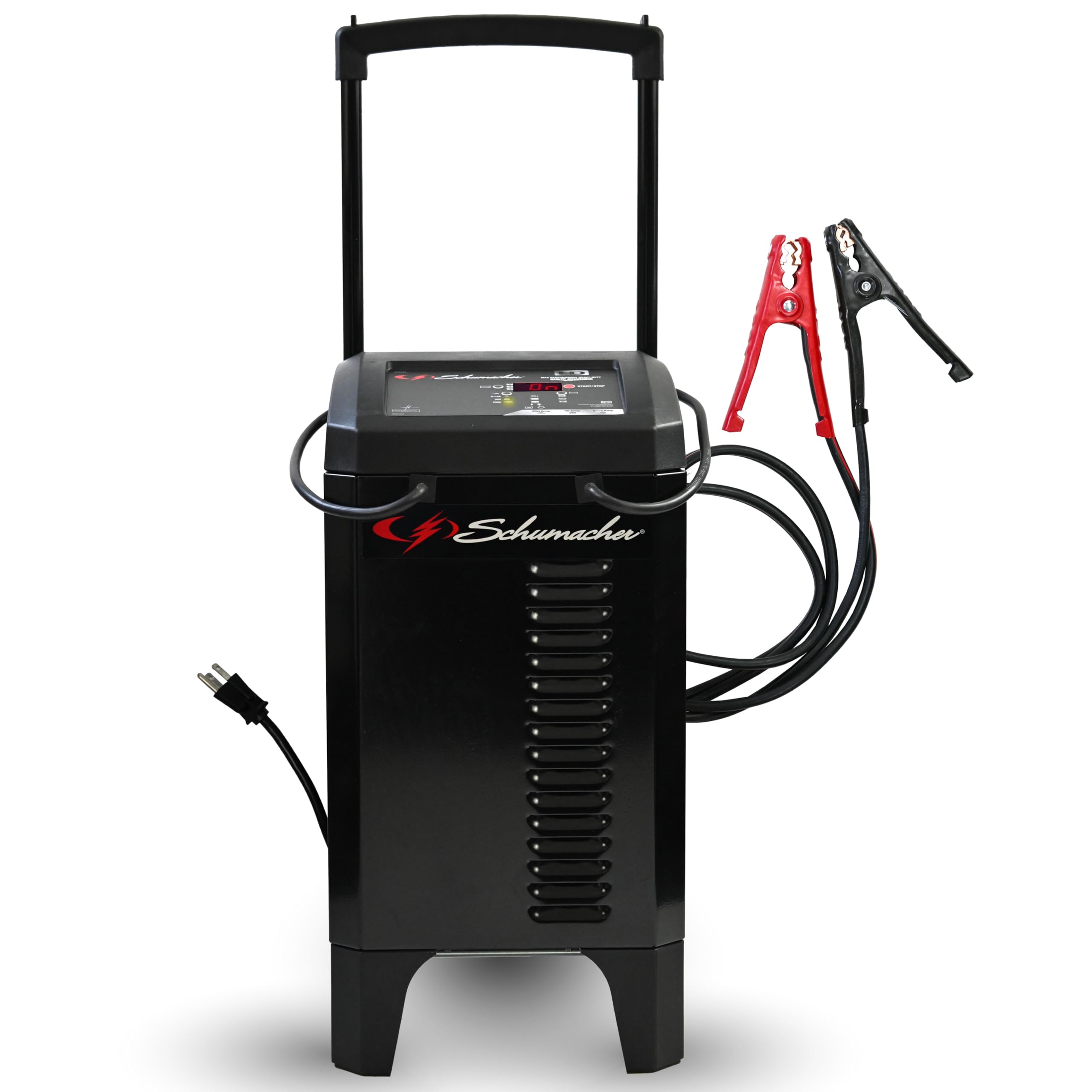
Pick this wheeled unit for shop or fleet settings where 250A engine start and heavy-duty construction matter more than portability.
Pros
- 250A 12V and 125A 6V engine start covers large batteries
- Steel case and wheels suit repeated garage or shop use
- Reconditioning mode targets sulfate buildup for extended battery life
Cons
- Nearly 30 pounds, not intended for glovebox or trunk storage
- Sizable footprint compared to handheld testers
- Alternator tester reports pass/fail status rather than exact output values
The SC1325 is built for repeated heavy use rather than occasional roadside charging. Its retractable handle and solid wheels make moving it between vehicles in a shop practical, and the 40A boost mode speeds up charging when time matters. Reverse polarity protection and auto voltage detection round out the safety features. Its size and weight rule it out for anyone who wants a charger that fits in a trunk or saddlebag.
Mislezy Multi-Voltage Smart Battery Charger
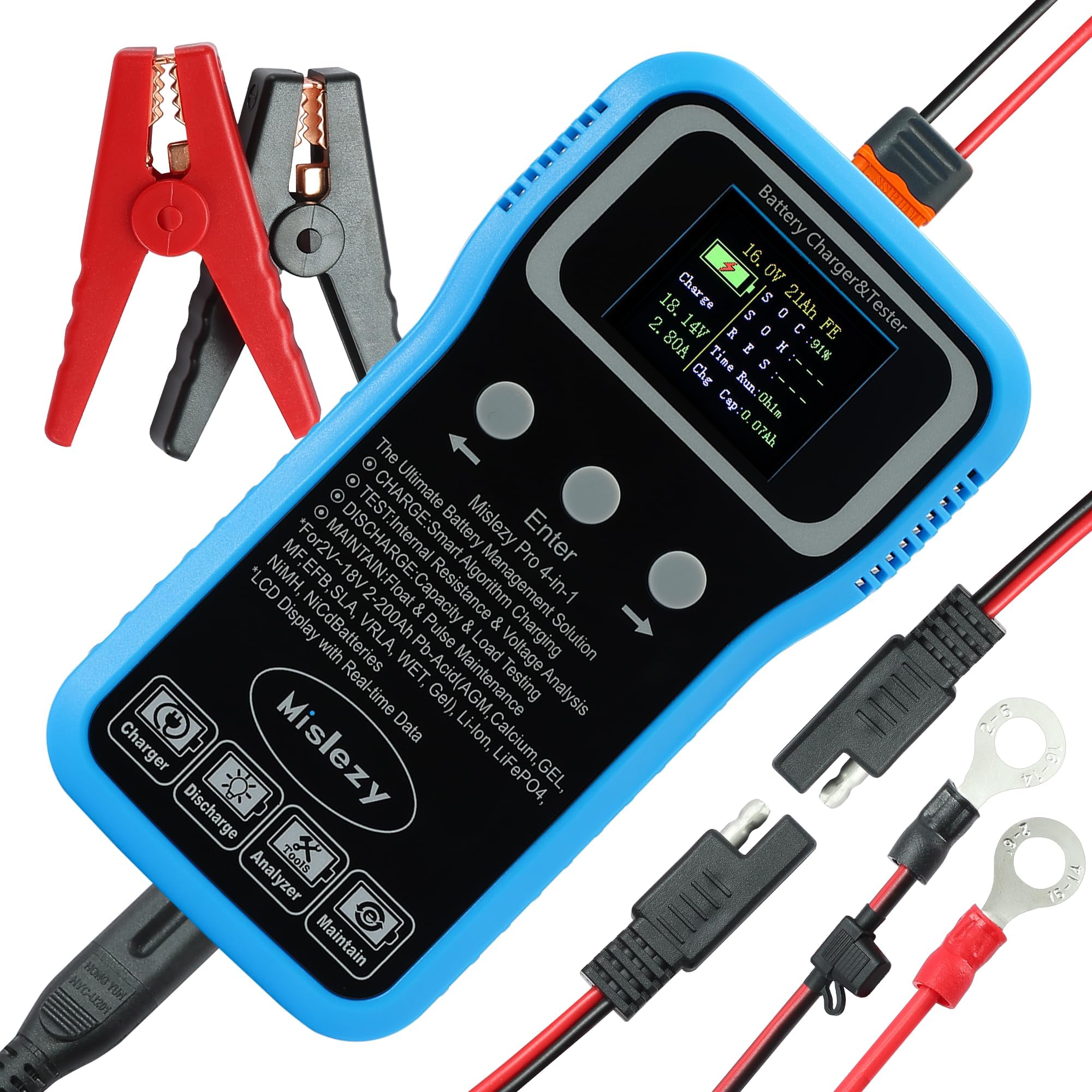
This is a niche option for owners managing a mix of battery chemistries, including lithium, LiFePO4, NiMH, and NiCd, across 6V, 12V, and 24V systems.
Pros
- Covers an unusually wide range of chemistries beyond lead-acid
- Includes both charge and controlled discharge testing
- Color TFT display shows detailed capacity and curve data
Cons
- Small review count relative to established competitors
- 4A charging is slower than higher-amperage rivals
- Engine diagnostics feature requires careful interpretation for accuracy
The R-BM600 stands out for supporting NiMH and NiCd batteries alongside the usual lead-acid and lithium types, useful for households managing power tools, electronics, and vehicle batteries with one device. The discharge testing function measures true effective capacity rather than relying on voltage alone. Its limited release history means less accumulated feedback than the more established brands on this list, so verifying compatibility with a specific battery chemistry before relying on it for critical equipment is worthwhile.
Lancol CAT-500 Battery Tester & Charger

This charger fits owners dealing with a severely drained battery, since it can force-charge packs as low as 3V before switching to normal charging.
Pros
- Forced pre-charge works on batteries as low as 3V
- Generates a shareable QR code diagnostic report
- Seven-fold safety protections including overtemperature and backflow
Cons
- Customer reviews report inconsistent test accuracy
- Instructions described as incomplete by some buyers
- Lithium charging support inconsistent according to reviewer feedback
The CAT-500 targets a specific problem: batteries too depleted for a standard charger to recognize. Its 8A charging core and 8-step algorithm adjust current and voltage automatically once the battery accepts a charge. Reviewer feedback is mixed on test accuracy, with some describing reliable results and others reporting readings that didn’t match a second tester. Anyone relying on this model for a pass/fail replacement decision should confirm results with a second method.
TOPDON BT200 Battery & Alternator Tester

This is the strongest pick for anyone who wants precise diagnostic data and does not need charging capability in the same tool.
Pros
- Conductance technology covers 12V and 24V batteries from 100-2000 CCA
- Cranking test and charging-system test run independently for full diagnostics
- Sunlight-readable color display with simple Good/Replace prompts
Cons
- No charging or maintenance function
- No engine-start capability
- Requires a separate charger for any battery that needs power
The BT200 is a dedicated diagnostic tool, not a charger. It measures cranking performance and alternator charging output separately, which helps pinpoint whether a no-start issue traces back to the battery, the starter, or the charging system. Copper clamps and a memory function for recalling prior tests add convenience for repeat use across a fleet or household of vehicles. Pairing it with a separate smart charger covers both testing and charging needs.
Buying Guide
Match Amperage to Your Battery and Timeline
Charging amperage determines how quickly a battery recovers and how gentle the process is on battery cells.
| Amperage | Best Use Case |
|---|---|
| 1-3A | Small motorcycle, ATV, or lawn equipment batteries; long-term maintenance |
| 5A | Standard car and SUV batteries; overnight charging |
| 15-30A | Trucks, RVs, and larger batteries needing faster recovery |
| 40-250A (engine start) | Jump-starting a dead battery without a second vehicle |
Lower amperage chargers take longer but reduce heat and stress on battery plates. Higher amperage chargers cut charging time but require batteries rated to accept faster charging safely.
Understand What “Alternator Tester” Actually Means
An alternator check on a charger typically measures voltage output while the engine runs, flagging whether it falls within a normal range. This differs from a dedicated charging-system test that analyzes ripple, load response, and output stability in more depth. A basic pass/fail alternator indicator narrows down a problem; it does not replace a full diagnostic at a repair shop when the issue is unclear.
Confirm Battery Chemistry Compatibility
| Chemistry | Common Support Level |
|---|---|
| Flooded / Wet | Supported by nearly all chargers in this category |
| AGM / GEL / EFB | Supported by most smart chargers with multiple stages |
| Lithium / LiFePO4 | Supported only on select models; confirm before use |
| 6V systems | Limited to models explicitly rated for 6V |
| NiMH / NiCd | Rare; found only in specialized multi-chemistry chargers |
Charging the wrong chemistry on a charger not rated for it risks damaging the battery or the charger.
Weigh Charging Stages Against Simplicity
Multi-stage charging (often 6-8 steps including desulfation, bulk, absorption, and float) adjusts current and voltage automatically as the battery reaches full charge. This reduces overcharging risk compared to basic 2-3 stage designs. Beginners charging a single vehicle occasionally may not need the most complex stage count; anyone maintaining stored vehicles across a season benefits from automatic maintenance and float modes.
Consider Portability and Display Quality
Compact units with carrying cases suit glovebox or garage-shelf storage. Wheeled units with steel housings suit shop environments where the charger stays in one place. A clear LCD or color display makes reading diagnostic data faster, particularly outdoors in bright light.
FAQs
What does “smart” or “automatic” charging mean? An automatic charger monitors battery voltage and adjusts current without manual input, switching from bulk charging to a lower maintenance current as the battery approaches full charge. This reduces the risk of overcharging compared to a basic charger left running on a fixed setting.
Can a charger with an alternator tester diagnose all charging-system problems? It can flag whether alternator output falls within a normal voltage range while the engine runs. It cannot diagnose intermittent faults, wiring issues, or belt-related charging problems the way a full shop diagnostic can.
What is pulse repair or desulfation, and does it always work? Pulse repair sends brief electrical pulses to reduce sulfate crystal buildup on battery plates, a common cause of reduced capacity in batteries left unused. It can improve a battery’s ability to hold charge in some cases, but it cannot restore a battery with physical damage or completely failed cells.
Do I need a charger with engine-start capability? Engine start is useful for jump-starting a dead battery without a second vehicle, but it draws high current briefly and is not a substitute for a properly charged battery. Charger-only models suit drivers who plan ahead and rarely face a fully dead battery.
Are 6V, 12V, and 24V chargers interchangeable? No. Using a charger on a voltage system it is not rated for risks damage to the battery and the charger itself. Confirm voltage compatibility before connecting any charger to a 6V classic vehicle or a 24V commercial system.
Is a dedicated battery tester better than a charger with a built-in test function? A dedicated tester like the TOPDON BT200 focuses entirely on measuring CCA, cranking performance, and charging-system output, often with more detailed reporting than a combination unit. A charger with a built-in tester adds convenience for owners who want one tool instead of two.
Conclusion
Selecting the right charger with alternator tester comes down to matching amperage and battery chemistry to the vehicles being serviced. Owners with a single car or motorcycle and occasional maintenance needs do well with a compact 5A smart charger like the FOXWELL BC521 or ANCEL BT521, both of which combine diagnostic detail with gentle multi-stage charging.
Anyone regularly jump-starting vehicles or working across 6V and 12V equipment benefits from the added engine-start power in the Schumacher or DEWALT models, accepting the tradeoff in size and weight. Drivers who only need precise diagnostic numbers, without a charging function attached, get the clearest test data from a dedicated unit like the TOPDON BT200. Checking chemistry compatibility and amperage ratings against your specific vehicles before buying prevents mismatched expectations once the charger arrives.