
10 Best Battery Charger for Car Battery: 2026 Picks

A car battery that drains overnight or refuses to turn over on a cold morning is one of the most common vehicle headaches. The right charger fixes both problems: some units keep a healthy battery topped off for months, while others deliver enough amperage to revive a deeply discharged one or start the engine outright. Picking between them means understanding what each type actually does.
Battery chargers fall into a few broad categories. Trickle chargers and smart maintainers deliver low current for long-term upkeep on a battery that is already in decent shape. Mid-range automatic chargers (5A to 15A) charge faster and often include desulfation modes that break down crystal buildup on battery plates. Heavy-duty units add engine-start functions, pushing 100A or more for a few seconds to crank a dead battery without a full charge cycle.
Amperage is only part of the story: battery chemistry, vehicle size, and how often the battery gets used matter just as much when matching a charger to the job. A motorcycle battery and a diesel truck battery have very different needs, and lithium (LiFePO4) batteries require a charger built to handle their charging profile safely.
Best for everyday maintenance: NOCO GENIUS1 1A 6/12V Smart Battery Charger
Best all-around charger: NOCO GENIUS5 5A 6/12V Smart Battery Charger
Best for larger batteries and faster charging: NOCO GENIUS10 10A 6/12V Smart Battery Charger
Best budget automatic charger: Schumacher SC1280 15A Charger & Maintainer
Best for emergency jump-starts: Schumacher SC1281 6A Charger with 100A Engine Start
Best for motorcycles and small batteries: Battery Tender Plus 12V 1.25A Maintainer
Best compact trickle charger: MOTOPOWER MP00205A 800mA Charger
Best for heavy-duty engine starting: Schumacher SC1445 Wheeled 250A Starter/Charger
Best for diagnostics plus charging: DEWALT DXAEC100 30A Charger with Engine Start
Best for garage all-rounders: CRAFTSMAN CMXCESM258 12A Charger & Maintainer
NOCO GENIUS1 1A 6/12V Smart Battery Charger

This compact charger suits drivers who need low-current, long-term maintenance rather than a fast recharge.
Pros
- Safe for indefinite connection thanks to constant voltage monitoring
- Works with both lead-acid and lithium (LiFePO4) batteries
- Small footprint fits tight engine bays and storage spaces
Cons
- 1A output charges slowly on larger batteries
- No mounting bracket included
- Best suited to small batteries, not full-size trucks
The GENIUS1 is built for upkeep, not speed. Its 1-amp output takes hours to fully charge a car battery, but that’s the point: this unit is meant to sit connected to a motorcycle, lawn mower, or seasonal vehicle for weeks at a time. The integrated thermal sensor adjusts charging based on temperature, which helps prevent overcharging in summer heat.
Force Mode lets it attempt a charge on batteries that have dropped to zero volts, something many basic chargers can’t do. For a daily-driven car battery, though, a higher-amp model charges faster.
NOCO GENIUS5 5A 6/12V Smart Battery Charger

The GENIUS5 balances charging speed and portability well enough to serve as a single charger for most cars, motorcycles, and boats.
Pros
- 5A output charges faster than trickle-only units
- Handles lead-acid and lithium batteries up to 120Ah
- Includes mounting bracket for permanent garage installation
Cons
- Not powerful enough for large truck or RV batteries
- No engine-start function for dead batteries needing an immediate jump
- Slightly bulkier than the GENIUS1
This model steps up from the GENIUS1 with enough current to charge a typical car battery in a matter of hours instead of overnight. The same desulfation and temperature-compensation features carry over, and the mounting bracket makes it easy to leave permanently wired into a garage setup.
Reviewers frequently mention reviving batteries that sat unused for months. It remains a charger and maintainer, not a jump-starter, so a completely dead battery still needs time to recover before the vehicle will start.
NOCO GENIUS10 10A 6/12V Smart Battery Charger

The GENIUS10 fits owners with larger batteries, such as full-size trucks or marine batteries, who still want smart charging features.
Pros
- 10A output supports batteries up to 230Ah
- Same desulfation and temperature compensation as smaller GENIUS models
- Mounting bracket included for garage use
Cons
- Heavier and larger than the GENIUS1 or GENIUS5
- Overkill for small powersport batteries
- Still not a substitute for an engine-start charger
Stepping up to 10A cuts charging time noticeably compared to the GENIUS5, which matters for anyone charging a large truck, RV, or boat battery. It keeps the same safety net of thermal compensation and Force Mode for deeply discharged batteries.
Owners switching from older, bulkier chargers often note how much smaller this unit is for the power it delivers. For a small motorcycle battery, though, 10A is more current than necessary.
Schumacher SC1280 15A Charger & Maintainer

The SC1280 offers rapid 15A charging at a lower price than most comparable smart chargers.
Pros
- 15A rapid charge mode cuts down wait time
- Built-in desulfation mode for aging batteries
- Reverse clamp protection prevents accidental damage
Cons
- No lithium (LiFePO4) compatibility mentioned
- Bulkier than the NOCO GENIUS line
- Shorter warranty than NOCO’s three-year coverage
This charger targets budget-conscious DIYers who want speed without paying for extra smart features. The 15A setting handles large batteries quickly, while the 3A maintain mode keeps things safe for long-term connection.
The microprocessor control adjusts amperage automatically, and the reverse-polarity protection adds a meaningful safety layer for less experienced users. It lacks the lithium battery support some newer chargers include.
Schumacher SC1281 6A Charger with 100A Engine Start
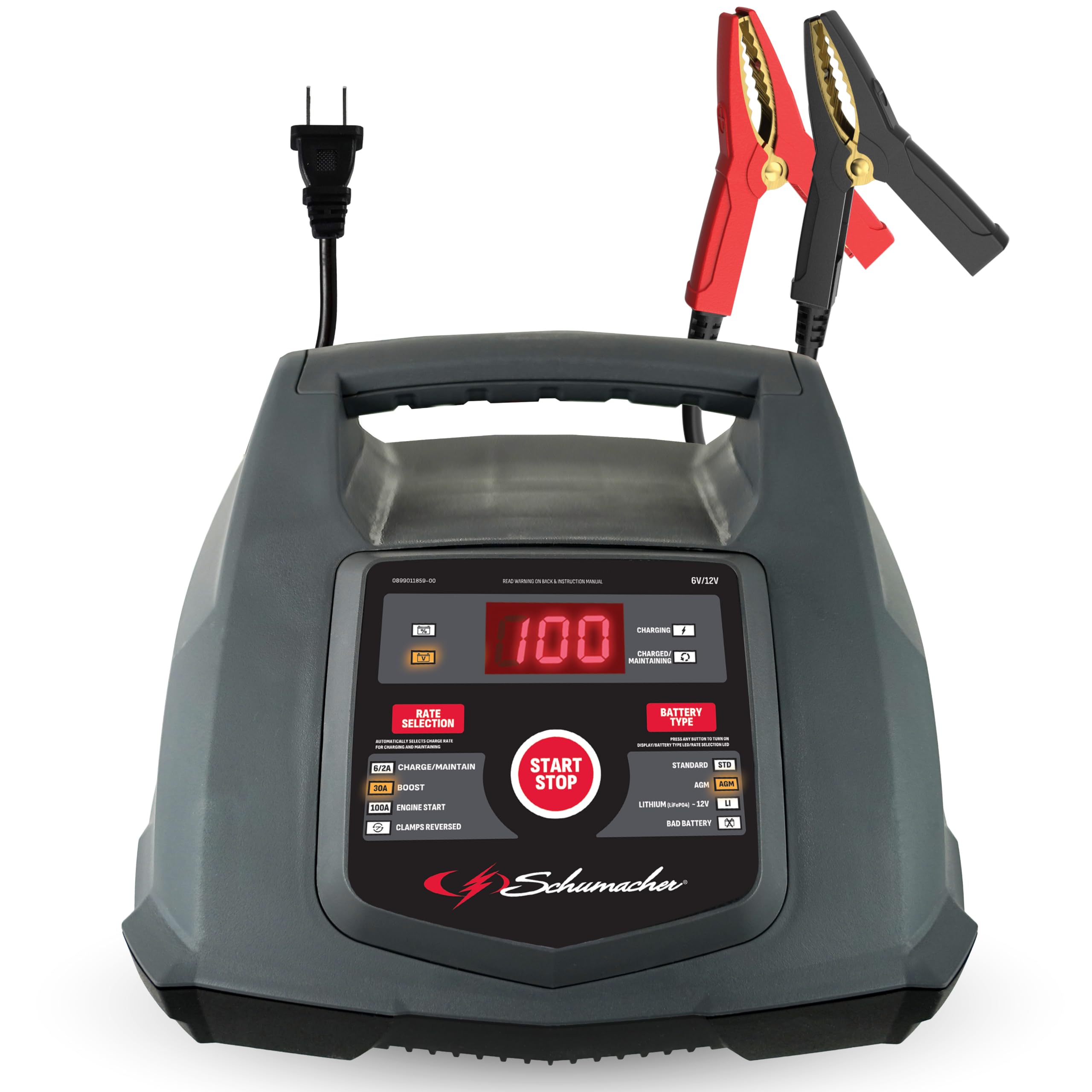
This unit doubles as an emergency jump-starter, making it a good pick for drivers who need more than routine maintenance.
Pros
- 100A engine start helps fire up a dead battery fast
- Built-in battery and alternator tester diagnoses issues
- Supports 6V and 12V, including lithium batteries
Cons
- Heavier and bulkier than dedicated maintainers
- 6A charge rate is modest for full recharging
- Not ideal for long-term trickle maintenance alone
The SC1281 fills a different role than the NOCO or straightforward Schumacher chargers: it’s built for the moment a battery won’t start the car at all. The 100A engine-start function paired with 30A boost charging gets a vehicle running, while the alternator tester helps rule out a bigger electrical problem.
Charging speed for full recovery is slower than dedicated chargers rated higher than 6A. Owners who want both jump-start capability and daily maintenance may need a second unit for the latter.
Battery Tender Plus 12V 1.25A Maintainer

The Battery Tender Plus is a trusted option for keeping motorcycle, ATV, and lawn mower batteries topped off between uses.
Pros
- Long manufacturer warranty backs long-term reliability
- Quick-disconnect harness simplifies repeated hookups
- Two-color LED gives a clear charge status at a glance
Cons
- 1.25A output charges very slowly
- 120V-only design won’t work on non-US power without an adapter
- Not suited to reviving large or deeply discharged batteries
This maintainer has built a loyal following among motorcycle and classic car owners, some reporting over a decade of reliable use. The 4-step charging program keeps the battery at proper float voltage without overcharging it.
Its low output makes it a poor match for a fully discharged car battery, where charging could take a full day or more. It’s better suited to batteries that already hold most of their charge and just need upkeep.
MOTOPOWER MP00205A 800mA Charger

This budget-friendly maintainer works well for small batteries that just need occasional topping off, such as those in stored vehicles.
Pros
- Competitively priced compared to other smart maintainers
- Spark-proof design adds a layer of safety
- 24-hour timer automatically shifts to maintenance mode
Cons
- 800mA output is the slowest in this roundup
- Best for small batteries, not full-size vehicles
- Limited to standard 12V lead-acid types
Owners with garaged cars, lawn tractors, or seasonal ATVs often keep one of these connected through the off-season. The pulse desulfation feature runs automatically, and the zero-output standby mode means no battery drain when idle.
Its low amperage means it isn’t built for a battery that’s badly discharged. As a low-cost way to prevent a stored battery from going flat, it does the job reliably.
Schumacher SC1445 Wheeled 250A Starter/Charger
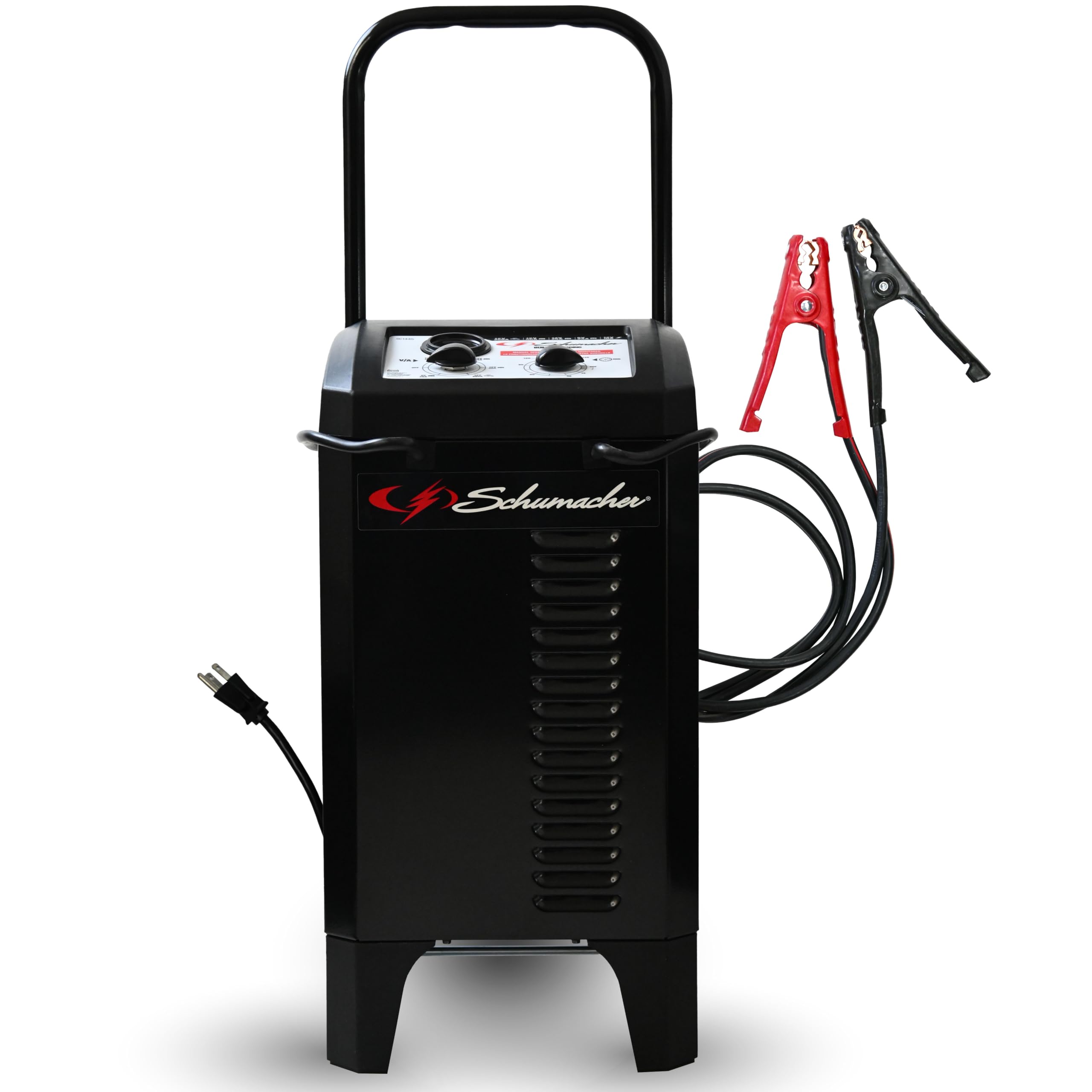
This heavy-duty wheeled unit is built for garages that need serious cranking power for trucks, RVs, and farm equipment.
Pros
- 250A engine start handles large engines with ease
- Manual timer gives precise control over charge duration
- Wheeled steel housing withstands heavy garage use
Cons
- Manual operation means no automatic shutoff by charge state
- Much heavier and larger than portable chargers
- Requires user knowledge of proper charge timing
Unlike the automatic chargers in this list, the SC1445 puts control in the user’s hands with a 135-minute manual timer instead of automatic sensing. That suits experienced DIYers who understand their battery’s needs, but it raises the risk of overcharging for less experienced users.
The 250A start rating stands out for starting large trucks, tractors, and RVs. Its size and weight make it a garage fixture rather than a grab-and-go tool.
DEWALT DXAEC100 30A Charger with Engine Start

This DEWALT unit combines a 30A charger, 100A engine start, and alternator tester in one package for drivers who want multiple tools in a single box.
Pros
- Alternator check helps spot charging-system problems
- LCD display shows clear charging progress
- Automatic battery reconditioning targets sulfate buildup
Cons
- Mixed reliability feedback in customer reviews
- Limited to WET, GEL, and AGM batteries (no lithium mentioned)
- Bulkier than dedicated maintainers
The alternator diagnostic feature sets this charger apart, giving a quick read on whether a recurring dead battery points to a bigger electrical issue. The 30A charge rate and 100A start cover both routine charging and emergency situations.
Some owners report units failing after light use, so this model suits buyers who want its diagnostic feature enough to accept that risk. The one-touch controls keep daily use simple despite the added functions.
CRAFTSMAN CMXCESM258 12A Charger & Maintainer
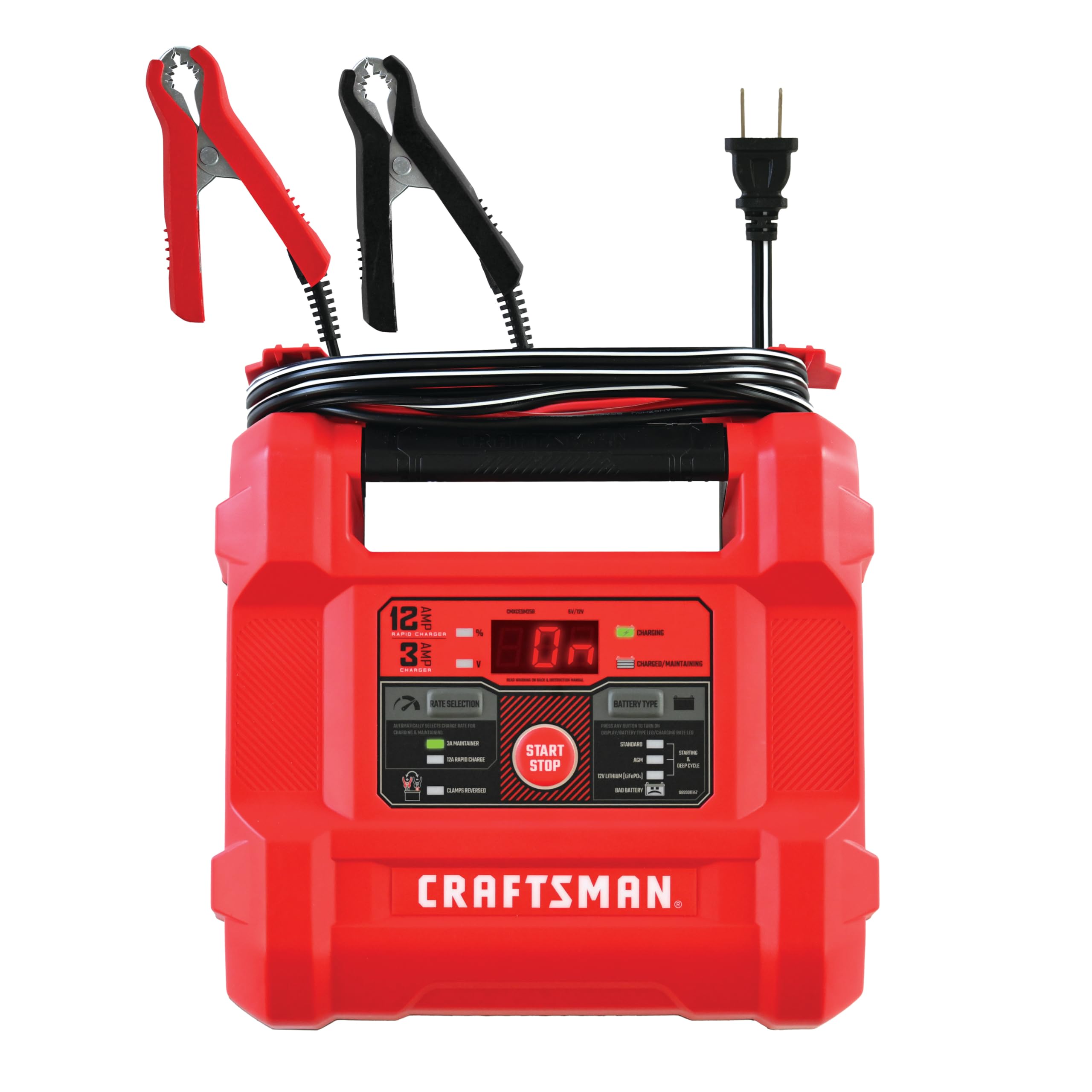
The CMXCESM258 offers a solid middle ground: 12A charging with lithium battery compatibility at a reasonable size.
Pros
- Supports standard, AGM, deep-cycle, and lithium (LiFePO4) batteries
- Digital display and LED indicators make status easy to read
- 12-foot combined cable reach eases hookup in tight garages
Cons
- No engine-start function for dead-battery emergencies
- Reverse hook-up protection only prevents operation, doesn’t alert clearly
- Some users report it can’t detect certain bad batteries
This charger automatically detects voltage and adjusts amperage, which simplifies use for owners unfamiliar with manual settings. The reverse hook-up protection stops the unit from operating if the clamps are connected backward, guarding against accidental shorts.
Reviewers generally find it reliable for reviving batteries that have sat idle, with one noting a full charge in a few hours. It won’t start a vehicle on its own, so severely dead batteries need patience rather than an instant jump.
Buying Guide
Match Amperage to Battery Size and Use Case
Higher amperage charges faster but isn’t always the right choice. A 1A to 2A charger suits small batteries in motorcycles, ATVs, and lawn equipment that mostly need maintenance. A 10A to 15A charger handles full-size car and truck batteries in a reasonable time. Anything above 20A usually points to a charger built for large trucks, RVs, or emergency starting.
| Battery Type | Recommended Charger Output |
|---|---|
| Motorcycle, ATV, lawn equipment | 1A to 2A |
| Car, small SUV | 5A to 10A |
| Truck, RV, marine | 10A to 15A |
| Emergency jump-start | Engine-start rated units (50A to 250A) |
Understand the Difference Between a Maintainer and a Charger
A maintainer keeps a healthy battery topped off using low current and float charging, which prevents overcharging during long-term connection. A charger delivers higher current to bring a discharged battery back up faster. Some units combine both functions with automatic switching between charge and maintenance modes.
Check Battery Chemistry Compatibility
Lead-acid batteries (flooded, AGM, gel) and lithium (LiFePO4) batteries charge differently. A charger without a lithium-specific mode can undercharge or damage a LiFePO4 battery. Confirm the charger lists compatibility before use, especially on newer vehicles or powersport equipment using lithium batteries.
Look for Safety Features
Reverse polarity protection, overcharge protection, and spark-proof connections reduce the risk of damage or injury. Automatic chargers with microprocessor control adjust output based on battery condition, which lowers the risk of user error compared to fully manual units.
Consider Portability and Mounting
Compact chargers fit in a glove box or tight engine bay, while wheeled units with engine-start functions are heavier and best kept in a garage. Mounting brackets let some models stay permanently wired to a vehicle for easy seasonal use.
Weigh Engine-Start Power for Emergencies
A charger alone won’t start a car with a dead battery quickly. Units rated for 100A or higher engine start can crank an engine within seconds, which matters for anyone who wants a single tool that both charges and rescues a dead battery.
FAQs
Can a battery charger revive a completely dead car battery? Many smart chargers can recover a battery that has dropped to a low voltage, and some include a forced mode for batteries near zero volts. A battery that is old, physically damaged, or has a shorted cell may not accept a charge no matter how long it stays connected.
What’s the difference between a trickle charger and a smart maintainer? A basic trickle charger sends a steady low current without adjusting for battery condition, which risks overcharging over time. A smart maintainer monitors voltage and switches to float mode automatically, making it safer for indefinite connection.
Is it safe to leave a smart charger connected for weeks? Smart chargers with automatic float or maintenance modes are designed for long-term connection. Manual chargers without automatic shutoff need a timer or periodic checking to avoid overcharging.
Do I need a special charger for a lithium (LiFePO4) battery? Yes. Lithium batteries have a different charging profile than lead-acid batteries, and a charger without a dedicated lithium mode can undercharge or stress the cells. Check the product specifications before charging a lithium battery.
What amperage charger do I need for a car battery? Most car batteries charge well on 5A to 15A chargers, with higher amperage cutting charge time. Trucks, RVs, and marine batteries with larger amp-hour ratings often benefit from a 10A or higher charger to avoid excessively long charge times.
Can a battery charger also jump-start my car? Only chargers with an engine-start rating, typically 50A or higher, can crank an engine directly. Standard maintainers and chargers need to fully charge the battery first before the vehicle can start.
Conclusion
Choosing the right charger starts with matching output to the battery and the situation. A small maintainer like the Battery Tender Plus or MOTOPOWER MP00205A suits a motorcycle or stored vehicle that just needs steady upkeep. A mid-range smart charger such as the NOCO GENIUS5 or GENIUS10 covers most cars, trucks, and boats with faster charging and lithium compatibility.
For emergencies, a unit with engine-start power, like the Schumacher SC1281 or SC1445, gets a dead battery’s vehicle running without waiting hours for a full charge. Buyers working on multiple vehicle types should weigh amperage, battery chemistry support, and whether jump-starting capability is worth the added bulk before settling on one charger for the garage.
