
10 Best 6/12 Volt Car Battery Charger Options for Reliable Charging and Maintenance

A dead battery rarely announces itself in advance, and a battery that dies slowly from disuse is just as common as one that fails suddenly in cold weather. Cars, motorcycles, boats, RVs, and lawn equipment all rely on 6V or 12V lead-acid batteries that lose charge over time, especially during winter storage or long stretches of light use. A dedicated charger keeps that battery ready without the guesswork of jump-starting a vehicle that should have started on its own.
Lead-acid batteries (flooded, AGM, gel) and lithium iron phosphate (LiFePO4) batteries charge differently, and using the wrong charger or profile can shorten battery life or fail to charge the battery at all. Amperage output determines how fast a charger works: low-amp units (1-2A) suit small batteries and long-term maintenance, while higher-amp chargers (10A-25A) recover larger batteries faster but require more attention to avoid overcharging. The right charger matches its output and charging profile to the battery’s chemistry, size, and how the vehicle is used, whether that’s daily driving, seasonal storage, or emergency recovery from a fully dead state.
Buyers should also check voltage selection (6V vs. 12V), whether the unit supports lithium batteries, connector types (clamps vs. eyelet terminals), and safety features like reverse-polarity protection. A charger built for maintenance won’t necessarily recover a deeply discharged battery, and a high-amp charger isn’t always the right choice for a motorcycle or lawn tractor battery that’s a fraction of a car battery’s capacity.
Best for all-around use: NOCO GENIUS10 10A Smart Battery Charger
Best for fast recovery of large batteries: Schumacher Electric SC1280 15A Charger
Best for motorcycles and small batteries: NOCO GENIUS5 5A Smart Charger
Best for engine-start emergencies: TowerTop 25A Smart Charger with Engine Start
Best for professional or shop use: Clore Automotive PL2320 20-Amp Charger
Best for long-term trickle maintenance: NOCO GENIUS1 1A Smart Charger
Best budget maintainer: Schumacher Electric SC1355 1.5A Charger
Best for LiFePO4 compatibility on a budget: GOOLOO S4 4A Smart Charger
Best compact plug-in maintainer: MOTOPOWER MP00205A 800mA Charger
Best for multi-voltage lead-acid systems: AUTOUTLET 6-24V Battery Charger
NOCO GENIUS10 10A Smart Battery Charger

This charger suits owners who want one unit capable of handling everything from a car battery to a lithium-powered boat battery.
Pros
- Supports lead-acid and LiFePO4 batteries up to 230Ah
- Force Mode charges batteries down to zero volts
- Temperature compensation adjusts charging for ambient conditions
Cons
- 10A output charges large batteries slower than higher-amp units
- Higher price than basic trickle chargers
- Clamps draw some criticism for build quality versus the unit itself
The GENIUS10 covers 6V and 12V lead-acid batteries, including AGM, gel, and flooded types, plus lithium-ion batteries up to 230 amp-hours. Its integrated thermal sensor adjusts charging based on ambient temperature, which limits overcharging risk in summer and undercharging in winter.
Force Mode allows manual charging of batteries at zero volts, a feature many automatic chargers lack. Precision pulse charging targets sulfation and acid stratification, addressing the root causes of reduced battery capacity in older batteries. The unit ships with eyelet terminals and a mounting bracket, making it suited to permanent garage installation.
Schumacher Electric SC1280 15A Charger

Buyers needing to recover a large, deeply discharged battery quickly should consider this 15A charger.
Pros
- 15A rapid charge rate suits large batteries
- Built-in battery tester provides diagnostics
- Reverse clamp protection prevents damage from incorrect hookup
Cons
- No lithium battery support
- 1-year warranty is shorter than premium competitors
- Bulkier than compact maintainers
The SC1280 delivers 15A to standard, AGM, gel, and deep-cycle 12V batteries, plus a 2A mode for 6V batteries. Microprocessor control adjusts amperage automatically, and a 3A maintain mode keeps batteries topped off after the initial charge without overcharging.
An advanced desulfation mode targets older batteries showing reduced performance, and the built-in tester lets owners check battery health before committing to a full charge cycle. Reverse clamp protection stops the unit from operating if the clamps connect backward, a practical safety layer for less experienced users.
NOCO GENIUS5 5A Smart Charger

This model fits owners who want NOCO’s smart-charging features in a smaller, lower-output package suited to motorcycles, ATVs, and smaller car batteries.
Pros
- Supports lead-acid and LiFePO4 batteries up to 120Ah
- Compact size at under two pounds
- Same Force Mode and pulse charging as the GENIUS10
Cons
- 5A output charges large batteries more slowly
- Not intended for batteries above 120Ah
- Costs more than basic trickle chargers with similar amperage
The GENIUS5 shares the GENIUS10’s temperature-compensated charging and sulfation-reversing pulse technology in a smaller housing rated for batteries up to 120 amp-hours. It charges 6V and 12V lead-acid and lithium batteries, and Force Mode still allows charging from zero volts.
At 1.6 pounds, it suits owners who move the charger between vehicles, garages, or storage units. The tradeoff for the compact size is a longer charge time on larger batteries compared to the 10A model, so owners with full-size truck or SUV batteries may find the GENIUS10 a better match.
TowerTop 25A Smart Charger with Engine Start
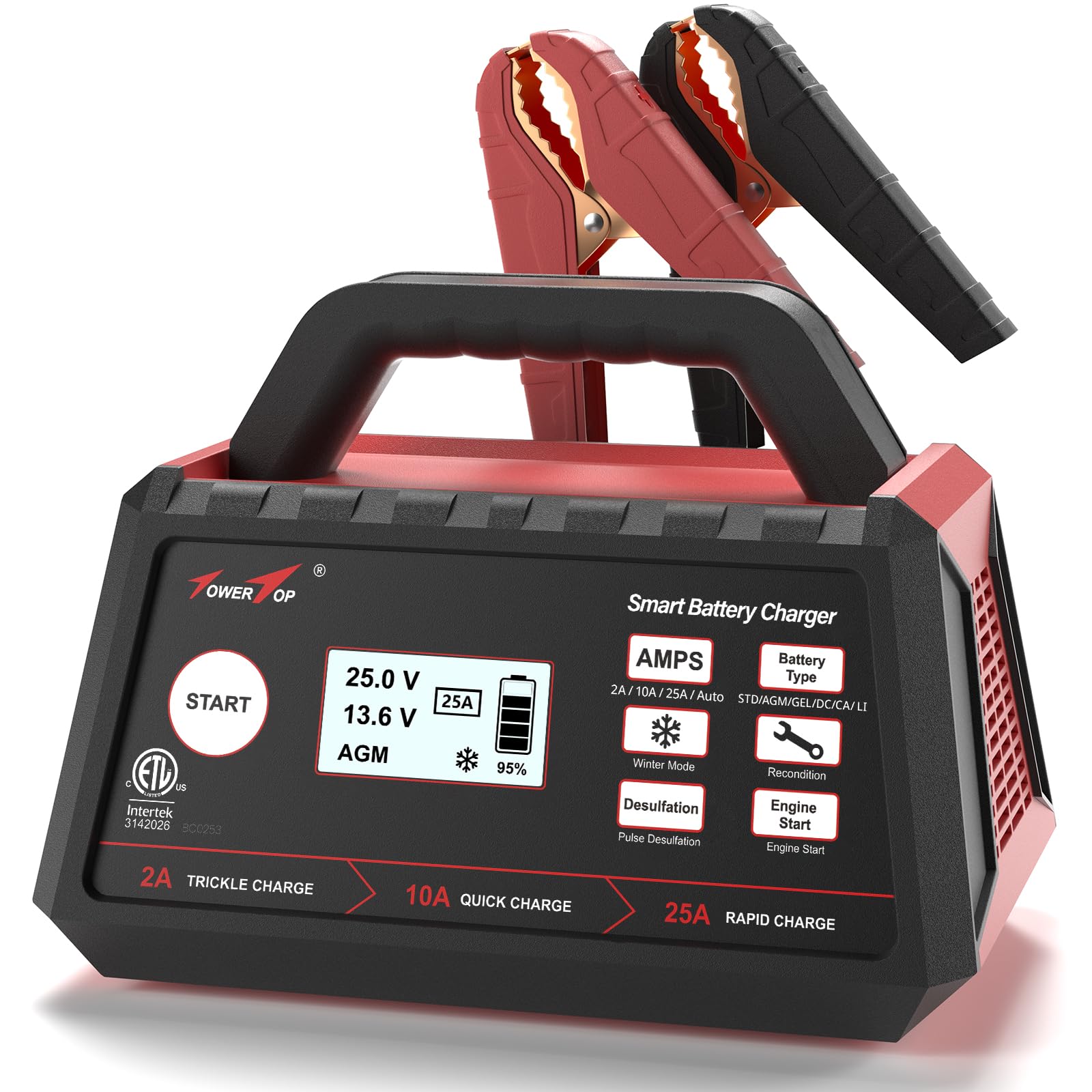
Drivers who occasionally need help starting a car with a weak battery will find the built-in engine-start function useful.
Pros
- Engine Start mode delivers 100A to help start vehicles
- Three selectable currents (2A/10A/25A) plus auto mode
- Winter Mode boosts voltage for cold-weather charging
Cons
- 12V only, no 6V support
- Engine Start requires some existing battery charge to work
- LCD display adds complexity versus simple analog units
The TowerTop charger offers 2A, 10A, and 25A settings, with the 25A rate capable of charging a 100Ah battery in under four hours according to the manufacturer’s specifications. An 8-stage charging process handles desulfation, bulk charging, absorption, and float maintenance.
Engine Start mode supplies 100A to assist starting a vehicle with a struggling battery, distinct from jump-starting a fully dead one. Winter Mode adds voltage to compensate for cold-weather resistance. Buyers should confirm their battery has some residual charge before relying on Engine Start in an emergency.
Clore Automotive PL2320 20-Amp Charger

Technicians and serious DIYers who need a power supply mode for diagnostics or programming will get the most from this charger.
Pros
- Power supply mode maintains stable voltage during diagnostics
- 2A/10A/20A selectable charge rates
- Handles flooded, AGM, gel, spiral wound, and marine batteries
Cons
- No lithium battery support listed
- 1-year warranty
- 110V input only; not rated for 220-240V use
The PL2320 combines fast charging with a power supply mode that holds system voltage steady for extended diagnostic sessions or light module programming, a feature mechanics and hobbyist coders value. Multi-phase charging adapts to flooded, AGM, gel, spiral wound, marine, and deep-cycle battery types at 6V or 12V.
Reviewers with automotive repair backgrounds note its usefulness for keeping voltage stable while running scan tools. Buyers outside the US should confirm voltage compatibility before purchase, since the unit accepts 110V input only.
NOCO GENIUS1 1A Smart Charger

This 1A charger suits small batteries in motorcycles, lawn equipment, and seasonal vehicles that need gentle, long-term maintenance rather than fast charging.
Pros
- Compact, plug-in design with integrated eyelet terminals
- Supports lead-acid and lithium batteries up to 30Ah
- Same Force Mode and pulse-charging tech as larger GENIUS units
Cons
- 1A output is too slow for larger car or truck batteries
- Longer charge times, around 10 hours for a fully depleted small battery
- No mounting bracket included, unlike the GENIUS5 and GENIUS10
The GENIUS1 applies NOCO’s temperature-compensated, pulse-charging technology to batteries as small as those found in motorcycles and lawn tractors, up to 30 amp-hours. It charges from as low as 1 volt and includes Force Mode for fully dead batteries.
Its compact direct-plug design and integrated eyelet terminals make it convenient for permanent installation on a seasonal vehicle. The tradeoff for its size is amperage: at 1A, it is not intended for larger batteries that need faster recovery.
Schumacher Electric SC1355 1.5A Charger

Owners looking for an affordable trickle maintainer for a motorcycle or seasonal vehicle will find this a straightforward option.
Pros
- Automatic voltage detection for 6V and 12V batteries
- Desulfation mode helps recover older batteries
- Reverse polarity protection included
Cons
- 1.5A output limits it to small-battery maintenance
- No lithium battery support
- Lacks a display for monitoring charge status
The SC1355 provides 1.5A of charging current with automatic detection of 6V or 12V batteries, covering standard, AGM, and deep-cycle types. Smart trickle charging lets the unit stay connected long-term without overcharging risk.
Its desulfation feature targets sulfation buildup in aging batteries, and reverse polarity protection guards against incorrect clamp connections. Quick-connect clamps and ring leads are included, simplifying setup for owners maintaining a motorcycle or seasonal vehicle through winter storage.
GOOLOO S4 4A Smart Charger

Buyers wanting LiFePO4 compatibility without paying premium prices should look at this 4A charger.
Pros
- Supports 6V/12V lead-acid and 12V LiFePO4 batteries
- 10-stage charging program with LCD display
- Charges batteries as low as 3 volts
Cons
- 4A output charges larger batteries slowly
- Shorter 18-month warranty than premium brands
- Fewer amp-rate options than higher-end competitors
The GOOLOO S4 charges 6V and 12V lead-acid batteries (wet, gel, AGM, sealed) plus 12V LiFePO4 batteries, a combination not always found at this price point. Its 10-stage program includes automatic repair and pulse charging aimed at reversing sulfation.
The LCD display shows voltage, charging mode, and battery status, giving owners more visibility than clamp-only chargers. Temperature-adaptive charging reduces overcharge risk in hot weather and undercharging in cold conditions, useful for owners maintaining motorcycles or boats through seasonal changes.
MOTOPOWER MP00205A 800mA Charger

This 800mA charger works best as a low-cost, low-current maintainer for a 12V battery that just needs to stay topped off.
Pros
- Compact size, under a pound
- Automatic desulfation via pulse current
- Spark-proof connection and multi-level safety protections
Cons
- 12V only, no 6V option
- 800mA output is too low for charging a depleted battery quickly
- No LCD display for monitoring status
The MP00205A targets 12V lead-acid batteries, including flooded and sealed AGM/gel types, with 800mA of maintenance current. A built-in 24-hour timer switches the unit to maintenance mode once voltage passes 14V, avoiding gassing from prolonged overcharge.
Zero output in standby mode means no battery drain while connected but not actively charging, and spark-proof connections add a safety margin during hookup. Its low current output makes it suited to keeping an already-charged battery maintained, not recovering one that’s significantly discharged.
AUTOUTLET 6-24V Battery Charger
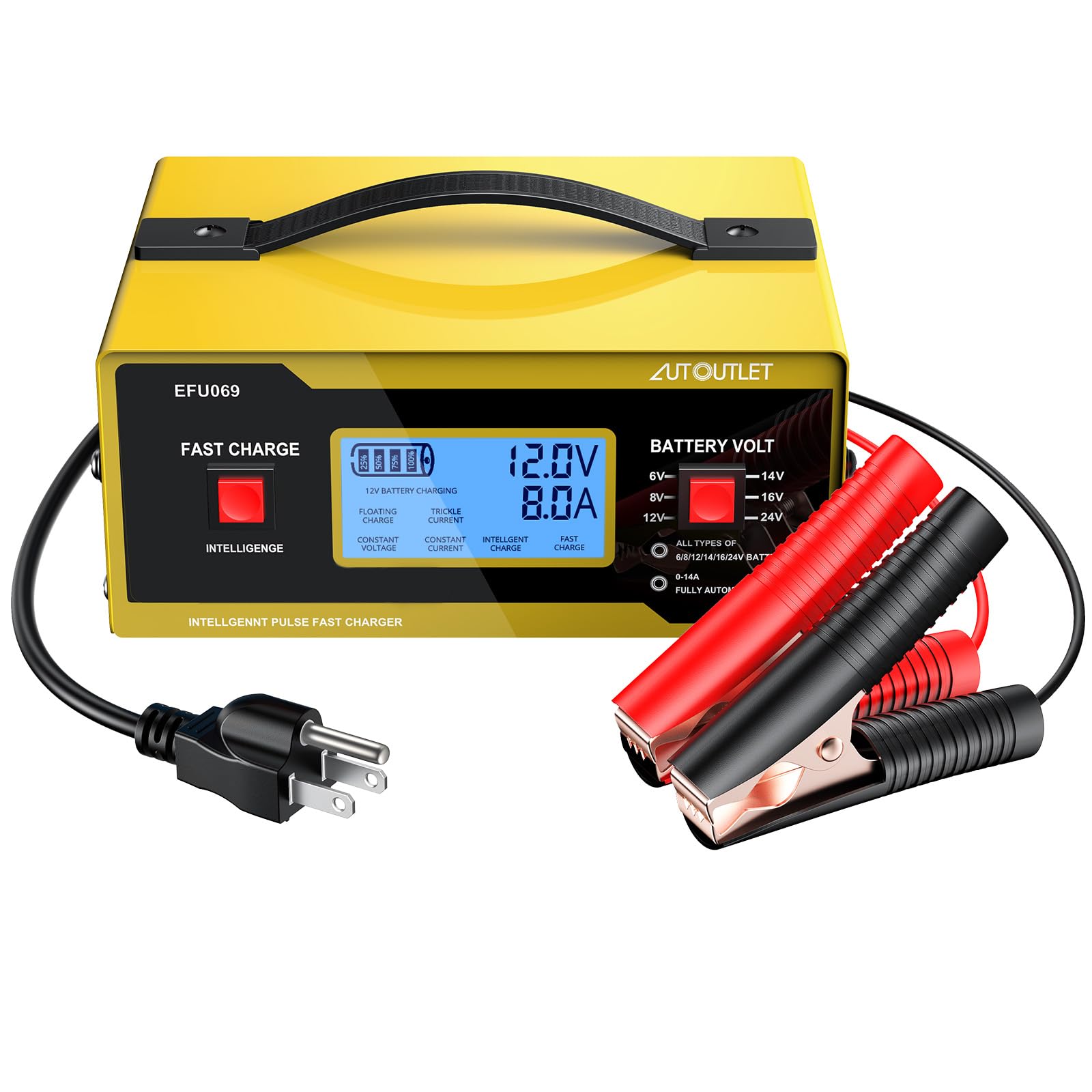
Owners managing multiple lead-acid systems at different voltages, including golf carts, will find this charger’s range useful.
Pros
- Covers 6/8/12/14/16/24V lead-acid batteries
- 7-stage charging process for 12V, 3-stage for 6V
- Digital display with reverse polarity indicator
Cons
- No lithium battery support at all
- Not suited to a single dedicated vehicle use case
- Amperage tops out at 14A, slower than dedicated high-output chargers
The AUTOUTLET charger’s voltage range, 6V through 24V, sets it apart from most single-voltage competitors, making it useful for households with a golf cart, motorcycle, and car all needing charging support. It automatically detects battery voltage and adjusts its charging stage accordingly.
Multilevel safety protections cover overcharge, over-voltage, overheat, and short circuit conditions, with an LED indicator for reverse polarity. The explicit exclusion of lithium batteries means owners with LiFePO4 packs should choose a different model from this list.
Buying Guide
Match Amperage to Battery Size and Use Case
Charging amperage determines how quickly a charger restores a battery and how it should be used. A rough guideline: divide the battery’s amp-hour (Ah) rating by the charger’s amperage to estimate charge time in hours, though actual times vary with battery condition.
| Charger Output | Best Suited For | Typical Charge Time (50Ah battery) |
|---|---|---|
| Under 2A | Motorcycles, lawn equipment, long-term maintenance | 25+ hours |
| 4A-5A | Small car batteries, ATVs, boats | 10-13 hours |
| 10A-15A | Standard car and truck batteries | 3-5 hours |
| 20A-25A | Large batteries, fleet or shop use | 2-3 hours |
Lower-amperage chargers minimize heat and stress on the battery, making them well suited to long-term trickle maintenance. Higher-amperage units recover a discharged battery faster but require monitoring, particularly on non-automatic models.
Confirm Battery Chemistry Compatibility
Lead-acid batteries (flooded, AGM, gel, and sealed/SLA) and lithium iron phosphate (LiFePO4) batteries require different charging voltages and profiles. Charging a lithium battery with a lead-acid-only charger can undercharge it or fail to reach a full charge state. Not every charger supports both chemistries, so check compatibility before connecting a lithium battery.
Verify Voltage Selection
Some vehicles, particularly classic cars, tractors, and golf carts, use 6V batteries instead of 12V. A charger needs either automatic voltage detection or a manual switch to charge both correctly. Charging a 6V battery with a 12V-only setting risks damage.
Consider Automatic vs. Manual Operation
Automatic (smart) chargers detect battery voltage, adjust charging current, and switch to a maintenance or float mode once the battery reaches full charge. Manual chargers require the user to monitor progress and disconnect at the right time, raising the risk of overcharging on longer sessions.
Look for Desulfation and Repair Modes
Sulfation, a buildup of lead sulfate crystals on battery plates, reduces capacity over time, especially in batteries left partially discharged for extended periods. Desulfation modes use pulse charging to break down these deposits, though they cannot revive a battery with significant internal damage or physical wear.
Check Connector Types and Included Accessories
Most chargers include alligator clamps for temporary connections and ring/eyelet terminals for permanent installation. Owners who charge the same vehicle repeatedly benefit from leaving eyelet terminals attached to the battery for quick reconnection.
FAQs
Can a 12V battery charger damage a 6V battery? Yes, if the charger lacks 6V/12V automatic detection or a manual voltage switch. Applying 12V charging voltage to a 6V battery can overcharge and damage it, so confirm the charger explicitly supports 6V batteries before use.
Is it safe to leave a smart battery charger connected indefinitely? Automatic smart chargers with float or maintenance modes are designed for indefinite connection, since they reduce output once the battery reaches full charge and only deliver current as needed. Manual or basic trickle chargers without automatic shutoff should not be left connected without periodic monitoring.
Will a battery charger work on a completely dead battery? Standard automatic chargers often fail to detect batteries below 1-2 volts and won’t begin charging. Chargers with a Force Mode or manual override can initiate charging on batteries at or near zero volts, though a battery that has been fully dead for an extended period may not fully recover.
Can a lead-acid charger be used on a lithium (LiFePO4) battery? Not safely in most cases. LiFePO4 batteries require a different charging voltage curve than lead-acid batteries, and using an incompatible charger can result in undercharging or failure to charge. Confirm explicit LiFePO4 support before connecting a lithium battery.
What does desulfation mode actually do? It applies pulse charging patterns designed to break down lead sulfate crystals that accumulate on battery plates during prolonged partial discharge. This can restore some lost capacity in moderately sulfated batteries, but it does not reverse physical degradation or aged battery chemistry.
When should a high-amperage charger be chosen over a maintainer? High-amperage chargers (15A and above) suit situations requiring fast recovery of a significantly discharged battery, such as before a trip or after extended disuse. Low-amperage maintainers (1-5A) suit batteries that are already charged and simply need to stay topped off during storage.
Do these chargers work for winter storage? Chargers with temperature compensation adjust their charging voltage based on ambient temperature, reducing the risk of undercharging in cold garages or unheated storage spaces. Models with a dedicated Winter Mode add extra voltage to counter the increased internal resistance batteries exhibit in low temperatures.
Conclusion
Matching a charger to the battery and the vehicle’s use pattern prevents both slow chargers and unnecessary overcharging. A daily-driven car with a large battery benefits from a 10A-15A automatic charger, while a motorcycle stored over winter does better with a 1A-5A maintainer that can stay connected for months. Owners with lithium batteries should confirm LiFePO4 support explicitly, since lead-acid-only chargers won’t charge them correctly.
Buyers dealing with a battery that won’t hold charge at all should look for Force Mode or manual override capability, since standard automatic chargers often refuse to engage below 1-2 volts. Checking amperage, voltage support, and battery chemistry compatibility before purchase avoids the common mistake of buying a charger that’s mismatched to the battery it’s meant to serve.